Every maintenance manager responsible for end-of-line packaging equipment knows the downstream domino effect: a palletizer that drops a layer due to a misaligned row-forming bar does not just disrupt that pallet — it triggers a cascade of downstream disruptions that extends all the way to the loading dock. The stretch wrapper applies inconsistent film tension because its film carriage motor bearings have degraded unevenly, and the affected pallet arrives at the customer with load instability that generates a shipping quality complaint, a return authorization, and a corrective action request that consumes the maintenance manager's next week in documentation. The palletizer's gripper head has been shifting position incrementally over 20,000 cycles, accumulating lateral play that no operator notices during visual inspection because the shift happens in tenths of a millimeter per day. The stretch wrapper's pre-stretch roller pair has developed a speed mismatch that reduces film elongation from 250 percent to 210 percent — still within the machine's specification range, but producing a net wrap force that is 15 percent below the level needed for the specific load configuration traveling to a high-humidity distribution region. The problem is not that the end-of-line equipment fails. The problem is that palletizers and stretch wrappers degrade in patterns that are invisible to periodic inspection, produce failures that look like operator errors or product quality issues rather than mechanical degradation, and generate shipping claims that are attributed to transportation damage rather than the true root cause of machine condition. iFactory's AI-powered pattern stability and motor health monitoring for end-of-line equipment closes this gap by correlating every pallet pattern defect, every film tension deviation, and every gripper position error with the machine's real-time mechanical state — identifying the specific wear patterns, motor degradation trajectories, and gripper condition trends that precede shipping quality failures before the pallet leaves the facility.
Why End-of-Line Equipment Defies Conventional Maintenance Approaches
Palletizers and stretch wrappers occupy a maintenance blind spot in most packaging operations. They are not high-speed machines like cartoners and case packers, so they do not receive the same predictive maintenance investment. They are not process-critical in the same way as upstream filling or sealing equipment, so production managers prioritize maintenance resources accordingly. They are expected to run reliably with periodic lubrication, visual inspection, and component replacement at fixed intervals. This expectation is structurally wrong for the failure patterns these machines actually exhibit.
Palletizer degradation is predominantly mechanical wear in the row-forming, layer-squeezing, and pallet-hoist systems — components that wear gradually and produce failure signatures that look like product defects rather than equipment problems. A row-forming bar whose position drifts by 2 millimeters over 10,000 cycles does not trigger a machine alarm because the position is still within the controller's acceptable tolerance. But that 2 millimeter drift produces a pallet pattern where every layer is shifted by the same increment, creating a load that is stable in the palletizer but becomes unstable during transit when vibration and shock loads interact with the offset centre of gravity. The shipping claim is filed as transportation damage. The maintenance manager investigates and finds no equipment fault. The next palletizer adjustment is scheduled for the next preventive maintenance cycle — by which point hundreds of unstable pallets have already been shipped.
Stretch wrapper degradation follows a similar pattern. Stretch film tension is controlled by the relative speeds of the pre-stretch rollers, the film carriage vertical travel rate, and the turntable rotation speed. The motors driving these axes produce their own degradation signatures — bearing wear, belt tension loss, encoder drift — each of which changes the effective tension applied to the film. A stretch wrapper whose turntable drive motor bearings have accumulated 8,000 hours of operation may show a 3 to 5 percent speed variation during acceleration and deceleration that is invisible to the operator but produces a measurable reduction in net wrap force at the top and bottom of the pallet where the speed transitions occur. The pallet appears well-wrapped on visual inspection. The film tension is insufficient to restrain the load during handling. The shipping damage claim is filed as a packaging material issue. The true root cause — the motor bearing degradation — is not identified unless the maintenance manager has data that correlates film tension outcomes with motor health indicators. Book a Demo to see how iFactory's AI platform correlates motor health with wrap quality outcomes on your stretch wrappers.
AI Pattern Stability Monitoring — The Bridge Between Mechanical Wear and Shipping Quality
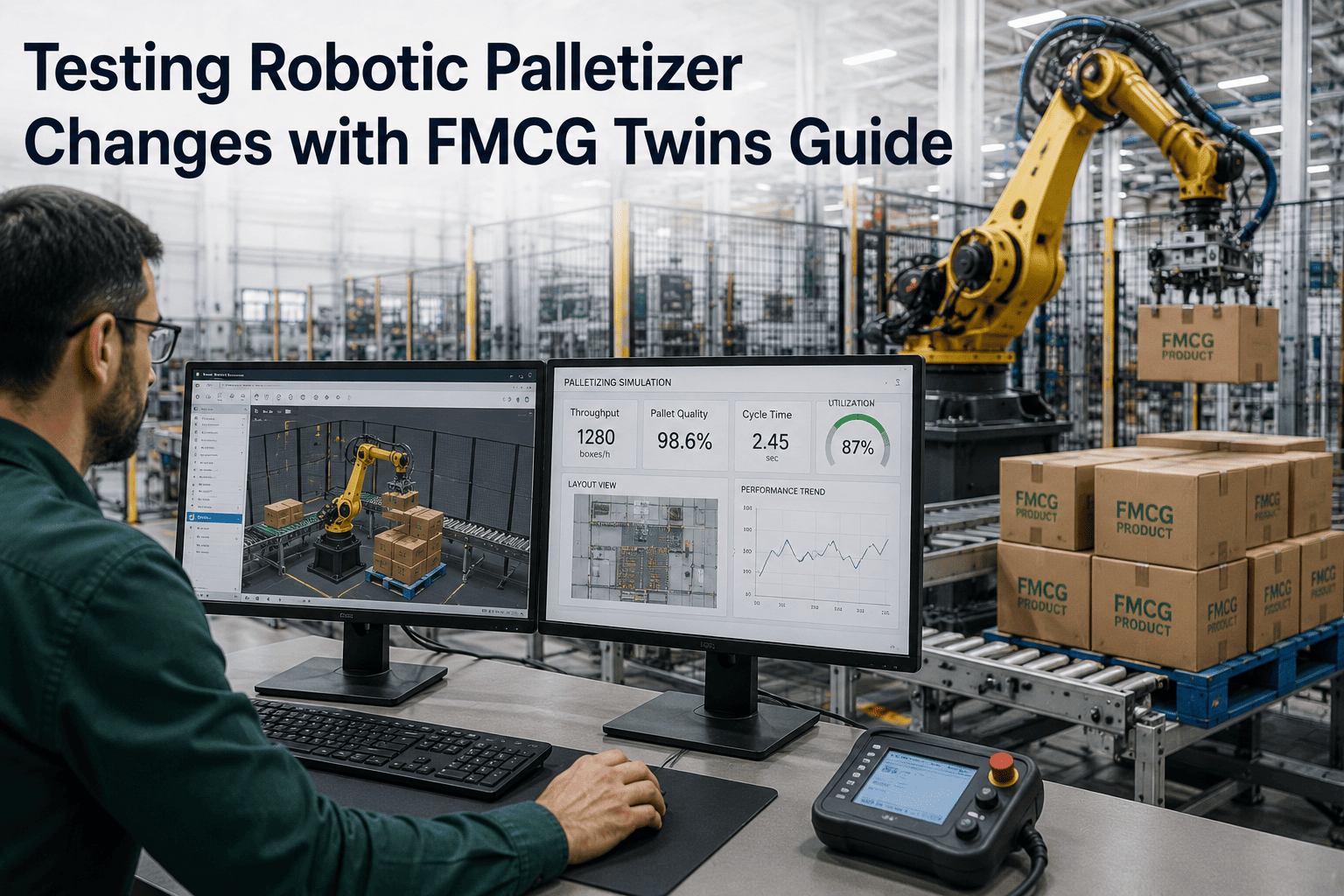
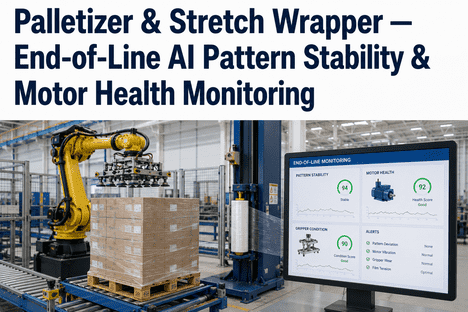
Pattern stability monitoring is the analytics layer that connects mechanical condition to shipping quality. The iFactory platform tracks every pallet pattern produced by every palletizer — layer count, pattern type, layer offset, squeeze pressure profile, and pallet hoist positioning — and correlates these parameters with the machine's real-time mechanical state. When the AI detects a pattern deviation that exceeds the statistical norm for the current SKU and format, it does not flag a quality issue. It flags a mechanical investigation, because the pattern deviation is the first visible indicator of a mechanical condition that will produce a shipping quality failure if left uncorrected.
The correlation between pattern deviation and mechanical degradation follows predictable signatures. A row-forming bar that shows increasing positioning variance over consecutive cycles indicates guide rail wear that will eventually produce pattern defects requiring manual intervention. A layer squeezer that applies uneven pressure from one side indicates a hydraulic or pneumatic cylinder with seal degradation that will escalate to a jam event. A pallet hoist that drifts in vertical positioning across the shift indicates chain stretch or sprocket wear that will produce inconsistent layer stacking. Each signature is detectable in the pattern data days to weeks before the mechanical condition produces an unplanned stop or a shipping failure. The maintenance manager who sees the pattern deviation alert knows which mechanical component to inspect and what the likely failure mode will be — before the failure occurs.
For stretch wrappers, pattern stability monitoring tracks film wrap parameters — film tension profile across the pallet height, film carriage speed consistency, turntable rotation uniformity, pre-stretch ratio actual versus setpoint — and correlates these with the mechanical health of the motors and drive components that produce them. A film carriage that shows increasing vertical speed variation as it moves from the bottom to the top of the pallet indicates carriage guide rail wear or drive belt degradation. A turntable that shows rotation speed non-uniformity at specific angular positions indicates bearing damage or drive motor encoder degradation. A pre-stretch roller pair that shows increasing speed ratio error indicates roller bearing wear or belt tension loss that will reduce film elongation and net wrap force. The AI identifies the specific motor or drive component contributing to each parameter deviation and quantifies the degradation trajectory. Book a Demo to see how iFactory's pattern stability analytics translate mechanical degradation into actionable maintenance alerts.
Motor Health Monitoring — Predictive Analytics for the Motors That Drive End-of-Line Equipment
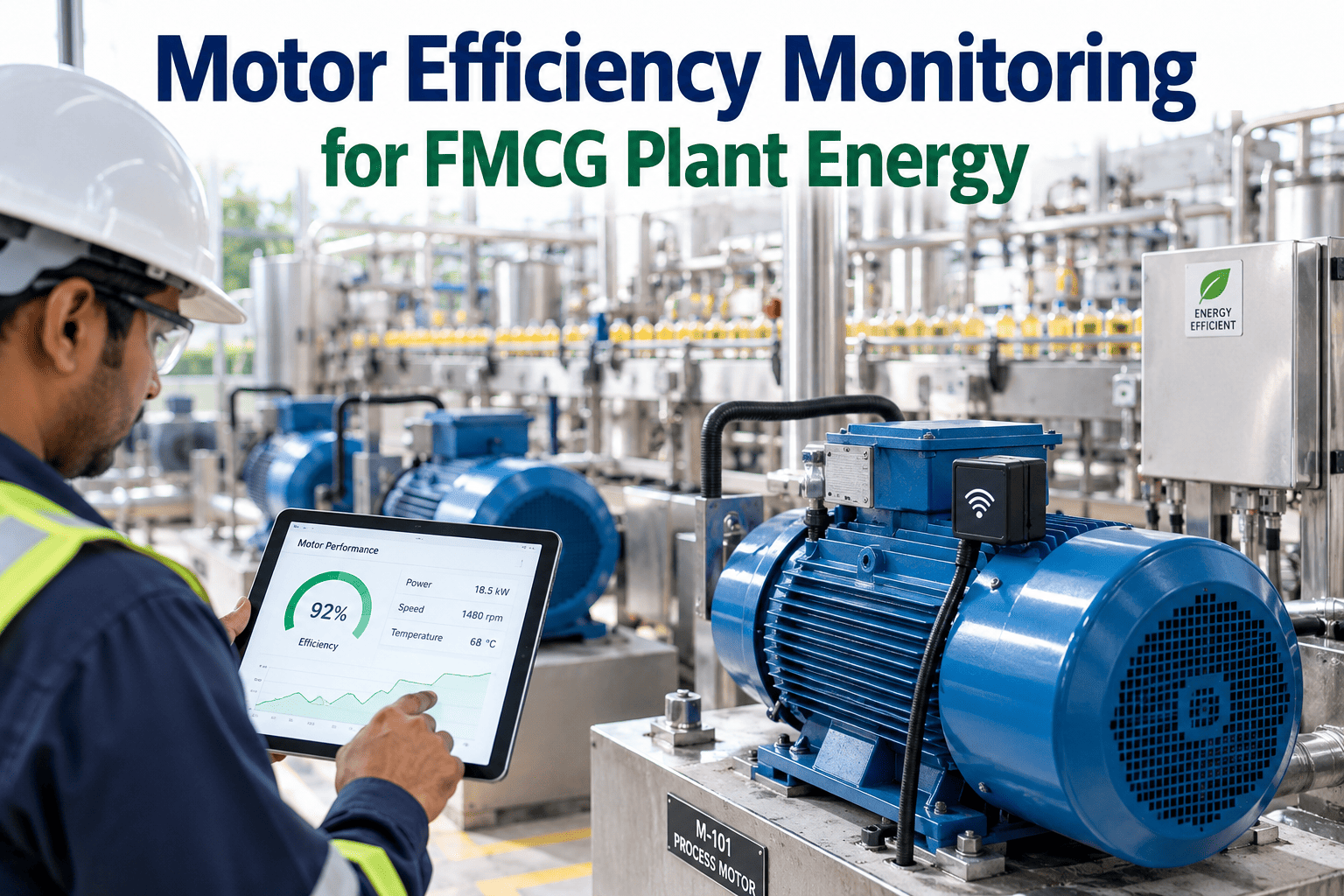
The electric motors that power palletizer and stretch wrapper axes are the most failure-prone components in end-of-line equipment — and the most difficult to diagnose because they often degrade gradually, producing subtle changes in current draw, vibration, and speed regulation that do not trigger any alarm until the motor faults completely. iFactory's motor health monitoring analytics extract degradation indicators from the motor data already available in the machine's control system — motor current signature, drive torque output, speed encoder feedback, acceleration and deceleration profiles, and thermal model estimates. The platform does not require additional vibration sensors or thermal cameras. It uses the data the drive system already generates to build a motor health index for every motor in the end-of-line equipment fleet.
The motor health index is a normalized score from 0 to 100 that represents the motor's current condition relative to its baseline state when it was new or last rebuilt. The index is derived from five degradation indicators: current signature harmonic distortion (bearing and winding wear), torque-to-current ratio (mechanical load path degradation), speed regulation error (encoder degradation), acceleration profile asymmetry (mechanical binding or misalignment), and thermal model deviation (cooling degradation or overload history). When the motor health index drops below a configurable threshold, the platform generates a maintenance alert with the specific degradation indicator driving the decline, the estimated remaining useful life, and the recommended intervention.
For the maintenance manager, the motor health dashboard provides a single-screen view of every motor in the end-of-line fleet sorted by health index — enabling prioritization of maintenance resources on the motors that need attention rather than following a fixed-interval replacement schedule that replaces healthy motors and misses degrading ones. The financial impact is significant: motors replaced on fixed intervals are typically retired with 30 to 50 percent of useful life remaining, while motors that fail between intervals cause unplanned downtime that costs 5 to 10 times more than the same replacement performed during scheduled maintenance. Condition-based motor replacement driven by AI health monitoring eliminates both waste categories. Talk to an Expert to learn how iFactory's motor health monitoring translates your existing drive data into a prioritized maintenance queue.
Gripper Condition Assessment — Preventing the Most Disruptive End-of-Line Failure
A gripper failure on a robotic or gantry palletizer is among the most disruptive events in end-of-line packaging. The gripper drops a layer mid-transfer, scattering product across the work cell, requiring operator intervention for cleanup, and potentially damaging product that must be reworked or scrapped. The recovery time for a dropped layer event averages 15 to 30 minutes — significantly longer than a jam on a cartoner or case packer because the product is already on the pallet and must be removed before the machine can be restarted. Most gripper failures are not sudden. They are the end point of a degradation trajectory that includes position repeatability drift, grip force reduction, cycle time increase, and vacuum or pneumatic pressure loss — each of which is detectable before the failure occurs.
iFactory's gripper condition assessment analytics track four gripper integrity parameters continuously: position repeatability at each pick-and-place point (detecting joint wear and actuator degradation), grip force or vacuum pressure profile during each pick cycle (detecting seal wear, vacuum leakage, and actuator force loss), cycle time trend per pick (detecting bearing and guide wear that increases motion resistance), and gripper alignment deviation across successive layers (detecting structural deflection or mounting degradation). When any parameter exceeds its statistical norm, the platform generates a condition alert with the specific gripper component most likely causing the deviation and a recommended intervention timeline.
The maintenance manager who receives a gripper condition alert can schedule the intervention during the next planned product changeover or shift end — a 15-minute recalibration or seal replacement during planned downtime replaces a 30-minute dropped-layer recovery during production. Over the course of a year, converting two or three gripper failures from unplanned events to scheduled interventions recovers hours of production time and eliminates the downstream scheduling disruption that each dropped-layer event causes. Book a Demo to see how iFactory's gripper condition monitoring detects degradation before the next dropped layer occurs on your palletizers.
What the iFactory End-of-Line Dashboard Shows the Maintenance Manager
The maintenance manager's dashboard for end-of-line equipment is designed to answer the questions that define the role: which machines are developing conditions that will produce unplanned downtime, which motors are degrading toward failure, which grippers need recalibration before the next layer drop, and what the shipping quality trend looks like correlated to equipment condition. Each view surfaces the actionable output of the AI analytics rather than the raw data.
We had been tracking shipping claims as a logistics issue for over a year. Every complaint was investigated independently — transportation damage, loading procedure, packaging material specification. The pattern was invisible because no one was correlating the claims back to the machine condition on the day the pallet was produced. After deploying iFactory's AI monitoring, the first correlation the platform identified was that 70 percent of the claims from a specific distribution region were produced on the same stretch wrapper during a three-week window when its turntable drive motor health index had dropped from 82 to 61 — a degradation trajectory that no one had detected because the wrapper was still running within its operational parameters. We replaced the motor bearings during scheduled maintenance, the film wrap tension returned to specification, and the claims from that region stopped completely. The platform paid for itself in claim cost avoidance within the first quarter.
— Maintenance Manager, Multi-Line Packaging Operation — 3 Palletizers, 4 Stretch Wrappers, 200+ SKUs, National DistributionHow Maintenance Managers Calculate ROI for End-of-Line AI Monitoring
The return on investment for AI-powered palletizer and stretch wrapper monitoring operates across four cost categories, each independently significant and collectively transformative for end-of-line maintenance economics.
Conclusion
End-of-line palletizers and stretch wrappers are the last machines that touch the product before it reaches the customer — and they are the machines most likely to be maintained on fixed intervals and visual inspections rather than continuous condition monitoring. The failure patterns of these machines — incremental position drift in row-forming bars, gradual motor degradation in turntable drives, creeping gripper position error in pick heads — are invisible to the maintenance approaches that serve upstream equipment well. They produce failure outcomes that look like product defects, transportation damage, or operator errors rather than the mechanical degradation they actually are. The shipping claim attributed to rough handling was caused by a stretch wrapper whose pre-stretch roller speed mismatch reduced film tension below the load stability threshold. The product damage attributed to packaging material failure was caused by a palletizer whose row-forming bar drift produced a pattern with an offset centre of gravity. The dropped layer attributed to an operator error was caused by a gripper whose position repeatability had degraded beyond the tolerance needed for the current product format.
iFactory's AI-powered pattern stability monitoring, motor health tracking, and gripper condition assessment close this gap by correlating every pallet pattern deviation, every film tension inconsistency, and every gripper position error with the machine's real-time mechanical state. The platform does not require additional sensors, does not disrupt production, and does not replace the maintenance manager's expertise. It adds a condition-aware intelligence layer above the existing control and maintenance systems — making the knowledge of what is happening on end-of-line equipment continuous, predictive, and directly correlated with shipping quality outcomes.
iFactory's end-of-line AI monitoring platform is designed for maintenance managers who need to eliminate shipping claims, prevent unplanned downtime, and optimize maintenance spend on palletizers and stretch wrappers. Book a Demo to see the AI pattern stability and motor health dashboard configured for your end-of-line equipment fleet, or talk to an expert about a free end-of-line maintenance assessment for your operation.