A finished product's traceability is only as strong as its weakest recorded link, and for most FMCG plants that weak link sits upstream, at the point where an ingredient lot is received, staged and dispensed onto the line. If that handoff is logged loosely, by shift memory or a paper tag that gets lost in the staging area, no amount of downstream batch recording can repair the gap later. Lot tracking that holds together from receiving dock to finished unit is what makes a recall trace actually complete rather than a best guess. Plant and quality teams can see how iFactory AI links raw material lots through to finished batches before the next supplier audit.
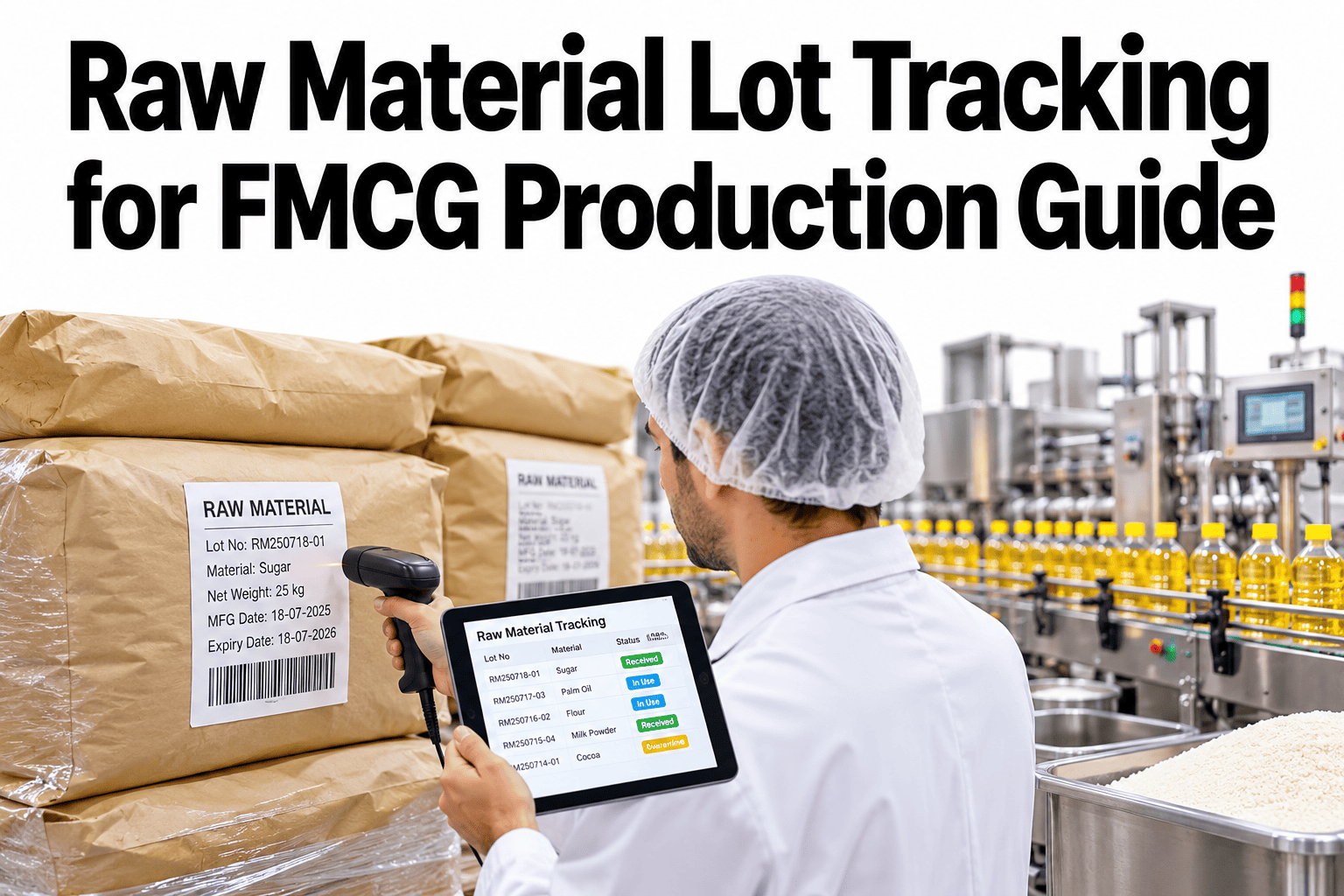
Raw Material Lot Tracking for FMCG Production
Receiving, staging, dispensing and consumption, recorded as one unbroken chain from dock to finished unit.
Where the Chain Usually Breaks
Most plants record receiving and finished batches reasonably well. The middle, staging and dispensing, is where lot identity most often gets lost.
Multiple lots of the same ingredient sit in the same staging area without a clear separation.
A handwritten or verbal record of which lot was weighed out is easy to get wrong under time pressure.
Leftover material from one lot gets combined with a new one without the mix being recorded.
None of these gaps are deliberate. They happen because the handoff points are the busiest, most time-pressured moments in the process.
Four Records That Need to Connect
A complete chain needs each of these captured and linked to the next, not recorded as four separate systems that happen to share a plant.
| Record | What It Captures | Common Gap |
|---|---|---|
| Receiving | Lot number, supplier, quantity and incoming inspection result | Supplier lot number not captured in a searchable format |
| Staging | Where and how long a lot sat before use | No location tracking once material leaves the receiving dock |
| Dispensing | Exact lot and quantity pulled for a specific production run | Dispensing logged by ingredient name only, not lot |
| Consumption | Which finished batch actually used the dispensed material | Weak link between dispensing record and the batch record |
Find Where Your Own Chain Breaks
Book a 30-minute session and iFactory AI will walk your receiving, staging, dispensing and consumption records to show exactly where lot identity is currently getting lost.
Partial Lots: The Hardest Case to Get Right
A full lot consumed in one dispensing event is easy to trace. A partial lot carried forward and mixed with a new delivery is where most systems lose the thread.
What a Complete Lot Record Looks Like at the Finished Unit
The end goal is simple to state and hard to achieve without discipline at every step: pick any finished unit, and know exactly which raw material lots went into it.
Lot received
Supplier lot number and inspection result captured at the dock.
Lot staged
Location and dwell time recorded while awaiting use.
Lot dispensed
Exact lot and quantity linked to a specific production order.
Batch produced
Finished batch record carries forward every contributing lot.
The plants with genuinely complete traceability are the ones that treat staging and dispensing with the same rigor as receiving and finished batch recording, rather than assuming those middle steps will sort themselves out operationally. Partial lot carryover is the single most common point where a trace chain quietly breaks, because it happens in the middle of a busy shift with no natural prompt to record the mix. Build a deliberate checkpoint for partial lots specifically, since that is where a recall investigation is most likely to stall.
Where iFactory AI Fits
iFactory AI links receiving, staging, dispensing and consumption records automatically, so lot identity survives every handoff through to the finished batch.
End-to-end lot linkage
Every stage from receiving to consumption is connected, so a finished batch's full material history is always available.
Partial lot handling
Carryover and mixed lots are recorded with their original lot numbers and ratios, not collapsed into one entry.
Staging visibility
Location and dwell time are tracked for staged material, closing the gap where lot identity is most often lost.
Ask in plain language
Ask which raw material lots went into a specific finished batch and receive a direct answer.
Frequently Asked Questions
Where does raw material traceability usually break down first?
Staging and dispensing are the most common failure points, since receiving and finished batch records tend to be captured more consistently while the middle steps happen under time pressure with less structured logging. You can watch a lot chain traced end to end on sample production data in a live session.
How should partial lot carryover be recorded?
Log the leftover quantity against its original lot number, and when it is mixed with a new delivery, record the mix event with both lot numbers and their ratios, so the finished batch record can show every contributing lot rather than just the most recent one. To review your own handling, request a partial lot review with the iFactory AI team, or ask support what data is needed.
Does lot tracking need to cover every raw material, or just the critical ones?
Ideally every material that ends up in the finished product, since a recall trigger can come from an ingredient that was not considered high risk beforehand. A short product tour of material coverage setup shows how this is scoped for a plant.
How does this connect to a recall investigation?
A complete chain from receiving through consumption means a specific raw material lot can be traced forward to every finished batch it touched, which is the foundation a recall trace depends on. See how lot linkage supports a trace-forward investigation in a guided walkthrough.
What does it take to get lot tracking working on the floor, not just on paper?
The dispensing and staging steps need a capture method that fits into the actual pace of production, since any process operators find slower than the old way tends to get skipped under pressure. Schedule a walkthrough of floor-level capture methods to see what fits your operation.
Close the Gap Between Receiving and the Finished Unit
iFactory AI links raw material lots through every handoff to the finished batch. Book a walkthrough to see it built around your own production line.