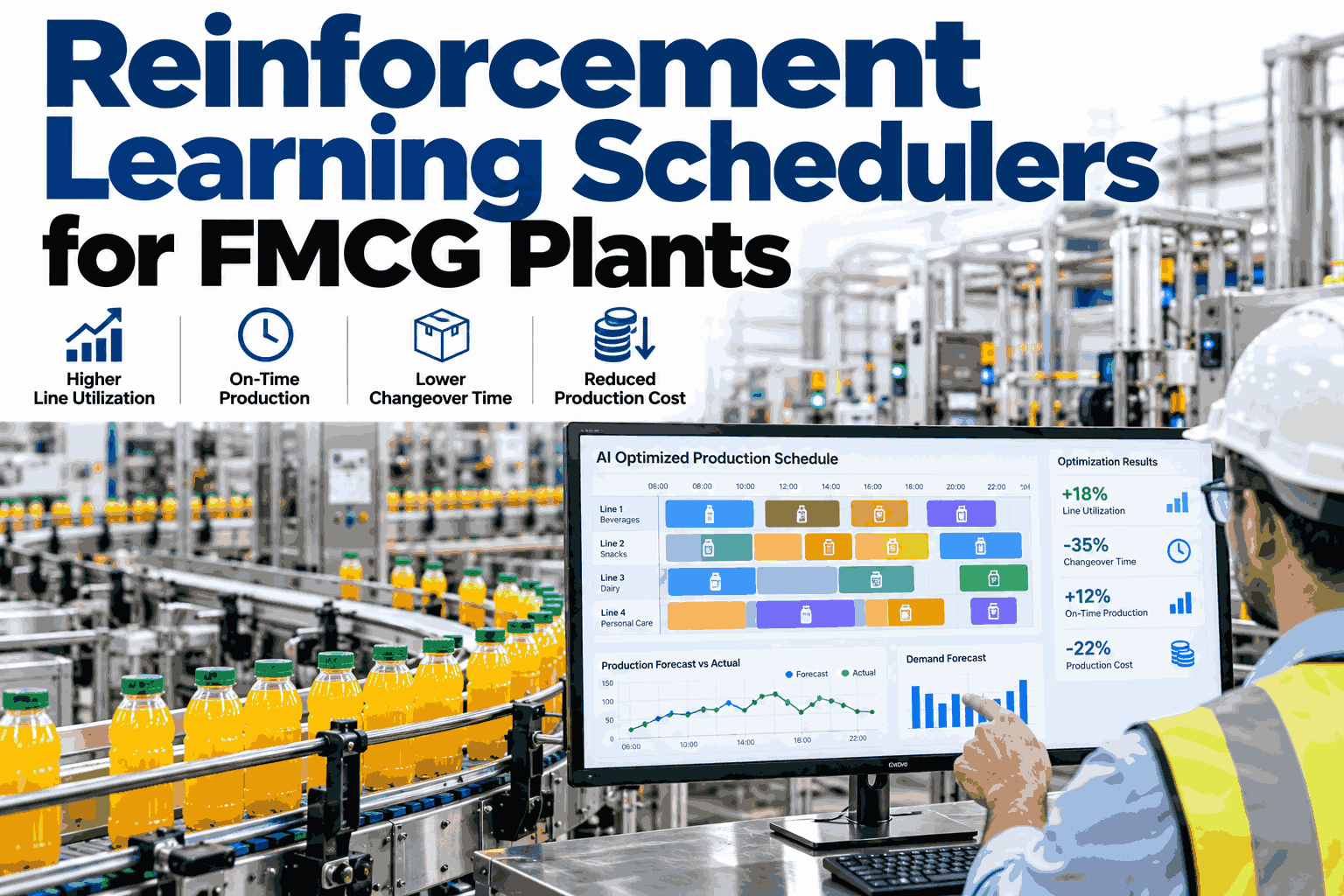
Reinforcement learning does not beat a well-tuned APS solver across the board, and any page claiming otherwise is skipping the part that actually matters: where each one wins. A traditional solver still produces the better schedule when the combinatorial search space is small enough to explore directly. RL starts winning once that space gets too large or too fast-changing for an exact solver to finish before the plan is already stale. FMCG scheduling, with its short runs, frequent changeovers, and shelf-life pressure, sits closer to that second condition than most other manufacturing sectors. Talk to iFactory AI about where your own scheduling problem actually falls on that line.
Where RL Actually Beats a Traditional Solver, and Where It Doesn't
RL schedulers don't replace APS outright. They win under specific conditions: high scheduling density, frequent disruption, and search spaces too large for an exact solver to finish in time.
What APS Solvers Are Actually Good At
A traditional APS system, built on integer programming or a similar exact-optimization method, searches the full space of possible schedules and can prove a solution is optimal, or close to it, within defined constraints.
That strength holds as long as the search space stays small enough to explore in reasonable time. A published comparison of exact solvers against reinforcement learning on a real scheduling problem found that at low scheduling density, a well-designed integer-programming solver produced zero disruptions after a delay event, something no RL-based method matched at that same density.
This is worth stating plainly because the opposite claim circulates often in vendor marketing: that AI, broadly framed, simply outperforms older optimization techniques across the board. That framing collapses two very different technologies into one, and the collapse hides the actual engineering trade-off a plant needs to understand before spending a budget on either one. An integer-programming solver is not "legacy" technology being replaced by something newer and better. It is a different tool, with different guarantees, suited to a different part of the problem space, and the research cited above is one of the few places that trade-off is actually measured rather than asserted.
Where the Same Research Found APS Starting to Break
The same comparison ran the identical solvers at a higher scheduling density, roughly doubling the number of overlapping constraints being juggled at once. The integer-programming solver that had produced a perfect result at low density failed to produce any schedule at all within a 90-minute solving window at the higher density.
Search Space Growth
Adding constraints doesn't add search space linearly, it multiplies it, which is why a solver that handles one density comfortably can completely stall at the next.
Nonlinear Objectives
Robustness terms added to make a schedule more resilient to disruption often make the underlying optimization problem considerably harder to solve exactly.
Re-Solve Frequency
A solver that takes 90 minutes to finish is useless for a plant that needs a new schedule every few minutes after a disruption.
A hybrid approach from that same research, which used a learned reward signal to guide a simplified integer-programming solver rather than replacing it outright, produced schedules in under two seconds at the higher density, with 33 to 48 percent fewer disruptions than the plain integer-programming baseline at that density. The learned component didn't replace the exact solver's feasibility guarantees; it told the solver which trade-offs to prioritize when the full exact search was no longer practical.
That hybrid structure is the pattern worth paying attention to, more than the specific numbers from one study on one dataset. The learned component in that research didn't need to understand the full scheduling problem or guarantee a feasible result on its own, because the integer-programming layer underneath it was still responsible for feasibility. The learning only had to supply a better sense of which trade-offs mattered, which is a narrower and more tractable task than learning to solve the scheduling problem end to end.
Find Out Which Side of That Line Your Plant Sits On
Book a session and see whether your actual scheduling density calls for a traditional solver, an RL-guided hybrid, or both running side by side.
Why FMCG Scheduling Tends to Sit on the RL Side of the Line
Not every plant needs to think hard about this trade-off. A plant running long, stable batches with infrequent changeovers rarely pushes a scheduling density high enough for an exact solver to struggle. FMCG production usually looks different.
| FMCG Characteristic | Effect on Scheduling Density |
|---|---|
| Short production runs | More changeovers per shift, each one adding a new constraint to juggle |
| Frequent SKU and flavor variation | More distinct product configurations competing for the same lines |
| Shelf-life and freshness windows | Time-sensitive constraints that tighten the feasible schedule window further |
| Promotional and seasonal demand spikes | Sudden density increases that an exact solver tuned for normal volume may not handle quickly |
None of this means a traditional APS solver is wrong for FMCG. It means the density at which that solver starts to struggle is reached more often in FMCG than in sectors running longer, more stable production runs, which is exactly the condition under which a learned, RL-guided component starts to earn its complexity.
It also means the right question for an FMCG plant to ask isn't "should we adopt RL," framed as a binary technology choice, but "how often does our scheduling density actually cross the threshold where our current solver struggles." A plant running steady, predictable volume most of the year with a handful of promotional spikes may only need the learned component active during those spikes, with the exact solver handling everything else. That is a very different, and usually cheaper, deployment than assuming RL needs to run the entire schedule year-round.
What a Training Environment Actually Needs to Represent
An RL scheduler learns by interacting with a simulated version of the plant, not the real one, which means the quality of that simulation is the ceiling on how good the learned policy can ever get.
Real Constraint Structure
Changeover times, labor skill matching, and tooling availability need to be modeled with the same rules the real plant actually enforces, not a simplified stand-in.
Realistic Disruption Patterns
Breakdowns, rush orders, and material delays need to occur in the simulation at rates and patterns that resemble the plant's actual disruption history, not a uniform random distribution.
A Global View of the Schedule
An agent that assigns one slot at a time without seeing the full schedule it's building can paint itself into a corner, a documented failure mode in published scheduling research.
That last point is worth taking seriously because it is a real, demonstrated weakness, not a theoretical concern. In the same published comparison referenced above, a pure RL agent assigning schedule slots sequentially, without a global view of the schedule it was building, produced far more disruptions in testing than any integer-programming-based method, even though both were solving the same underlying problem.
Beyond these three, a training environment also needs an honest accounting of its own limits. The same research noted that its model had to be retrained whenever the underlying population it was scheduling changed significantly, which translates directly to an FMCG context: a training environment built around last year's SKU mix and line configuration may need meaningful retraining once a new product line or a new piece of equipment changes the constraint structure it was trained against. Treating the training environment as a one-time build rather than something that needs periodic refreshing is a common and avoidable mistake.
Designing a Reward Function That Doesn't Backfire
An RL agent optimizes exactly what its reward function tells it to, which means a reward function that sounds reasonable in a planning meeting can still produce behavior nobody actually wants once the agent starts training against it.
Reward Only On-Time Delivery
An agent rewarded purely for hitting due dates can learn to front-load easy orders and let the hardest ones slip, since the reward signal never penalizes which orders got deprioritized.
Reward Only Minimal Changeovers
An agent rewarded purely for fewer changeovers can learn to batch dissimilar products together in ways that satisfy the reward but cause real downstream quality or cleaning issues.
Reward Robustness Directly
The research referenced above used a reward built around schedule buffer, explicitly rewarding gaps that absorb a disruption, which is a more direct signal than rewarding the absence of disruption after the fact.
The practical lesson is that a reward function needs to be tested against edge cases before it ever touches a real schedule, specifically by checking what the highest-reward schedule looks like under the proposed function and whether a human scheduler would actually approve of it. This kind of adversarial review, deliberately looking for the schedule the function would reward that nobody actually wants, is cheap to do in simulation and expensive to discover after the agent has already been given control of a real line.
Safe-Deployment Patterns Worth Building In From the Start
None of the general scheduling-AI marketing pages in this category describe RL-specific deployment safeguards, which is itself a gap worth noting, because an RL agent's failure modes are different from a rules-based optimizer's failure modes.
Shadow Mode Before Live Control
The RL agent proposes schedules alongside the existing solver for a defined period without ever controlling the actual line, so its recommendations can be compared against real outcomes before it's trusted.
Hard Constraint Guardrails
Certain rules, like minimum batch sizes or mandatory cleaning cycles between allergen-containing runs, are enforced outside the learned policy entirely, so the agent cannot learn its way around them.
Automatic Fallback
If the RL component's confidence drops or its proposed schedule deviates sharply from recent patterns, the system falls back to the traditional solver rather than committing an untested plan.
Planner Override on Every Run
A human scheduler reviews and can override any proposed schedule before it goes live, the same human-in-the-loop principle traditional APS vendors already apply, carried over deliberately to the RL component.
A Short Self-Check Before Piloting an RL Scheduler
Run these against your current scheduling setup. A no on any of these points at a gap worth closing before an RL pilot, not after.
Where iFactory AI Fits
iFactory AI's dynamic scheduler pairs a finite-capacity planning engine with a learned component trained on your plant's actual constraint structure and disruption history, deployed through the safeguards described above rather than replacing your existing solver outright.
Density-Aware Routing
Scheduling problems within the exact solver's practical range stay there; only the high-density, high-disruption cases route to the learned component.
Plant-Specific Training Environment
The simulation the RL component trains against is built from your own changeover times, labor constraints, and historical disruption patterns, not a generic template.
Shadow-Mode Rollout
New scheduling logic runs alongside your current process for a defined evaluation window before it is ever given live control.
Planner-in-the-Loop Control
Every proposed schedule, from either the exact solver or the learned component, is reviewable and overridable by a human scheduler before it goes live.
Expert Review
"The mistake most teams make with RL scheduling is treating it as a replacement for their APS system rather than a specialist that only gets called in when the exact solver is actually struggling. The published research backs this up directly: a pure RL agent lacking a global view of the schedule produced dramatically more disruptions than a traditional solver in head-to-head testing, and only a hybrid approach that kept the solver's feasibility guarantees while borrowing a learned reward signal actually beat the baseline, and only at higher scheduling density."
This review point is the single most important filter before investing in an RL scheduling pilot: confirm your actual scheduling density first, because below a certain threshold a traditional solver still wins outright. Have us measure that threshold against your real production data before committing to either approach.
Frequently Asked Questions
Does reinforcement learning always produce a better schedule than a traditional APS solver?
No. Published research comparing the two directly found that a pure RL agent never beat a well-tuned integer-programming solver on the metrics being optimized, and produced meaningfully more disruptions in testing. RL earns its place only at higher scheduling density, where the exact solver starts taking too long to finish before the production plan is already stale. We can check which side of that line you're on before recommending either approach.
What makes FMCG scheduling a better fit for RL than other manufacturing sectors?
Short production runs, frequent SKU and flavor changeovers, shelf-life pressure, and seasonal demand spikes all push scheduling density higher than sectors running longer, more stable batches. That higher density is exactly the condition under which an exact solver starts to struggle and a learned component starts to add real value.
What is the biggest documented failure mode of a pure RL scheduler?
An agent that assigns schedule slots one at a time without a global view of the full schedule it's building can paint itself into a corner, leaving a later slot unfillable. This was a documented finding in published scheduling research, not a theoretical risk, and it is why a hybrid approach that keeps an exact solver's feasibility guarantees tends to outperform a standalone RL agent in practice.
How do we know if our reward function is actually safe before going live?
Generate the highest-reward schedule the function would produce under a wide range of simulated scenarios, including deliberate edge cases, and have an experienced human scheduler review whether they would actually approve each one. A reward function that produces a schedule no human scheduler would sign off on needs revision before it ever reaches a real plant, regardless of how clean the underlying metric looks on paper.
What does "shadow mode" actually mean for an RL scheduler rollout?
The RL component generates proposed schedules in parallel with whatever system currently controls the line, without ever being given live control itself. Those proposals are compared against actual outcomes over a defined evaluation period, which is how confidence in the learned component is built before any real risk is taken. Ask our team how long a typical shadow-mode window runs for a plant your size.
Find Out If RL Actually Fits Your Scheduling Problem
iFactory AI pairs a finite-capacity solver with a density-aware learned component, deployed through shadow mode and planner override, not as a blind replacement for your current APS. Book a walkthrough on your own scheduling data.