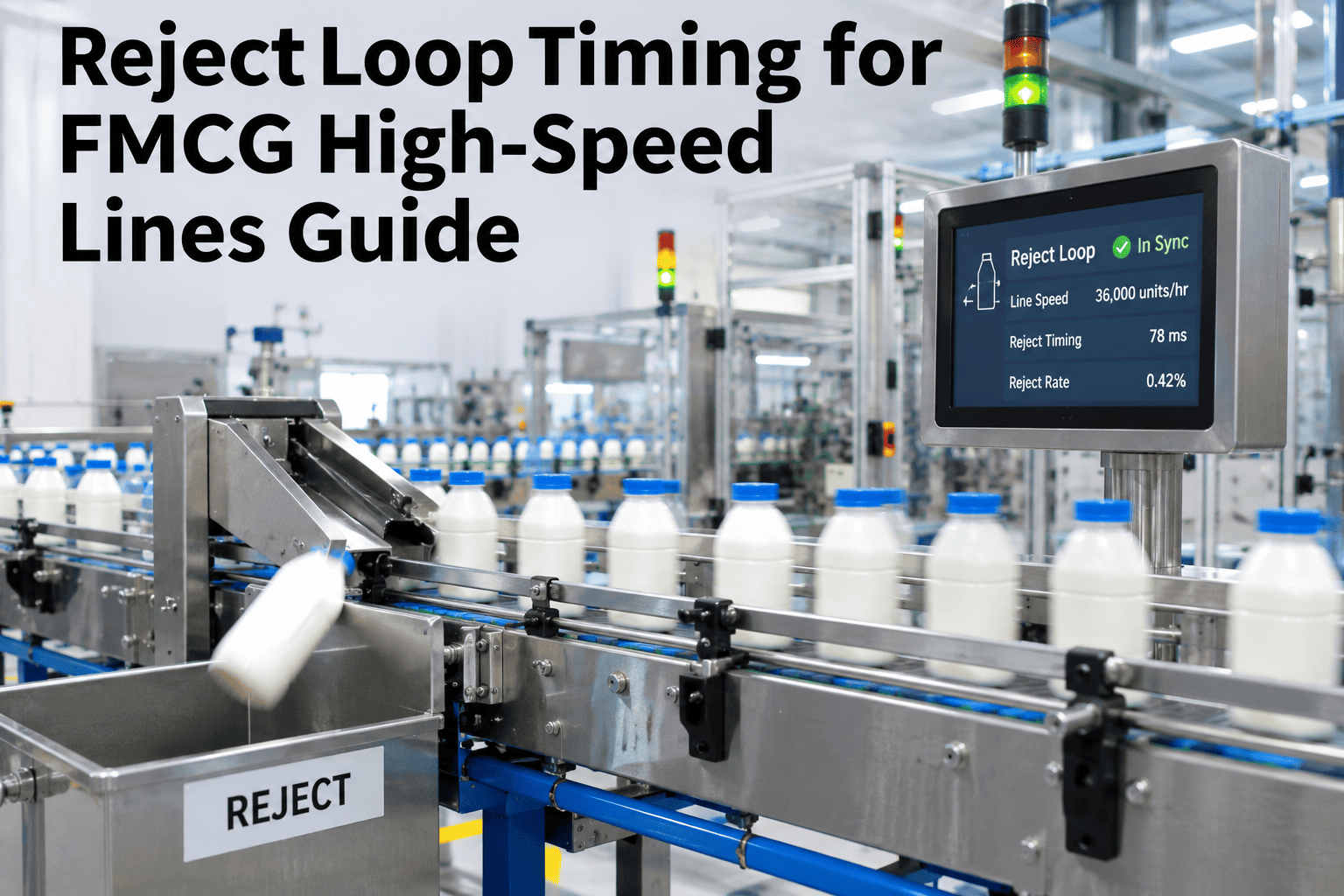
Reject loop timing is the interval between a detector flagging a unit and the reject device removing exactly that unit. It is the sum of detection and control delay, actuator response and the time the unit needs to travel from the inspection point to the reject point. On a fast FMCG line, a timing error of a fraction of a second means the divert hits the wrong pack, and the flagged unit carries on to the customer. Operations teams can measure the latency stack on their own line in a short session.
Make Sure the Unit You Flag Is the Unit You Remove
iFactory AI, an on-premise industrial AI platform, helps engineers measure the full detect-to-divert delay and prove it across the whole line speed range.
What Is Reject Loop Timing and How Is It Calculated?
The reject device must fire when the flagged unit reaches it. Program the delay from the measured distance and the actual belt speed, not the nominal figure (2M Technology, 2026).
What Adds Up in the Latency Stack?
Each stage adds time. Add them from measurements, not from data sheets. Teams can send a latency worksheet request to get a template.
| Stage | Where the Delay Comes From | How to Measure It |
|---|---|---|
| Detection and processing | Camera exposure, image analysis, detector signal | Time stamp at trigger and decision |
| Network and PLC | Scan time and message transfer | Log decision to output change |
| Actuator response | Valve, solenoid or arm movement, 10–100 ms | High-speed recording of the device |
| Product travel | Distance and speed consistency | Encoder count between points |
Why Does Belt Speed Shrink the Tolerance Window?
The window is the gap between packs, in time. As speed rises, the same gap shrinks. The figures below are an illustrative example with a 0.8 m reject distance and 0.3 m between packs.
Find Out How Much Margin Your Reject Really Has
Share your line speeds, pack pitch and reject distance. iFactory AI's team will show the delay budget and how tight the window is at top speed.
Which Reject Method Fits Which Pack?
Pack weight and shape decide the device. Published limits from one metal detector range show the pattern (Mettler-Toledo SL1500 data sheet).
| Method | Typical Pack | Watch For |
|---|---|---|
| Air blast | Light packs, under 2 kg | Air pressure and valve wear |
| Pusher | Heavier packs, up to 10 kg or 30 kg by model | Full travel and return time |
| Overhead sweep | Packs that need gentle contact | Sweep timing against pack gap |
| Stop on detect | Slow or manual-clear lines | Operator response and lockout |
How Do You Confirm the Reject Actually Landed?
A reject that is never confirmed is only a hope. Retailer-grade systems add six safeguards (Thermo Fisher Scientific compliance backgrounder).
How Do You Validate Timing Across the Whole Speed Range?
Run test units at the slowest and fastest observed speeds, not only the nominal one, and test back-to-back rejects (iFactory engineering guide, 2026).
Should the Line Stop on Detect or Keep Running?
Both are valid, and the choice follows pack value, speed and risk. Teams can compare both options for their own line in a short session.
Which Reject Faults Fail Silently?
Where Does iFactory AI Fit in Reject Timing?
iFactory's integration engineers measure the latency stack across camera, network and PLC and confirm reject placement against the real line speed range before go-live.
Latency Measurement
Detect-to-divert delay is measured on your line, stage by stage.
Speed-Range Validation
Timing is proven from slowest to fastest speed.
Reject Confirmation Log
Every flagged unit is matched to a confirmed divert.
Drift Alerts
Rising actuator response or speed change raises a work order.
What Belongs in a Reject Test Record?
Expert Review: Judging a Reject Loop
Frequently Asked Questions
How do you calculate reject delay on a conveyor?
Divide the measured distance to the reject point by the actual belt speed, then subtract the actuator response time. Use measured speeds, not nominal ones. Work through the sums on your line with our team.
Why do rejects miss at high speed?
At higher speed the gap between packs shrinks in time, so the same timing error now hits the wrong unit. Actuator wear and speed drift add to it. Ask support how to check the window on your fastest recipe.
How long does a reject actuator take to respond?
Physical response is typically 10 to 100 milliseconds, depending on mechanism, air pressure and wear (iFactory engineering guide, 2026). Measure your own device rather than assuming a value. See actuator timing measured in a short demo.
How do you prove a rejected unit reached the bin?
Fit a reject confirmation sensor and a bin-full sensor, and make the line alarm and stop if the reject does not enter the bin (Thermo Fisher Scientific). Log every confirmation. Review a confirmation log built for your line.
Does iFactory AI change the reject hardware?
No. Your air blast, pusher or diverter stays. iFactory AI measures the delay, validates it across speeds and logs each confirmed reject. Plan the integration with our engineers.
Prove Every Flagged Unit Leaves the Line
See iFactory AI measure your detect-to-divert delay and confirm every reject. Book a walkthrough using your own line speeds and reject layout.