RFID has a reputation problem in FMCG warehousing: plenty of operators tried it a decade ago, got inconsistent read rates and a shelf full of unused hardware, and concluded the technology simply doesn't work for their environment. In most of those cases, the technology was fine — the tag economics, reader placement, and rollout sequencing were the actual points of failure. Getting those three details right is the difference between a system that finally gives accurate real-time inventory and one that becomes an expensive lesson, and it's the starting point for every RFID engagement the iFactory team runs with FMCG warehouse operators.
RFID DEPLOYMENT
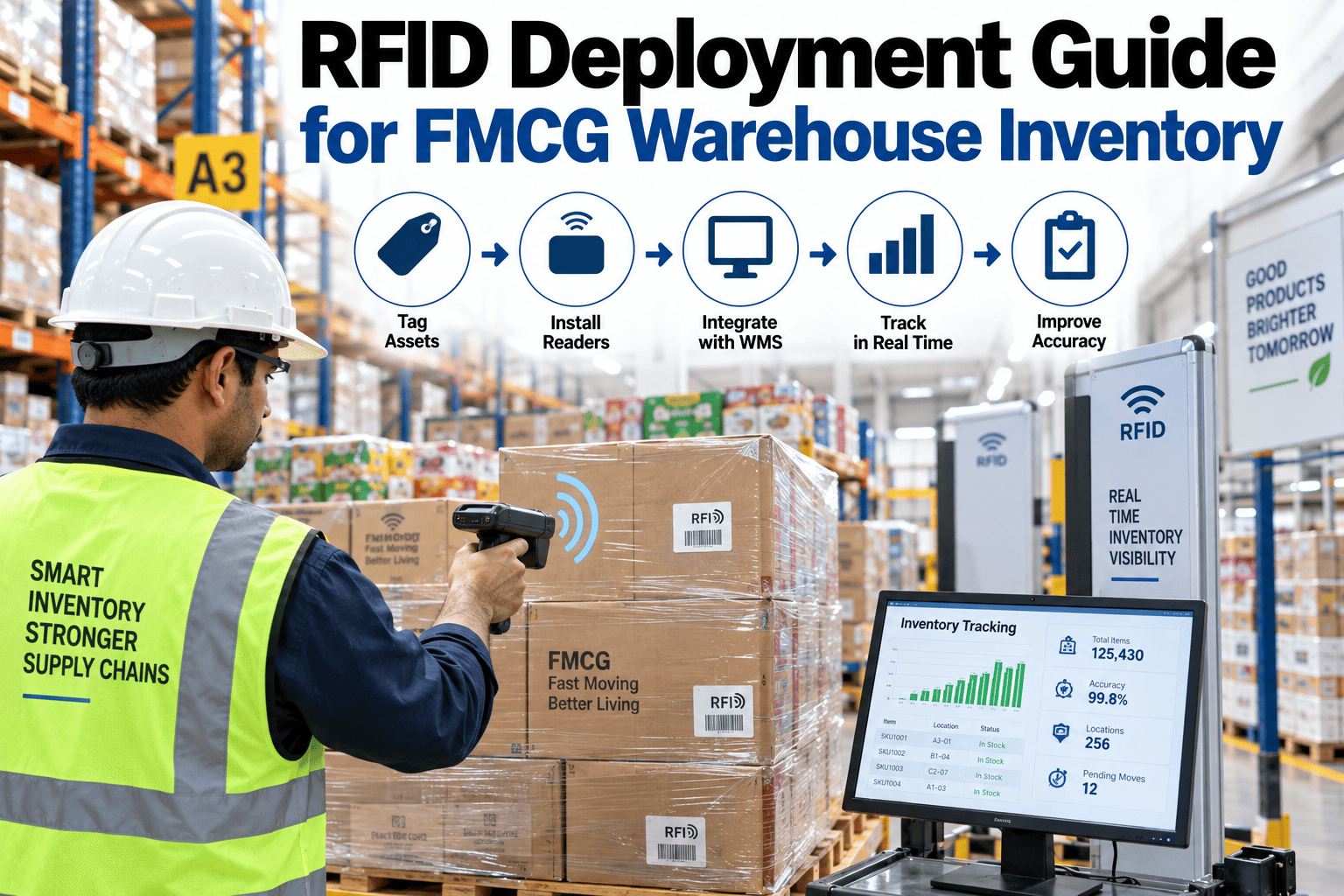
RFID Deployment Guide for FMCG Warehouse Inventory
Tag economics, reader placement, portal design, and a phased rollout sequence that finally makes RFID-based inventory accuracy pay off — instead of becoming shelfware.
Tag Read Range
Portal Zone
Facility Coverage
Why So Many First RFID Attempts Fall Short
The typical failed RFID rollout follows a predictable pattern: tags are chosen based on unit cost alone, readers are installed wherever seemed convenient, and the whole facility goes live at once instead of in phases. Each of those three decisions independently degrades read accuracy, and combined, they produce a system that misses enough inventory movements to be worse than trusting a manual count. None of these are technology limitations — they are planning shortcuts that a structured deployment approach avoids entirely.
Tag Economics — Choosing the Right Tag for Each Product Category
Tag cost is not a single number; it varies significantly by tag type, and choosing the cheapest option for every product category is one of the most common ways a deployment's read accuracy quietly suffers. Liquid and metal products in particular require specialized tags, since standard tags perform poorly near those materials.
Standard Inlay Tags
$0.05 – $0.10 per unit
Best for dry goods, cardboard cases, and non-liquid, non-metal packaging where read range requirements are moderate.
Liquid & Metal-Rated Tags
$0.15 – $0.35 per unit
Required for beverages, canned goods, and metal packaging, where standard tags experience significant read range degradation.
Case & Pallet Tags
$0.20 – $0.50 per unit
Higher-durability tags built for repeated handling on reusable cases and pallets moving through multiple facility cycles.
Specialty High-Memory Tags
$0.40 – $1.00+ per unit
Used selectively for high-value SKUs needing serialized tracking data beyond a basic identifier, such as batch or lot detail.
Reader Placement — Where Portals Actually Belong
A reader positioned in the wrong location will produce misleading data even with perfect tags, either missing movements entirely or double-counting items that pass through overlapping read zones. The facility map below shows the placement pattern that consistently produces the most reliable read accuracy across FMCG warehouse layouts.
1
Dock Door Portals
Fixed portal readers at every inbound and outbound dock door capture every pallet crossing the threshold in either direction.
2
Forklift-Mounted Readers
Readers mounted on forklifts capture put-away and retrieval movements as pallets are placed into or pulled from racking.
3
Pack Station Readers
Fixed readers at pack and label stations confirm case-level tag reads at the point where cartons are finalized for shipment.
4
Handheld Cycle Count Readers
Mobile handheld readers support periodic cycle counts and exception investigation without requiring a full facility scan.
Design an RFID Deployment for Your Own Facility
iFactory assesses your product mix, facility layout, and current inventory accuracy to recommend the right tag types, reader placement, and rollout sequence before any hardware is purchased.
The Phased Rollout That Prevents a Failed Deployment
Deploying RFID across an entire facility on day one is the single riskiest way to roll out the technology, because any tag, reader, or process issue affects the whole operation simultaneously with no clean way to isolate the cause. A phased rollout confines problems to a small, manageable scope at each stage.
PHASE 1
Single Zone Pilot
One dock door or one product category is tagged and read for two to four weeks, with read accuracy validated against manual counts before expanding further.
PHASE 2
Full Receiving & Shipping Coverage
Portal readers are installed across all dock doors, extending tag coverage to the full range of product categories moving through inbound and outbound flow.
PHASE 3
In-Facility Movement Tracking
Forklift-mounted and pack station readers are added to capture put-away, retrieval, and packing movements, closing the loop on real-time location accuracy.
PHASE 4
Full Facility & Analytics Integration
RFID data feeds directly into inventory and warehouse management systems, replacing manual cycle counts with continuous, automated accuracy tracking.
A Warehouse Operations Manager on the Second Attempt
"
We had tried RFID once before, years earlier, and it was genuinely discouraging — read rates were inconsistent enough that our team stopped trusting the system within a couple of months and quietly went back to manual cycle counts. When we revisited it, the biggest difference was starting with a single dock door and a single product category instead of trying to cover the whole facility at once. That pilot surfaced tag placement issues on our beverage cases almost immediately, which we were able to fix with a liquid-rated tag before rolling out any further. Because we caught that problem in a contained pilot instead of across the entire warehouse, our team's confidence in the system built steadily instead of collapsing the way it had the first time. Eighteen months later we are running full facility coverage with read accuracy well above what manual counting ever gave us, and it genuinely comes down to the sequencing being different, not the underlying technology.
— Warehouse Operations Manager, National FMCG Distributor · Led RFID Rollout Across 4 Distribution Centers
Frequently Asked Questions
What read accuracy should we realistically expect from a well-designed RFID system?
A properly designed RFID deployment with appropriate tag selection and reader placement typically achieves read accuracy in the high-90% range at portal and pack station read points, which is a substantial improvement over the accuracy most facilities achieve with manual or barcode-based counting alone. Achieving this level consistently requires the tag economics and placement decisions covered above to be handled correctly for your specific product mix, since generic assumptions about tag performance often do not hold for challenging categories like liquids or metallized packaging.
How much does a full RFID deployment typically cost for a mid-size distribution center?
Total cost varies significantly based on facility size, number of dock doors, product mix, and the specific tag types required, but most mid-size distribution centers should expect a combination of tag costs that scale with volume plus a fixed hardware investment in portal and handheld readers. Starting with a phased rollout, as described above, spreads this investment over time and allows the pilot phase to validate expected read accuracy before committing to full facility hardware spend, which meaningfully reduces the financial risk of the overall project.
Can RFID work alongside our existing barcode system, or does it need to fully replace it?
Most FMCG operators run RFID and barcode systems in parallel rather than replacing barcodes entirely, at least during the transition period and often permanently for certain product categories or supplier relationships that are not yet RFID-enabled. RFID typically takes over the high-volume automated read points — dock doors, pack stations — where the speed and accuracy advantage matters most, while barcodes remain useful for exception handling, supplier receiving where tags are not yet present, and any manual verification steps your team relies on.
How long before a phased RFID rollout reaches full facility coverage?
A typical phased rollout across the four phases described above takes six to twelve months from initial pilot to full facility and systems integration, depending on facility size and the number of dock doors and product categories involved. This timeline is intentionally longer than a single-phase, whole-facility deployment would take, but the trade-off is a dramatically lower risk of the kind of failed rollout that leaves hardware unused and inventory teams reverting to manual counts within the first year.
Does iFactory help select tags and reader placement for our specific product mix?
Yes — an RFID deployment assessment is typically the first step in any engagement, reviewing your specific product categories, packaging materials, facility layout, and current inventory accuracy challenges to recommend the right tag types and reader placement plan before any hardware purchase is made. This assessment is particularly important for FMCG operators with a mix of dry goods, beverages, and metal-packaged products, since a single generic tag choice rarely performs well across all three categories. To schedule an assessment,
book a demo, or
contact support with questions about your specific product mix.
Get RFID Right the Second Time — or the First
The right tags, the right reader placement, and a phased rollout sequence are what separate an RFID deployment that finally delivers accurate real-time inventory from one that becomes unused hardware within a year. iFactory builds the deployment plan for your specific facility.