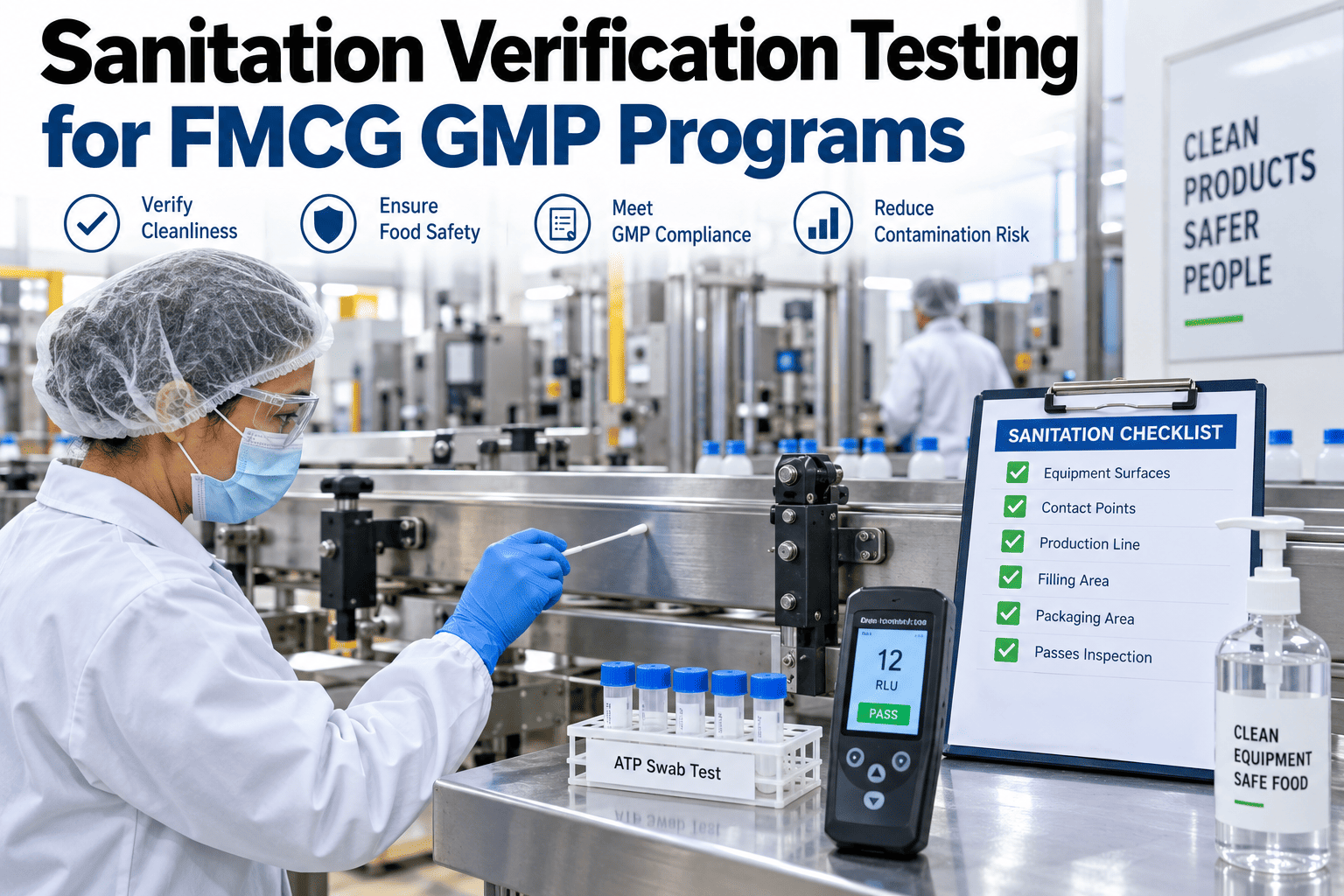
An auditor walking a plant floor doesn't just want to see a cleaning schedule taped to the wall — they want to see the verification data behind it: the ATP swab results, the micro sampling records, and a documented acceptance criteria that shows sanitation is actually being confirmed, not just performed on a checklist. The gap between "we clean the equipment" and "we can prove the equipment is clean to a statistical standard" is exactly where most GMP audit findings originate, and closing it is a core part of how iFactory supports FMCG plants building audit-ready sanitation programs.
GMP & QUALITY ASSURANCE
Sanitation Verification Testing for FMCG GMP Programs
ATP, protein swab, and micro sampling protocols with the statistical acceptance criteria auditors actually ask about — turning a cleaning schedule into a defensible verification record.
Cleaning Is Not the Same as Verified Clean
Every FMCG plant has a cleaning schedule, and most operators follow it diligently — but a completed cleaning task and a verified sanitation result are two entirely different things from a GMP standpoint. Verification means testing the actual surface after cleaning and confirming the result meets a documented acceptance criteria, with the data retained as evidence. Without that verification layer, a plant is documenting effort, not proving outcome, and that distinction is precisely what an experienced auditor is trained to probe.
The Three Verification Methods and When Each Applies
No single verification method covers every situation — each has a different speed, sensitivity, and cost profile, and a mature sanitation program typically uses all three in combination depending on the specific risk being verified.
ATP BIOLUMINESCENCE
Rapid Post-Cleaning Screen
Provides a result within seconds by measuring residual organic material on a surface, making it the practical choice for verifying every cleaning cycle in real time before production resumes.
PROTEIN SWAB
Allergen Cross-Contact Check
Detects residual protein specifically, making it especially valuable for verifying allergen changeovers where ATP alone may not reliably distinguish allergen protein from other organic residue.
MICROBIAL SAMPLING
Pathogen & Spoilage Organism Testing
Provides the most definitive result on microbial contamination risk, though with a longer turnaround than ATP, making it the standard for periodic deep verification and environmental monitoring programs.
Statistical Acceptance Criteria — What Auditors Actually Ask About
A verification test without a documented acceptance threshold produces a number, not a decision. Auditors consistently ask to see the specific criteria used to determine pass or fail, and the statistical basis for setting that threshold in the first place. The table below outlines a common structure for setting acceptance criteria across the three methods.
| Method | Common Acceptance Approach | Documentation Required |
|---|
| ATP Bioluminescence | Relative light unit (RLU) threshold set per surface type, based on baseline studies | RLU result, threshold, pass/fail, corrective action if failed |
| Protein Swab | Binary detected/not-detected or quantitative threshold for allergen changeovers | Result, allergen tested, changeover confirmation record |
| Microbial Sampling | Colony-forming unit (CFU) threshold by surface zone, with trending against historical baseline | CFU count, zone, trend comparison, corrective action log |
Build an Audit-Ready Verification Program
iFactory helps FMCG plants design sanitation verification protocols with documented acceptance criteria and digital records that stand up to GMP audit scrutiny.
Designing a Sampling Plan Auditors Will Trust
A sampling plan that tests the same three easy-to-reach spots every time is a common audit finding, because it does not represent genuine risk-based coverage of the equipment. A defensible sampling plan is built around the steps below, which together demonstrate that testing locations were chosen deliberately rather than for convenience.
1
Map High-Risk Contact Surfaces
Identify direct product contact surfaces and hard-to-clean areas — seams, gaskets, hollow shafts — as the priority testing locations.
2
Rotate Sampling Points Systematically
Use a documented rotation across all identified high-risk points rather than testing the same convenient locations on every cycle.
3
Set Frequency by Risk Level
Higher-risk zones and allergen changeover points get verified every cycle, while lower-risk zones follow a periodic verification schedule.
4
Trend Results Over Time
Individual pass/fail results are tracked over time by location, so a slow drift toward the acceptance threshold is caught before an actual failure occurs.
A Quality Assurance Manager on Passing an Unannounced Audit
"
We had a solid cleaning program on paper for years, but our verification records were a mix of paper logs and a spreadsheet nobody outside quality really understood, and our sampling locations were essentially the same five spots every single time because that's what the original protocol happened to specify a decade earlier. During an unannounced audit, the auditor asked directly why those specific locations were chosen and what the statistical basis was for our ATP threshold, and honestly we did not have a strong answer to either question at that moment. It was not a failed audit, but it generated a finding that took real work to close out afterward. Rebuilding the program with documented acceptance criteria and a genuine risk-based sampling rotation took about two months, but the next audit was a completely different experience — every question about why a location was tested and what threshold applied had a clear, documented answer, and the auditor moved through our sanitation section faster than any previous visit.
— Quality Assurance Manager, FMCG Food Manufacturer · Rebuilt Verification Program After Audit Finding
Common Audit Findings and How to Prevent Them
The gaps that most frequently generate GMP audit findings in sanitation verification are consistent across plants, and each one is preventable with a documented, defensible process rather than a reactive fix after the finding occurs.
✓
No documented statistical basis for acceptance thresholds — thresholds should be established through baseline studies, not set arbitrarily or copied from a generic industry number.
✓
Same sampling locations tested repeatedly — a documented rotation across all identified high-risk points demonstrates genuine risk-based coverage.
✓
No corrective action trail for failed results — every failed verification needs a documented corrective action and re-verification record, not just a note that cleaning was repeated.
✓
Paper records that are difficult to trend — digital records that support trending over time make it possible to catch a slow drift before it becomes a failure.
Frequently Asked Questions
Do we need all three verification methods, or is one sufficient?
Most mature sanitation programs use all three methods in combination, since each serves a distinct purpose that the others do not fully cover. ATP provides the rapid, real-time screen needed before production can resume after cleaning, protein swabbing specifically addresses allergen cross-contact risk that ATP alone may not reliably distinguish, and microbial sampling provides the definitive pathogen and spoilage organism data needed for periodic deep verification. Relying on a single method typically leaves a meaningful gap in either speed or specificity that auditors are likely to identify.
How do we establish a defensible ATP threshold if we don't already have one?
A defensible threshold is typically established through a baseline study — testing a representative sample of surfaces immediately after a known-effective cleaning cycle across multiple cycles, then setting the acceptance threshold statistically based on that observed baseline range rather than adopting a generic published number without validation for your specific equipment and cleaning process. This baseline study should be documented and retained as the evidentiary basis for the threshold, since this documentation is exactly what an auditor will ask to see if the threshold itself is questioned.
How often should sampling locations be rotated within a sanitation verification plan?
There is no single universal frequency, but a common approach rotates through the full set of identified high-risk sampling points over a defined cycle — often monthly or quarterly depending on the number of locations and production schedule — so that every high-risk point receives verification coverage within a reasonable timeframe rather than a small subset being tested repeatedly while others are never checked. The rotation schedule itself should be documented as part of the sampling plan, since demonstrating the logic behind the rotation is part of what makes the plan defensible to an auditor.
What should happen when a verification test fails?
A failed verification result should trigger a documented corrective action — typically re-cleaning the specific surface and re-testing before production resumes — with both the failure and the corrective action recorded as part of the permanent verification record. Simply noting that cleaning was repeated without documenting the original failure, the corrective action taken, and the passing re-verification result is a common gap that auditors specifically look for, since it suggests failures may not be consistently tracked or addressed.
Can iFactory help digitize our sanitation verification records for audit readiness?
Yes — moving from paper or spreadsheet-based verification logs to a digital record system is a common starting point for plants looking to improve audit readiness, since digital records make trending results over time and demonstrating a consistent corrective action process significantly more straightforward during an audit walkthrough. iFactory works with FMCG quality teams to design the underlying sampling plan and acceptance criteria alongside the digital recordkeeping system, so the two are built together rather than as separate projects. To discuss building an audit-ready verification program,
book a demo, or
contact our support team with specific questions.
Turn Your Cleaning Program Into a Defensible Verification Record
The gap between cleaning and verified clean is exactly where GMP audit findings originate. iFactory helps FMCG plants build ATP, protein swab, and micro sampling protocols with the documented acceptance criteria auditors expect to see.