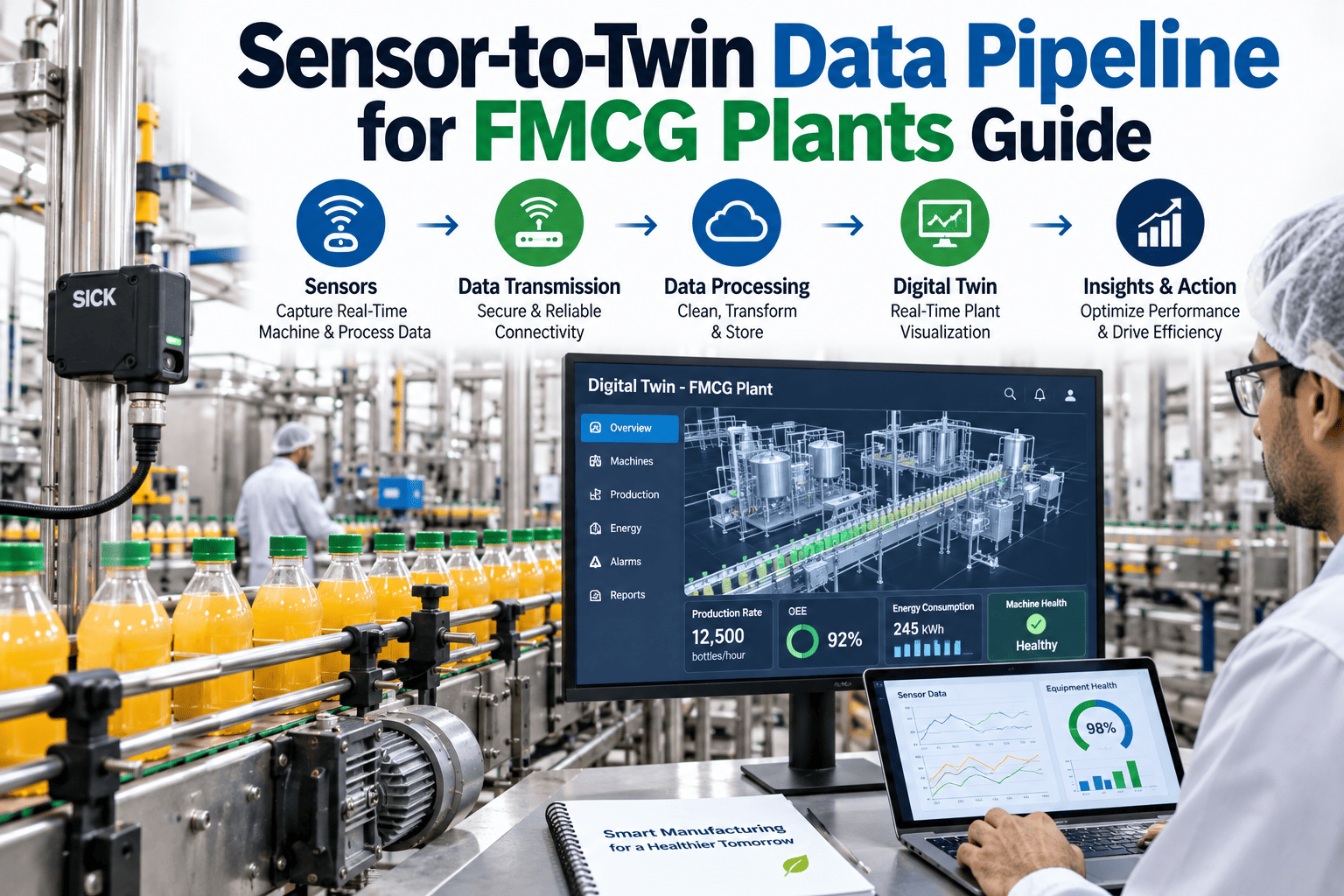
An FMCG plant's digital twin is only as good as the pipeline feeding it. A twin fed by data that's thirty seconds stale, or missing context because a sensor reading arrived without its equipment ID attached, doesn't model your plant — it models a plant that existed half a minute ago, which is a different plant during a filler changeover or a CIP cycle. The sensor-to-twin pipeline is the plumbing that decides whether the virtual model tracks the real production line in near real time or quietly drifts into fiction. Getting that plumbing right — the protocols, the edge processing, and the timestamp discipline — is what separates a twin used as a decision engine from one people stop trusting within a month. Teams mapping their own plant's sensor layer against a twin can walk through the pipeline design with iFactory AI's team.
Keep the Virtual Model Synchronised With Real Production State in Seconds
iFactory's Digital Twin connects to your existing MQTT, OPC-UA, and Modbus sensor infrastructure — no new hardware, no plant shutdown — and streams it through Kafka so the twin reflects the plant you actually have, not the plant from thirty seconds ago.
The Pipeline, End to End
A sensor-to-twin pipeline moves data through four distinct stages, each solving a different problem — from raw signal capture at the sensor to a synchronized state update inside the twin. Skipping or under-building any single stage is where most digital twin deployments quietly lose fidelity.
Temperature, pressure, flow, vibration, and vision sensors on filler, CIP, and packaging lines generate raw signals continuously.
MQTT, OPC-UA, and Modbus carry signals from PLCs and field devices to a gateway, using the protocol each device already speaks.
Filtering, normalization, and buffering happen close to the source, cutting the data volume before it ever leaves the plant network.
Kafka aggregates MQTT and OPC-UA sources into unified topics, feeding the twin, analytics, and AI models from one consistent stream.
The virtual model updates, its state converging with the physical line within the pipeline's defined synchronization window.
Why Three Protocols, Not One
FMCG plants rarely run one sensor standard end to end — a filler's PLC, a CIP skid's controller, and a vibration monitor on a conveyor motor often speak different languages by design. The pipeline has to meet each device where it is rather than forcing a single protocol across a heterogeneous floor.
Lightweight Edge Messaging
A publish-subscribe model built for constrained, bandwidth-limited networks — well suited to distributed edge devices sending frequent, small telemetry payloads.
Structured Machine Data
Gives structured, semantic access to machine-level data, integrating cleanly with PLCs and industrial controllers that already expose OPC-UA tags.
Legacy and Application Bridges
Modbus reaches older field devices already installed on the floor, while REST APIs connect the twin to MES, historian, and ERP systems above the sensor layer.
See Your Sensor Layer Mapped to a Live Twin
Book a 30-minute session and iFactory AI will walk through connecting your existing MQTT, OPC-UA, and Modbus infrastructure — no new hardware required.
Why Kafka Sits in the Middle
MQTT and OPC-UA are excellent at getting data off a device. Neither is designed to fan that data out reliably to a twin, an AI anomaly model, and a historian all at once, at scale, without one slow consumer stalling the others. That's the specific job Kafka does.
A topic-partitioning strategy — separating data by production line and signal type — keeps a busy vibration stream from crowding out a quieter temperature feed on the same broker, so every consumer gets what it needs without contention.
What Edge Processing Actually Does Before Data Leaves the Plant
Sending every raw signal straight to the cloud is slow and expensive. Edge processing does three specific jobs locally, close to the sensor, before anything travels further — and doing this well is what keeps the twin responsive instead of laggy.
Filtering
Noise and out-of-range readings get discarded at the source, so the twin isn't updated from a sensor glitch.
Normalization
Signals from different protocols and units get converted into a consistent schema before they reach the streaming layer.
Buffering
Short network interruptions don't lose data — readings queue locally and flush once connectivity returns.
Edge processing also cuts what actually needs to travel off the plant floor. Local filtering and aggregation reduce bandwidth substantially compared to streaming every raw reading, and in latency-sensitive cases — like a filler nozzle needing a decision inside 500 milliseconds — the processing has to happen locally because a round trip to a centralized server simply takes too long.
The Synchronization Question: How Fresh Is "Real Time"?
"Real time" gets used loosely. In an actual pipeline it means a specific, measurable window — and that window is a design decision, not an accident. Different parts of the system tolerate different amounts of lag.
| Layer | Typical Latency Target | Why It Matters at This Speed |
|---|---|---|
| Edge Node to Edge Node | Under 2 ms round-trip | Local failover and coordination between redundant edge devices |
| Sensor to Twin State | 1-second resolution | The baseline fidelity most FMCG twin deployments run at |
| Local Control Decisions | Under 500 ms | Nozzle, valve, or actuator response that can't wait on a cloud round trip |
| Configuration & State Drift Correction | ~30-second cadence | Periodic reconciliation that keeps twin and physical state converged |
A twin doesn't need every layer running at millisecond speed to be useful — it needs each layer running fast enough for the decision that layer supports, which is a deliberate architecture choice rather than a single blanket "real time" target.
The Timestamp Discipline That Keeps Twin and Physical Data From Diverging
A subtle but critical pipeline detail: physical sensor data and twin-generated data have to stay distinguishable, and every reading needs a timestamp and a device ID attached at the point of capture, not reconstructed later. Skip this and the twin can't reliably answer "what was the plant actually doing at 2:14pm" months after the fact.
Raw readings from real sensors, tagged with device ID and capture timestamp, routed to their own dedicated topic so they're never confused with simulated output.
Twin-generated state and predictions carry their own distinct label, kept in a parallel topic so analysts can compare simulated versus actual without cross-contamination.
A Composite Scenario: The Twin That Drifted Without Anyone Noticing
A beverage plant's digital twin had been running for several months, showing generally reasonable agreement with the physical filling line, and the operations team had grown comfortable trusting its what-if simulations for scheduling decisions.
A routine calibration check turned up a growing gap between predicted and actual fill weights on one line — not a sudden failure, but a slow drift that had been accumulating for weeks. The root cause traced back to a single vibration sensor on a capping head that had begun degrading gradually, producing readings that were technically within range but no longer representative of the head's real condition. Because the pipeline lacked a scheduled recalibration cadence, the twin's model had never been re-tuned against fresh production runs, and it had quietly kept trusting an increasingly unreliable input. Adding a quarterly recalibration check against live production data and flagging that specific sensor for early replacement closed the gap within two weeks.
Common Pipeline Failure Points
No Distinction Between Physical and Twin Data
Without separate, clearly labeled streams for real sensor data and twin-generated output, comparing predicted against actual becomes guesswork rather than a clean analysis.
Missing Recalibration Cadence
Equipment degrades, bearings wear, and sensors drift — a twin built once and never re-tuned against fresh production data will diverge from reality over time.
One Blanket Latency Target
Forcing every layer to millisecond speed wastes engineering effort where it isn't needed, while treating a control-critical layer the same as a dashboard update misses where speed actually matters.
No Edge Filtering Before the Cloud
Streaming every raw reading without local filtering and normalization drives up bandwidth cost and slows the whole pipeline down for no fidelity gain.
Is Your Sensor Layer Ready for a Twin?
Your existing sensors speak MQTT, OPC-UA, Modbus, or REST
Most FMCG plants already have this coverage between PLCs, historians, and IoT retrofits — the pipeline connects to what's there rather than requiring new hardware or a shutdown.
Your PLC/SCADA outputs, MES batch records, and ERP data all exist
A calibrated twin draws from all four sources together, and most modern food and beverage facilities already generate every one of them.
Someone owns the recalibration schedule, not just the initial build
A twin that's calibrated once at go-live and never revisited is the single most common way fidelity quietly erodes over the following year.
iFactory connects to the sensors, historian, and ERP you already have — no plant shutdown, no hardware replacement, no extended commissioning. The twin is calibrated against real production runs and stays synchronized through the same MQTT, OPC-UA, and Kafka pipeline described above.
Frequently Asked Questions
Do we need new sensors or hardware to feed a digital twin?
Usually not. A food or beverage plant digital twin typically integrates IoT sensors, PLC and SCADA outputs, MES batch records, and ERP data that already exist in most modern facilities, connecting through MQTT, OPC-UA, Modbus, and REST APIs without requiring new hardware, a plant shutdown, or an extended commissioning period. The pipeline is built to meet your existing sensor layer where it already is. iFactory AI's team can review your current sensor and protocol coverage to confirm what's already usable.
Why use Kafka instead of sending sensor data straight to the twin?
Kafka's publish-subscribe architecture lets multiple consumers — the twin, an AI anomaly model, and a historian — read from the same stream independently, without a slow consumer stalling the others or requiring separate point-to-point connections from every sensor to every destination system. Topic partitioning by production line and signal type keeps high-frequency streams like vibration data from crowding out lower-frequency ones like temperature on the same broker, which becomes essential once a plant has more than a handful of sensor sources feeding more than one downstream system.
How often does the twin need to be recalibrated?
Equipment degrades and sensors drift continuously, so periodic recalibration — commonly on a monthly or quarterly cadence — against fresh production data is what keeps a twin's model aligned with the physical plant's actual current condition rather than an assumption from when it was first built. A twin calibrated once and never revisited is the most common way fidelity erodes silently over time, since small drifts rarely trigger an obvious failure the way an outright sensor outage would. Book a demo to see how iFactory AI schedules and flags recalibration automatically.
What does "real-time" actually mean for a digital twin's sync speed?
It varies by layer rather than being a single fixed number. Most FMCG twin deployments run core sensor-to-twin synchronization at roughly 1-second resolution, while control-critical local decisions may need sub-500-millisecond response, and periodic state reconciliation between twin and physical system often runs on a slower cadence measured in tens of seconds. Matching the latency target to what each layer actually needs to support is a deliberate design choice, not a single blanket requirement applied everywhere.
How do we know if the twin has started drifting from reality?
The clearest signal is a widening gap between the twin's predictions and actual production outcomes on a metric you already track, such as fill weight, cycle time, or reject rate — a gap that grows gradually over weeks rather than appearing as a sudden failure. Keeping physical and twin-generated data in clearly separated, labeled streams makes this comparison straightforward to run on a schedule rather than something that only surfaces during an unrelated audit or complaint.
Build the Pipeline That Keeps Your Twin Honest
iFactory connects your existing MQTT, OPC-UA, and Modbus sensors through a Kafka-based pipeline that keeps the virtual model synchronised with real production state — with the recalibration discipline that keeps it that way. Book a walkthrough on data like yours.