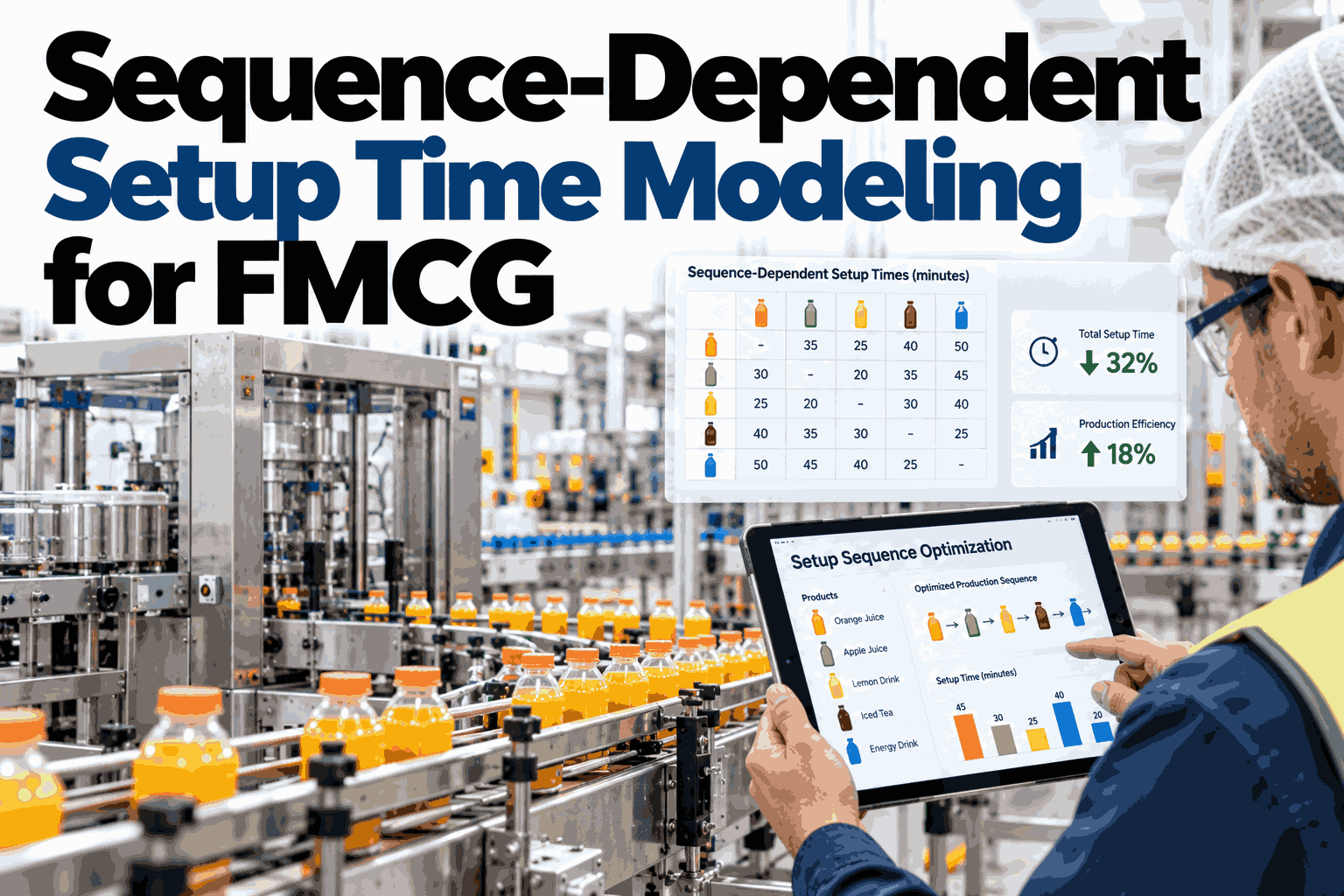
Most production schedules assume a changeover from Product A to Product B costs the same as B to A. On a real FMCG line that assumption is wrong in roughly half the cells of the matrix — light-to-dark runs shorter than dark-to-light, small-to-large formats often cost less than the reverse, and an allergen exit can take twice as long as the allergen entry. A scheduler that can't see that asymmetry will keep picking sequences that look fine on paper and cost hours on the floor. Teams ready to see their own changeover matrix modeled this way can talk to iFactory AI about scheduling with a real setup-time matrix.
The Changeover Matrix, Not a Flat Average, Drives the Schedule
iFactory AI's dynamic scheduler sequences orders against a real asymmetric setup-time matrix — allergen rules, color/format order, and measured transition minutes baked directly into the cost the scheduler optimizes against.
A Flat Changeover Average Hides the Real Cost
Most schedulers still treat every changeover as roughly equal, or scale a single average by product count. On a high-mix FMCG line, that assumption alone can be costing hours a week.
The Matrix Is the Document, Not the Dashboard
A changeover matrix sounds like a reporting artifact. On a well-run line it's closer to the single most useful planning document a scheduler owns — because every sequencing decision reduces to reading one cell of it.
Build Your Line's Own Transition Matrix
iFactory AI can walk through building a measured setup-time matrix from your own changeover logs. Get a scheduling demo on your own SKU mix.
Allergen Sequencing: The Asymmetry That Costs the Most
No single rule in the matrix carries more cost than the allergen entry-versus-exit split, and it's exactly the kind of asymmetry a flat-average scheduler can't represent at all.
Color and Format Order: Smaller Rules, Real Minutes
Beyond allergens, a handful of smaller, consistent asymmetries show up across most packaging and filling lines — small enough to ignore individually, costly enough in aggregate to matter.
Color order
Light-to-dark color transitions typically run a shorter clean than dark-to-light, because less residual color has to be flushed out.
Format order
Small-to-large format changes are often cheaper than large-to-small on many fillers, the reverse of what intuition suggests.
Promo and rush insertion
Inserting a promotional order by habit, between two unrelated runs, can add well over an hour versus slotting it at the front of an existing block.
Base-load wheels
A fixed repeating sequence for the 70-80% of volume that's predictable, with the matrix handling only the exceptions.
See the Allergen and Color-Order Rules in Your Own Sequence
Schedule a walkthrough and iFactory AI will show how these rules change your current week's sequence.
Why These Specific Rules, and Not a General Optimizer
A general-purpose scheduling optimizer can minimize total changeover time mathematically. It can't know, on its own, that an allergen exit has a food-safety implication a color change doesn't.
A Worked Comparison: Due-Date Order vs Matrix-Based Order
The difference between sequencing by due date and sequencing by the measured matrix isn't theoretical — it shows up directly in weekly changeover hours.
| Sequencing method | Changeovers | Total changeover time |
|---|---|---|
| Due-date order | 12 | ~7.6 hours |
| Matrix-based order | 9 | ~4.6 hours |
| Difference | -3 changeovers | ~3 hours recovered, same orders, same week |
Easy Savings First, Expensive Savings Last
Not all changeover-time recovery costs the same to capture. Sequencing a smarter order against an existing matrix is close to free; shortening the transitions themselves usually isn't.
Keeping the Matrix Current
A matrix built once and never revisited drifts out of date as fast as the floor changes — new SKUs, a retooled line, a different crew's habits all shift real transition times.
What Finite-Capacity Scheduling Adds on Top of the Matrix
A setup-time matrix tells the scheduler what a transition costs. Finite-capacity planning makes sure the resulting sequence actually fits the real hours, crews, and maintenance windows available.
A Composite Illustration: The Promo Order Nobody Resequenced
This is an illustrative composite, not a specific named plant, built to show how matrix-aware sequencing changes a real scheduling decision.
Getting Started Without Modeling Every SKU Pair at Once
Building a complete matrix for a 20-SKU line means over 300 directional transitions. Trying to measure all of them before scheduling anything is the wrong place to start.
Who Reads the Matrix, Day to Day
The setup-time matrix isn't a document for one role. Different people use it to answer different questions on the same underlying data.
Where iFactory AI Fits
A scheduler needs the real matrix, not a flat average, and it needs finite-capacity constraints layered on top of it. iFactory AI's dynamic scheduler builds both into the same optimization.
Measured Setup-Time Matrix
Every SKU-pair transition logged from real changeover data, asymmetric by direction.
Allergen & Color-Order Rules
Allergen blocking, color-order, and format-order rules enforced automatically in every sequence.
Finite-Capacity Planning
Crew hours and maintenance windows factored into the sequence, not assumed away.
Promo & Rush-Order Insertion
New orders slotted at the cheapest matrix-valid point, not wherever the due date happens to fit.
Turnkey AI, Live in 6-12 Weeks
iFactory AI ships as a complete hardware-and-software bundle — a pre-configured NVIDIA AI server, racked and ready, with software pre-loaded. Rack it, plug in power and Ethernet, and the AI is live. iFactory's team handles cabling, network setup, PLC/SCADA integration, operator training, and 24x7 remote monitoring.
Expert Review
This page's matrix figures and sequencing framework were reviewed for accuracy against published changeover-sequencing research before publication.
Frequently Asked Questions
Why does a changeover matrix need to be asymmetric rather than one shared number per SKU pair?
Because the physical cleaning and setup work is genuinely different depending on direction. A light-to-dark color change needs a shorter flush than dark-to-light, and entering an allergen format is typically much faster than the validated clean required to exit it. A matrix that assumes A→B costs the same as B→A is wrong in roughly half its cells, which is often enough to make an otherwise reasonable-looking sequence quietly expensive.
How does allergen sequencing actually reduce changeover time?
By grouping every allergen-containing SKU into one block during the week instead of scattering them across multiple days. The long, validated-clean exit transition then happens once per block rather than once per order, and that single block can be placed at a shift boundary or weekend window where the long clean costs the least in lost production time. Set up a walkthrough to see this logic applied to your own allergen SKUs.
Does matrix-based sequencing require a capital investment to see savings?
No — that's the point of capturing it first. Resequencing existing orders against a measured matrix is a planning change, not a hardware change, and published analysis suggests it can recover a meaningful share of weekly changeover time before any physical SMED or tooling project is funded. The more expensive savings, from actually shortening transitions, come later.
How is finite-capacity scheduling different from just having a good changeover matrix?
The matrix tells the scheduler what each transition costs. Finite-capacity planning makes sure the sequence the matrix suggests actually fits the real crew hours, shift patterns, and maintenance windows available that week — a cheap-on-paper sequence that collides with a planned maintenance window isn't actually usable, and finite-capacity logic is what catches that before it becomes a floor problem.
What's the fastest way to start building a setup-time matrix for a line that doesn't have one yet?
Most lines already have enough changeover log history to build an initial matrix from the last several weeks of transitions, starting with the SKU pairs that run most often. Reach out to iFactory AI's scheduling team and they can scope the initial matrix build against your own changeover records.
Schedule Against Your Real Setup-Time Matrix
iFactory AI's dynamic scheduler builds and sequences against a measured, asymmetric changeover matrix — allergen rules and format order included. Get a scheduling demo on your own SKU mix.