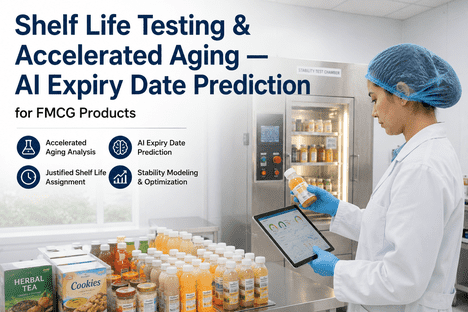
Every FMCG product carries an expiry date that represents a negotiated compromise between what the science supports, what the market demands, what the regulator requires, and what the supply chain can deliver. A typical shelf life assignment for a new FMCG product begins with a real-time stability study that runs for the intended shelf life duration — 9 to 24 months for most ambient-stable products — before a single unit ships to retail. The manufacturer either waits for the study to complete, delaying revenue by the full study duration, or launches with a conservative short-dated expiry based on early data, accepting that a 12-month shelf life instead of a scientifically justified 18-month shelf life may reduce retail distribution windows, increase markdowns on short-dated inventory, and shrink the addressable export market by limiting transit and warehousing time. The tension between waiting for complete stability data and launching with conservative assumptions costs FMCG manufacturers an estimated $4 billion to $7 billion annually in lost distribution, markdowns, and accelerated inventory turns. iFactory's AI-powered shelf life prediction platform changes this dynamic by combining accelerated aging data with machine learning models that predict real-time degradation trajectories, enabling manufacturers to assign justified shelf life with statistical confidence — not from conservative assumptions but from a predictive model that learns from every stability study the organisation has ever run.
Shelf Life Testing · Accelerated Aging AI · Expiry Prediction · FMCG Stability · Product Dating
$4-7 Billion Lost Annually to Conservative Shelf Life Assumptions. iFactory's AI Predicts Real Expiry — Not Worst-Case.
iFactory's AI shelf life prediction platform combines accelerated aging chamber data with machine learning degradation models to predict real-time product stability trajectories — enabling justified shelf life assignment with statistical confidence in weeks, not months.
$4-7B
Annual loss across FMCG from conservative shelf life assumptions — reduced distribution windows, retail markdowns on short-dated inventory, and restricted export market access
60-70%
Reduction in time-to-shelf-life-assignment using AI accelerated aging models compared to traditional real-time stability studies for ambient-stable products
30-50%
Increase in justified shelf life duration achieved by manufacturers using AI predictive modeling vs. traditional single-condition accelerated testing with linear extrapolation
85-92%
Accuracy of AI shelf life predictions validated against real-time stability study completions — enabling statistically confident assignment before traditional study endpoints
The Shelf Life Assignment Problem — Why Conservative Assumptions Cost More Than They Save
Shelf life is the single most consequential quality parameter for an FMCG product because it simultaneously determines consumer safety, regulatory compliance, retail acceptance, distribution economics, and brand reputation — yet it is typically assigned using methodologies that have not fundamentally changed in 40 years. A standard shelf life programme places product in a controlled environment chamber at a single accelerated condition — typically 40°C and 75% relative humidity — tests at predetermined intervals, and uses linear regression or Arrhenius modelling to estimate when a critical quality attribute will fall below the specification limit. The problem is that real-world degradation is not linear, Arrhenius models assume a single dominant reaction pathway that may not hold across temperature ranges, and the conservative bias built into every step of the process — choose the worst-case storage condition, apply a safety factor to the regression output, round down to the nearest month — systematically produces shelf life assignments that understate what the product can actually achieve. The result is a self-inflicted commercial penalty: shorter distribution radius, higher inventory write-offs, and restricted export potential, all justified by a methodology that was designed for safety but operates without any quantitative understanding of the probability distribution around the degradation prediction.
01
Linear Extrapolation Misses the Non-Linear Reality of Product Degradation
The traditional shelf life methodology assumes that the degradation rate measured during the accelerated study period continues at the same rate for the full intended shelf life. In practice, degradation kinetics are rarely linear. Oxidation reactions accelerate after antioxidant depletion. Moisture migration follows Fickian diffusion curves that change slope as the product approaches equilibrium. Microbial growth in preservative-limited systems follows lag-log-stationary phases that a single-rate model cannot capture. AI models trained on multi-condition accelerated data learn the actual shape of the degradation curve — including inflection points, threshold effects, and asymptotes — and produce shelf life predictions that reflect the real degradation trajectory rather than a straight-line approximation that systematically overestimates or underestimates stability at different points in the product life cycle.
02
Single-Condition Testing Cannot Predict Multi-Condition Reality
A product stored at 40°C and 75% RH in a stability chamber may degrade through a different mechanism than the same product stored at 25°C and 60% RH on a retail shelf or at 35°C and 80% RH during a monsoon-season ocean shipment. Arrhenius modelling assumes that the same reaction pathway dominates across all relevant temperature conditions, but this assumption fails for products with multiple degradation mechanisms — fat oxidation, enzymatic browning, moisture gain, vitamin loss — each with different activation energies that shift dominance across the temperature range. AI accelerated aging models learn from data collected at multiple temperature and humidity conditions simultaneously, identifying which degradation mechanism dominates at each condition and building a prediction surface rather than a single extrapolation line.
03
Conservative Safety Factors Have No Statistical Foundation
The standard industry practice of applying a safety factor to the extrapolated shelf life — dividing by 1.5 or subtracting a fixed percentage — is a rule of thumb with no statistical basis. It does not account for the variability in the degradation data, the uncertainty in the model parameters, or the probability that the product will remain within specification at any given time point. The safety factor is equally large whether the prediction is based on high-quality data from multiple batches and multiple conditions or on minimal data from a single batch at a single condition. AI shelf life prediction produces a probability distribution around each time point — the predicted value of each critical quality attribute plus a confidence interval that reflects the actual uncertainty in the data — so the shelf life assignment is based on the probability of remaining within specification at the intended expiry date, not on a fixed safety margin that treats all predictions as equally uncertain.
Accelerated Aging · Multi-Condition Modeling · Degradation Prediction · Statistical Confidence · Shelf Life
Linear Extrapolation and Safety Factors Are Guesswork. AI Predicts Your Product's Actual Degradation Curve.
iFactory's AI platform learns the true shape of your product's degradation curve from multi-condition accelerated data, predicts expiry dates with statistical confidence intervals, and eliminates the guesswork of safety factors that unnecessarily limit distribution.
The iFactory AI Shelf Life Prediction Platform — Four Capabilities That Transform FMCG Stability Testing
iFactory's shelf life prediction platform is purpose-built for the FMCG stability testing environment, where product portfolios are large, formulation changes are frequent, regulatory requirements vary by market, and the cost of a shelf life that is either too short or too long is measured in millions of dollars of lost revenue or recall risk. The platform delivers four integrated capabilities that together replace the linear-extrapolation-with-safety-factor methodology with a data-driven, probabilistic prediction engine that becomes more accurate with every stability study the organisation completes.
Multi-Condition Accelerated Aging Model
The platform ingests data from stability studies conducted at multiple temperature and humidity conditions simultaneously — typically 25°C/60% RH, 30°C/65% RH, 40°C/75% RH, and 50°C/80% RH — and trains a machine learning model that learns the degradation rate for each critical quality attribute at each condition. The model identifies which degradation mechanism dominates at each condition, detects changes in the rate-limiting mechanism as temperature increases, and produces a prediction surface that estimates the degradation trajectory for any time-temperature-humidity combination within the validated range. This surface replaces the single-condition linear extrapolation with a multi-dimensional prediction that accounts for the actual product behaviour across the environmental conditions it will encounter in distribution.
Probabilistic Shelf Life Assignment with Confidence Intervals
Instead of producing a single-point shelf life estimate with an arbitrary safety factor, the platform generates a probability distribution for each critical quality attribute — showing the likelihood that the product remains within specification at each time point. The quality manager selects the acceptable confidence level — for example, 95% probability that the attribute remains within specification at the assigned shelf life — and the platform returns the corresponding expiry date. This approach transforms shelf life assignment from a deterministic estimate with hidden uncertainty to a transparent decision supported by a statistically rigorous confidence statement that can be defended to regulators and retail partners.
Cross-Product Learning and Formulation Similarity Transfer
The platform's AI model learns from every stability study across the entire product portfolio, not just from the individual study being analysed. When a new product variant is developed with a formulation that is 80% similar to an existing product with a completed 18-month stability study, the platform transfers the degradation kinetics from the known product to the new variant and predicts the shelf life trajectory with dramatically reduced data requirements. This cross-product learning capability means that the platform's prediction accuracy improves continuously as the organisation accumulates stability data, and new product shelf life can be assigned in weeks rather than months by leveraging the degradation knowledge embedded in the existing product portfolio.
Real-Time Stability Tracking and Early Warning System
Once a shelf life is assigned and the product is in market, the platform continues to monitor real-time stability data from ongoing real-time studies and from returned product testing. If the degradation trajectory observed in real-time data deviates from the AI model's prediction — for example, a seasonal ingredient change causes faster-than-expected vitamin degradation — the platform generates an early warning and updates the shelf life prediction with the new data. This capability ensures that shelf life assignments are not static declarations made once at product launch but dynamic predictions that improve with every additional data point collected during the product's commercial life.
Implementation — Deploying AI Shelf Life Prediction in Your FMCG Stability Programme Within 90 Days
iFactory's shelf life prediction platform implementation follows a structured three-phase deployment designed to deliver statistically justified shelf life assignments within a single quarter. The platform integrates with existing laboratory information management systems, stability study scheduling tools, and regulatory documentation workflows — no replacement of current stability infrastructure is required.
Phase 1 · Days 1-30
Historical Data Ingestion, Model Training, and Baseline Validation
The first phase ingests all available historical stability study data — real-time and accelerated studies across product categories, formulations, packaging configurations, and storage conditions — into the platform's AI training pipeline. The model is trained on the complete historical dataset and validated by withholding a subset of completed studies and comparing the model's shelf life predictions against the actual study outcomes. The baseline validation establishes the prediction accuracy metrics that will be tracked through the deployment. Historical studies covering 3 to 5 years of stability data are typically integrated within the first two weeks, with model training and validation completed by day 30.
Historical stability data ingestion
Multi-condition model training
Baseline accuracy validation
Cross-product similarity mapping
Phase 2 · Days 31-60
Live Pilot on New Product Development Pipeline
The platform goes live on the active new product development pipeline. For each new product or formulation variant entering the stability programme, the platform generates an AI shelf life prediction using accelerated aging data as it becomes available — typically within 4 to 6 weeks of the study start date rather than waiting for the full real-time study duration. The predicted shelf life is compared against intermediate real-time data points to validate the model's forward accuracy. Quality managers use the platform's probabilistic assignment interface to set shelf life at the desired confidence level, with the platform documenting the statistical basis for regulatory submission and retail partner communication.
New product AI prediction pipeline
Accelerated data integration
Intermediate validation check
Probabilistic shelf life assignment
Phase 3 · Days 61-90
Portfolio-Wide Rollout and Continuous Learning Loop
Based on pilot validation results, the platform is deployed across the full product portfolio. All new stability studies — accelerated and real-time — are managed through the platform's prediction engine. Existing products with previously assigned shelf life are reviewed through the AI model to identify opportunities for shelf life extension based on the accumulated stability data. The platform's continuous learning loop ensures that every completed study improves the prediction accuracy for future products, and the real-time stability tracking module monitors in-market products for degradation trajectory deviations. Regulatory documentation packages are generated automatically from the platform's probabilistic shelf life assignment and supporting data visualizations.
Full portfolio deployment
Existing product shelf life review
Continuous learning loop activation
Regulatory documentation generation
"
I spent 14 years managing shelf life programmes the traditional way — place product in a 40°C chamber, test every four weeks, plot the data, draw a straight line, divide by 1.5, round down, and call it a shelf life. Every product launch meant a 12- to 18-month wait for full stability data, or a launch with a conservative date that our sales team knew was costing us distribution points. When we deployed iFactory's AI prediction platform on our ambient snack portfolio, the model trained on 47 completed stability studies from the previous five years and predicted shelf life trajectories for new products within six weeks of accelerated data collection. The first validation came when a product that our traditional method assigned 9 months of shelf life was predicted by the AI model to achieve 14 months with 94% probability. The real-time study completed at 14 months confirmed the product was still within specification on all critical attributes. We extended 23 products in the first year, adding an average of 4.2 months of justified shelf life per product. The revenue impact from extended distribution reach and reduced inventory markdowns was $3.8 million in the first year.
— Quality Manager, Multi-Category FMCG Manufacturer — Ambient, Chilled, and Frozen Product Portfolio
Conclusion
Shelf life is the most commercially consequential quality parameter for every FMCG product, yet the methodology used to assign it has not evolved to take advantage of the data, computing power, and machine learning algorithms that are routinely applied to every other aspect of product development and supply chain optimisation. The gap between the shelf life that a product can actually achieve and the shelf life that is assigned by conservative linear extrapolation with arbitrary safety factors represents billions of dollars in lost FMCG revenue every year — revenue that is left on the table not because the product degrades faster than expected but because the prediction methodology systematically underestimates stability.
iFactory's AI shelf life prediction platform closes this gap by replacing linear extrapolation with multi-condition machine learning models, replacing arbitrary safety factors with statistically rigorous confidence intervals, and replacing single-product analysis with cross-product learning that makes every new stability study more valuable than the last. With typical results including a 60% to 70% reduction in time-to-shelf-life-assignment, a 30% to 50% increase in justified shelf life duration, and a prediction accuracy of 85% to 92% validated against completed real-time studies, the question for FMCG quality leaders is not whether AI shelf life prediction works — it is whether the organisation is ready to stop treating shelf life as a static regulatory requirement and start managing it as a dynamic, data-driven competitive advantage. Book a Demo to see how iFactory's AI platform would predict shelf life for your highest-volume product categories using your existing accelerated stability data.
Frequently Asked Questions
$4-7 Billion Lost to Conservative Shelf Life. AI Predicts What Your Product Can Actually Achieve.
iFactory's AI shelf life prediction platform replaces linear extrapolation and arbitrary safety factors with multi-condition machine learning, probabilistic confidence intervals, and cross-product learning — delivering justified shelf life assignments in weeks instead of months.