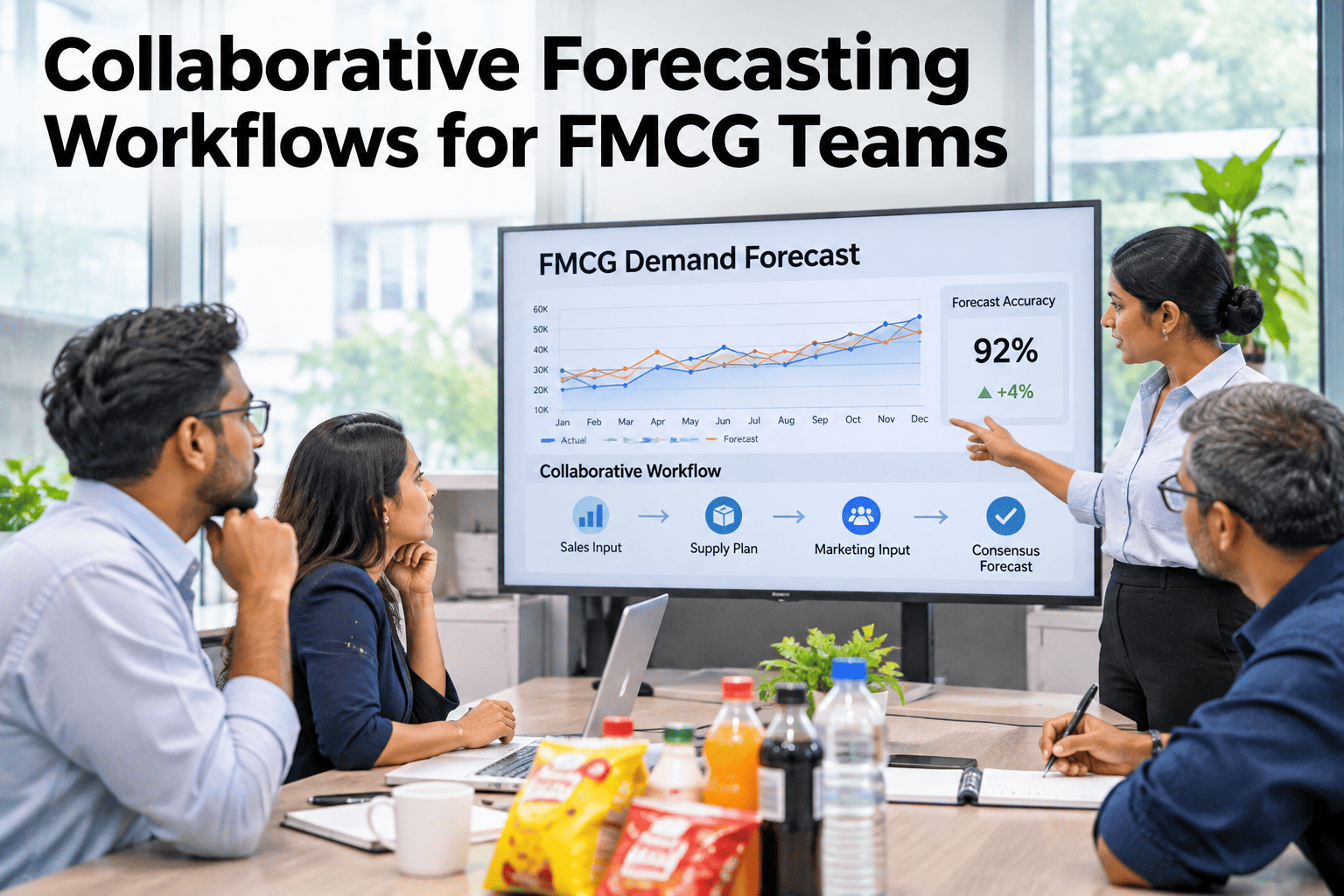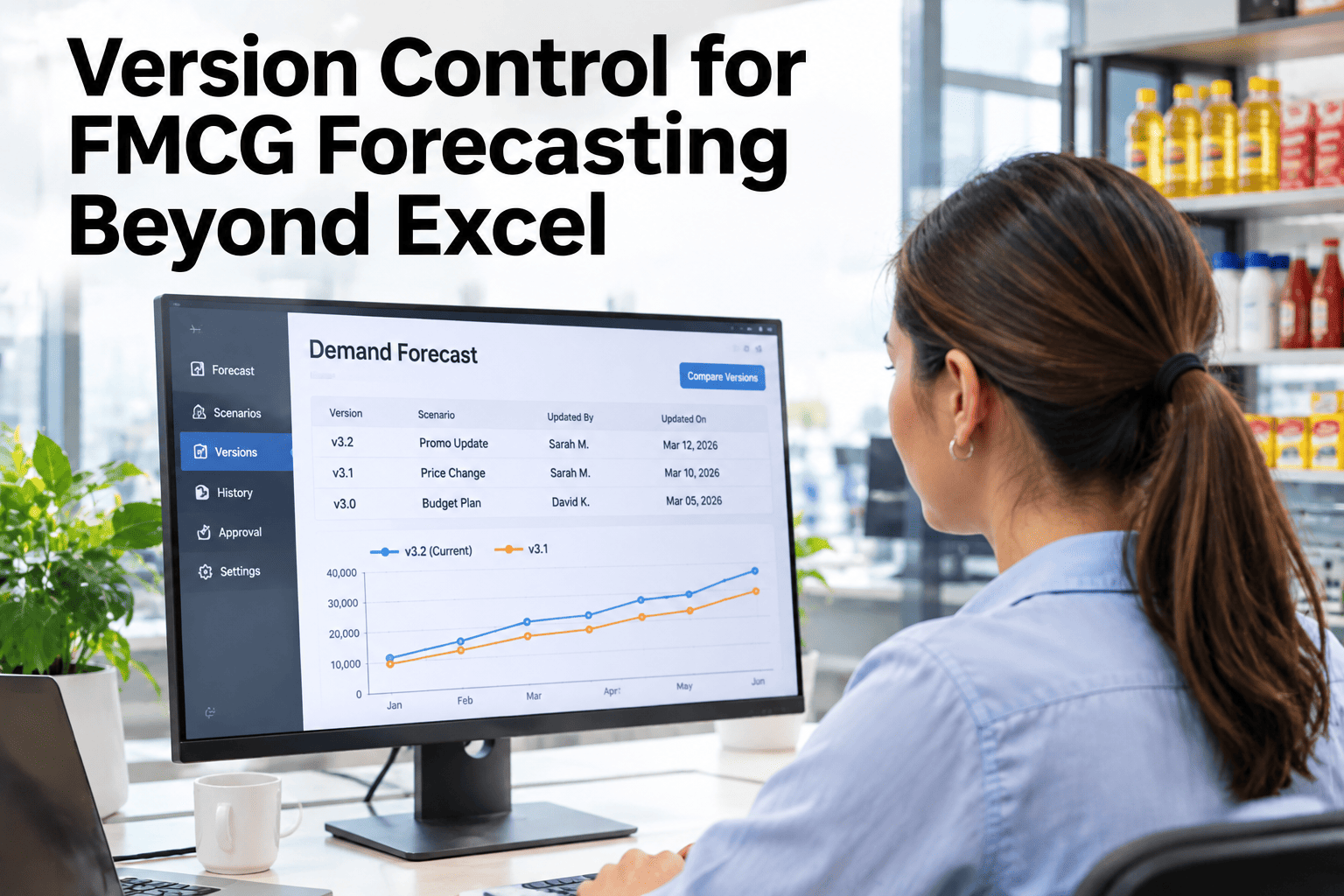
A collaborative forecasting workflow for an FMCG team starts from one statistical baseline and lets sales, marketing, supply and finance add structured input in the same system, instead of emailing spreadsheets around. Each input is recorded, challenged and measured, because manual adjustments are not always an improvement: a 2025 study found they improved bias and accuracy for only just over half of SKUs. The aim is a consensus number that everyone can trace back to its inputs. Demand teams can watch a consensus cycle run on their own SKUs in a short session.
Four Teams, One Baseline, and a Consensus Nobody Has to Email
iFactory AI, an on-premise industrial AI platform, gathers sales, marketing, supply and finance input in one place and shows which inputs actually improve the number.
What Is Collaborative Forecasting for FMCG Teams?
It is a shared process where each function contributes what it knows, inside one record. Research shows why the process needs measuring, not just meetings.
Who Contributes What to the Forecast?
Each team brings real knowledge and a typical bias. Naming both makes the process fairer. Teams can ask for a contribution matrix to adapt to their roles.
| Team | Brings | Typical Bias to Watch |
|---|---|---|
| Sales | Account plans, orders and retailer news | Cautious numbers to protect targets (John Galt) |
| Marketing | Promotions, launches and media plans | Optimism on new products (John Galt) |
| Supply | Capacity, constraints and lead times | Plans to what is easy to make |
| Finance | Budget and margin targets | Pulling the forecast toward budget |
What Does a Four-Week Consensus Cycle Look Like?
A fixed rhythm stops the process drifting into endless meetings, and it gives every team the same deadline for input. This is an example cycle to adapt to your own planning window and lock date.
Replace the Email Chain With One Shared Forecast
Share how your teams submit input today. iFactory AI's team will map a consensus cycle with roles, evidence rules and a clear lock date.
Which Inputs Add Value and Which Add Noise?
Forecast value added measures whether each step lowered error. The columns show an illustrative error index, where lower is better. Note that one step makes it worse.
100
78
74
84
76
How Should an Override Be Entered?
A structured entry makes every input comparable. Six fields cover it, and the size of the change should be judged against how noisy the item normally is (MIT CTL, 2018).
How Do You Settle a Disagreement?
Use a ladder so debates end in evidence, not volume. Teams can see a disagreement ladder in a live cycle with our team.
How Do You Track Bias by Team Over Time?
Track the direction of each team's adjustments, not only the size. A steady lean one way is a bias to coach, and it can be corrected over time (John Galt).
| Signal | What It Suggests | Action |
|---|---|---|
| Always adjusts upward | Optimism bias | Review launch and promotion assumptions |
| Always adjusts downward | Caution bias | Separate targets from forecasts |
| Large, rare changes | Event-driven input | Require evidence for each |
| Many small changes | Noise | Raise the threshold for entry |
How Do You Handle New Launches and Promotions?
These are the items where human knowledge matters most and bias is strongest, so they deserve their own rules.
What Should the Consensus Meeting Cover?
A short agenda keeps the meeting on decisions. Teams can request a meeting agenda template to adapt to their cycle.
Which Mistakes Break a Collaborative Process?
Where Does iFactory AI Fit in Collaborative Forecasting?
iFactory, an on-premise AI platform for manufacturing, links the shared forecast to the daily replan, so the plant sees the agreed number.
Expert Review: Judging a Consensus Process
Frequently Asked Questions
What is collaborative forecasting in FMCG?
It is a shared process where sales, marketing, supply and finance add structured input to a statistical baseline, producing one consensus forecast with a visible trail. It replaces spreadsheets passed by email. See the process on your own SKUs in a short demo.
Do manual adjustments improve forecast accuracy?
Not always. One study found adjustments improved bias and accuracy for only just over half of SKUs, and positive adjustments were more likely to worsen performance (Fildes, Goodwin and De Baets, 2025). Measure your own value added with our team.
How do we stop sales and marketing bias in the forecast?
Record every adjustment with a reason, track its direction by team, and feed the pattern back so the habit changes over time (John Galt). Keep targets separate from forecasts. Ask support for a bias report layout to adapt.
How often should the consensus meeting run?
Most FMCG teams run it monthly with weekly checks on key items, but the right rhythm follows your planning window. Review only contested items, so the meeting stays short. Design your cycle with our planners.
Does iFactory AI replace our planners?
No. Planners and function heads still decide. iFactory AI holds the shared forecast, records every input and shows which ones add value. See how it supports a planner in a walkthrough.
Build One Forecast Every Team Can Trace
See iFactory AI gather sales, marketing, supply and finance input and show which adds value. Book a walkthrough using your own SKUs and calendar.