The most expensive week in any FMCG line startup is rarely the installation itself, it's the week after, when mechanical, electrical, and controls teams discover their systems don't agree with each other in ways nobody caught on paper. A conveyor timing sequence that looked fine in isolation conflicts with a robot cycle it was never tested against, a sensor mapped to the wrong I/O point stalls the whole line, and every one of these surfaces only once real equipment is bolted down and powered up. Virtual commissioning exists specifically to move that discovery process earlier, into a simulated environment where a wrong wiring assumption costs an afternoon of debugging instead of a stalled line and a room full of people waiting for it to restart.
Find The Integration Problems Before The Equipment Is Even Installed
Virtual commissioning simulates the full mechanical, electrical, and control handoff of a production line before a single bolt is turned, cutting startup timelines and catching the exact class of error that normally surfaces during a live, high-pressure startup week.
Three Systems Have To Agree Perfectly, And They're Usually Designed Separately
A production line startup requires mechanical design, electrical wiring, and PLC control logic to work together flawlessly the first time real power flows through the system. In most projects, these three disciplines are designed in parallel by different teams working from the same specification but rarely testing against each other's actual output until installation. The mechanical team assumes a certain sensor response time, the electrical team wires based on a drawing that hasn't been updated in three revisions, and the controls team writes logic against an I/O map that shifted after the panel was already built. None of these gaps are visible on paper, because paper doesn't run. They only become visible once actual current flows and actual motion happens, which is exactly the moment a delay is most expensive, since the whole startup crew is standing on the floor waiting on the outcome.
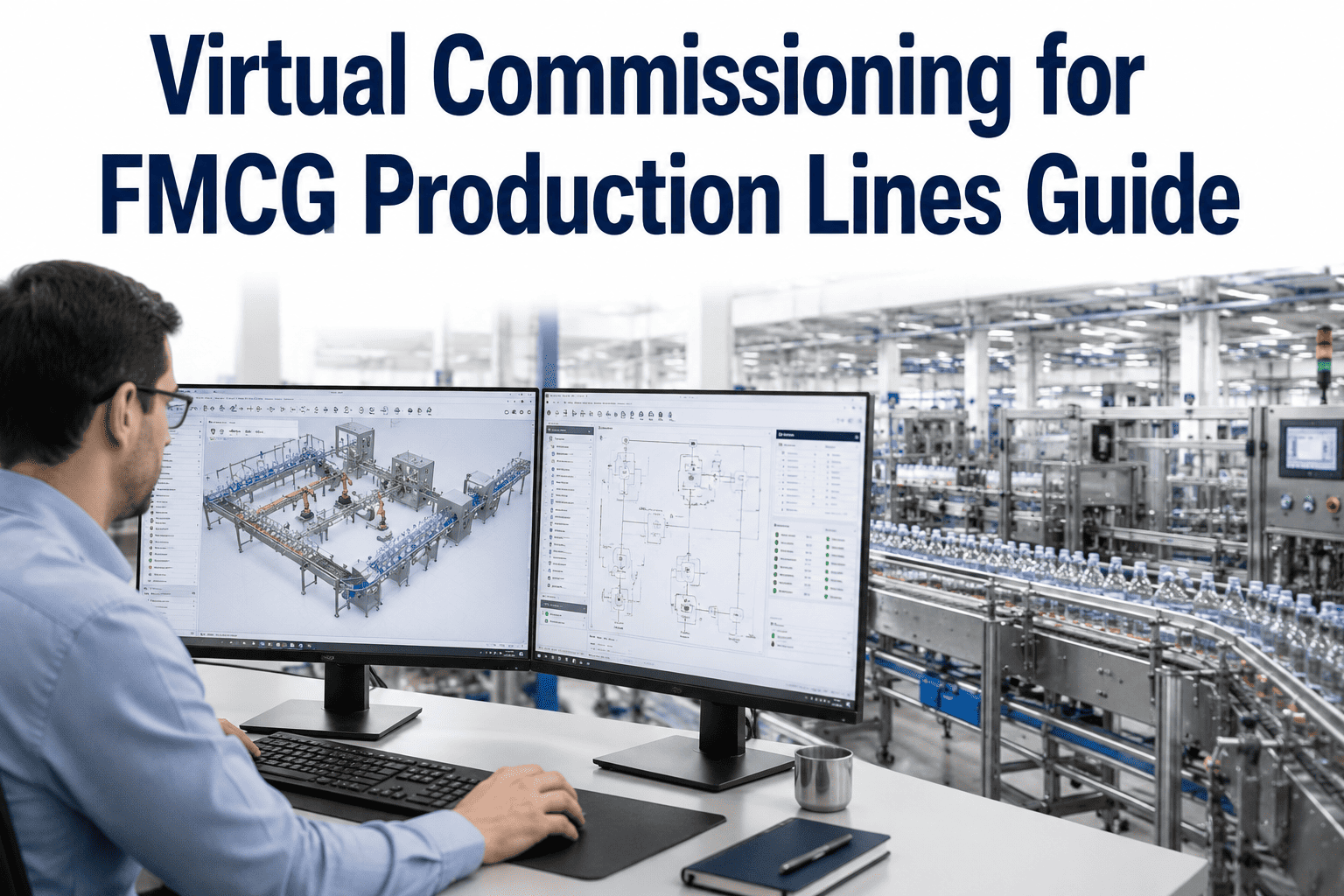
Virtual commissioning closes this gap by giving the control logic a realistic, physics-based virtual line to run against well before the real one exists, so integration errors surface in a simulation environment where fixing them costs a code change, not a stalled shift.
How A Virtual Commissioning Project Actually Moves Through Its Phases
Model The Mechanical System
A physics-accurate model of conveyors, actuators, and end-of-arm tooling is built from CAD data, capturing real motion behavior rather than static geometry.
Connect The Real Control Logic
The actual PLC program, not a placeholder, is connected to the virtual model, so the exact code that will run the real line is what gets tested.
Run Full Cycle Sequences Virtually
Normal production cycles, changeovers, and fault conditions are all run against the virtual line to expose timing and logic mismatches early.
Fix Issues In Code, Not On The Floor
Every mismatch found gets corrected in the control logic or mechanical model directly, before physical installation locks anything in place.
Validate Against The Physical Install
Once equipment arrives, the pre-tested control logic is loaded against the real line, with most integration risk already retired.
Your Startup Week Doesn't Have To Be A Debugging Marathon
iFactory builds a physics-accurate virtual model of your line and connects it directly to your real control logic, so integration errors get caught and fixed weeks before installation instead of during a live, high-pressure startup.
Where Virtual Commissioning Projects Lose Their Value If Done Carelessly
Testing Against Placeholder Logic
Running simulation against generic or simplified control code instead of the actual PLC program means the validation doesn't transfer to the real install.
Skipping Fault And Edge Cases
Only simulating the happy path leaves exactly the scenarios most likely to cause real downtime completely untested.
Ignoring Mechanical Tolerances
A model built with idealized geometry misses interference issues that real manufacturing tolerances introduce on the actual equipment.
Treating It As A One-Time Project
Commissioning value compounds when the same model is reused for future changeovers and line modifications, not discarded after one startup.
The Financial Reality Of Unvalidated Line Startups In FMCG
Unplanned downtime during commissioning is one of the most expensive categories of production loss because it typically involves the highest concentration of specialized labor on site at once, mechanical technicians, electrical engineers, controls programmers, and often vendor representatives, all billing simultaneously while the line sits idle. A single day of stalled commissioning on a mid-size FMCG line frequently costs tens of thousands of dollars once labor, lost production capacity, and schedule cascade effects on downstream teams are accounted for. Multiply a handful of these stalled days, which is common on a line with any meaningful mechanical or controls complexity, and the cost of an unvalidated startup routinely exceeds what a virtual commissioning process would have cost to run beforehand.
| Startup Approach | Typical Integration Errors Found | When They're Found |
|---|---|---|
| Traditional physical-only | Discovered live | During installation, highest cost |
| Partial simulation | Some caught early | Mixed, gaps remain |
| Full virtual commissioning | Most caught pre-install | Weeks before equipment arrives |
Why This Also Fixes A Communication Problem, Not Just A Technical One
Mechanical, electrical, and controls teams frequently work from the same specification document but interpret ambiguous details differently, and those interpretation gaps are a major source of integration errors that have nothing to do with any individual team's competence. A shared virtual model gives every discipline the same reference point to test against, which surfaces disagreements about expected behavior during the simulation phase, when a conversation resolves it, rather than during installation, when a physical rework resolves it. Plants that have adopted virtual commissioning consistently report that the process improves cross-team communication as much as it improves technical outcomes, since everyone is now debugging against the same virtual reality instead of their own separate assumptions about how the line should behave.
Questions FMCG Engineering Teams Ask Before Starting Virtual Commissioning
Retire Your Integration Risk Before Equipment Ever Arrives
See how iFactory connects your real control logic to a physics-accurate virtual model of your line, catching the errors that normally cost you a stalled startup week.