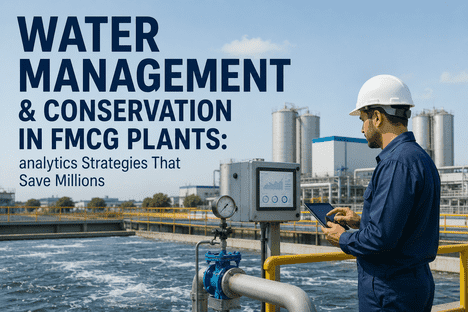
Food and beverage manufacturing is among the most water-intensive industries in the industrial sector. A typical FMCG facility processing fruits, vegetables, dairy, or packaged foods consumes between 2 and 8 liters of water per liter of product — with cleaning and sanitation accounting for 30 to 50 percent of total plant water use. Cooling towers, boiler feed, product washing, and facility hygiene collectively drive water withdrawal volumes that strain local watersheds and inflate operating budgets. For a mid-size FMCG plant processing 500,000 liters of product daily, a 25 percent reduction in water intensity translates to approximately 90 million liters saved annually and $280,000 in combined water procurement, pretreatment, and wastewater discharge costs. iFactory AI's water analytics platform addresses the fundamental challenge of FMCG water conservation: you cannot reduce what you do not measure. By deploying smart meters, AI-driven leak detection, CIP optimization algorithms, and real-time water balance dashboards, FMCG plants achieve sustainable water reduction without compromising food safety, production throughput, or regulatory compliance.
Water Conservation Strategies for FMCG Manufacturing
iFactory AI's water analytics platform reduces FMCG plant water consumption by up to 35% through real-time monitoring, AI leak detection, CIP optimization, and cooling tower intelligence.
The Water Cost Problem in FMCG Manufacturing
Water in FMCG manufacturing is simultaneously a procurement cost, a heating and cooling energy cost, a wastewater treatment cost, and an increasingly constrained regulatory resource. Plants operating in water-stressed regions face tightening withdrawal permits, rising municipal water rates, and discharge compliance costs that compound annually. Beyond direct costs, water consumption correlates with energy use — every liter of hot water for CIP represents embedded natural gas or steam energy, and every liter of cooling tower blowdown represents treated water discharged before its full thermal capacity is utilized. The following baseline metrics represent the water performance of a typical FMCG plant before deploying iFactory AI's water conservation analytics program.
Water Conservation Implementation Methodology
iFactory AI's water conservation deployment model follows a structured four-phase approach that moves from baseline measurement to continuous optimization. Each phase delivers measurable water savings that compound as the program matures across the plant.
Ready to audit your FMCG plant's water consumption? Book a Demo for a comprehensive water assessment and savings projection.
Water Savings ROI: Real FMCG Plant Results
The following savings breakdown represents documented results from FMCG plants that completed iFactory AI's 12-month water conservation program. Total annual savings averaged $280,000 per mid-size plant with full program cost recovered within 8 months of deployment.
| Conservation Initiative | Annual Water Savings | Annual Cost Savings |
|---|---|---|
| AI-Powered Leak Detection & Repair | 18.2 million liters | $54,000 |
| CIP Cycle Optimization | 31.5 million liters | $89,000 |
| Cooling Tower Cycle Increase (3.2 to 6.8) | 22.8 million liters | $61,000 |
| Condensate Recovery & Reuse | 11.4 million liters | $34,000 |
| Final Rinse Recovery for Pre-Rinse Reuse | 6.3 million liters | $19,000 |
| Reduced Wastewater Treatment Volume | (embedded in above) | $23,000 |
| Total Annual Impact | 90.2 million liters | $280,000 |
iFactory AI Water Conservation Platform Capabilities
Four integrated platform modules deliver the measurement, detection, optimization, and reporting capabilities that FMCG plants need to achieve sustained water reduction across all production and facility processes.
Real-Time Water Monitoring & Balance Dashboard
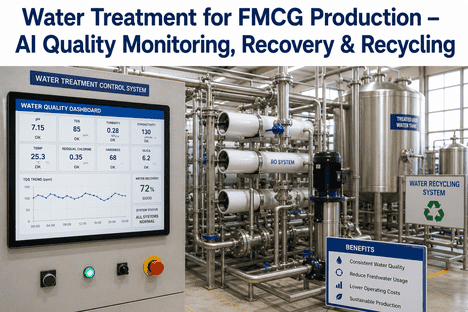
Smart meters at every sub-process point feed a live water balance dashboard showing consumption by zone, line, and shift. Automated water intensity calculations (L/L product) update in real time. Anomaly alerts flag deviations exceeding configurable thresholds — enabling immediate response to leaks and equipment malfunctions.
AI Leak Detection & Predictive Alerts
Machine learning models trained on plant-specific flow patterns detect leaks as small as 0.5 liters per minute — the equivalent of a dripping valve or a faulty seal. The platform distinguishes between planned process water use and anomalous consumption, generating prioritized repair tickets with estimated leak volume and cost impact.
CIP Optimization Engine
The AI-driven CIP module analyzes flow rate, temperature profile, conductivity, and chemical concentration across every wash cycle. It identifies opportunities to reduce rinse duration by 15-25%, recover final rinse water for the next pre-rinse cycle, and optimize detergent dosing. All optimization decisions are validated against microbial and allergen clearance requirements.
Sustainability Compliance & Reporting
Automated sustainability reports document water withdrawal, consumption, recycling, and discharge volumes per reporting period. Reports align with CDP, GRI, and SASB water reporting frameworks. Historical trend data supports regulatory permit renewal applications and corporate sustainability goal tracking with auditable data provenance.
Expert View: Water Conservation in FMCG Manufacturing
"The FMCG industry has made significant progress in water efficiency over the past decade, but most plants still operate with blind spots. They measure water at the plant inlet and the discharge point, but have no visibility into where water is being consumed between those two points. That lack of sub-process metering is the single biggest barrier to water conservation. iFactory AI's approach of deploying smart meters at every CIP skid, cooling tower, and process washing station creates the granular visibility needed to identify the 10 to 15 percent of water that is literally leaking away unnoticed. The AI leak detection capability is particularly important for FMCG plants, where a leaking valve in a hard-to-access area behind a processing tank can run for months before it is discovered. When that leak detection is paired with CIP optimization — which is where 30 to 50 percent of plant water goes — the combined savings of 25 to 35 percent are not aspirational. They are achievable within a single annual budget cycle."
Frequently Asked Questions
Conclusion
Water conservation in FMCG manufacturing is not primarily a technology challenge — it is a measurement and visibility challenge. Plants that cannot see where every liter of water is being consumed cannot identify the 15 to 25 percent that is wasted through leaks, oversized CIP cycles, inefficient cooling tower operation, and untapped reuse opportunities. iFactory AI's water analytics platform provides the measurement infrastructure, AI detection capabilities, and process optimization tools that FMCG plants need to achieve sustainable water reduction without compromising food safety or production efficiency.
The water savings are measurable, the payback is proven, and the technology is ready for your facility. Book a Demo to discuss your FMCG plant's water conservation program with iFactory AI's water analytics team.
Start Your Water Conservation Program Today
iFactory AI helps FMCG manufacturers reduce water consumption, lower operating costs, and meet sustainability targets with AI-powered water analytics and process optimization.