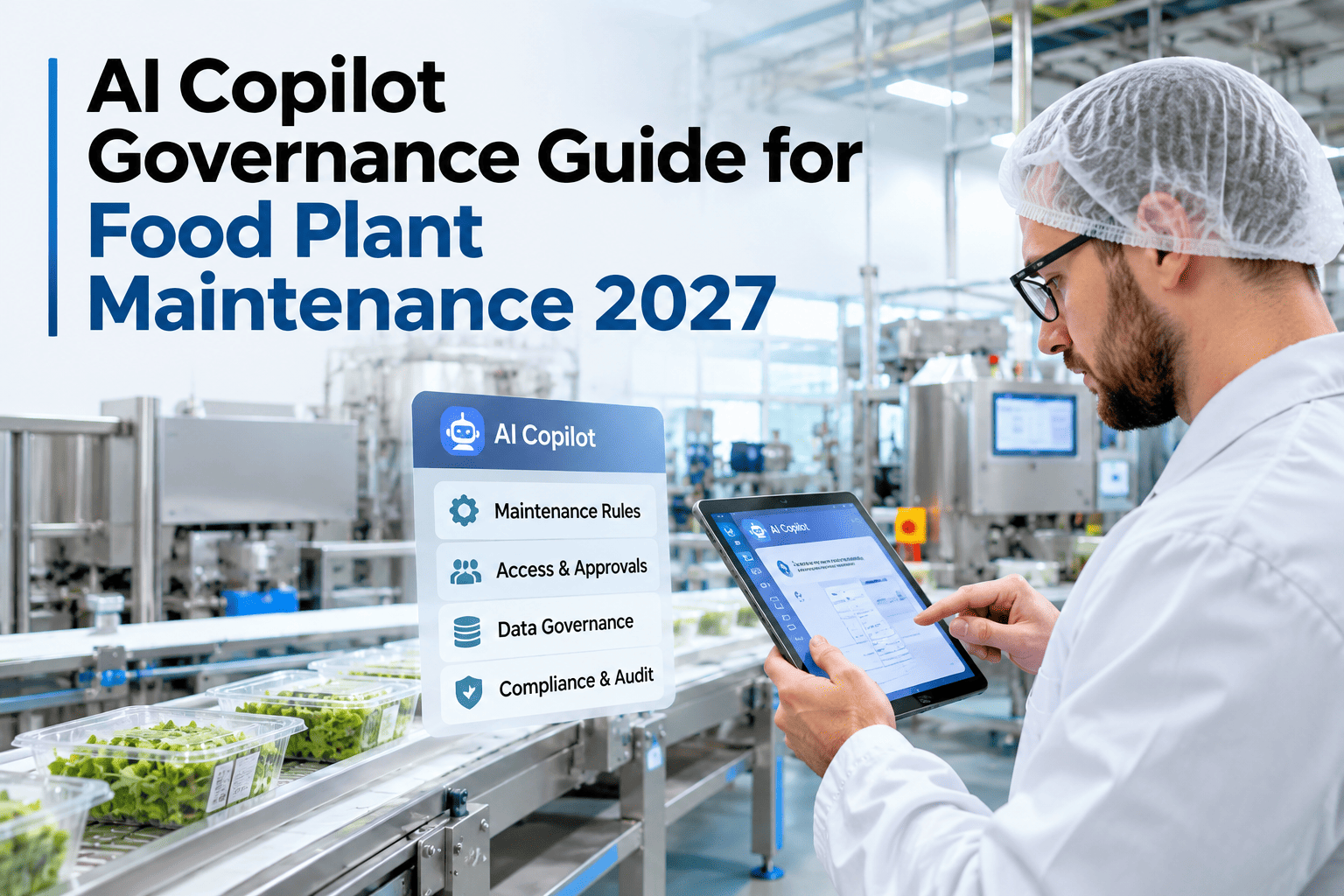
An AI copilot in a food plant maintenance environment is not just a productivity tool — it is a system that generates guidance that technicians act on, in a setting where acting on wrong guidance can mean a contamination event, a CCP deviation, or a failed SQF audit. The governance question for food plant AI is not "does it work?" but "how do we know when it is wrong, how do we stop it from causing harm, and how do we prove to an auditor that the system was under appropriate control?" These are answerable questions, and iFactory AI, an on-premise AI platform for food manufacturing, is built with specific architecture to answer them. Teams that want to understand the governance framework before committing to a deployment can review the governance model with iFactory AI's food plant team.
Build AI Into Food Plant Maintenance With Grounding Rules, Hallucination Guardrails, and an SQF-Defensible Audit Trail
iFactory AI, an on-premise AI platform for food manufacturing, implements five governance layers — source grounding, confidence thresholds, human override, audit logging, and continuous correction — so every AI recommendation is traceable, challengeable, and defensible under food safety audit.
What Is AI Hallucination and Why It Matters in Food Manufacturing
AI hallucination occurs when a large language model generates a response that is plausible-sounding but factually incorrect, unsupported by its source data, or invented from patterns in training data rather than from documented facts. In a general-purpose AI tool, hallucination is an inconvenience. In a food plant maintenance context, a hallucinated SOP step, an incorrect torque value, or a fabricated food-grade lubricant approval could result in a maintenance error with direct food safety consequences.
Source Grounding: How iFactory AI Prevents Fabricated Answers
Source grounding means the AI copilot answers only from documented sources — your CMMS work order history, your SOPs, your approved parts register, your equipment manuals — and cites the source for every factual statement it makes. When a question cannot be answered from these sources, the AI states that explicitly rather than generating a plausible-sounding response from general training data.
Teams preparing for SQF or BRC audits that want to demonstrate how grounding prevents non-compliant guidance can review the source citation format for your specific certification requirements.
Deploy AI in Your Food Plant With Governance Built In, Not Bolted On
iFactory AI's governance framework is configured before go-live — grounding rules, confidence thresholds, audit log structure, and correction workflows — so your AI is auditable from day one.
The AI Audit Trail: What SQF and BRC Auditors Need to See
When an auditor asks "how is AI being used in your maintenance programme?" they need to see that every AI interaction is logged, that the source of every AI recommendation is documented, that human confirmation occurred before action was taken, and that there is a correction mechanism for wrong answers. iFactory AI's audit trail satisfies all four requirements.
| Audit requirement | What the iFactory AI audit trail provides | Audit log field |
|---|---|---|
| Interaction log | Every query and response logged with technician ID, timestamp, and session ID | query_text, response_text, user_id, timestamp |
| Source citation | Every factual statement in a response tagged with the source document and version | source_ref, doc_version, doc_last_reviewed |
| Human confirmation | Technician confirmation action logged before any CMMS write occurs | confirmed_by, confirmation_timestamp |
| Correction record | Flagged incorrect responses logged with reviewer ID, correction applied, and date | flag_by, flag_reason, correction, corrected_by, corrected_date |
Confidence Thresholds: When the AI Says "I'm Not Sure"
The most important governance behaviour an AI copilot can have is knowing when to escalate rather than answer. iFactory AI's confidence threshold system assigns a confidence score to every response based on source match quality, recency of relevant data, and consistency with similar past cases. Responses below the threshold are presented differently.
Teams that want to configure confidence thresholds to match their plant's risk tolerance can ask iFactory AI's support team about threshold calibration for food manufacturing applications.
Frequently Asked Questions
How does iFactory AI prevent the AI from using its general training data instead of our plant's data?
iFactory AI implements Retrieval-Augmented Generation (RAG) architecture — when a technician asks a question, the system first retrieves relevant documents from your plant's indexed knowledge base, then generates a response grounded in those documents. If the retrieval returns no relevant documents above the confidence threshold, the AI responds with its escalation message rather than drawing on general training data. The AI is not permitted to combine your plant's documents with general web or training knowledge — it must source every factual statement from your indexed content. See the RAG architecture explained in a governance walkthrough.
What happens when a technician acts on AI guidance that turns out to be wrong?
The incident triggers the correction workflow: the wrong guidance is flagged in the audit log, reviewed by the maintenance manager and QA team, the source document is checked, and the knowledge base entry is corrected so the same guidance cannot be generated again. If the wrong guidance had food safety implications, the standard non-conformance procedure is followed — with the AI audit trail as documentary evidence of the guidance given and the action taken. The human confirmation step means the technician (not the AI) made the final decision — which is both the correct governance principle and the correct audit position. Ask the support team about the incident correction workflow and food safety escalation procedure.
How is the AI audit trail stored and for how long?
The AI interaction audit trail is stored on the iFactory AI on-premise server and is accessible to authorised users (maintenance manager, QA team, auditors) through the management dashboard. Retention period is configurable — most food plants align it with their CMMS work order retention policy, typically 2–5 years. The trail can be exported in CSV or PDF format for inclusion in SQF, BRC, or FDA audit packages. Because the trail is on-premise, there is no dependency on a cloud provider's data retention policies. Review the audit trail format and export options with iFactory AI's food plant team.
Does the AI governance framework require significant ongoing management?
The core governance framework is configured at deployment and runs automatically — grounding rules, confidence thresholds, human override requirements, and audit logging are all automated. Ongoing management involves a monthly review of flagged low-confidence queries (to identify knowledge gaps) and periodic knowledge base updates as SOPs and equipment change. iFactory AI's support team provides a governance health dashboard that surfaces these items without requiring daily management attention. Most food plants allocate 2–4 hours per month to AI governance review. Ask about the governance health dashboard and monthly review workflow.
How do we demonstrate AI governance to an SQF or BRC auditor who is unfamiliar with AI?
iFactory AI provides a standard AI governance documentation package that maps the five governance layers to the relevant clauses in SQF Edition 9 and BRC Global Standard for Food Safety Issue 9. The package includes a one-page governance summary (suitable for auditor overview), sample audit trail exports, the confidence threshold policy, and the correction workflow procedure. Most food safety auditors respond positively to the layered approach — human override, source citation, and correction trail are principles they recognise from other quality management systems. Request the SQF/BRC AI governance documentation package.
Deploy Food Plant AI That Can Defend Every Answer Under Audit
iFactory AI's governance framework is built for food manufacturing — grounding rules, hallucination guardrails, human override, full audit trail, and correction workflow, all configured before go-live and documented for SQF and BRC audits.