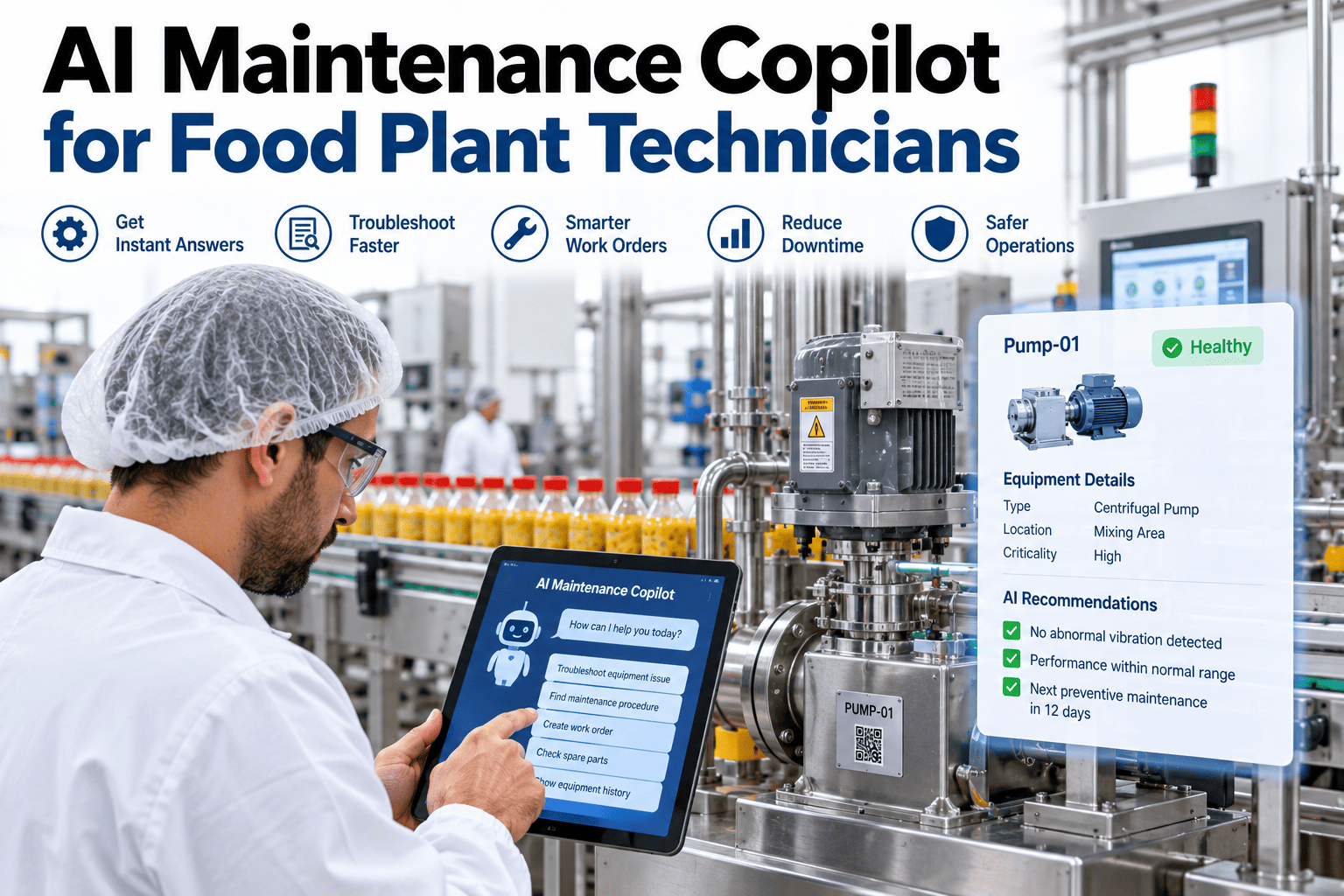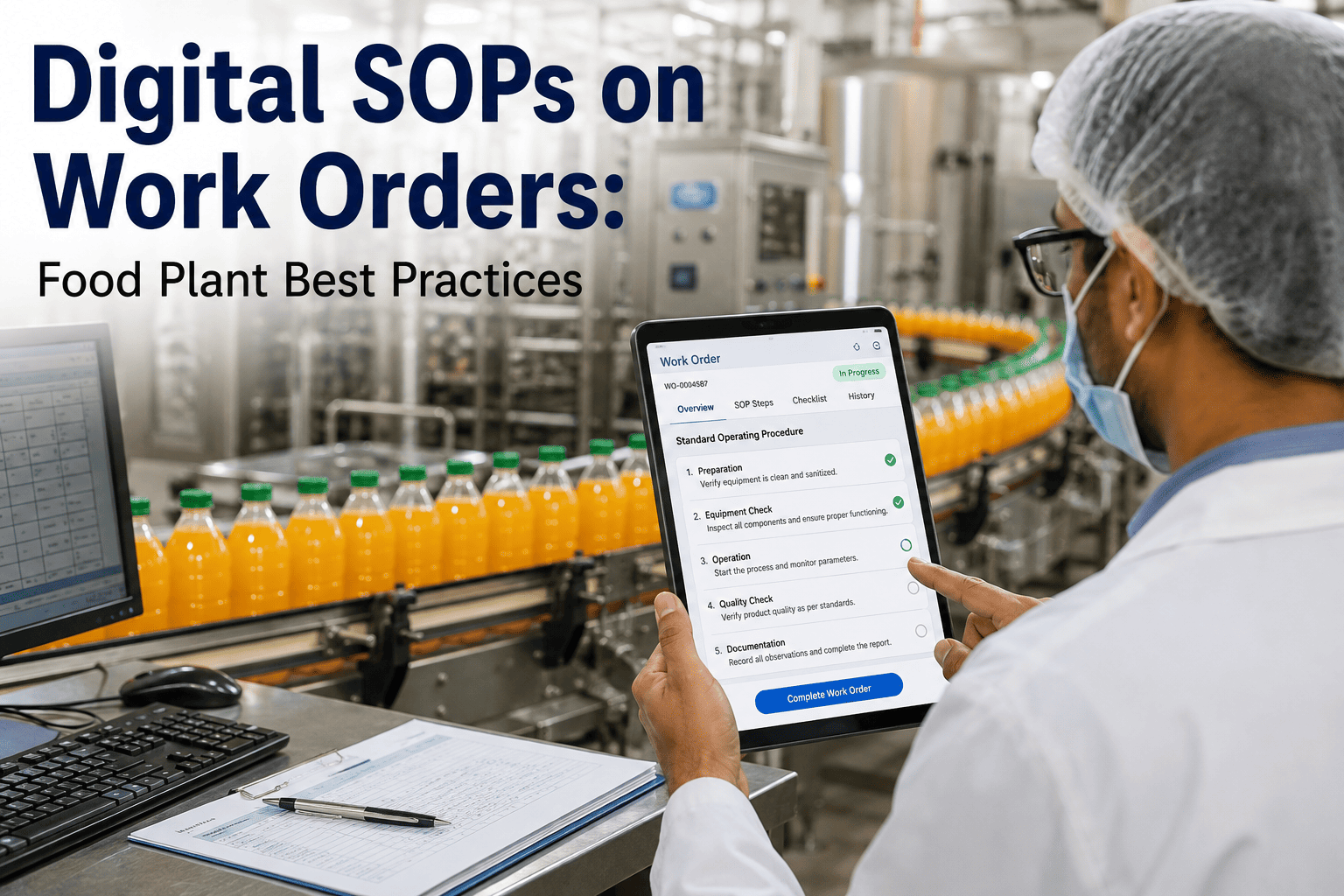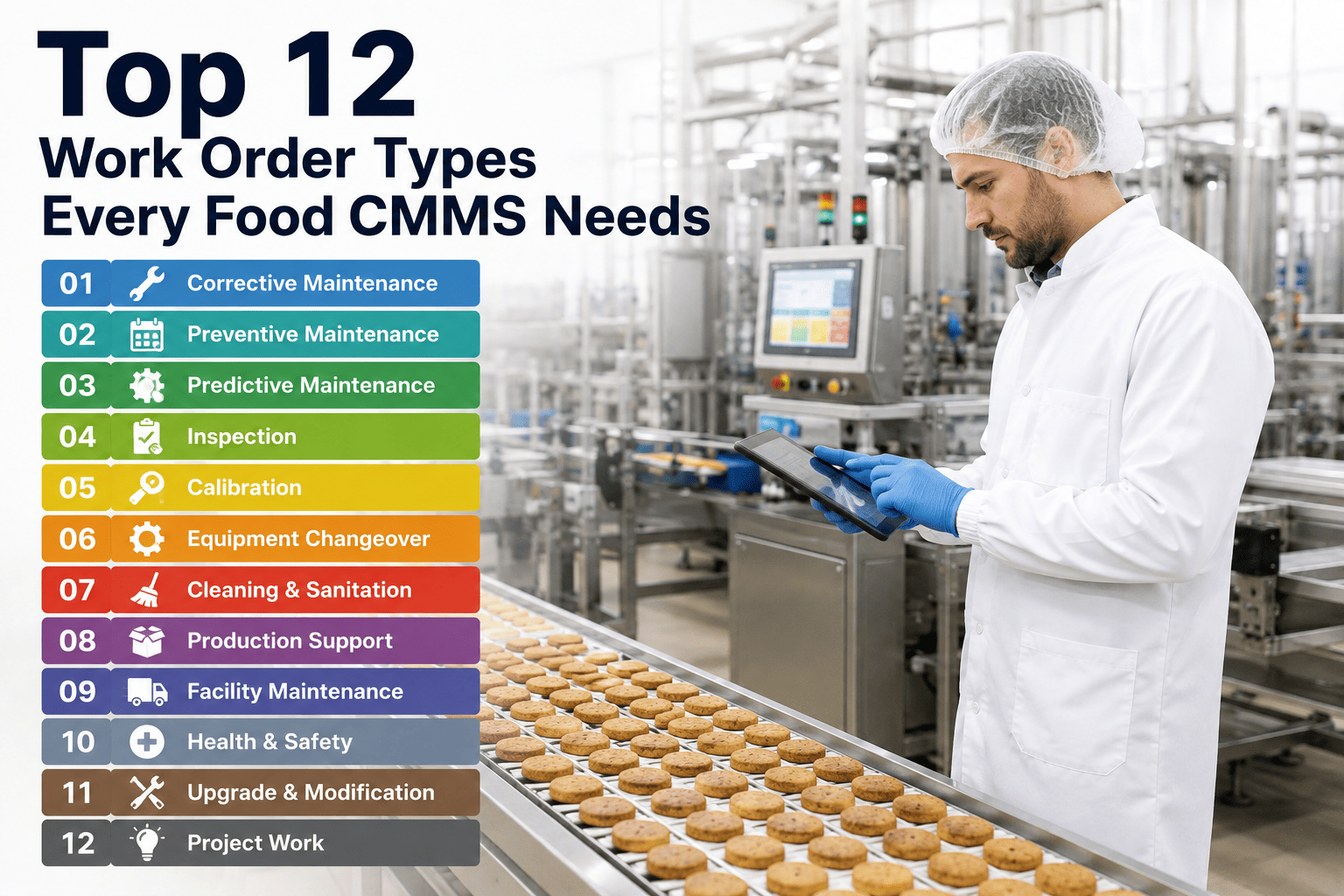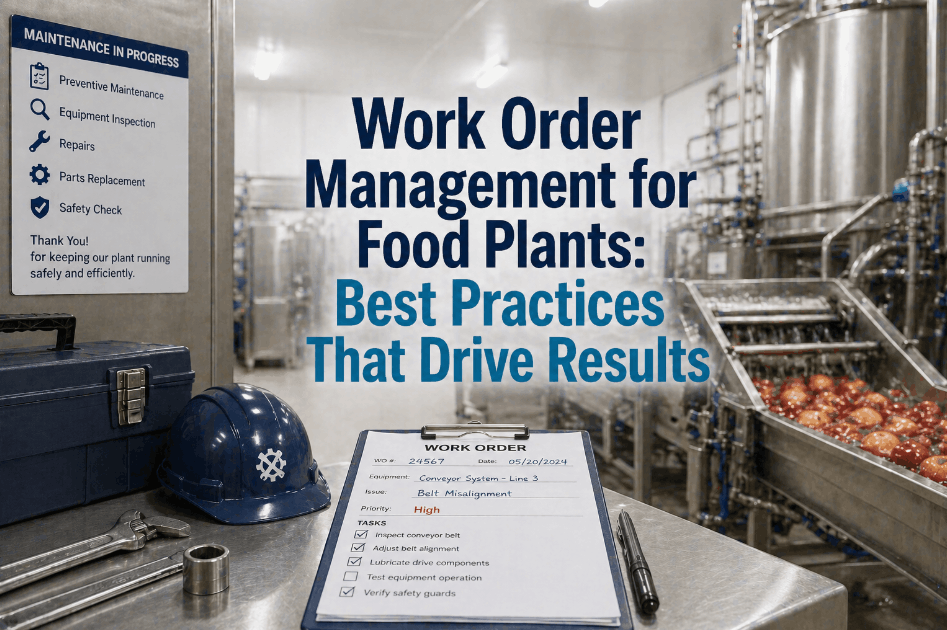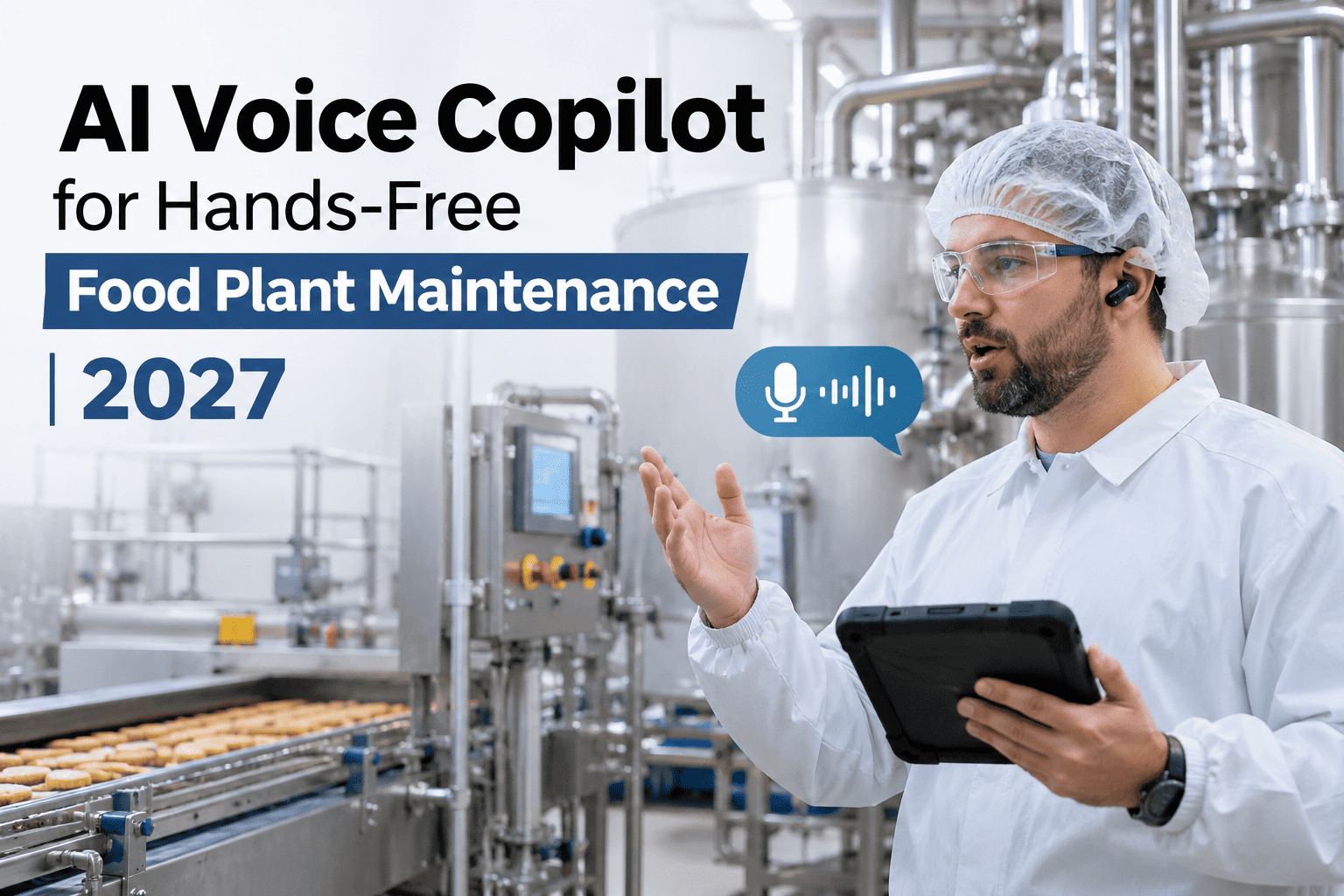
A maintenance technician inside a spiral freezer at -18°C, wearing cryogenic gloves and ear defenders, cannot pull out a phone and type a query into a maintenance system. A technician on top of a mixing bowl reaching into the agitator housing cannot hold a tablet. A technician in a CIP chemical zone cannot take off their PPE to swipe through a CMMS screen. These are not edge cases — they describe the working conditions of a food plant maintenance shift, where the moments that most need guidance are exactly the moments when hands-free is not a convenience but a physical necessity. iFactory AI, an on-premise AI platform for food manufacturing, deploys a voice copilot that technicians activate by speaking, receive answers through an earpiece, and confirm by voice — without removing gloves, changing posture, or leaving the work area. Teams that want to see what a gloves-on maintenance query looks like in practice can book a voice copilot demonstration with iFactory AI's food plant team.
Ask, Listen, and Act — Gloves On, Inside the Freezer, on Top of the Mixer
iFactory AI's on-premise voice copilot lets food plant technicians query maintenance history, receive fault guidance, confirm parts, and close work orders entirely by voice — no screen, no typing, no PPE removal required.
What Is an AI Voice Copilot for Food Plant Maintenance?
An AI voice copilot for food plant maintenance is a speech-activated assistant, deployed on-premise in iFactory AI, that technicians interact with entirely through spoken queries and spoken confirmations. It runs on a lightweight mobile client on the technician's device (phone, wrist display, or smart glasses), processes voice input locally for activation and transmits the query to the on-premise iFactory AI server, and returns a spoken response through an earpiece or bone-conduction audio device.
Because iFactory AI is deployed on-premise on an NVIDIA GPU server inside the plant, voice queries are processed on the local network — no audio data leaves the site, no cloud latency, and no dependency on mobile data signal in the depths of a refrigerated store. Ask the support team about network latency for voice queries in your plant's layout.
A Typical Hands-Free Voice Interaction From Start to Close
The voice interaction follows a natural conversation pattern — no command syntax, no menu navigation, no codes to remember. The technician speaks the way they would speak to a knowledgeable colleague standing next to them.
Give Your Technicians a Senior Colleague in Their Ear — Anywhere on the Plant Floor
iFactory AI's voice copilot deploys on-premise — no cloud, no signal dependency — and works with the PPE your technicians already wear, from freezer to CIP zone to confined access.
Compatible Devices and Wearables for Food Plant Voice AI
iFactory AI's voice copilot is designed to work with the devices and wearables already in use in food plant environments — not to require new hardware that the team will not adopt. The voice client runs on Android and iOS, and pairs with any Bluetooth audio device that food plant environments permit.
Food Safety Considerations for Voice AI Deployment
Deploying voice AI in a food plant environment requires three food safety considerations that do not apply in general manufacturing: audio recording policy, device hygiene in food zones, and noise environment validation.
Frequently Asked Questions
How accurate is the voice recognition in noisy food plant environments?
Wake word recognition and query transcription accuracy depend on the noise level, the microphone quality, and whether a noise-cancelling or bone-conduction device is used. iFactory AI validates voice recognition in each deployment zone before go-live. In environments above 85 dB (filling lines, freezer fans, compressor rooms), noise-cancelling directional microphones or bone-conduction headsets are recommended. These achieve wake word accuracy above 95% in food plant noise testing. The AI also supports fallback to typed input when voice accuracy drops below threshold, so technicians are never stranded without an option. Book a site noise assessment as part of the voice copilot planning session.
What happens if the technician misunderstands the AI's spoken guidance?
The voice copilot is designed with explicit confirmation steps for any action that has a consequence — parts issuance, work order close-out, food safety sign-off. The technician must say "confirm" or repeat back the key detail before the AI writes anything to the CMMS. If the technician misheard the guidance, they can ask the AI to repeat, slow down, or switch to text display on their device. All voice sessions are logged in full text in the AI audit trail — so if a misunderstanding caused an incorrect action, the log shows what was said and what was confirmed. Ask about the confirmation design for high-stakes voice actions in food plant deployment.
Does the voice copilot work in a freezer at -18°C or colder?
Yes, with appropriate device selection. Standard consumer smartphones lose battery performance below -10°C and may fail entirely below -20°C. For spiral freezer and cold store environments, iFactory AI recommends industrial Android devices rated to -30°C, or keeping the phone in a heated body harness pouch (chest level, under outer PPE) with a Bluetooth earpiece extending to the work area. Bone-conduction headsets function at -20°C and are preferred for freezer environments because they do not require an in-ear insert under ear defenders. Review device recommendations for your coldest zones in a planning session.
Can multiple technicians use the voice copilot simultaneously on the same shift?
Yes — each technician has their own iFactory AI session authenticated by their user credentials. Sessions are independent: one technician querying the spiral freezer motor does not interfere with another querying the filler. The on-premise NVIDIA server handles multiple concurrent voice sessions with no degradation in response time under typical food plant team sizes (up to 20 concurrent sessions on the standard deployment hardware). Ask about concurrent session capacity for your team size.
How is the voice copilot introduced to technicians who are sceptical about AI?
The most effective introduction is a 20-minute hands-on session where the technician asks the AI about their own machines, in their own words, and sees it retrieve real work order history from their own CMMS. Scepticism about AI in food plant maintenance usually dissolves when the technician asks about the spiral freezer fault they dealt with last winter and the AI returns the exact resolution steps from the work order they closed. iFactory AI's deployment team facilitates these introduction sessions for every technician cohort before go-live. Book a technician introduction session as part of the deployment plan.
The Best Maintenance Tool Is One a Technician Can Use With Both Hands Full
iFactory AI's on-premise voice copilot works in freezers, CIP zones, confined access areas, and anywhere else a food plant technician needs guidance — without touching a screen, removing PPE, or waiting for a signal.