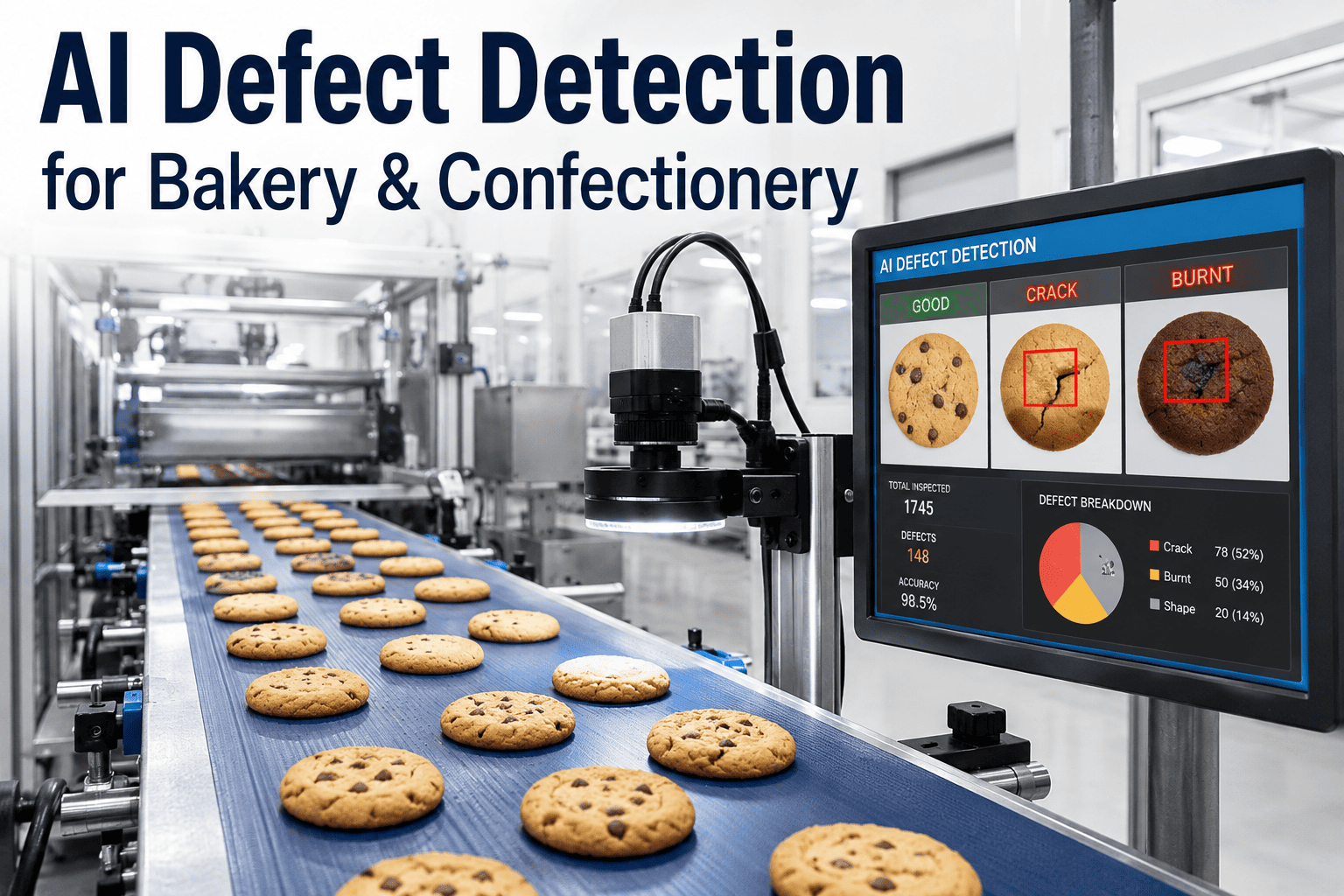
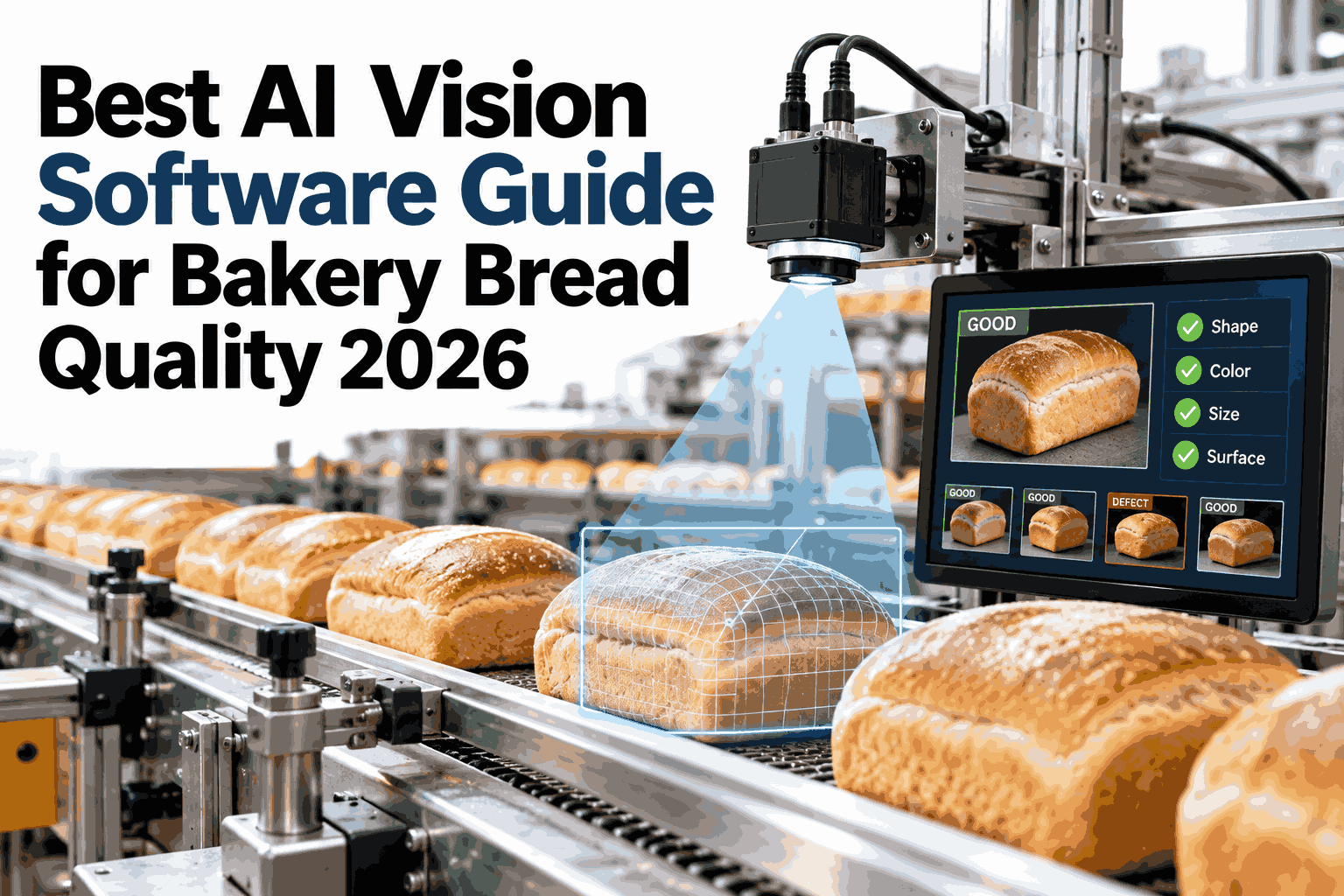
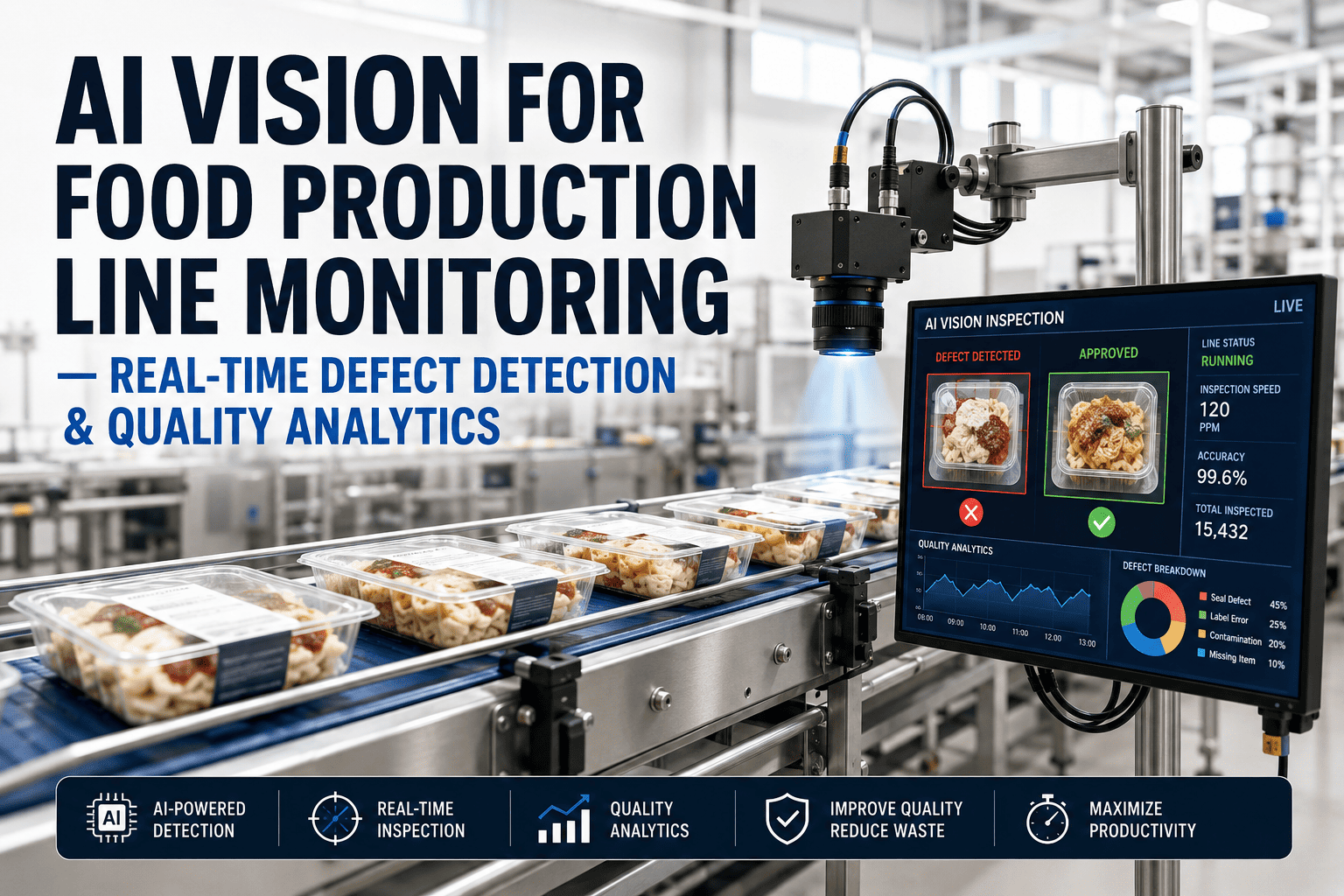
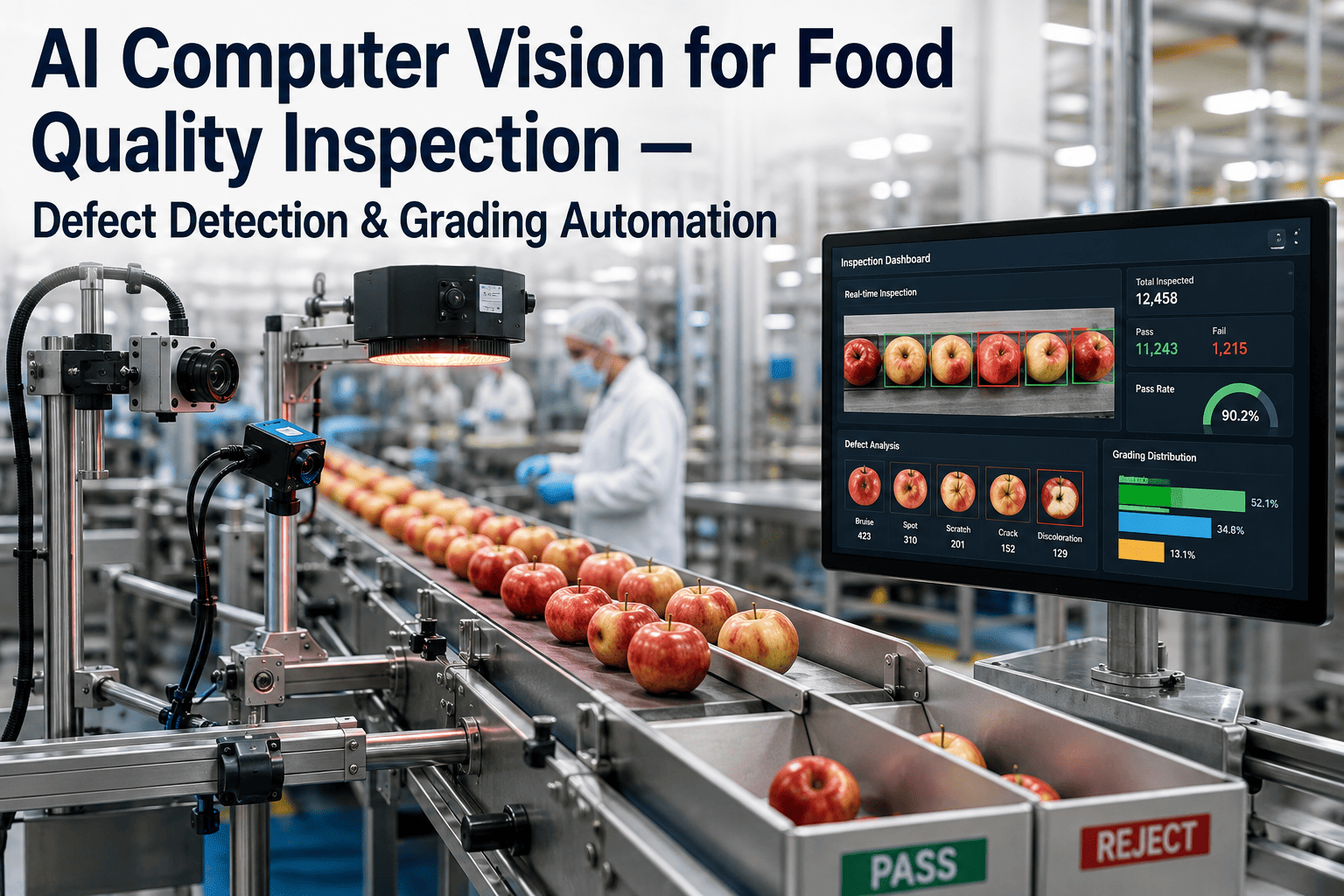
A trained bakery inspector standing over a cookie belt at 600 pieces per minute has to make roughly ten pass-or-reject decisions every second — for ten hours a shift. Human accuracy on that task holds around 85% at the start of a shift and drops after the third hour. Meanwhile the defects that actually cost the plant money — a hairline crack in a shortbread, a chocolate bloom on a moulded praline, uneven topping distribution on a decorated biscuit, a sugar-coat colour deviation, a broken corner on an animal cracker — all show up in the tenths of a second the human eye cannot reliably parse. That is where AI defect detection has moved from novelty to production-grade infrastructure for bakery and confectionery lines. Book a demo to see AI vision inspecting your product at full line speed.
FOOD QUALITY INSPECTION · BAKERY & CONFECTIONERY · AI SURFACE DEFECT DETECTION
AI Vision Catches the Bakery and Confectionery Surface Defects Human Inspection Cannot Hold at Line Speed
AI surface inspection sits over the belt with high-resolution cameras and structured lighting, classifying every piece against a model trained on your specific product — cracks, broken pieces, colour variation, topping distribution, shape consistency, and blemishes flagged and rejected in under 100 milliseconds per piece.
99%
AI Defect Detection Rate on Every Unit at Full Line Speed
~85%
Typical Manual Inspection Accuracy on High-Speed Bakery Lines
<100ms
Per-Piece Inference Latency for a Trained Bakery Model
WHY MANUAL INSPECTION STOPS SCALING
The Point Where Human Bakery Inspection Breaks — and Why AI Vision Is the Only Practical Answer
Modern high-speed bakery and confectionery lines run at 500 to 800 pieces per minute across cookies, biscuits, wafers, moulded chocolate, enrobed products, and decorated cakes. Human inspection at that speed depends on two things that do not last: eye acuity for hairline surface defects, and consistent judgement across a full shift. A commercial bakery in Texas rejecting 12% of finished product at manual inspection stations was missing misshapen loaves, catching colour issues too late, and struggling to keep pace at 800 units per minute — a documented pattern across the industry, not a one-off.
The economics are equally clear on the confectionery side. A UK premium chocolate manufacturer running 94% first-pass yield across three moulding and enrobing lines was still losing $2.1M annually to rework, scrap, and customer complaints — the defects were slipping through fatigue-sensitive manual QC and reaching consumer packs. AI vision does not replace the qualified QA function. It replaces the moment-by-moment visual screening that human eyes cannot reliably deliver at 100% of units on a fast belt.
SIX DEFECT CATEGORIES
The Six Surface Defect Categories AI Vision Catches on Bakery and Confectionery Product
Every bakery or confectionery AI model is trained against six recurring defect categories. The specific manifestation varies by product — a crack on a shortbread looks different from a shell fracture on a moulded praline — but the underlying category taxonomy is the same across the industry.
D1
Cracking & Surface Fractures
Hairline cracks on shortbreads, spider-web fractures on hard-panned confectionery, and shell splits on moulded pralines. The AI model detects sub-millimetre fractures that human inspectors miss until the pack is opened by a customer.
D2
Broken Pieces & Chipping
A missing corner on a rectangular biscuit, a broken leg on an animal cracker, chipping on the edge of an enrobed bar. The AI first classifies what the piece should look like, then flags every deviation from the expected outline.
D3
Colour Variation
Under-baked pale product, over-baked dark spots, sugar-coat colour deviation on panned goods, chocolate bloom on moulded pieces. Colour models trained on the plant's own product distribution flag drift before it becomes a batch problem.
D4
Topping & Decoration Distribution
Chocolate chips clustered on one side of a cookie, sprinkles missing from a decorated biscuit, uneven glazing coverage on a doughnut. Distribution models measure spatial density, not just presence, against the recipe's decoration specification.
D5
Shape & Dimensional Consistency
Loaf height and width variance, bun symmetry and roundness, crust spread uniformity, bar length and thickness on enrobed products. The AI measures every unit against the tolerance envelope the recipe defines — not a sampled subset.
D6
Surface Blemishes & Foreign Matter
Burn spots, blister voids on enrobed chocolate, unwanted seed clusters, and non-product foreign matter caught on the belt. This category is where the highest-consequence detections sit — food safety, not just aesthetics.
PRODUCT-DEFECT MAPPING
Which Defect Categories Actually Matter Most for Your Product
An AI vision deployment tuned for animal crackers is not the same model as one tuned for moulded pralines. The product-defect matrix below is how bakery and confectionery quality teams prioritise which defect categories to train against first — the two or three that drive most of the reject rate on a specific product family.
| Product Family |
Primary Defect Categories |
Common Trigger |
| Cookies & Biscuits |
Broken pieces, colour, shape |
Oven bake variation, cooling stress |
| Moulded Chocolate |
Cracking, bloom, shell fractures |
Tempering, demould speed, humidity |
| Enrobed Bars |
Colour, blemishes, chipping |
Enrober temperature, coating flow |
| Bread & Buns |
Shape, colour, cracking |
Proof time, oven zone control |
| Decorated Products |
Topping distribution, colour |
Depositor calibration, dwell time |
| Panned Confectionery |
Colour, shape, blemishes |
Pan speed, syrup temperature |
Every Defect Category Below Is a Reject Rate You Are Already Paying For — Manually
A trained AI vision model on the right camera station inspects every unit for the specific defect mix your product actually generates — at full line speed, every shift, with false positive rates well below manual variance.
LINE INTEGRATION
Where the Cameras Actually Go — Five Station Types on a Bakery or Confectionery Line
An AI vision system is only as good as its camera positioning and lighting. Getting either wrong on a bakery line means the model is looking at glare, shadows, or motion blur — not product. The five station types below are the standard integration points on a bakery or confectionery line, each with its own optical requirements.
Station 1
Infeed & Depositor Station
Cameras positioned before the oven verify weight distribution, dough shape, and depositor performance. Catching issues here means bad product never enters the oven — the earliest and cheapest reject point on the line.
Station 2
Oven Exit Inspection
Immediately post-bake, cameras verify colour, expansion, and initial surface condition. Product is still hot, so lighting must handle steam and thermal reflection. This is where oven zone drift shows up first.
Station 3
Post-Cooling Surface Inspection
After the cooling tunnel, product surface has stabilised and cracks that develop from cooling stress are visible. This is the primary surface-defect station for cookies, biscuits, and shortbreads — the highest-value defect capture on most lines.
Station 4
Decoration or Enrober Exit
Post-decoration cameras verify topping distribution, coating coverage, and colour of applied layers. IP69K washdown-rated housings and structured LED lighting handle the reflective, high-contrast surfaces of enrobed and glazed product.
Station 5
Pre-Wrap & Packaging Inspection
Final inspection point before primary packaging. Catches any remaining defects, verifies fill count for multi-piece packs, and confirms product orientation into the wrapper. Rejection at this point protects the customer-facing pack.
PERFORMANCE METRICS
The Five Model Performance Metrics a Bakery Quality Lead Should Actually Track
A vendor pitch that leads with "99% accuracy" is telling you nothing useful — accuracy on what class, at what false positive rate, at what line speed. The five metrics below are what bakery and confectionery quality leads actually use to evaluate whether an AI vision model is production-ready or still a pilot.
| Metric |
What It Measures |
Bakery-Grade Target |
| Recall (Detection Rate) |
% of real defects the model catches |
≥ 98% on target class |
| Precision |
% of flagged items that are actually defective |
≥ 95% |
| False Positive Rate |
Good product incorrectly rejected |
< 1% of good product |
| Inference Latency |
Time from image capture to decision |
< 100 ms per piece |
| Throughput |
Pieces per minute the model handles |
Full line rate + 20% headroom |
FREQUENTLY ASKED QUESTIONS
Bakery and Confectionery Quality Leaders' Questions on AI Defect Detection
How much product data does the AI vision model need to reach production-grade accuracy on our specific bakery line?
A production-grade model on a defined bakery product typically calibrates against several thousand labelled images per defect class — often collected during a two-to-four week supervised commissioning period on the actual line. The exact number depends on how visually distinct the defect classes are and how consistent your product is. Highly consistent products like animal crackers need less data than variable-appearance products like rustic breads or hand-decorated pastries.
Book a demo to review a training data plan for your product mix.
Does the AI vision system replace our existing metal detector, X-ray, or checkweigher on the line?
No. AI surface inspection is complementary to metal detection, X-ray, and checkweighers, not a substitute. Metal detectors and X-ray systems handle foreign body contamination invisible to any camera. Checkweighers verify weight, which vision alone cannot measure directly. AI vision adds a layer these instruments do not cover — surface, shape, colour, and decoration defects — and shares the same reject mechanism.
Contact bakery vision support to see how vision integrates with your existing HACCP-critical instruments.
Can one AI model handle multiple product SKUs on the same line, or do we need a separate model for every product?
A well-configured deployment uses one model architecture with per-SKU trained parameters. When the line changes over from one product to another, the operator selects the SKU in the vision system and the correct model weights load — inspection continues without a code change. What is not workable is trying to have one universal model recognise every product in the catalogue, because defect classes and tolerances vary too much between, say, a moulded praline and a rustic sourdough.
Book a session to walk through multi-SKU model management.
What happens to a running AI vision model when we introduce a new product variant or recipe change?
A recipe change that alters product appearance — a new topping, a colour shift, a decoration change — requires retraining or fine-tuning the model on the new product before it goes into full inspection service. Most bakery vision deployments schedule this retraining in the same window as recipe validation, using images captured during the trial runs the plant already conducts before commercial launch. Model retraining does not require pausing production on unrelated SKUs.
Talk to bakery vision support to structure a change-control process for your model library.
How does an AI vision deployment handle line speed variation between shifts and product runs?
The vision model itself is speed-agnostic within the camera's frame rate ceiling — inference latency stays below 100 ms per piece whether the line runs at 400 pieces per minute or 800. What has to be sized correctly at commissioning is the camera frame rate and lighting integration time for the maximum line speed the product will ever run. Once that hardware envelope is set, the same model handles every intermediate speed without recalibration.
Book a session to review the camera and lighting spec for your line's speed range.
SEE IT ON YOUR PRODUCT
Give Your Bakery or Confectionery Line the Inspection Consistency Human Eyes Cannot Deliver at Full Speed
AI vision catches cracks, broken pieces, colour drift, topping issues, shape variance, and blemishes on every unit at line speed. Book a working session to map an AI defect detection deployment onto your bakery or confectionery line.