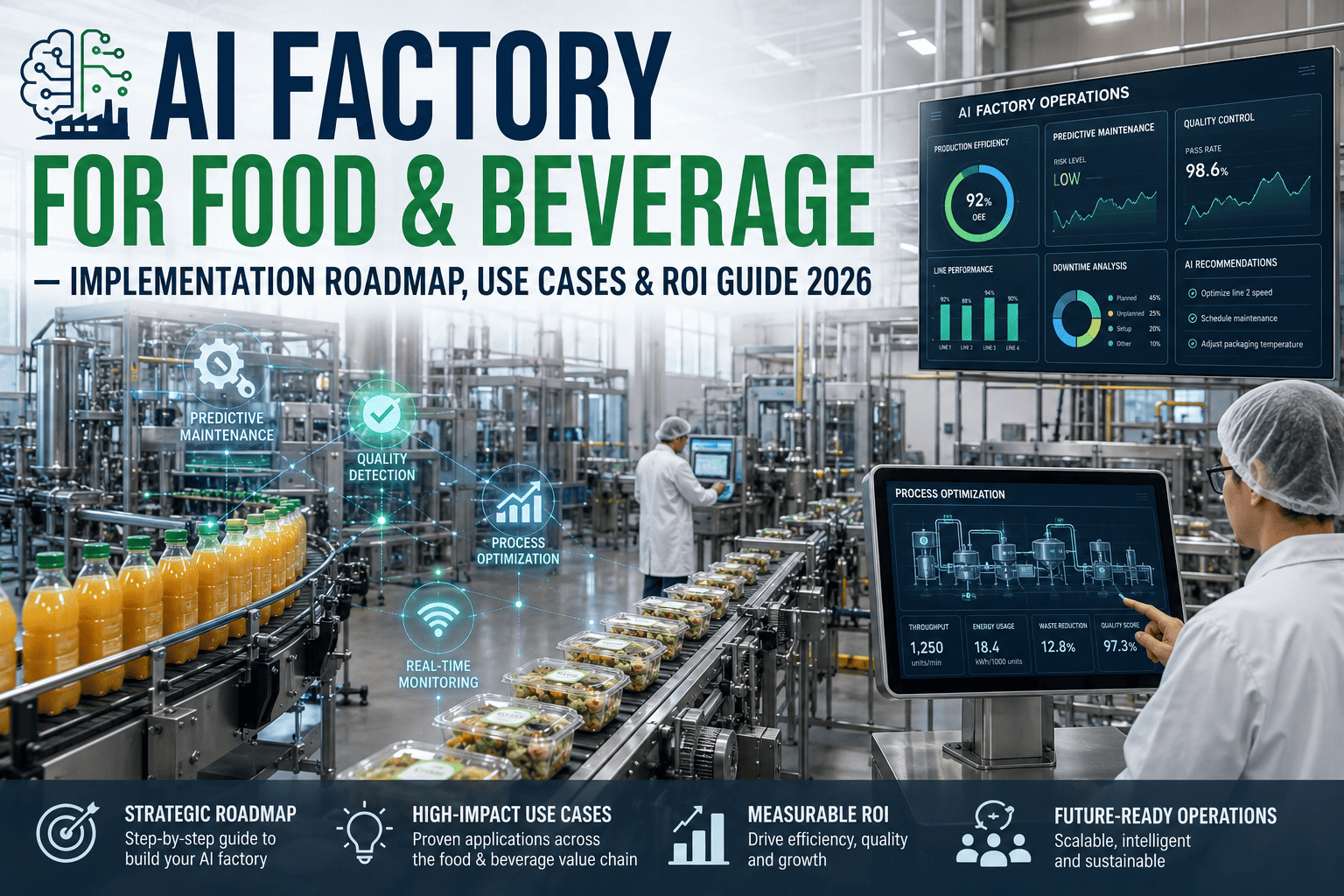
Most food and beverage plants do not fail at AI because the technology does not work — they fail because they try to deploy ten use cases at once with no sequencing, no data foundation, and no way to prove ROI before the budget conversation happens again next year. Operations directors who get this right treat AI as a phased capability build, not a single software purchase, starting with the use case that pays for itself fastest and using that win to fund the next phase. iFactory AI's AI factory platform is built around exactly that phased approach, connecting to the data you already generate instead of demanding a rip-and-replace of your existing systems.
Why Most Plant AI Initiatives Stall Before Phase Two
The typical failure pattern is not a bad model — it is an operations director approving a broad AI vision, a vendor deploying five use cases simultaneously against fragmented data, and six months later nobody being able to say definitively whether any of it moved a KPI. Data fragmented across MES, ERP, and spreadsheets is the single biggest blocker to AI value, because a model trained on incomplete production data produces recommendations nobody trusts enough to act on. The plants that succeed pick one high-friction, well-instrumented process first, prove the ROI in hard numbers, and only then expand.
The Four-Phase AI Factory Roadmap
Connect one core data source — usually MES or quality data — and deploy a single high-value use case like defect detection or downtime prediction to prove measurable ROI within one quarter.
Connect ERP, inventory, and additional production line data so AI use cases can see across functions rather than operating on a single isolated data source.
Extend AI use cases into demand forecasting, quality prediction, and maintenance planning, using the trust built in Phase 1 to bring more teams on board.
Run AI recommendations as a continuous optimization layer across production, quality, and supply chain, with planners reviewing exceptions instead of rebuilding plans manually.
AI Use Cases Ranked by Typical Time-to-Value
Sensor and MES data already exist for most lines, making this the fastest use case to deploy and validate against historical downtime logs.
Camera-based defect detection can be trained on existing product images and validated against current manual inspection results within weeks.
Requires clean historical consumption data and production schedule integration, typically a second-phase use case once data pipelines are established.
Needs sufficient sensor history and failure event labeling to train reliably, making it a strong Phase 3 candidate rather than a first use case.
Calculating ROI: What to Measure at Each Phase
| Phase | Primary KPI | Typical Measurement Window |
|---|---|---|
| Phase 1 | Reduction in unplanned downtime or defect escape rate | 4–8 weeks post-deployment |
| Phase 2 | Forecast accuracy improvement and inventory carrying cost reduction | 1–2 planning cycles |
| Phase 3 | Cross-functional planning cycle time reduction | 1–2 quarters |
| Phase 4 | Blended OEE improvement and total planning labor reallocated | 2–3 quarters |
Data Readiness Checklist Before You Start
A single well-instrumented data source beats fragmented data across five poorly connected systems.
Pilots without a clear owner rarely survive the transition from proof-of-concept to funded expansion.
Without a documented "before" number, no ROI claim after deployment will be credible to finance.
AI recommendations that operators don't trust get ignored regardless of model accuracy.
Operations Director Perspective
We tried an enterprise-wide AI rollout three years ago that touched five plants and eight use cases simultaneously, and eighteen months in, I could not point to a single number that proved it worked. When we restarted with a narrower scope — one plant, one use case, defect detection on our highest-scrap line — we had a validated 22 percent scrap reduction within ten weeks, measured against a baseline we had documented before we started. That number is what got Phase 2 funded without a fight, and it changed how I evaluate every AI proposal that crosses my desk now: show me the baseline, show me the single metric that will move, and show me it in one plant before I greenlight five.
— Operations Director, Multi-Plant Food & Beverage ManufacturerConclusion
The AI-powered factory is not built in one deployment — it is built one validated use case at a time, each one funding the next through measured, not estimated, results. Operations directors who resist the pressure to deploy everything at once are the ones whose AI initiatives are still funded, expanding, and trusted by the floor two years later. Book a demo to map a phased AI roadmap against your own plant's data readiness.
Frequently Asked Questions
The best first use case is usually the one with existing, clean data and a clear, measurable baseline — commonly downtime and anomaly detection or visual quality inspection, since sensor and image data typically already exist. Demand forecasting and predictive maintenance tend to require more upfront data integration and are better suited to later phases. Book a demo to assess which use case fits your current data readiness.
Requirements vary by use case, but most defect-detection and anomaly-detection models can be trained on a few months of clean, labeled data, while forecasting and predictive maintenance benefit from 12 months or more of history. Data quality and consistency matter more than sheer volume — a smaller, clean dataset outperforms a larger, fragmented one.
Trust builds fastest when operators are involved before deployment, when the AI system explains why it made a recommendation rather than issuing a black-box output, and when early wins are visible and communicated quickly. Rollouts that skip frontline involvement and announce AI as a top-down mandate see significantly lower adoption regardless of model accuracy.
A first validated use case typically deploys in 8 to 12 weeks, with cross-functional expansion into two or three additional use cases over the following two to three quarters, and plant-wide optimization generally reached within 12 to 18 months for most manufacturing operations. Timelines extend significantly for organizations with fragmented data systems that require integration work before any use case can be trained reliably.
No, a well-designed AI factory platform connects to and layers on top of your existing MES, ERP, and quality systems rather than replacing them, since ripping out core operational systems adds risk and delay without improving AI outcomes. iFactory AI is built to integrate with the systems you already run. Contact support to review integration options for your current tech stack.