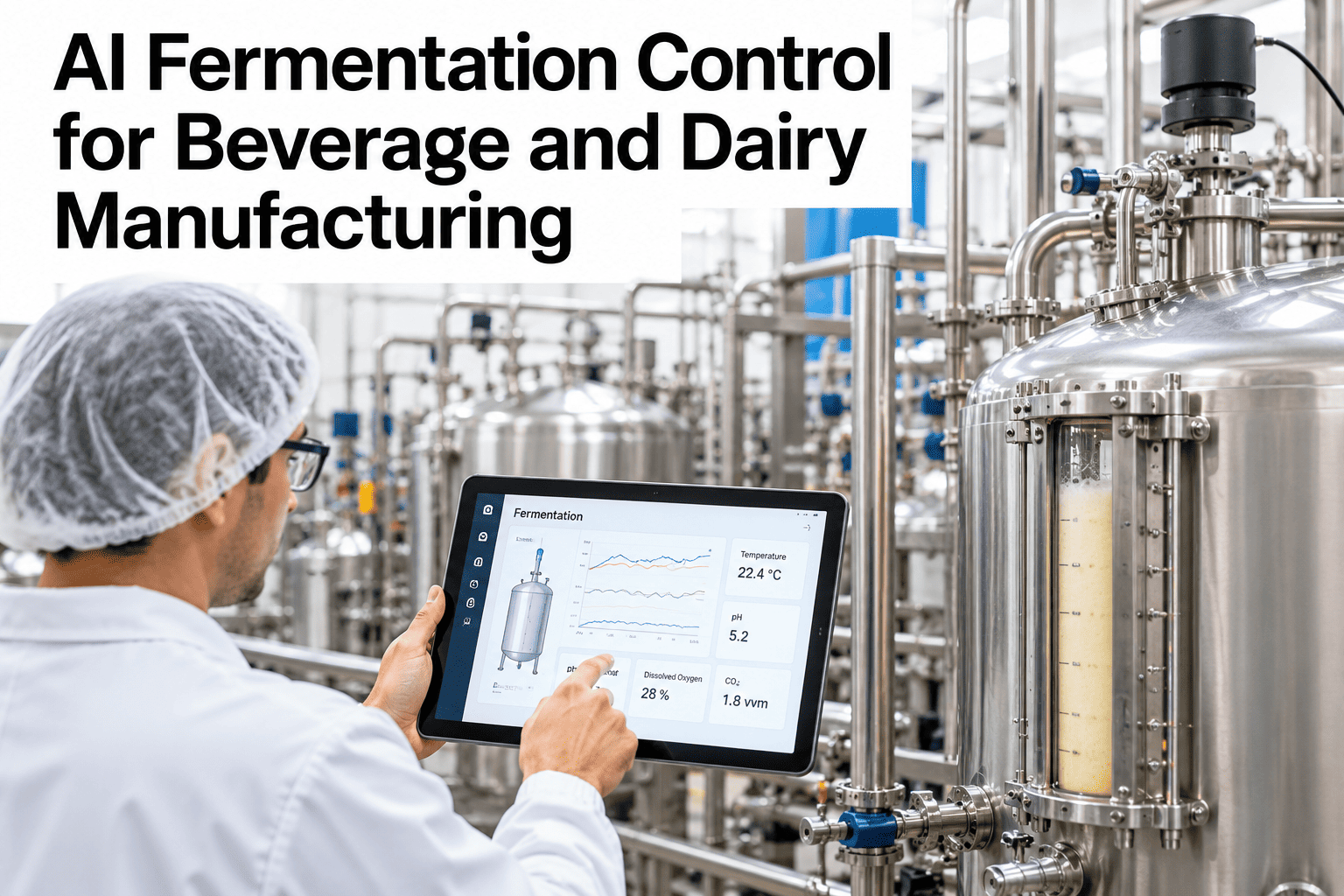
Two fermentation vessels running the same recipe side by side rarely finish at exactly the same time, and the gap between them usually traces back to small differences in pH trajectory, dissolved oxygen and temperature that compound over hours into a meaningfully different endpoint. Add seasonal shifts in raw material composition on top of that, and the same recipe can behave noticeably differently in July than it does in January, even with every set point on the panel held perfectly constant throughout. Modeling pH, dissolved oxygen and temperature together, rather than controlling each one in isolation as three separate loops, is what shrinks that vessel-to-vessel and season-to-season variability down to something a plant can actually plan around with confidence. Process teams can see this modeled against their own fermentation data on iFactory AI before the next batch runs long or short.
Why Do Two Identical Vessels Never Finish at the Same Time?
iFactory AI models pH, DO and temperature together to shrink vessel-to-vessel and season-to-season fermentation variability.
Why Controlling Each Variable Separately Falls Short
pH, dissolved oxygen and temperature all influence the same fermentation process, and each one shifts in response to what the others are doing. Controlling them as three independent loops misses the interactions that actually drive a batch's trajectory.
pH shifts as fermentation progresses, and the rate of shift itself carries information.
How quickly oxygen depletes reflects microbial activity and vessel conditions.
Small temperature differences compound over a long fermentation into a large endpoint gap.
Incoming milk or must composition changes with season, shifting the starting point.
What Gets Modeled Together
| Input | What It Contributes |
|---|---|
| pH trajectory | Tracks fermentation progress against the expected curve |
| Dissolved oxygen trend | Reflects microbial activity and vessel-specific conditions |
| Vessel temperature profile | Shows whether heat distribution matches the target across the batch |
| Raw material characteristics | Accounts for the starting composition feeding into this specific batch |
Model Your Own Vessel-to-Vessel Variation
Bring a recent batch comparison to a 30-minute working session.
From Vessel Start to Consistent Endpoint
Starting pH, DO and temperature are captured against the target profile.
The three variables are tracked together against the expected fermentation curve.
Temperature or aeration shifts to bring a drifting vessel back toward target.
The batch is verified against target before release to the next stage.
Why Catching Drift Early Matters More Than Catching It at All
A drifting vessel caught at the endpoint can still be identified and understood, but by then the batch has already run its full course, and whatever correction gets applied only benefits the next batch rather than the one currently affected.
Catching the same drift in its first few hours, while the vessel still has time to respond to a temperature or aeration adjustment, is what actually prevents the gap from growing rather than just explaining it after the fact once the damage is already done.
A Scenario: The Vessel That Finished Six Hours Late
Picture two fermentation vessels started at the same time with the same recipe, where one finishes on schedule and the other runs six hours longer, with no obvious single cause visible on either vessel's individual trend.
Reviewed separately, neither the pH curve nor the DO trend looks dramatically unusual on its own. Reviewed together, a slightly slower DO depletion paired with a marginally cooler temperature reading in the slow vessel's early hours explains most of the gap, a combination that would be easy to miss looking at either variable alone but becomes clear once they are modeled as a single trajectory. Catching that combination early enough to adjust temperature would have brought the two vessels back into alignment well before the six-hour gap accumulated.
Independent Control vs Combined Modeling
What Changes for Scheduling, Not Just Quality
A fermentation that reliably finishes within a tight time window is easier to plan downstream processing, packaging and labor around than one that might finish six hours early or late depending on factors nobody can predict in advance.
That scheduling benefit often matters as much to a plant's operations team as the quality consistency does to the process team, since unpredictable batch duration ripples into staffing and downstream line scheduling in ways that are easy to underestimate until they are actually reduced.
What Stays With the Process Team
Why This Grows More Valuable as Vessel Count Increases
A plant running two or three fermentation vessels can sometimes manage variation through close manual attention from an experienced operator who develops a feel for each vessel's quirks over time.
That approach does not scale well as vessel count grows, since no operator can hold a detailed mental model of a dozen or more vessels simultaneously, which is exactly where a combined model that tracks every vessel the same consistent way starts to outperform individual operator intuition, however skilled.
Why Seasonal Raw Material Shifts Deserve Specific Attention
A recipe tuned around a summer milk or must composition can behave noticeably differently once winter raw material arrives, since protein, sugar and mineral content shift with season even when the supplier and specification stay nominally the same.
A fixed set point treats every season the same way, which means the gap between target and actual performance tends to widen at exactly the times of year when raw material composition has drifted furthest from whatever baseline the original recipe was tuned against.
Why Dairy and Beverage Fermentation Each Carry Their Own Nuances
A yogurt or cheese fermentation and a beer or kombucha fermentation share the same underlying principle of modeling pH, DO and temperature together, but the specific sensitivities differ enough that a generic profile rarely fits both well.
Starter culture activity is highly sensitive to small temperature swings.
Different strains respond differently to the same DO and temperature profile.
Larger vessels often show more internal temperature gradient than small ones.
Shorter fermentations leave less time to correct a drifting trajectory.
Starting With the Product Line Showing the Most Variation
A plant running several fermented products rarely needs to apply this approach everywhere at once. Starting with the product showing the clearest vessel-to-vessel inconsistency in current batch records provides the fastest, most convincing proof point.
Where iFactory AI Fits
Models variables together
Tracks pH, DO and temperature as one combined trajectory.
Catches vessel drift early
Flags a diverging vessel well before the endpoint gap grows large.
Accounts for season
Adjusts expectations as raw material composition shifts through the year.
Keeps the team in control
Leaves recipe and release decisions with the process team.
Expert Review
A food and beverage process engineering perspective, reviewed for accuracy before publication: fermentation variability is frequently treated as an inherent biological unpredictability, but a meaningful share of vessel-to-vessel gaps trace back to small, correctable differences in how pH, DO and temperature interacted early in the batch. Catching that interaction early is usually more valuable than any single-variable tuning adjustment. Reviewing a recent vessel comparison against your own data often shows where the gap actually started. Confirm specific feature capabilities against your plant's vessel instrumentation and control systems before relying on any workflow.
Frequently Asked Questions
Does this replace existing fermentation vessel controllers?
No, it works alongside existing vessel controllers by adjusting the targets they follow based on the combined pH, DO and temperature model, rather than replacing the underlying control hardware. See how this integrates with your current vessel setup and existing SCADA or batch control system.
What sensors are needed for this to work?
Standard pH, DO and temperature probes already common on most fermentation vessels are typically sufficient as a starting point, with additional sensing added where available to refine the model further. Ask about what sensing your current vessels already support and whether any gaps need to be filled first.
How does this handle different products on the same vessels?
Each product typically has its own target trajectory, and the model compensates toward whichever profile is active for the batch currently fermenting in that vessel. Explore multi-product fermentation profile management across shared vessel capacity.
Can this help explain a past batch that ran unusually long or short?
Yes, reviewing the combined pH, DO and temperature history for a specific batch often reveals the interaction that drove the unusual duration, even when no single variable looked clearly abnormal on its own. Talk through reviewing a past batch against this model to see what the combined trajectory would have shown.
How long before vessel-to-vessel variation noticeably shrinks?
Many plants see a measurable reduction in endpoint variation within the first several batches, since the most common causes of drift tend to recur and get caught and corrected quickly once the combined model is in place. See a realistic timeline for your own fermentation process and vessel count.
Bring Your Vessels Into Alignment, Season After Season
iFactory AI models pH, DO and temperature together to shrink vessel and season variability. See this on your own fermentation data.