When a quality dip shows up on a report, the investigation that follows usually starts with a meeting, a list of possible causes, and hours spent pulling records to check each one in turn, long after the process minutes that actually explain the dip have already passed. A system that ranks the top contributing drivers on one screen, with the exact process minutes to go inspect, collapses that entire investigation into something a quality engineer can act on immediately rather than reconstruct after the fact. Building this kind of ranked, pointed root cause view is what actually shortens the time from a quality dip to a corrective action, and our team can walk you through how this ranking works on your own process data.
Food manufacturing, quality root cause analysis
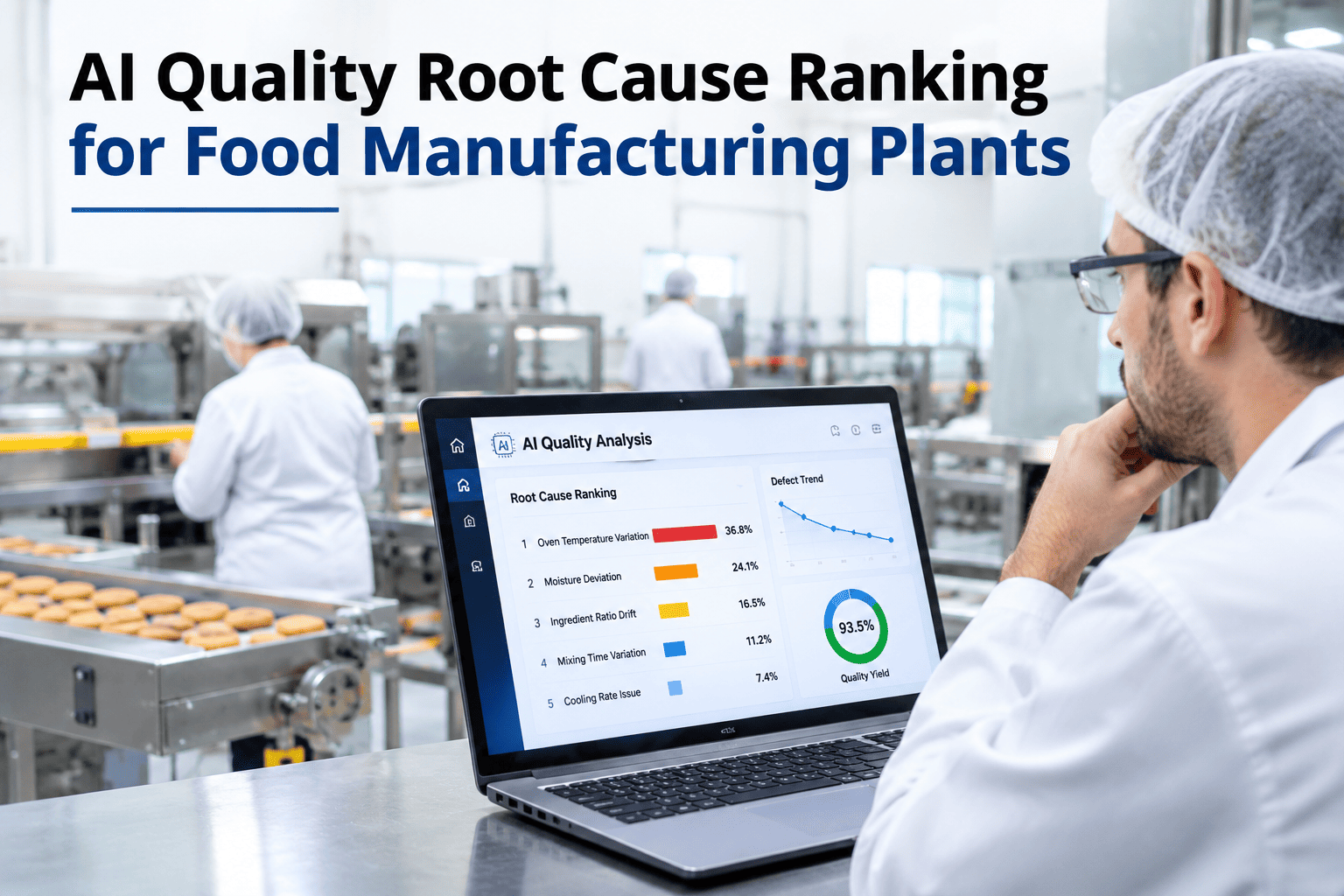
Rank the Top Drivers of a Quality Dip on One Screen, With the Exact Minutes to Check
iFactory AI ranks the top three contributing drivers of a quality dip and points directly to the process minutes worth inspecting, collapsing a multi-hour investigation into one screen.
Why investigations take so long
A Manual Investigation Reconstructs What a System Could Already Know
A quality dip discovered on a report triggers a manual process of pulling records, checking each plausible cause one at a time, and reconstructing a timeline, when the data needed to point directly at the likely cause was already sitting in the process records the whole time.
Dip appears on a report
A quality metric shows a decline after the fact
Manual list of suspects
The team brainstorms possible causes to check
Records pulled one at a time
Each suspect is checked manually against available records
Hours pass before a cause is found
The actual data needed was available the whole time
Three ranking elements
What a Ranked Root Cause View Actually Provides
Top driver ranking
The three factors most strongly linked to the quality dip, ordered by contribution.
Pattern-to-process linkage
Each driver tied back to a specific process condition, not just a statistical correlation.
Exact process minutes
The specific time window a quality engineer should go inspect first.
Check Your Current Investigation Time
Share how long your last quality dip investigation took and see what ranked root cause analysis would change.
Investigation comparison
Manual Investigation Versus Ranked Root Cause View
| Step | Manual investigation | Ranked root cause view |
|---|
| Identifying suspects | Team brainstorms possible causes | Model ranks top contributing drivers automatically |
| Checking each suspect | Records pulled and reviewed one at a time | Each driver already linked to specific process data |
| Finding the time window | Manual timeline reconstruction | Exact process minutes surfaced directly |
| Time to corrective action | Hours to days | Minutes to an hour |
Ranking pipeline
Four Steps From Quality Dip to Pointed Investigation
1
Detect the quality dip
A decline in a tracked quality metric is identified.
2
Rank contributing factors
The model identifies and ranks the top three likely drivers.
3
Link to process minutes
Each driver is tied to the specific time window to inspect.
4
Engineer confirms and acts
The quality engineer verifies the ranked cause and takes corrective action.
Common pitfalls
Three Problems With Manual Root Cause Investigation
1
Investigation starts from team memory, not data
The list of suspects reflects what people remember, not what the data actually shows.
2
No prioritization among possible causes
Every suspect gets checked with equal effort regardless of likelihood.
3
Investigation happens long after the dip occurred
By the time a cause is found, the conditions that caused it may have already changed.
Expert review
The value of ranking is that it replaces a brainstorm with a data-driven starting point. A quality engineer who starts an investigation already knowing the top three likely drivers and the exact minutes to check spends their time confirming rather than searching.
Watch for
A root cause process that starts every investigation with a blank brainstorm rather than a data-driven ranking.
Do next
Time your next quality dip investigation from detection to corrective action to establish your current baseline.
— iFactory food quality specialists
Frequently asked questions
What Plants Ask About AI Root Cause Ranking
How does the model decide which three drivers to rank?
The ranking is based on which process factors show the strongest statistical and known-causal link to the specific quality metric that dipped, drawing on historical patterns from your own process data.
Ask about your specific quality metrics.
What if the actual cause is not one of the top three ranked?
The ranking is a starting point, not a guaranteed answer, so a quality engineer still applies their own judgment, and cases where the true cause falls outside the top three become useful feedback for refining the ranking model over time.
Discuss handling ranking misses.
How precise are the "exact process minutes" the system identifies?
The precision depends on how tightly your production and quality data are time-aligned, so a tightly synchronized system can point to a narrow window while looser data alignment gives a broader but still useful range.
Talk through your data alignment.
Does this replace the quality engineer's investigation entirely?
No, it points the investigation in the right direction immediately, but confirming the actual cause and deciding on corrective action still requires the engineer's expertise and judgment.
Ask about the engineer's role.
Can this work for intermittent quality dips that are hard to pin down?
Yes, and this is often where ranking adds the most value, since an intermittent issue is exactly the kind of pattern that is hard for a person to spot manually across scattered historical data but can be surfaced by the model's analysis across many past occurrences.
Discuss your intermittent quality issues.
From a multi-hour brainstorm to a one-screen starting point
Give Your QA Team a Ranked Starting Point, Not a Blank Investigation
Book a session with iFactory AI to review your quality investigation process and see how ranked root cause analysis fits your plant.