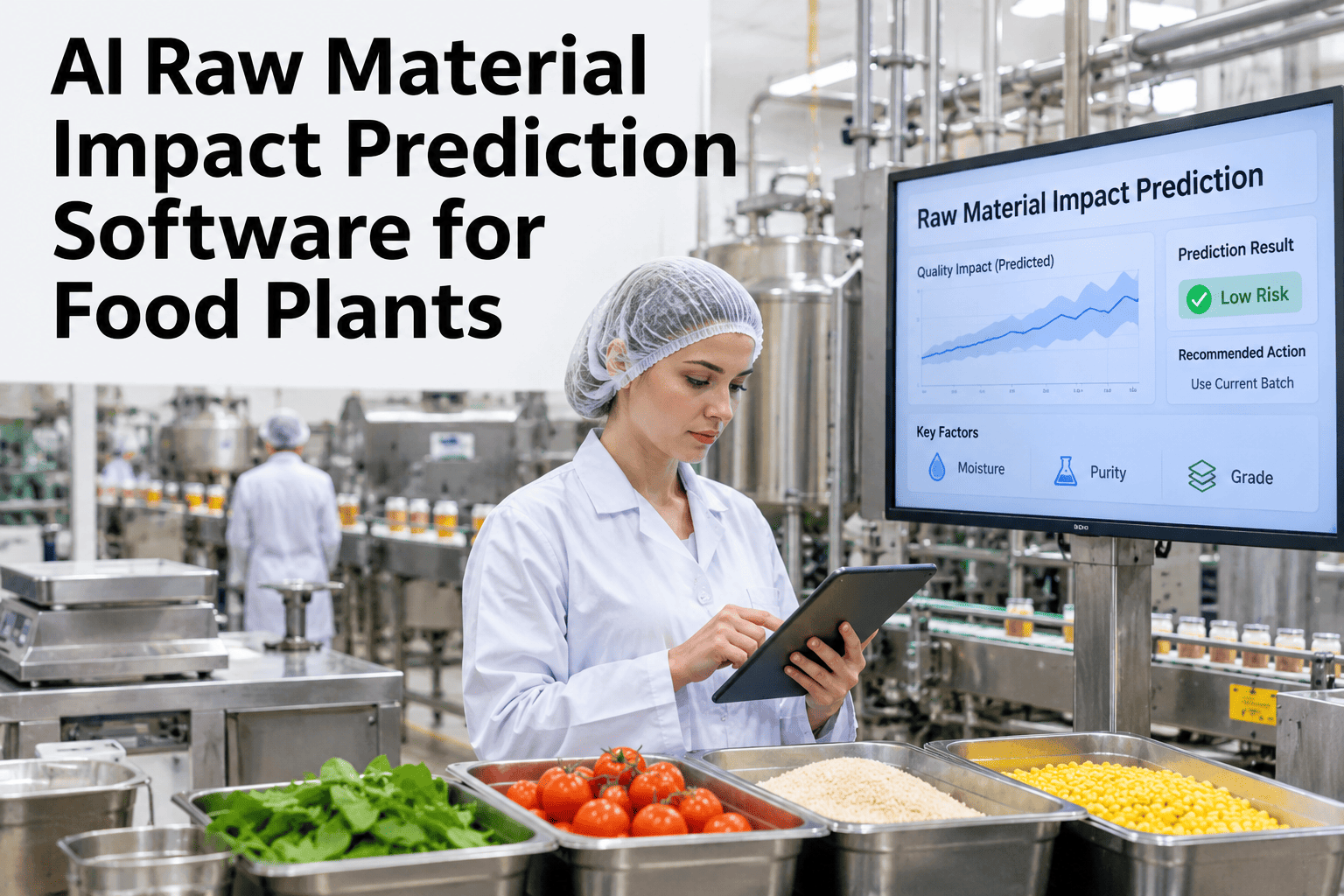
Two lots of the same ingredient from the same supplier can still behave differently on the line — moisture content, particle size, and viscosity all vary lot to lot, and that variation shows up as inconsistent finished product even when every process parameter stays exactly on target. iFactory, an on-premise AI platform with automated analytics reporting built in, predicts how tomorrow's incoming lot will affect the finished product before the run starts. Food plant quality teams who want this ahead of their next receiving inspection can request a demo with our team.
Raw Material Impact Prediction · Food Plants, 2026
Know How Tomorrow's Lot Will Behave Before It's Already Running
iFactory AI reads incoming lot properties against your historical process data, predicting the finished-product impact before the batch starts — not after the quality lab flags it.
Lot A
96
Predicted quality score
Lot B
82
Predicted quality score
Lot C
71
Predicted quality score — flagged
Why lot-to-lot variation matters
The Same Specification, a Different Ingredient
A certificate of analysis confirms an ingredient meets its written specification, but specification ranges are often wide enough to permit real behavioral differences on the line — a flour lot at the high end of its moisture spec behaves differently in a mixer than one at the low end, even though both pass incoming QC identically.
What the model reads
Three Inputs Behind a Lot Impact Prediction
Incoming lot properties
Moisture, particle size, viscosity, or other measured attributes from receiving or supplier documentation.
Historical process-outcome pairs
How similar lot properties have historically correlated with finished-product quality on this specific line.
Current process setpoints
The planned run parameters this lot will actually be processed under.
What a prediction enables
Four Responses to a Flagged Lot, Before the Run Starts
| Response | When it applies |
|---|
| Adjust process setpoints | The lot's predicted behavior can be compensated for with a known parameter change |
| Blend with another lot | Mixing with a lot at the other end of the spec range brings the blend back to normal |
| Reroute to a less sensitive product | The lot is fine for a less demanding SKU even if it's risky for a premium one |
| Flag for closer inspection | The predicted risk is high enough to warrant additional incoming testing before use |
See What Your Recent Lot Variation Would Have Predicted
Share your recent receiving data and finished-product quality results, and iFactory AI will show what a lot impact model would have flagged in advance.
Reactive vs predictive
Finding Out After the Batch Versus Before It Starts
Reactive discovery
Lot behavior only becomes visible once the batch is already running
A problem lot is discovered through a failed quality check
The affected production is already committed by the time anyone knows
Predictive screening
Lot behavior is predicted against the specific run it's headed for
A problem lot is flagged before the batch even starts
A process adjustment or reroute decision happens with no product at risk
Keeping the model current
A Prediction Is Only as Good as Its Training Data
A model trained on a narrow range of historical lot variation will struggle to predict outside that range — which is why most programs continue logging every lot's actual measured properties against its finished-product outcome, so the model's accuracy improves as more of the real variation the plant actually sees gets captured.
Expert review
What a Food Quality Engineer Checks First
Raw material impact prediction earns trust when it's validated against real outcomes, not just trusted on the strength of the supplier's certificate of analysis.
Verdict
Strong when the model has enough historical lot-outcome pairs to cover the real range of variation this plant sees.
Watch for
Treating a model trained on one supplier's lot variation as valid for a different or new supplier without revalidation.
Do next
Pull your last quarter's incoming lot test results and check how consistently they're actually linked back to the finished-product outcome for that specific lot.
Frequently asked questions
What Food Plants Ask About Raw Material Prediction
Does this replace our incoming inspection process?
How much historical data do we need before predictions are reliable?
The model needs enough lot-outcome pairs to cover the real range of variation the plant sees — a few months of consistently linked receiving and quality data is a typical starting point.
Ask support about your current data readiness.
Can this handle a new raw material supplier we haven't used before?
A new supplier starts with lower prediction confidence until enough lot-outcome data accumulates for that specific source, since the model is learning that supplier's own variation pattern.
Talk through onboarding a new supplier.
What raw material properties matter most for the prediction?
This depends heavily on the product and process — moisture, particle size, and viscosity are common drivers in food manufacturing, but the most predictive properties for your specific line are identified during model setup.
Ask support which properties matter for your product.
Can a flagged lot still be used, just with a process adjustment?
Know the lot's impact before the run starts
Predict Finished-Product Impact From Incoming Lot Data
Book a demo to see how iFactory AI predicts raw material impact on your specific lines and products.