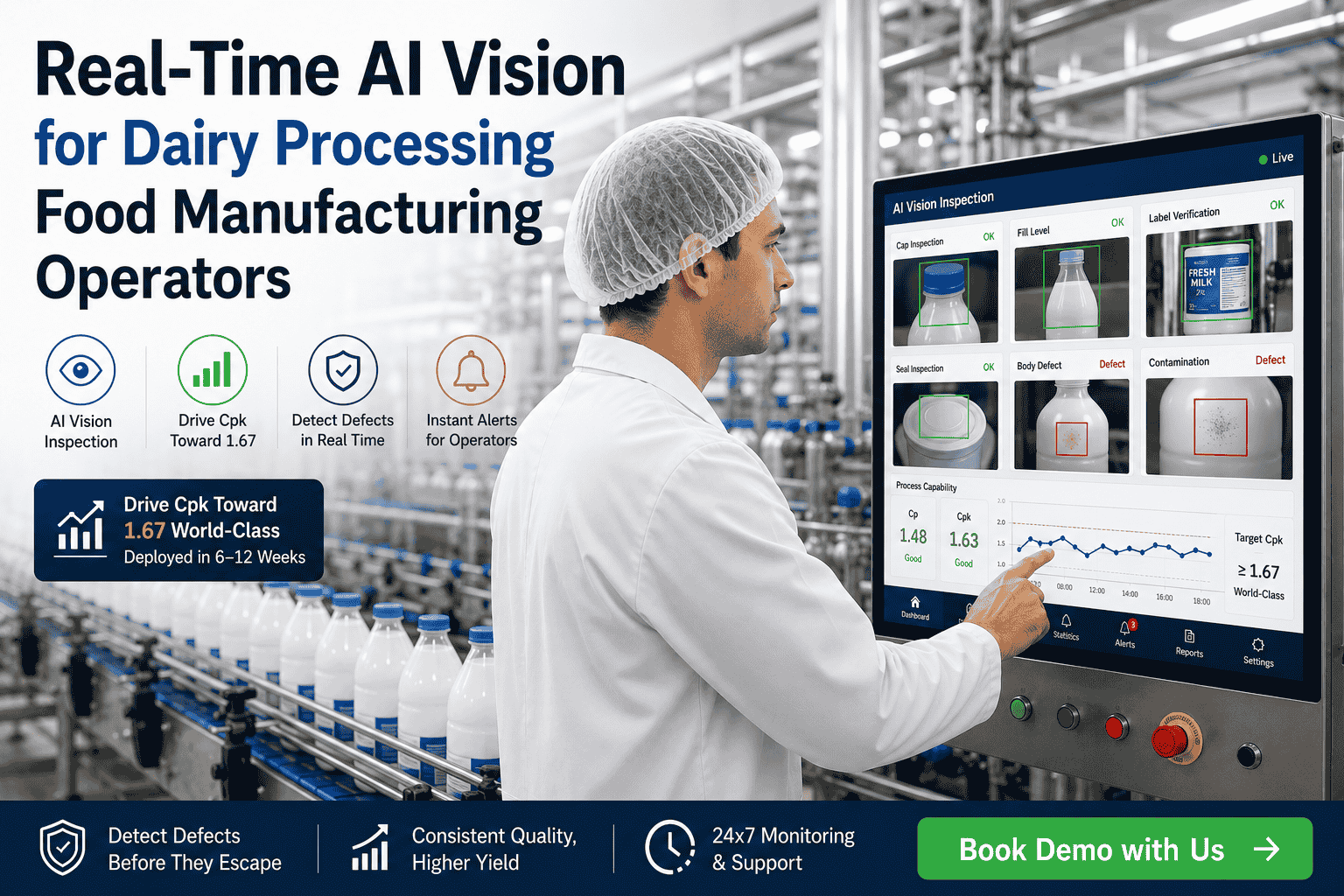
AI Vision Inspection for Dairy Processing Operators
By Riley Quinn on May 27, 2026
The question dairy plant operations leaders are asking in 2026 isn’t whether to deploy AI vision inspection — it’s where to deploy it first, what to evaluate when comparing vendors, and how fast the ROI actually materializes. A single prevented recall on a dairy line typically saves $10M–$100M; a single missing-cap event that ships to a major retailer can trigger six-figure penalty clauses. Meanwhile vision systems now inspect at line speeds exceeding 1,200 units per minute with 99%+ accuracy, integrate with existing PLC and SCADA via standard protocols, and pay back full investment in 6–12 months on most dairy lines. This guide is for operators and operations leads evaluating AI vision for dairy processing — what each inspection point delivers, where ROI lands first, how to evaluate vendor claims, and what the deployment actually looks like on your line. Book a demo with us to walk through a deployment plan built around your top three defect categories.
Vision Inspection Deployment Map
Six Inspection Points Across the Dairy Line
Each point earns ROI differently. The smartest deployments start with one high-impact point, prove the case, then expand to the others.
01
Separator outlet
Skim clarity · turbidity drift
02
Pasteurizer outlet
Color · foreign body detection
03
Filler station
Fill level · foam pattern
04
Capper / seal station
Cap presence · seal integrity
05
Labeler / date coder
Label skew · date code OCR
06
Case packer
Pack count · pattern verify
All six points feed the same inference engine, the same operator HMI, and the same audit trail.
Why AI Vision Now — The Business Case Has Tipped
Three things changed in the last 24 months that make AI vision the default rather than the upgrade. Edge GPU inference costs dropped to where a multi-camera installation pays back in months. Pre-trained dairy-specific models reduced deployment time from years to weeks. And recall costs climbed past $10M average per incident, which means a single prevented recall pays for the entire program. The buyer’s calculus shifted from “can we afford this” to “can we afford not to.”
99.8%
AI Detection Accuracy
Versus 85% for human inspection at sustained line speed. The gap widens after hour 4 of a shift as operator fatigue compounds.
30–40%
Defect Rate Reduction
Documented reduction after AI vision deployment plus real-time process parameter adjustment. The vision data feeds upstream tuning.
75%
Recall Risk Reduction
Average recall costs run $10M–$100M per incident. Reducing recall probability by 75% is structural risk insurance, not just quality improvement.
6–12 mo
Typical ROI Payback
Full investment recovery through scrap reduction, recall prevention, inspector redeployment, and audit-prep cost elimination.
The Six Inspection Points — Where Each Earns ROI
Not all inspection points pay back equally. Some prevent contamination escapes (high consequence, lower frequency). Some catch giveaway (lower consequence, higher frequency). Some prevent customer-visible defects (the brand-protection plays). Understanding which point matters most for your specific risk profile is how you choose where to start.
Point 01
Separator Outlet
Detects
Skim turbidity drift, bowl efficiency degradation, fat carryover events, foreign body in stream
ROI driver
Catches separator drift days before downstream specs are affected. Prevents off-spec batches at the upstream source.
Point 02
Pasteurizer Outlet
Detects
Color anomalies (burn-on indicators), foreign particles, viscosity-related flow irregularities
ROI driver
Catches process upsets before the affected milk reaches packaging. Prevents recall-grade contamination escapes.
Point 03
Filler Station
Detects
Fill level variance per nozzle, foam pattern abnormalities, container presence verification
ROI driver
Eliminates giveaway from systematic overfill bias. Typical savings $200K–$500K/year on high-volume lines.
Single largest customer-complaint driver on dairy lines. Prevention here is direct brand protection.
Point 05
Labeler & Date Coder
Detects
Label skew, wrong-SKU labels, missing or smeared date codes, peeling corners, double-labels
ROI driver
Wrong-label events are the single most common cause of dairy recalls. OCR-grade vision eliminates this class structurally.
Point 06
Case Packer
Detects
Missing units in case, wrong pack pattern, mixed-SKU contamination, damaged outer cases
ROI driver
Last-line defense before shipment. Retail chargeback prevention plus mixed-SKU recall avoidance.
Want to see which of the six points would deliver fastest ROI on your specific line? Book a deployment-priority assessment with our dairy vision specialists.
What to Evaluate When Comparing Vendors — The Buyer’s Framework
The AI vision market in 2026 has dozens of vendors making similar-sounding claims. The differences that matter for dairy processing aren’t in the marketing decks — they’re in eight specific evaluation criteria that determine whether the deployment delivers ROI in 6 months or fails to deliver at all. Here’s the checklist most operations leads wish they’d had before signing.
Swipe horizontally to compare evaluation criteria
Evaluation criterion
Acceptable
What you want
Detection accuracy
≥97%
99%+ with documented false-positive rate <0.1%
Inference latency
<100ms
<50ms on edge GPU, accommodates 1,200+ UPM
Pre-trained dairy models
Generic food-industry models
Pre-tuned for dairy SKUs, defect classes, lighting conditions
PLC / SCADA integration
Custom adapter required
Native support: OPC UA, Modbus TCP, EtherNet/IP
SKU changeover handling
Reprogramming per SKU
AI auto-recognizes layouts, zero changeover downtime
Audit trail compliance
Logs to file
21 CFR Part 11 tamper-evident, GFSI-scheme-ready
Deployment timeline
3–6 months
6–12 weeks with pre-configured templates
Continuous learning
Static models, manual retrain
Auto-retraining from operator overrides, monthly improvements
A 30-Minute Demo Worth the Calendar Slot
iFactory will walk through every criterion in the evaluation table against your line’s specifications — line speed, SKU count, current defect rates, existing PLC and SCADA stack. You leave with a deployment plan, a ROI projection, and clarity on which inspection point earns first.
The biggest commercial-investigation question after “does it work” is “does it work with what we already have.” The honest answer for dairy plants in 2026 is yes — vision integration patterns are mature and predictable. Here’s what the connection looks like across the four systems vision must talk to.
PLC / SCADA
OPC UA · Modbus TCP · EtherNet/IP · PROFINET
Vision sends pass/reject/review verdicts to existing PLCs. PLCs trigger reject actuators within milliseconds of inference. No control loop changes required.
MES / Historian
REST API · SQL · MQTT · Kafka
Defect events, images, lot codes, and timestamps stream to MES and historian. Quality data joins production data for full traceability.
QMS / LIMS
REST API · HL7 · ODBC
CAPA records auto-generated from defect spikes. Reject images linked to lab samples. Compliance documentation builds itself.
CMMS / EAM
REST API · Webhooks
Auto-trigger work orders when defect rates spike on a specific filler nozzle, capper head, or labeler. Maintenance gets the signal before quality fails.
The Five-Phase Deployment Path — What 6 to 12 Weeks Actually Looks Like
Deployment is the part most buyers under-estimate. Not the technology itself but the disciplined sequence of phases that turns a vendor demo into a production-grade inspection layer. Here’s the path iFactory walks every dairy customer through, and what each phase delivers.
Phase 01
Week 1–2
Site Assessment & Point Selection
Survey line speeds, defect categories, current inspection workflow. Choose first deployment point based on highest defect escape cost. Confirm PLC/SCADA integration approach.
Phase 02
Week 2–5
Camera Installation & Edge Setup
Mount cameras and lighting at inspection point. Install edge AI server. Wire PLC integration. Run capture validation against existing line output to verify image quality.
Phase 03
Week 5–8
Model Tuning & Shadow Mode
Pre-trained dairy models fine-tuned on your specific products. Run shadow mode: AI decisions logged but not acted on. Compare against manual inspection. Tune confidence thresholds.
Phase 04
Week 8–10
Live Rejection Activation
Switch from shadow mode to live rejection. Monitor reject rates, false-positive rates, operator overrides daily. Validate against historical defect rates and customer complaint baselines.
Phase 05
Week 10–12
Workflow Integration & Handover
Connect to MES, QMS, CMMS, audit trail. Train operators on HMI and override workflow. Establish continuous learning feedback loop. Document baseline metrics for ROI tracking.
Ready to start Phase 01 on your line? Book a site assessment with our dairy vision team.
Expert Perspective
"The most successful AI vision deployments in dairy don’t try to inspect everything at once. They start with one point, prove the ROI within a single quarter, and expand from there. The point selection matters enormously — we typically recommend the capper-seal station first for plants whose top customer complaint is missing or cocked caps, the labeler for plants whose top recall risk is wrong-SKU labels, and the filler for plants where overfill giveaway is the dominant cost. The technology is now mature enough that the decision isn’t whether vision works — it’s whether the plant is disciplined enough about phased rollout to capture the ROI in 6 to 12 months rather than 18 to 24."
— Dairy Manufacturing Vision Practice, 2026 industry insight
$10M+
average recall cost · single prevention pays for entire program
1,200 UPM
line speed AI vision inspects without slowing production
27×
faster than manual inspection in documented deployments
Conclusion: The Question Has Shifted from "Whether" to "Where First"
AI vision inspection has crossed the maturity threshold for dairy processing. Detection accuracy beats human inspection by a documented margin. Recall prevention alone justifies the investment on most lines. Pre-trained dairy models compress deployment from years to weeks. PLC and SCADA integration is standardized. Compliance evidence builds itself. The buyer’s question has fundamentally shifted — from whether to deploy vision to where to deploy it first, how fast it pays back, and which vendor delivers the cleanest integration. Operations leads who delay the decision through 2026 risk being the only plant in their network without it during the next retailer audit cycle. Operations leads who move now capture the first-mover advantage of cleaner SKUs, fewer customer complaints, and structurally lower recall exposure. The deployment math favors action. Book a demo with us to see exactly what AI vision would look like on your dairy line.
Walk Through a Vendor Evaluation Built for Your Line
iFactory’s dairy vision practice runs a 30-minute working session through every evaluation criterion against your line’s specs. You leave with a deployment-priority recommendation, ROI projection, and a clear path through the five deployment phases.
Which inspection point should a dairy plant deploy first?
The right starting point depends on which defect category is currently producing the highest escape cost. Plants whose top customer complaint involves missing or cocked caps should start at the capper-seal station — that’s typically the single largest brand-protection ROI driver on dairy lines. Plants whose top recall risk is wrong-SKU labels or missing date codes should start at the labeler. Plants with documented giveaway problems from overfill bias should start at the filler. The pattern across hundreds of dairy deployments: pick the one point that addresses your top recurring problem, prove the ROI within 12 weeks, then expand to adjacent points one at a time. Trying to deploy all six points simultaneously delays first ROI capture and complicates threshold tuning.
What ROI should a dairy plant realistically expect?
Documented dairy industry results show 6–12 month payback periods with multiple ROI streams compounding. Defect rate reduction typically lands in the 30–40% range after deployment plus upstream process tuning informed by vision data. Recall risk reduction of around 75% provides structural insurance — given average recall costs of $10M–$100M per incident, a single prevented recall typically pays for the entire program. Inspector labor savings (often 1/4 of current inspection workforce redeployed to root-cause engineering) plus giveaway reduction ($200K–$500K/year on high-volume filler lines) add ongoing savings. Customer complaint reduction of approximately 22% delivers brand protection that’s hard to quantify but easy to feel.
How does AI vision handle frequent SKU changeovers on dairy lines?
This is where AI vision dramatically outperforms older rule-based machine vision. Traditional vision systems require complete reprogramming for each new SKU — a brittle, downtime-generating process. AI vision uses pre-trained models that recognize layouts, text patterns, and packaging formats. SKU changeovers happen with zero vision-system downtime: the operator selects the SKU profile from the HMI, and the system applies the appropriate inspection criteria automatically. For new SKUs that haven’t been seen before, the platform can typically learn the new pattern from a few hundred validated samples in shadow mode before going live. Most modern dairy plants change SKUs multiple times per day; AI vision is built for that reality.
Does this replace existing PLC, SCADA, MES, or QMS systems?
No. AI vision sits above existing controls and data infrastructure, integrating through standard industrial protocols. Cameras capture, the edge AI server runs inference, and verdicts flow to your existing PLC over OPC UA, Modbus TCP, EtherNet/IP, or PROFINET. Your existing PLCs continue to control reject actuators exactly as today. Defect events stream to your existing MES and historian via REST API or MQTT. CAPA records flow into your existing QMS via REST API. Maintenance work orders trigger in your existing CMMS via webhooks. Vision adds an intelligence layer on top of the systems you already operate — it doesn’t replace any of them. That’s why deployment runs 6–12 weeks rather than the multi-year rip-and-replace projects buyers sometimes fear.
What separates a serious AI vision vendor from a marketing claim?
Eight criteria distinguish production-grade vendors from demo-grade ones: detection accuracy with documented false-positive rates (real vendors disclose both, marketing-grade ones only disclose the headline accuracy number); inference latency under 50ms on edge GPU; pre-trained dairy-specific models with documented SKU coverage; native PLC/SCADA integration without custom adapters; AI-based SKU changeover handling rather than per-SKU reprogramming; 21 CFR Part 11 and GFSI-scheme-ready audit trail compliance; 6–12 week deployment timeline with pre-configured templates; and continuous-learning architecture that improves the model from operator overrides rather than requiring annual manual retrains. Any vendor unwilling to commit to specific numbers on all eight is selling the demo, not the deployment.