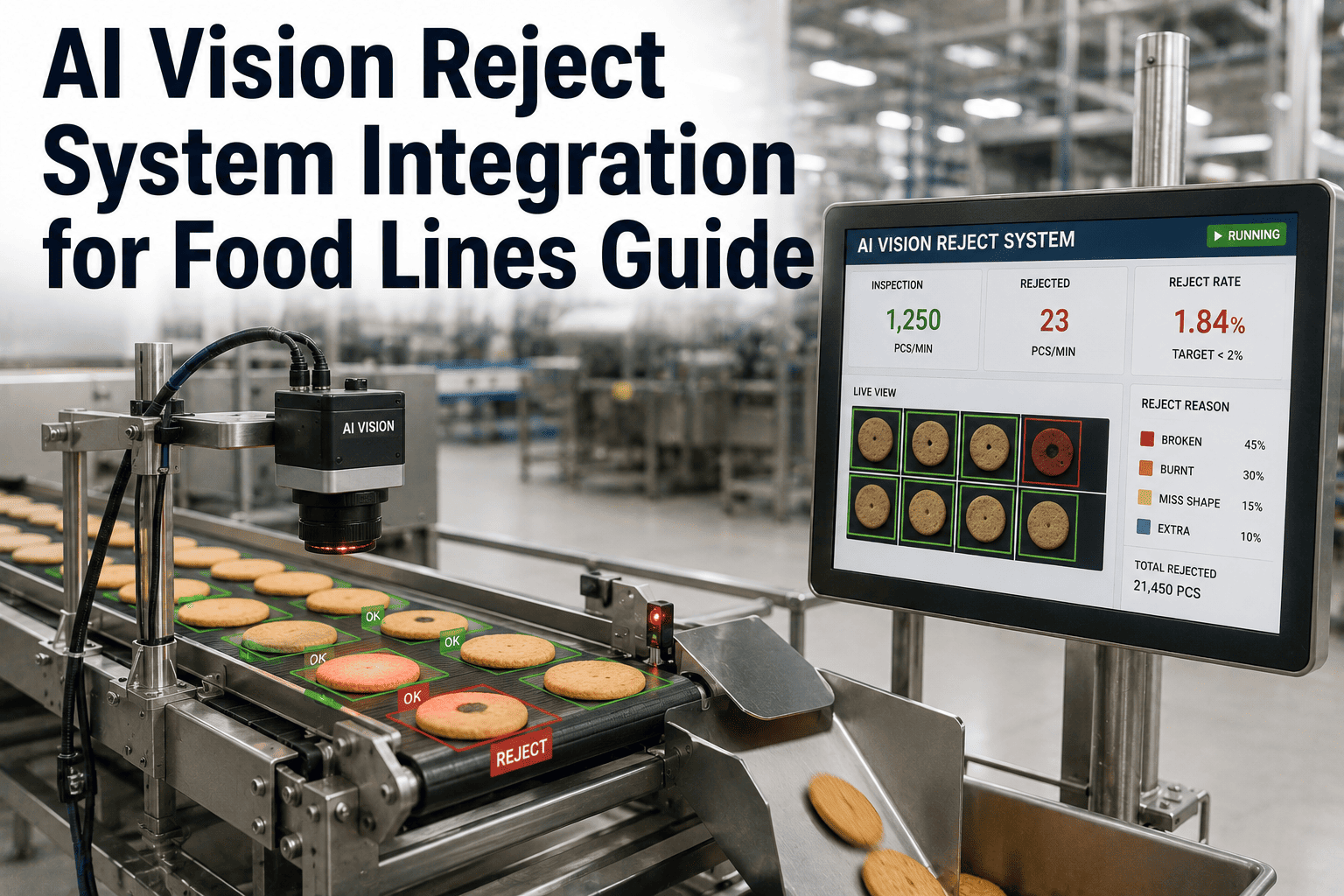
A foreign object detection system firing a reject signal is only half the story — the question nobody checks by default is whether the flagged unit actually left the production stream, or whether it bounced off a worn reject arm and rode back onto the line undetected. Reject verification is a second, independent check confirming every flagged unit reached the reject bin, and that no unit the system should have flagged slipped through as a false negative. You can audit your own reject mechanism's actual success rate with our team.
FOD System Reliability, 2027
A Reject Signal Is Not the Same as a Rejected Unit
iFactory, an on-premise AI platform for AI vision inspection, adds dual verification to existing FOD systems, confirming every flagged unit actually reached the reject bin and catching false negatives the primary detection missed.
Primary Detection — Flags Unit
Verification Camera — Confirms Bin Entry
Logged — Confirmed or Flagged for Review
What it is
What Is Reject Verification, and Why Does Detection Alone Fall Short?
Reject verification is a second inspection point, positioned after the physical reject mechanism, confirming the specific unit flagged by primary detection actually left the production stream and reached the reject bin — not just that a reject signal was sent.
A reject arm, air blast, or diverter can fail mechanically — worn components, timing drift, or a jam — without the control system ever knowing the physical reject did not happen. Without verification, a plant can run for a full shift believing contaminated product is being caught when it is not.
Two failure modes
The Two Gaps Verification Is Built to Catch
Failed physical reject
The system correctly flagged a unit, but the reject mechanism failed to remove it from the line.
False negative
Primary detection missed a contaminated unit entirely, and it was never flagged in the first place.
Both go unseen without it
A dashboard showing "100% rejects processed" can be true and still mean nothing without a second check.
How it works
Four Steps to Setting Up Dual Verification
1
Position a verification camera downstream of the physical reject mechanism, watching the reject bin and the main line path.
2
Match each primary detection event to a corresponding confirmed bin entry within an expected time window.
3
Flag any unmatched event — a flagged unit with no confirmed bin entry — for immediate operator attention.
4
Log a running reject success rate so a slow mechanical degradation shows up as a trend, not a surprise.
Comparison
Single-Point Detection vs Dual Verification
| Dimension | Single-Point Detection | Dual Verification |
|---|
| What's measured | Reject signals sent | Reject signals sent and confirmed |
| Mechanical failure visibility | Invisible until a complaint or audit | Flagged immediately as a mismatch |
| False-negative detection | None — primary detection is trusted alone | Verification camera can catch some misses independently |
| Confidence level reported | Assumed 100% based on signal count | Measured against actual confirmed outcome |
Expert review
What a Food Safety Auditor Would Check First
Holds up
Independent verification of a control's actual effect, rather than trusting the control's own signal, is a standard quality-systems principle applied here to FOD specifically.
Watch for
A reject success metric that is actually just a count of signals sent, relabeled as a confirmation rate — ask specifically whether bin entry is independently confirmed.
Do next
Audit your highest-risk line's reject mechanism first, since a mechanical failure there carries the most exposure if it has been going undetected.
FAQ
What Food Plants Ask About Reject Verification
How do we know if our current reject mechanism is actually working?
Without a verification camera, most plants only know a reject signal was sent, not whether the unit physically left the line. A verification check is the only way to measure actual bin-entry confirmation against signals sent.
Audit your own reject rate with our team.
Can reject verification catch contaminants primary detection missed entirely?
In some cases yes — a verification camera positioned on the main line path can independently flag a unit primary detection missed, functioning as a second detection layer rather than only confirming bin entry.
Ask how dual detection works for your line.
How often do reject mechanisms actually fail silently?
Mechanical reject components wear over time like any moving part, and without independent verification, a gradual timing drift or partial failure can run for an extended period before anyone notices the pattern in downstream complaints.
Does this require new hardware on an existing FOD system?
Typically a verification camera and bin-entry sensor are added downstream of the existing reject mechanism, rather than replacing the primary detection system already in place.
Discuss your current FOD setup with our team.
What should trigger an immediate operator alert versus a logged trend?
An individual unmatched event — a flagged unit with no confirmed bin entry — should trigger an immediate alert, while a slow decline in overall confirmation rate is better tracked as a trend for maintenance planning.
Set up alert thresholds with our team.