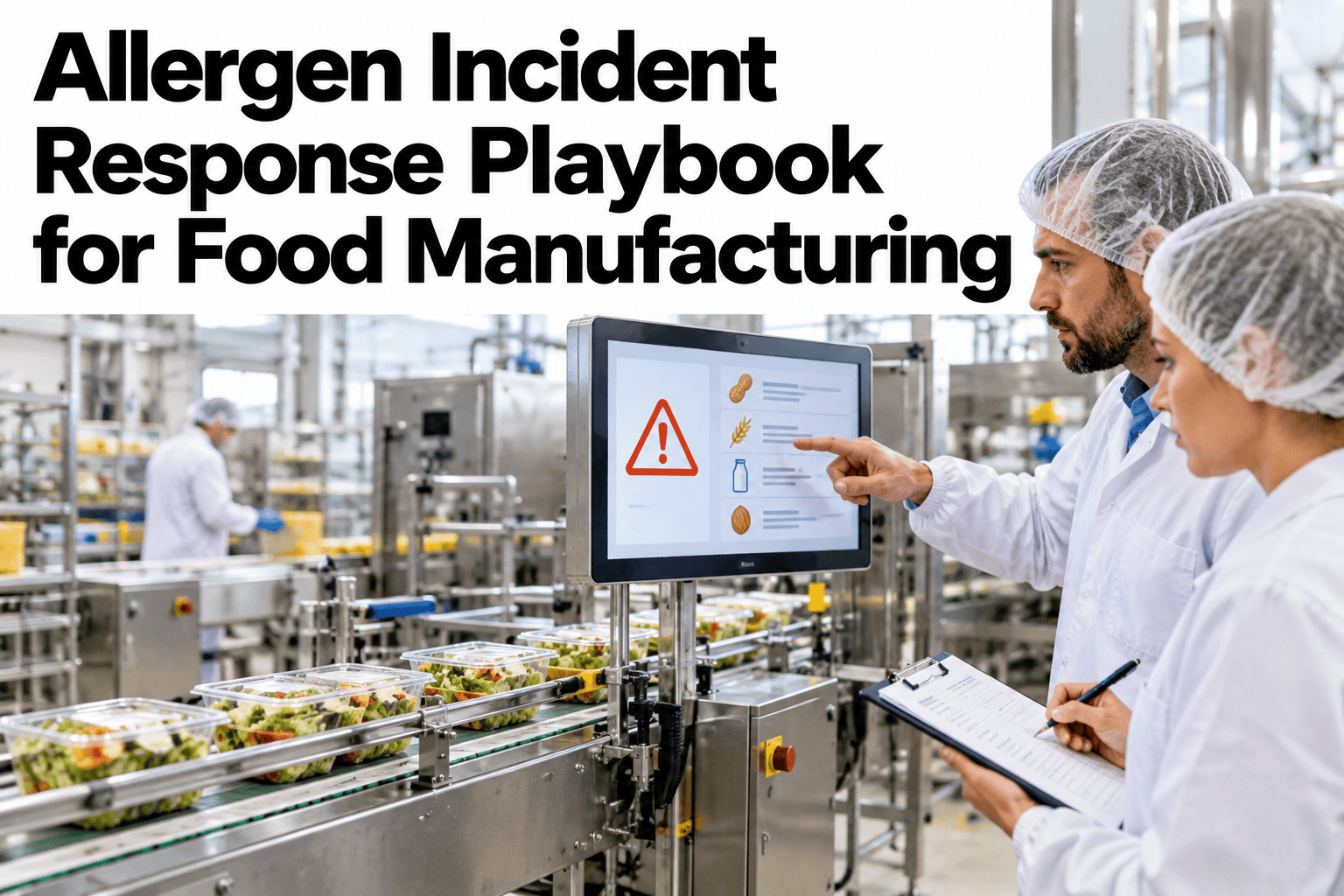
An undeclared allergen finding does not wait for a convenient time. It shows up mid-shift, often from a supplier change nobody flagged or a label mix-up on a changeover, and the plant has roughly four hours before the decision window closes on holding the batch, retesting it, or releasing it into distribution. Teams that have a written playbook move through those four hours calmly; teams that do not spend the first hour arguing about who owns the call. Quality and plant leaders can walk through a live allergen incident timeline built around their own SKUs on iFactory AI before the next finding, not during it.
The First Four Hours Decide the Batch
A structured hold-retest-release playbook turns a panicked allergen finding into a documented, defensible decision.
Why the First Hour Is the Hardest One
An allergen finding usually arrives as a half-confirmed signal: a rapid test strip, a complaint, or a supplier notice about a changed facility. Nobody wants to hold a full batch on a maybe, but releasing on a maybe is worse. A playbook exists so the first decision is made against a written threshold, not a gut feeling under pressure.
Without a named decision-maker, the hold call gets debated instead of made.
Lot numbers, line assignments and retest results live in different notebooks.
Finding every downstream lot touched by a shared line eats the clock.
Teams argue about what level of signal justifies a hold, every single time.
The Escalation Matrix
A matrix that pairs the type of signal with a required action removes the debate from the first hour. Everyone on shift can read the same row and act.
| Signal | Confidence | Required Action | Who Decides |
|---|---|---|---|
| Positive rapid test | High | Immediate hold, full trace-back | QA Manager |
| Customer complaint, symptom match | Medium-high | Hold remaining lot, begin investigation | QA Manager |
| Supplier facility change notice | Medium | Review COA, sample next production run | QA Supervisor |
| Label or changeover deviation | Medium | Hold affected run, verify label accuracy | Shift Lead + QA |
| Ambiguous visual or odor report | Low | Log, monitor, sample at next checkpoint | Shift Lead |
Turn This Matrix Into Your Plant's Own Rules
Bring your product list and current hold criteria to a 30-minute working session.
Hour by Hour: What a Clean Response Looks Like
Hold all lots touched by the shared line or equipment, not just the suspect lot.
Pull every downstream lot, shipment and customer the batch could have reached.
Run confirmatory testing on representative samples from the held lots.
Release, rework or reject, with the evidence trail attached to the record.
What Gets Logged at Every Stage
A playbook is only as strong as the record it leaves behind. Regulators and customers will ask what was known, when, and what was done about it.
What the Decision Record Needs to Survive an Audit
Regulators and customer auditors do not just want to know that the right call was made. They want to see the reasoning that got the team there, in a form that holds up months later when nobody fully remembers the shift.
That means the record should show the exact signal that triggered review, the specific lots placed on hold and why, who authorized each step, and the test results that justified the final release or rejection decision. A verbal explanation during an audit is not the same as a timestamped record built while the event was unfolding.
A Scenario: The Changeover That Almost Shipped
Picture a line that runs a peanut-containing product, then switches to a peanut-free line twenty minutes later than the schedule called for. The gap is small, but the cleaning verification record for that changeover is incomplete.
Without a playbook, the batch likely ships on schedule, because nobody has a clear rule for an incomplete cleaning record. With one, the incomplete record itself triggers a hold under the matrix above, and the batch waits for a swab test before it moves. The four-hour clock starts the moment the gap is noticed, not after someone decides it matters.
Reject vs Rework vs Release
Common Mistakes That Stretch the Four Hours Into a Day
Most delayed allergen responses are not caused by a lack of urgency. They are caused by small process gaps that each cost thirty minutes, and together eat the entire response window before a decision gets made.
A named decision-maker with written authority should not need to wait for a second sign-off on an initial hold.
Searching paper batch records for every lot that touched a shared line can take longer than the whole response window should allow.
Without a clear sampling plan, teams sometimes retest the suspect lot but miss the lots that ran just before or after it.
Internal investigation sometimes finishes before anyone remembers that shipped product needs its own notification step.
Building the Playbook With the People Who Will Use It
A playbook written by one person in an office and handed down rarely survives contact with a real shift. The strongest versions are built with input from the people who will actually execute it under pressure.
Where iFactory AI Fits
Flags the signal
Surfaces rapid test, complaint and supplier data in one place as it arrives.
Builds the hold list
Pulls every lot tied to the affected line or equipment automatically.
Tracks the clock
Shows elapsed time against your defined response window.
Stores the record
Keeps the decision, evidence and sign-off together for audit.
Metrics Worth Tracking After Every Incident
Every allergen incident, whether confirmed or a false alarm, is a chance to improve the playbook itself. A small set of metrics tracked over time shows whether the response is actually getting faster and more consistent.
| Metric | What It Tells You |
|---|---|
| Time to first hold | How quickly the signal turned into a contained batch |
| Time to complete trace-back | Whether downstream lots are found fast enough to matter |
| Percent of holds cleared vs confirmed | Whether thresholds are set at a reasonable sensitivity |
| Time to customer notification | How exposed the plant stayed after an internal decision was made |
| CAPA closure time | Whether the root cause actually gets fixed, not just documented |
A plant that only measures whether an incident happened misses the more useful question: how long did it take to respond well once it did. Tracking that number across every event, confirmed or not, is what turns a playbook from a document into a habit.
Expert Review
A food safety QA perspective, reviewed for accuracy before publication: most allergen incidents are not caused by a lack of testing, but by a lack of a pre-agreed decision rule, which forces good people to invent a process under pressure. The plants that handle findings best treat the playbook as a living document, updated after every real event, not written once and filed away. Reviewing a draft playbook against your own product mix is a useful way to find the gaps before they matter. Confirm specific regulatory requirements with your own compliance team before relying on any workflow.
Frequently Asked Questions
How fast does an allergen hold decision really need to be?
There is no universal legal deadline, but the practical window is short, since product keeps moving toward shipment the whole time. Many plants target a decision within a few hours of the first signal so the hold can still cover everything affected. See how a response window would work for your shipping schedule.
Who should have authority to call a hold?
Most plants name a QA manager or supervisor as the primary decision-maker, with a shift lead able to initiate a hold when QA is not immediately available. The key is that the authority is written down in advance, not decided in the moment. Discuss a decision authority structure for your shifts.
What if the trace-back touches product already shipped?
The playbook should extend past the plant gate, with a notification step for distributors or customers who may already have affected lots. Speed matters here too, since the same four-hour mindset applies to getting the notice out. Ask about connecting trace-back data to your shipped lot records.
How does a playbook handle a false alarm?
A good playbook treats a cleared hold as a normal outcome, not a failure, and still documents the signal, the investigation and the release decision. That record protects the plant if the same signal type recurs later. Talk through how cleared holds get documented.
Can the playbook work across multiple plants with different allergens?
Yes, the structure stays the same even though the specific allergens and thresholds differ by site. A shared template with site-specific values keeps response consistent without forcing identical rules everywhere. Explore a shared playbook template across your sites.
Have a Playbook Before the Next Finding, Not During It
iFactory AI connects the signal, the hold list and the decision record into one response you can act on fast. Book a walkthrough with your own product list.