A stainless tank that's been through five years of daily caustic wash-down cycles doesn't age the same way its depreciation schedule assumes it does. Food and beverage equipment lives a harder life than the straight-line assumption baked into most accounting software — constant sanitation chemicals, thermal cycling, and washdown environments accelerate wear well beyond what a generic useful-life table anticipates, and that gap between book value and real condition is exactly what makes a CAPEX request hard to defend at budget review. Plant finance and maintenance teams closing that gap can Book a Demo to see how iFactory ties depreciation tracking directly to maintenance condition data.
Why Food Plant Equipment Depreciates Differently Than the Books Assume
Standard depreciation schedules are built around a generic useful-life assumption that has no way to account for what's actually happening to a piece of equipment on the floor. A conveyor running in a dry goods area ages very differently from one running in a daily wash-down zone exposed to caustic cleaning chemicals and thermal cycling between hot sanitation cycles and cold product runs. The accounting schedule depreciates both assets identically based on asset class, while the wash-down unit is very likely wearing out — corroding, fatiguing, degrading — considerably faster than its book value implies. This gap between accounting depreciation and physical condition is where CAPEX planning most often goes wrong.
Three Numbers That Tell Different Parts of the Story
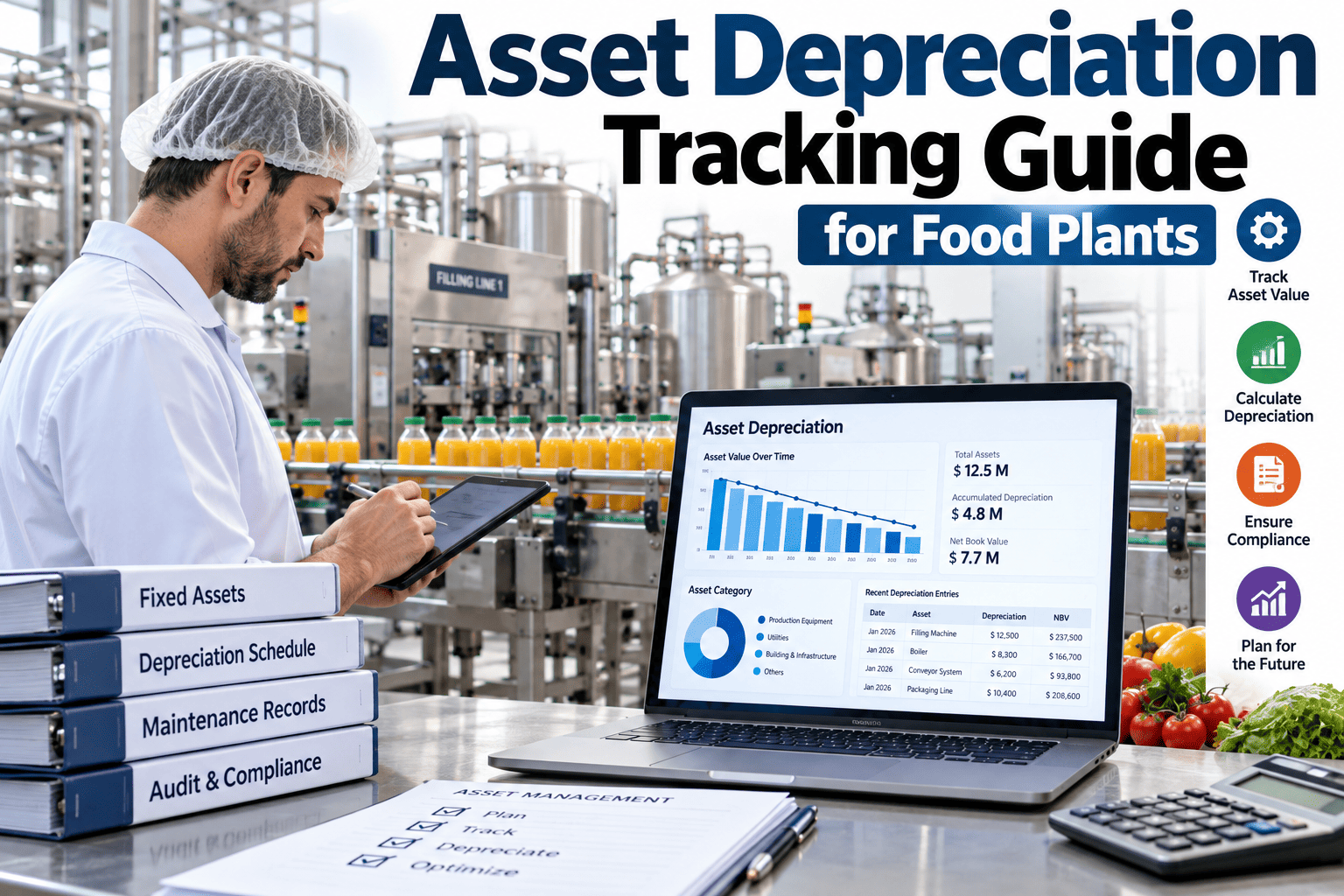
Effective asset tracking for a food plant means holding three distinct figures side by side, because each one answers a different question and no single number gives the full picture on its own. Book value answers what the asset is worth on the balance sheet today under standard accounting depreciation. Replacement cost answers what it would actually cost to replace that asset right now, which for food-grade stainless and sanitary equipment has climbed well beyond what older depreciation schedules assumed at acquisition. Remaining useful life, informed by actual maintenance and condition data rather than a generic accounting assumption, answers how much longer the asset can realistically keep running before it becomes a reliability or food-safety risk.
Straight-Line vs. Condition-Adjusted Life Estimates
Straight-line depreciation assumes an asset loses value at a constant rate across a fixed useful-life period, which is administratively simple but disconnected from how food plant equipment actually degrades. Equipment running variable duty cycles, exposed to inconsistent sanitation intensity across product changeovers, or subject to seasonal production surges doesn't wear out on a straight line at all — a piece of equipment run hard during a seasonal peak accumulates more real wear in that period than the same number of calendar months would suggest under a straight-line assumption.
| Approach | Basis | Limitation for Food Plants |
|---|---|---|
| Straight-line depreciation | Fixed calendar-based schedule regardless of actual use | Ignores wash-down intensity, duty cycle, and seasonal load variation |
| Units-of-production depreciation | Tied to actual throughput or run hours | Better reflects use, but still misses corrosion and sanitation-driven wear |
| Condition-adjusted estimate | Informed by maintenance history, inspection data, and wear indicators | Requires integrating maintenance data most finance systems don't have access to |
Building the CAPEX Case Finance Will Actually Approve
A CAPEX request built solely around a low remaining book value is a weak argument on its own, since a low book value doesn't necessarily mean an asset is failing, and finance reviewers who have seen this argument before are right to be skeptical of it in isolation. A far stronger case combines low remaining book value with concrete maintenance evidence — rising repair frequency, increasing repair cost per event, a documented corrosion or fatigue trend — and a clear replacement cost comparison showing the widening gap between what the asset is worth on paper and what replacing it would actually cost today.
Maintenance Trend Evidence
Rising repair frequency or cost per event on the specific asset, not a generic industry benchmark, makes the deterioration concrete and specific.
Replacement Cost Reality
Current market replacement cost, not the original acquisition cost years ago, shows the true financial exposure of continuing to run an aging asset.
Food Safety and Compliance Risk
Where degradation carries a hygienic design or sanitation compliance risk, this dimension often carries more weight in review than cost alone.
Sanitation Environment as a Depreciation Variable
Two identical pieces of equipment installed the same year in the same plant can have meaningfully different real remaining life purely based on which production area they sit in. Equipment in a daily full wash-down zone with caustic or acid cleaning chemicals experiences accelerated corrosion and gasket, seal, and coating degradation compared to the same equipment in a dry storage or packaging area with minimal chemical exposure. Tracking sanitation environment as a factor alongside standard asset class and age gives a far more accurate starting point for estimating real remaining life than treating every asset of the same type identically regardless of where it operates.
Frequently Asked Questions: Asset Depreciation Tracking for Food Plants
How do we estimate remaining useful life when maintenance records are incomplete for older assets?
Incomplete history doesn't prevent a reasonable estimate — starting with whatever maintenance records do exist, combined with a current physical condition assessment and comparison against similar assets in comparable service environments elsewhere in the plant, gives a workable starting estimate that improves in accuracy as ongoing maintenance data accumulates going forward. Teams can Book a Demo to review how to build condition-based estimates from partial historical data.
Should replacement cost be updated annually, or is that too frequent for practical tracking?
Annual updates are a reasonable cadence for most food-grade equipment categories, since material and fabrication costs for stainless and sanitary equipment have shown enough year-over-year movement that a replacement cost figure left unchanged for several years can understate the real gap significantly by the time a CAPEX request is finally made.
How much weight should food safety risk carry compared to pure financial depreciation in a CAPEX case?
Food safety and hygienic design risk often deserves to carry more weight than financial depreciation alone in the review process, since a failure with food safety implications carries recall, regulatory, and brand consequences that dwarf the direct repair or replacement cost, and framing the CAPEX case around this risk dimension explicitly tends to resonate more strongly with reviewers than a purely financial argument.
Can seasonal production plants adjust depreciation tracking to reflect their variable duty cycles?
Yes — a units-of-production or run-hour-based tracking approach, layered with condition data collected specifically around peak season periods, captures the accelerated wear that a seasonal surge produces far better than a calendar-based straight-line assumption that spreads wear evenly across months regardless of actual production intensity during any given period.
How do we present the book value versus replacement cost gap in a way finance finds credible?
Presenting the gap as a trend over the asset's life, rather than a single current snapshot, helps finance see that the widening difference is a predictable pattern rather than an isolated or convenient number pulled together just for this specific request, and pairing that trend with the maintenance evidence described above gives reviewers multiple independent signals pointing toward the same conclusion. Contact iFactory Support for guidance on structuring this presentation for a specific CAPEX review process.