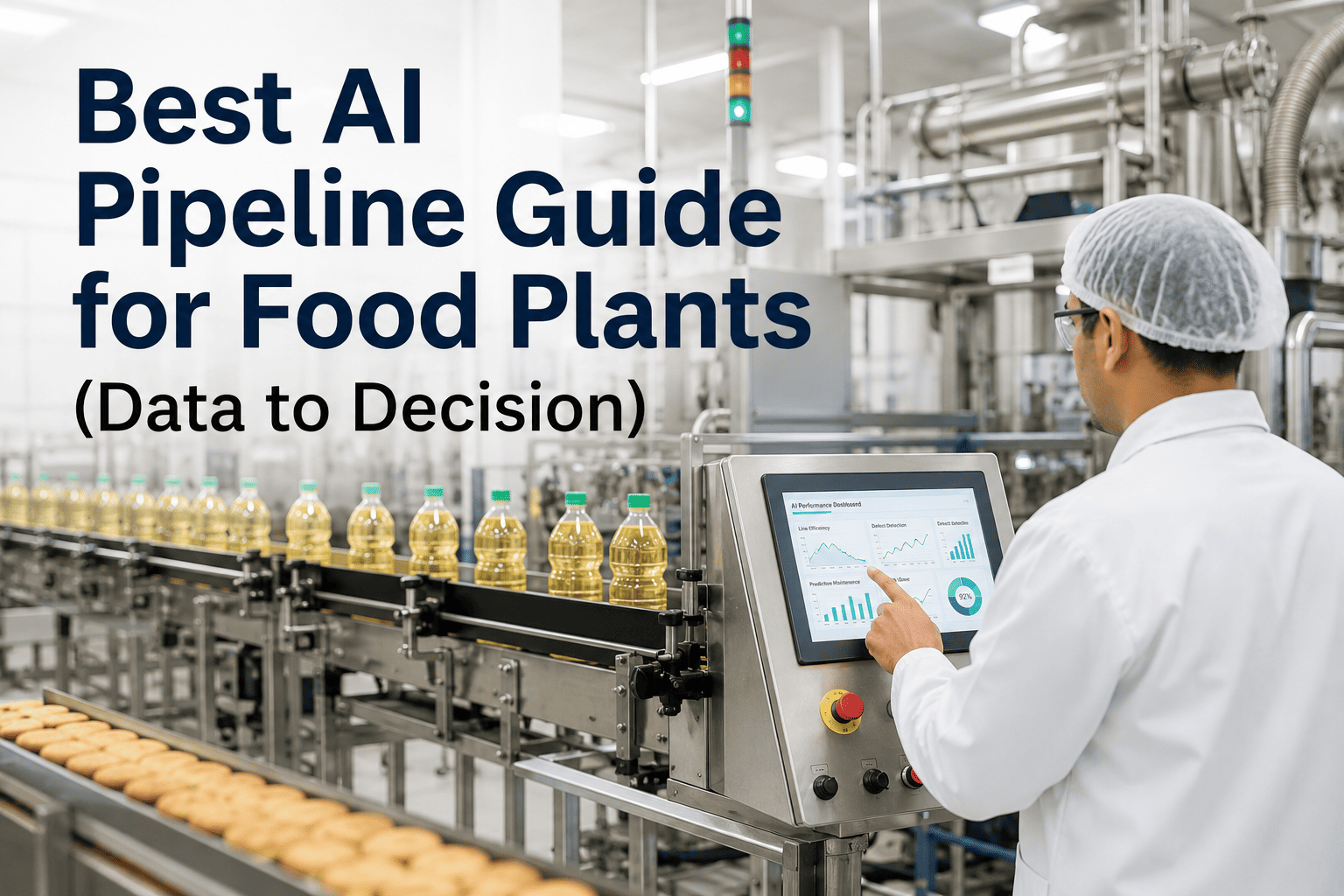
Most food plants already have more sensor and batch data sitting in historians and spreadsheets than anyone has actually used, which is exactly why "we need an AI pipeline" so often turns into a stalled project rather than a working system. The gap is rarely a lack of data, it is a missing structure connecting raw readings to a decision someone actually acts on before the batch ships. This guide walks through what a working AI pipeline looks like in a food plant, stage by stage, and where most builds quietly break down. You can book a demo to see the same pipeline mapped against your own plant's data sources.
DATA TO DECISION
The AI Pipeline Food Plants Actually Need, End to End
From raw sensor readings to a decision an operator can act on in the moment, mapped to the realities of batch variability, shift changes, and equipment that was not built with AI in mind.
WHY MOST PIPELINE PROJECTS STALL
The Break Usually Happens Between Storage and Action
Plants rarely struggle to collect data anymore, sensors on filling lines, pasteurizers, and mixers already generate a steady stream of readings. What breaks down is everything after collection: getting that data into a usable structure, engineering it into features a model can actually learn from, and then translating a model's output into something an operator can act on in real time without needing a data science background to interpret it. A pipeline that stops at a dashboard nobody checks has not actually closed the loop from data to decision.
1
Ingest
Pull readings from PLCs, historians, LIMS, and manual QA logs into a single stream, handling different formats and sampling rates without losing timing accuracy.
2
Store
Land raw and cleaned data in a structure that preserves batch, line, and shift context, since a reading without its production context is close to useless later.
3
Feature Engineer
Turn raw signals into variables that actually reflect food-specific behavior, such as rate-of-change in viscosity or drift patterns across a shift rather than a single point reading.
4
Model
Train and validate a model against the specific outcome that matters, whether that is a quality defect, a yield loss, or an equipment failure pattern.
5
Action
Surface the model's output as a specific, timely instruction an operator or supervisor can act on before the batch or shift ends, not a report reviewed a week later.
See This Pipeline Against Your Actual Data Sources
Bring your historian and MES setup to the call. We will map where each stage fits against what you already have running.
WHERE PIPELINES BREAK
Five Failure Points Worth Checking Before You Build
Most AI pipeline failures in food plants trace back to one of a handful of recurring issues, and almost all of them are avoidable if they are caught during planning rather than discovered mid-build.
ARCHITECTURE LAYERS
Four Layers That Need to Work Together, Not Just Exist
A working pipeline is not four separate tools bolted together, it is four layers designed to hand off cleanly to each other. Gaps between layers, not weakness within any single layer, are what usually cause a pipeline to underperform once it leaves the pilot stage.
Data Layer
Historians, MES, LIMS, and manual logs feeding a unified structure with consistent batch and shift tagging.
Compute Layer
Processing infrastructure sized to the plant's actual data volume, not an oversized cloud build that adds cost without adding value.
Model Layer
Trained models specific to the outcome being predicted, retrained on a schedule that matches how fast the process actually drifts.
Decision Layer
The interface, alert, or automated action that turns a model's output into something a person on the floor actually does differently.
FREQUENTLY ASKED QUESTIONS
What Plant and IT Teams Ask Before Building This
Do we need a data lake or data warehouse before we can start an AI pipeline?
Not necessarily as a first step, many plants start with a scoped pipeline covering a single line or use case that pulls directly from existing historian and MES data, and expand storage infrastructure as the pipeline proves value. Building a full data lake before proving any use case tends to slow projects down without improving the eventual outcome.
Book a demo to see a scoped pipeline design for your first use case.
How much historical data do we need before a model can be trained reliably?
It depends heavily on the outcome being modeled, but most food-specific use cases need at least several months of data covering normal seasonal and ingredient variation, since a model trained on too narrow a window will struggle the first time conditions shift outside what it has seen. Quality of context, meaning correctly tagged batches and shifts, usually matters more than raw volume.
Contact our support team to assess whether your current historical data is sufficient.
What happens if a sensor goes offline or starts reporting bad data mid-pipeline?
A properly built ingestion layer should flag missing or anomalous sensor input rather than silently passing it downstream into a model, since a model making decisions on bad input is often worse than no model at all. This is one of the most overlooked failure points in pipelines built quickly without validation checks at the ingest stage.
Book a demo to see how sensor validation is handled before data reaches the model layer.
Can this pipeline work across multiple plants with different equipment and systems?
Yes, though each plant typically needs its own ingestion mapping since equipment, sensor types, and historian configurations vary even within the same company, while the storage, model, and decision layers can often be shared or templated across sites. Treating every plant as identical at the ingestion stage is a common reason multi-site rollouts stall.
Contact our support team to discuss a multi-site rollout plan.
How often does the model layer need to be retrained once the pipeline is live?
Retraining frequency should match how fast the underlying process actually drifts, which for many food processes means a quarterly or seasonal cadence rather than continuous retraining, though some fast-changing lines benefit from monthly checks. Retraining on a fixed schedule without checking for actual drift first can waste resources or, worse, introduce instability into a model that was performing well.
Book a demo to review a retraining cadence suited to your process.
Map This Pipeline Against Your Own Systems
iFactory connects to the historian, MES, and LIMS setup you already have, without a rip-and-replace project. Book a demo to see it built around your data.