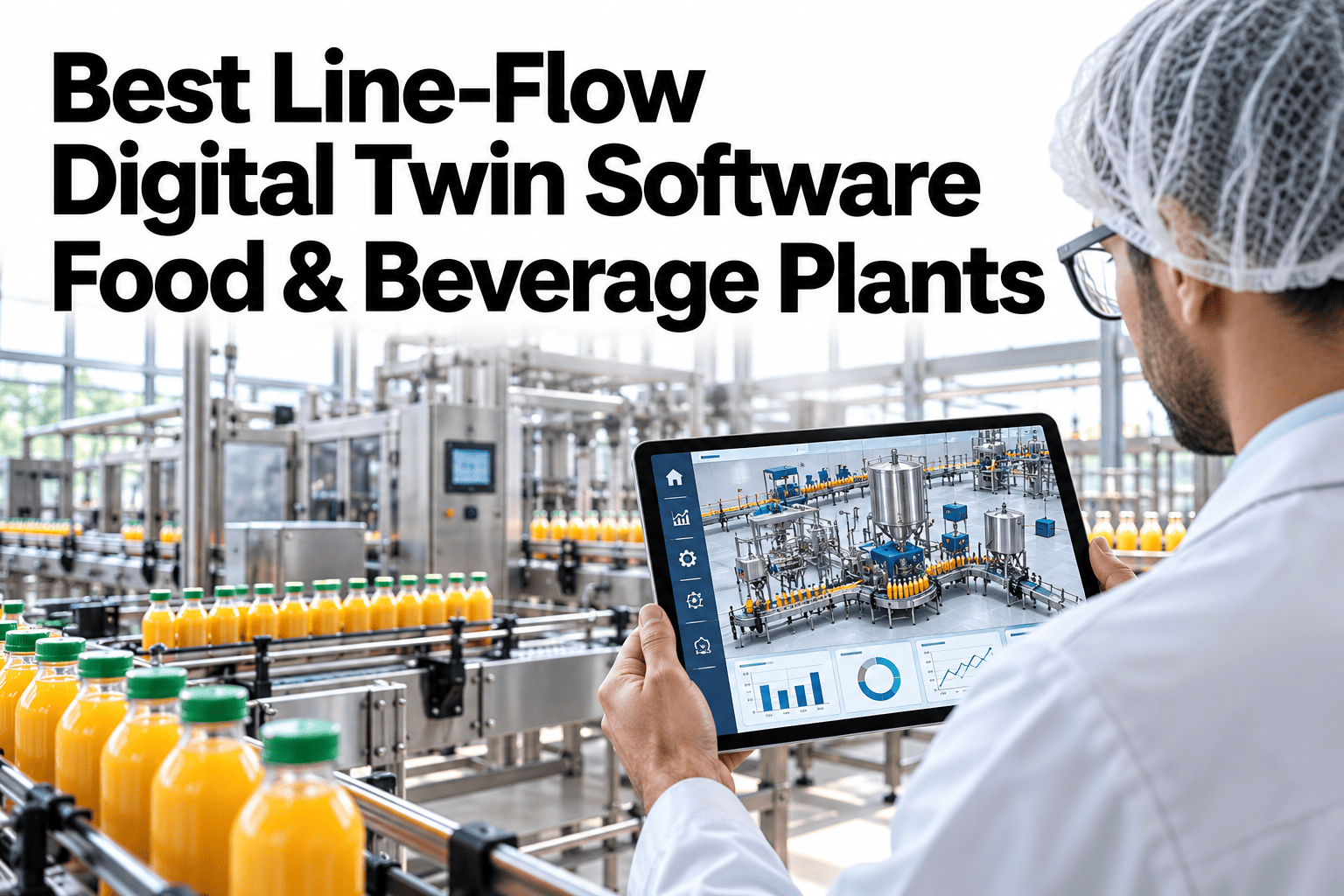
A capex meeting on Friday rarely has room for "we think it might work." A digital twin gives the room something better: a model of the actual plant that can be asked a what-if question on Thursday and defended with numbers on Friday. For food manufacturing specifically, that means modeling lines, buffers and changeovers well enough that a proposed fix can be tested before a single machine is touched. iFactory AI, an on-premise AI platform for manufacturing, builds that model from a plant's own speed and downtime data, and operations leaders can watch their own line's constraint found on a model before the next capex cycle.
Defend the Capex Decision With a Model, Not a Guess
The best AI plant digital twin software for food manufacturing models your actual lines, tests a proposed fix before you buy it, and gives you a number to defend in the capex meeting.
What Is a Plant Digital Twin, in Plain Terms?
A plant digital twin is a software model of a line's machines, buffers and product flow, calibrated against real speed and downtime data until its output matches what the plant actually produces. Once it matches, the twin can be asked a question the real line cannot safely answer on demand, such as what happens if a buffer is added or a changeover is shortened, without touching a single machine.
What Makes a Food Line Harder to Model Than a Generic Factory
Validate a Twin Against Your Own Output
Share a few weeks of line speed and downtime data and see how closely a model of your plant matches what actually happened.
Where a Twin Finds Savings Nobody Was Looking For
The most valuable finding a twin produces is often not the question someone asked, it is the side effect the model reveals while answering it. Testing a changeover fix on the cartoner might show, almost as a footnote, that a buffer resized at the same time would prevent the next bottleneck from appearing at all. That kind of compound insight rarely surfaces from a spreadsheet, because a spreadsheet does not simulate how one change ripples through the rest of the line.
This is also why running the model for more than one SKU matters. A buffer sized well for a high-volume run can be the wrong size entirely for a low-volume specialty run on the same line, and a twin built to test only one format will miss that the real constraint moves depending on what is running that day.
Three What-If Questions Worth Asking Before You Buy
| What-if question | What the twin shows | Decision it supports |
|---|---|---|
| Add a buffer between two machines | How much blocking and starving actually falls | Buy time, not just equipment |
| Shorten a changeover by five minutes | Output gain, and where the constraint moves next | Prioritize the training or tooling fix |
| Speed up the slowest machine | Whether output actually improves or the next machine limits it | Avoid a capital spend with no payoff |
A Twin Is a Living Model, Not a One-Time Report
A twin built once and never revisited slowly drifts away from the real line as equipment is replaced, products change and operating practices evolve. The useful lifespan of a twin depends on how often it gets recalibrated against fresh output data, not on how sophisticated the original build was.
Plants that treat the twin as a standing resource, checking its prediction accuracy monthly against the latest output and recalibrating when the gap widens, get far more value over time than plants that build one impressive model for a single capex decision and then let it sit unused until the next big request comes around.
How a Twin Earns the Right to Be Trusted
Mistakes That Undercut a Twin Project
What a Plant Needs Before the First Model Runs
Building a usable twin does not require a perfect data environment. It requires a few weeks of measured speed and downtime history for the line in question, agreement on which SKUs or formats matter most, and a willingness to validate the model against known weeks before trusting any new prediction it produces.
A Faster Filler Request, Reconsidered
A plant preparing a capex request for a faster filler built a twin of the line first. The model, once validated against six weeks of real output, showed the cartoner running at full availability already while the filler sat blocked for a sixth of the shift. Speeding up the filler would have added cost without adding output, because the cartoner was the real constraint. The capital was redirected to a changeover fix on the cartoner instead, which delivered a measurable output gain at a fraction of the planned cost.
What an Operations Director Would Check Before Trusting a Twin
What Food Plants Ask Before Building a Digital Twin
Walk In to the Capex Meeting With a Number
Book a session with iFactory AI to build a digital twin of your own food manufacturing line and test your next proposed fix on it first.