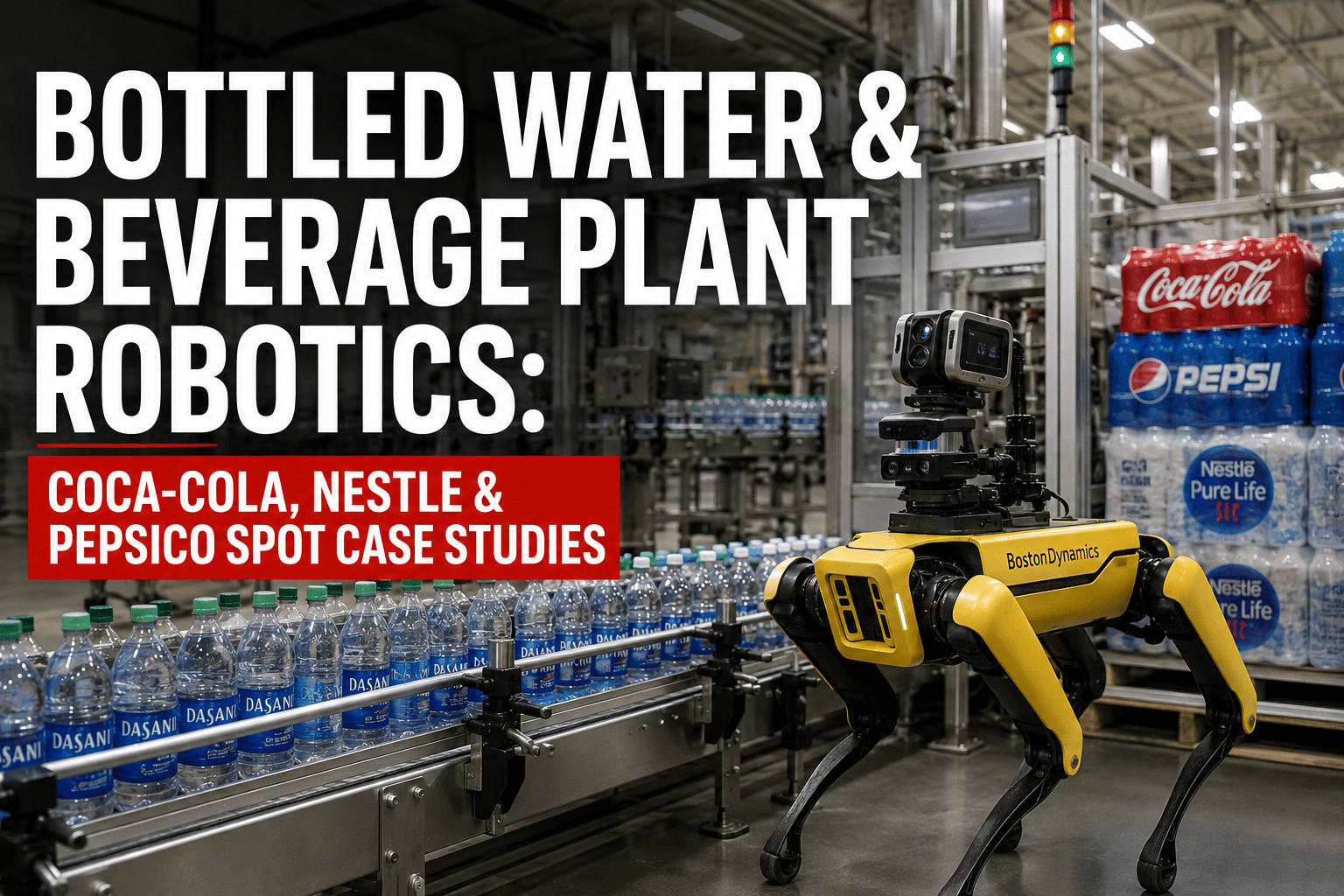
Bottled Water & Beverage Plant Robotics: Coca-Cola, Nestle & PepsiCo Spot Case Studies
By james Hart on May 26, 2026
The bottled water and beverage industry has become one of the most visible early adopters of quadruped robotics, AI vision inspection, and predictive maintenance in food & beverage manufacturing. Boston Dynamics Spot deployments have been publicly documented across major CPG manufacturing sites, and tier-1 beverage producers — including operations associated with Coca-Cola, Nestle, and PepsiCo — have published case studies on automated bottling line inspection, predictive maintenance for fillers and cappers, and AI-assisted sanitation verification. What makes these deployments operationally valuable isn't the robot — it's the AI software layer that turns inspection data into HACCP records, predictive maintenance work orders, and FSMA 204 traceability. iFactory's AI-powered CMMS provides exactly that intelligence layer for beverage plants. Book a demo to see how iFactory connects beverage plant robotics, sensors, and PLCs to a single AI platform.
Beverage Plant Robotics & AI — 2026
Bottled Water & Beverage Plant Robotics: How Tier-1 CPG Plants Are Automating Inspection & PdM
Industry case context from Coca-Cola, Nestle, PepsiCo deployments · Filler & capper PdM · Bottling line OEE · Sanitation verification · FSMA 204 traceability — beverage plant playbook 2026.
OEE achievable on monitored bottling and filling lines
50%
Reduction in unplanned downtime on filler/capper assets
48hr+
Filler bearing & capper torque failure prediction lead time
100%
CIP cycle tracking with automated SQF & BRC audit records
Why Beverage Plants Are the Leading Robotics Adopters in Food & Beverage
Beverage manufacturing — bottled water, carbonated soft drinks, sparkling water, energy drinks, juice, and dairy beverages — operates the highest line-speed, highest-volume production environments in the food industry. A single bottling line may run 60,000 bottles per hour, meaning every minute of unplanned downtime erases approximately 1,000 units of finished product. The combination of high line speed, tight CIP and sanitation windows, FSMA 204 traceability requirements, and CPG-level recall risk makes beverage plants the most natural early adopters of robotic inspection, AI vision quality control, and AI-powered predictive maintenance. Public deployments at major beverage CPG operations have demonstrated the operational value — the question for most plants is no longer "if" but "how" to build the software intelligence layer that makes the robotics investment deliver.
Beverage Plant Line Map — Where Robotics & AI Deploy
Water Treatment
Source & RO
Filtration · UV · Reverse osmosis
Sensor PdM
▶
Bottling
Fillers & Cappers
Rinsers · Fillers · Cappers · Torque
PdM + Vision
▶
Labeling
Label & Code
Labelers · Date coders · Inkjet
AI Vision
▶
Packaging
Case & Palletize
Case packers · Shrink · Palletizers
OEE + PdM
▶
Warehouse
Cold Chain
Cold storage · Shipping · FSMA 204
Traceability
Three Operational Problems Beverage Plants Solve With AI
01
Filler & Capper Failures That Stop the Entire Line
Beverage bottling lines are sequentially coupled — a filler failure stops the rinser, the capper, the labeler, and the palletizer instantly. Capper torque drift, filler valve wear, and drive motor bearing degradation are the most common unplanned downtime drivers, and all of them progress invisibly until failure. iFactory's AI predictive maintenance models — trained on food-grade equipment patterns including fillers, cappers, and bottling conveyors — analyse vibration, motor current, and torque data and predict failures 48 hours or more in advance. Work orders auto-generate with required spare parts, enabling scheduled service rather than emergency response during peak production.
48hr+ filler PdMCapper torque monitoringAuto work orders
02
CIP and Sanitation Validation Under SQF, BRC, FSSC 22000 Audit Pressure
Beverage plants run Clean-in-Place cycles between every product changeover, every shift, and at defined frequencies on every wetted surface. Failed CIP cycles create microbial risk, batch holds, and audit findings. Manual CIP logbook entry is error-prone and slow to retrieve during audits. iFactory's CIP tracking continuously monitors flow rates, chemical concentrations, rinse temperatures, and contact times — automatically capturing every cycle's parameters in immutable digital records. Failed cycles trigger re-wash notifications and can lock out line restart until verification is complete. Audit packs are pre-formatted for SQF, BRC, and FSSC 22000 retrieval. Book a demo to see CIP automation for your bottling lines.
CIP auto-trackingLine lock-out on failureSQF / BRC ready
03
FSMA 204 Traceability for Multi-SKU, Multi-Lot Beverage Operations
Beverage CPG operations run dozens of SKUs across multiple lines, with shared filler heads, label changeovers, and raw material lots cycling through production every shift. FSMA 204 requires Key Data Elements captured at every Critical Tracking Event — receiving, processing, packaging, shipping — and one-click trace-back reports in recall scenarios. iFactory configures FSMA 204 traceability for your specific SKU portfolio, mapping CTEs to your bottling line topology and capturing lot data automatically through SAP, Oracle, and PLC integrations. Trace reports that previously required hours of binder cross-referencing become one-click retrievals.
Multi-SKU FSMA 204CTE mapped to linesOne-click trace reports
What Tier-1 Beverage Plants Have Publicly Deployed
Public industry coverage of beverage CPG robotics adoption provides useful context for what tier-1 deployments look like. The pattern is consistent: robotic and AI vision platforms capture inspection data, and a software intelligence layer translates that data into compliance records, maintenance workflows, and OEE dashboards. iFactory is the intelligence layer — purpose-built for food & beverage. Contact iFactory to discuss your beverage plant integration scope.
Beverage Category
Common Robotics & AI Use
iFactory Integration Output
Why It Matters
Bottled Water
Filler PdM · AI vision QC
HACCP CCP automation · OEE dashboards
High line speed makes every minute of downtime a 1,000-unit loss
Carbonated Soft Drinks
Capper torque PdM · CO2 monitoring
Capper torque alerts · CIP automation
Capper torque drift creates leakers and consumer-facing quality failures
Sparkling Water
Carbonation control · label vision
FSMA 204 trace · audit pack
High-mix SKU operations need automated lot-to-line traceability
Energy Drinks
Filler valve PdM · allergen control
Allergen workflows · changeover sign-off
Caffeine, taurine, and ingredient changeovers require validated procedures
Juice & Dairy Beverages
Pasteurizer PdM · cold chain monitoring
Cold chain temperature logs · CCP records
Pasteurization and cold chain are CCPs that require continuous documentation
Beer & Hard Seltzer
Brew PdM · bottling line OEE
OEE dashboards · maintenance scheduling
Brew cycle and tank cleaning timing directly impacts plant throughput
Coffee & RTD Tea
UHT processing PdM · vision QC
Sanitation verification · audit records
UHT processing failures lead to spoilage and consumer complaints
Beverage Plant Use Cases: What iFactory Automates on Each Line
Filler Line
Filler & Capper Predictive Maintenance
Monitoring: Continuous
iFactory's predictive maintenance models continuously analyse vibration, motor current, capper torque, and drive bearing condition on bottling lines. Pre-built templates cover the most common filler and capper architectures used across tier-1 beverage plants — rotary fillers, gravity fillers, pressure fillers, screw cappers, and crown cappers. Failure prediction signals are generated 48 hours or more in advance, allowing belt service, valve replacement, and torque calibration to be scheduled during planned downtime instead of stopping a running line.
Failure prediction48hr+ advance warning
Downtime impact50% reduction on monitored equipment
CIP Cycle Tracking and Automated Sanitation Verification
Monitoring: Per cycle
Every CIP cycle on every bottling line, tank, and pipeline is captured automatically — flow rates, chemical concentrations, rinse temperatures, and contact times logged with timestamps. Failed cycles trigger re-wash notifications and the platform can lock out line restart until verification is complete. Photo evidence is captured at sign-off. The full cycle history is pre-formatted for SQF, BRC, and FSSC 22000 audit retrieval — eliminating the hours of binder searching that conventional CIP logbooks require. Contact iFactory about CIP integration with your line PLCs.
Parameters trackedFlow · temp · concentration · contact time
AI vision cameras at the labeler, date coder, and case packer stations capture every bottle's label position, date code legibility, fill level, and cap seating — feeding image data to iFactory's vision processing layer running on the NVIDIA AI server. Defect events trigger automatic line alerts, reject mechanism activation, and immutable visual evidence capture for the lot record. Vision data also supports allergen changeover verification — confirming the correct label SKU is running on the correct production line before the first case is sealed.
Vision checksLabel · date code · fill · cap seating
FSMA 204 Lot Tracking Across Multi-SKU Bottling Operations
Monitoring: Per lot
iFactory captures Key Data Elements at every Critical Tracking Event across the beverage plant — incoming raw water, ingredient batches, syrup mixing, filling, packaging, palletizing, and outbound shipping. Lot data flows through SAP, Oracle, and PLC integrations into the platform automatically, building the trace record without manual entry. When a recall or audit scenario requires trace-back, one-click reports retrieve every lot, line, time window, and downstream destination. The same data supports OEE reporting per SKU and per line.
KDE captureAutomatic at every CTE
Trace reportsOne-click retrieval
What iFactory Delivers for Beverage Plants
85%+
OEE achievable on monitored bottling and filling lines
Real-time loss analysis and root cause data from PLC and sensor integration
50%
Less unplanned downtime on monitored equipment
48hr+ failure prediction on fillers, cappers, and conveyors
Fillers, cappers, conveyors, packaging pre-configured at install
FAQ: Beverage Plant Robotics and AI Integration
iFactory works with food and beverage manufacturers across the industry. Customer deployments are governed by confidentiality agreements, so specific facility-by-facility references are shared during qualified buyer conversations under NDA. References to Coca-Cola, Nestle, and PepsiCo in industry context throughout this page reflect publicly documented robotics and AI adoption in the broader beverage CPG sector — not direct claims about iFactory customer relationships. For a discussion of relevant deployments and customer references for your beverage operation, book a scoping call with iFactory's team. Book a demo to discuss applicable customer references for your plant.
iFactory is a software intelligence layer — not a hardware vendor. The platform integrates with inspection data from any source already in your plant, including fixed PLC sensors, SCADA systems, IoT temperature loggers, mobile inspector devices, AI vision cameras, and robotic platforms such as quadruped robots. When a Spot or similar robot captures vibration, thermal, or visual data on bottling line equipment, that data feeds iFactory's predictive maintenance models and audit-ready record system. The robot itself is sourced and deployed by your facility — iFactory provides the intelligence layer that turns the data into operational outcomes.
iFactory's pre-built food & beverage templates cover the equipment families that run beverage plants — fillers and bottlers (rotary, gravity, pressure), cappers, conveyors (belt, modular, sanitary), mixers and blenders, pasteurizers, packaging lines (case packers, shrink, palletizers), ovens and fryers, and boilers and steam systems. Each template includes asset hierarchy, common failure modes, recommended preventive maintenance intervals, and HACCP-relevant inspection points. Pre-built templates combined with guided data migration and 90-day implementation support enable 1-2 week deployment instead of the multi-month rollout that legacy CMMS platforms require. Contact iFactory to review template coverage for your equipment list.
iFactory configures FSMA 204 traceability for your specific SKU portfolio and bottling line topology during the implementation phase. Key Data Elements are captured at every Critical Tracking Event — incoming raw materials, intermediate processing, filling, packaging, and outbound shipping — through SAP, Oracle, and PLC integrations rather than manual entry. The platform supports multi-SKU operations where shared filler heads, label changeovers, and ingredient lots cycle through production every shift. One-click trace reports retrieve every lot, line, time window, and downstream destination for recall or audit scenarios. The platform also supports FDA, HACCP / HARPC, SQF, BRC, FSSC 22000, GMP, and FDA 21 CFR Part 11 — covering the full compliance footprint of a tier-1 beverage operation.
Yes. iFactory provides standard integrations for the systems most common across beverage plants — SAP, Oracle, Rockwell, Siemens, and Wonderware — among more than one hundred supported integrations. PLC and SCADA telemetry, ERP lot data, and shop floor inspection records flow into the platform through configured connectors rather than custom integration sprints. The pre-built integration tooling is what enables 1-2 week deployment timelines on the iFactory platform itself, and supports the broader 12-week turnkey program for plants deploying alongside new NVIDIA AI server infrastructure.
Deploy iFactory for Your Beverage Plant Operations
AI-powered CMMS purpose-built for food & beverage — connecting bottling line PLCs, AI vision cameras, robotic inspection data, and ERP lot records into a single intelligence layer. HACCP automation, CIP tracking, allergen control, FSMA 204 traceability, and 48hr+ failure prediction on fillers, cappers, and conveyors. 1-2 week deployment with pre-built bottling line templates and 90-day implementation support.