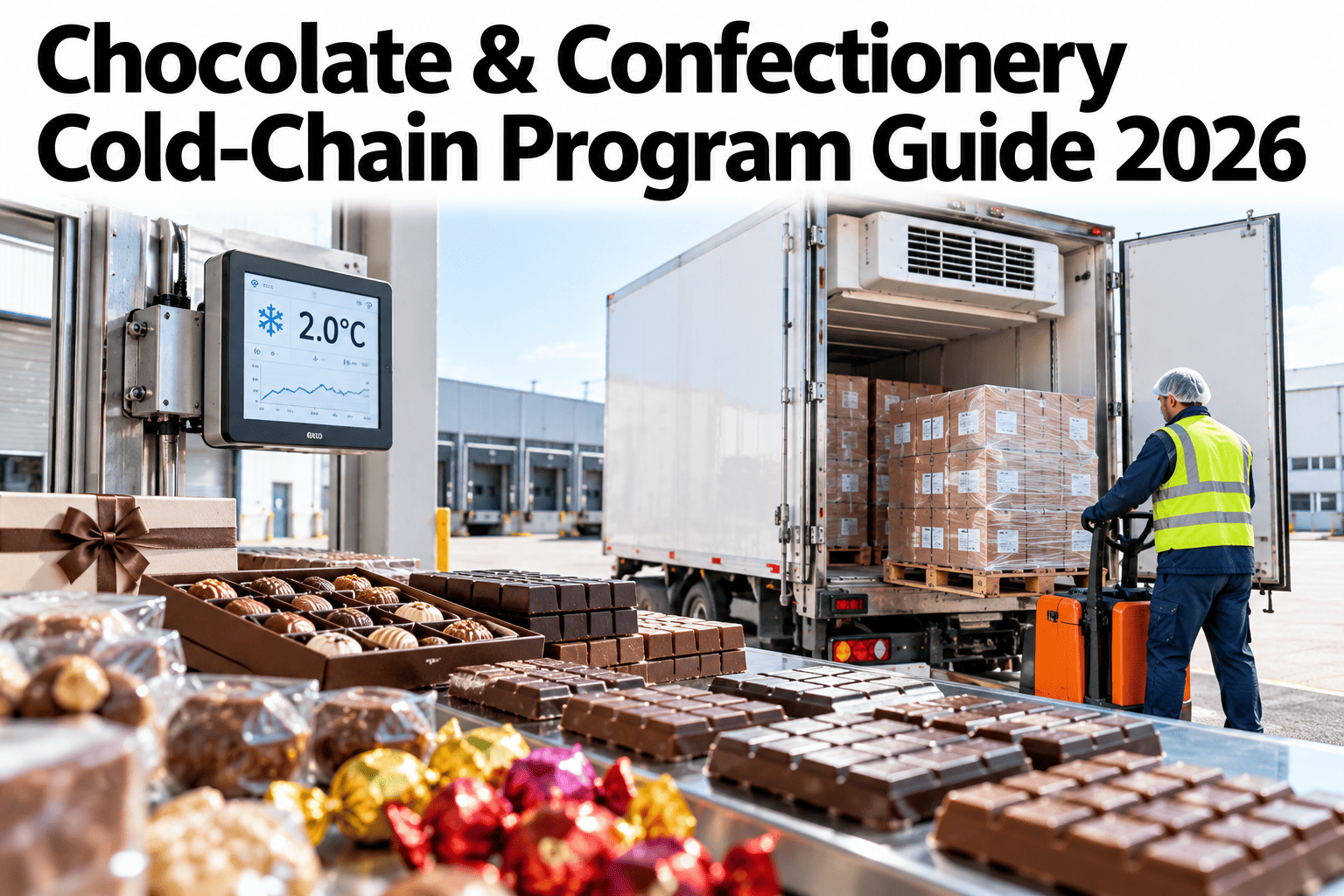
Chocolate is unusually sensitive to temperature swings. A pallet that never triggers a cooler alarm can still develop a dull, whitish film called bloom after repeated warming and cooling, or after moving between cold and warm areas with moisture around. Many plants watch only for faults in the cold store and miss the earlier steps where risk builds. A confectionery thermal programme reads risk along the whole chain, not just inside the cooler. To see how this could work for your products, you can review a thermal risk map with our team.
Cold-chain quality for confectionery
Protect Chocolate From Bloom by Reading Thermal Risk Before the Cooler Alarms
iFactory AI tracks temperature, humidity and handling along the confectionery chain, so teams act on early risk instead of late faults.
Where chocolate quality is won or lost
StorageTransfersHumidityTransport
The problemBloom Often Starts Where Nobody Is Looking
Bloom is a visual and quality defect rather than a safety issue, but it destroys shelf appeal and triggers returns.
Warm spell
Product warms slightly during storage or transit
Cool down
Fat or sugar structure changes as temperature falls
Surface change
A grey or white film begins to form
Complaint
The customer sees it long after the event
The damage is gradual and cumulative, so a single alarm rarely tells the story.
Types of riskSix Thermal Risks in a Confectionery Chain
Fat bloom
Repeated warming and cooling can move fat to the surface.
Sugar bloom
Moisture on cold product dissolves sugar that recrystallises as a dull film.
Melting and deformation
High temperatures soften shapes and ruin packaging.
Condensation
Cold product moved into warm, humid air collects moisture.
Cold shock
Moving from cold to warm too quickly stresses the product.
Cumulative stress
Many small excursions add up over weeks.
Recipes and products differ. Confirm safe storage ranges with your recipe developers and suppliers.
Temperature and humidityStorage Guidance Is Often a Narrow Band
Many sources suggest storing chocolate in a cool, stable range, often somewhere in the mid teens Celsius, with moderate humidity. Exact needs vary by product.
| Stage | What matters | Typical risk |
|---|
| Finished goods storage | Stable temperature and moderate humidity | Slow swings cause gradual bloom |
| Dock and transfer | Short, controlled exposure | Condensation when cold product meets warm air |
| Transport | Even temperature through the journey | Hot trailers and delays |
| Retail and customer storage | Beyond your control but you can guide packaging | Display lighting and warm shelves |
| Return and rework | Clear criteria for what can be reused | Hidden heat history |
Stability matters as much as the number. A steady temperature slightly above ideal can be safer than a cycle across a wide range.
Map the Thermal Risk in Your Confectionery Chain
Share your storage, transfer and transport steps and see how iFactory AI would show where risk builds up.
The transfer stepMoving From Cold to Warm Without Condensation
1
Cool stage
Product sits in cold storage.
2
Acclimatise
Move to a buffer area with intermediate conditions.
3
Check conditions
Monitor product and air temperature and humidity.
4
Release
Open or move product when it is safe from condensation.
Moisture forms when cold surfaces meet warm, humid air. A controlled buffer step prevents most problems.
Risk gridTemperature Swings and Humidity Together
Condition
Stable temperature
Large swings
Moderate humidity
Lower risk
Good conditions for storage
Check packaging
Moisture risk in sealed or open packs
High humidity
Fat bloom risk
Cycling is the main concern
Highest risk
Swings and moisture combine
Aim to keep both temperature and humidity stable, especially in transfer areas and during peak seasons.
Programme elementsFive Parts of a Thermal Programme
1
Map the chain
List every place product stays or moves, from line to customer.
2
Set ranges
Agree temperature and humidity limits by product type.
3
Monitor early
Place sensors at transfer points, not only in cold stores.
4
Respond to patterns
React to repeated small excursions, not only big ones.
5
Review complaints
Link returns to temperature history by batch.
A programme with these five parts finds problems earlier than alarm-only monitoring. To build yours, ask our team for a confectionery monitoring template.
Before and afterWhat an Earlier View Changes
Track the same measures before and after introducing thermal monitoring. This view is illustrative.
Alarm-only monitoring
Link from complaint to cause
Batches with known thermal history
Thermal programme
Link from complaint to cause
Batches with known thermal history
RolloutFive Steps to a Thermal Programme
1
Map and measure
Place temporary sensors along the chain for two to four weeks.
2
Find the weak points
Look for swings, long dwell times and humidity peaks.
3
Set limits and alerts
Agree ranges and early warning levels.
4
Fix the top issues
Add buffers, improve transport and adjust storage.
5
Review by batch
Link thermal history to quality results.
Chain map from production to customer
Temperature and humidity ranges set per product
Sensors at dock, transfer and transport stages
Alerts for repeated small excursions
Acclimatisation steps for cold-to-warm moves
Batch-level temperature history stored
Complaint review linked to thermal data
Seasonal review for summer and winter risks
Expert reviewWhat a Confectionery Quality Manager Would Check First
Expert review
For chocolate, the pattern matters more than a single reading. Repeated small swings and moist transfers do quiet damage that a simple alarm cannot show.
VerdictStrong when monitoring covers transfers and humidity as well as cold stores.
Watch forThresholds that only trip on large events and miss repeated small ones.
Do nextMap one product's journey and look for swings and condensation points.
Frequently asked questionsWhat Confectionery Teams Ask About Cold-Chain Programmes
What temperature should chocolate be stored at?
Guidance often points to a cool, stable range in the mid teens Celsius with moderate humidity, but the right range depends on the recipe, packaging and customer requirements. Confirm with your development team and suppliers.
Discuss ranges for your products.
What causes bloom?
Fat bloom is linked to temperature changes that move fat to the surface, and sugar bloom to moisture dissolving sugar that later recrystallises. Both are quality defects, and both can build without any major alarm.
Ask about bloom prevention.
Why monitor humidity as well as temperature?
Humidity drives condensation and sugar bloom, especially when cold product moves into warmer air. A temperature reading alone can miss the risk.
See humidity monitoring options.
How can we link complaints to the cold chain?
Keep temperature history by batch and compare it with complaint data. Patterns often show which transfer, route or season causes the problem.
Ask about batch linking.
Is cold storage always better for chocolate?
Not always. Very cold storage can cause condensation when product warms, so many plants use controlled cool storage with acclimatisation steps. Match the approach to the product.
Plan a storage review.
Stable temperature, stable quality
Protect Your Chocolate Before the Bloom Appears
Book a session with iFactory AI to map your thermal risks, add early monitoring and link every batch to its temperature history.