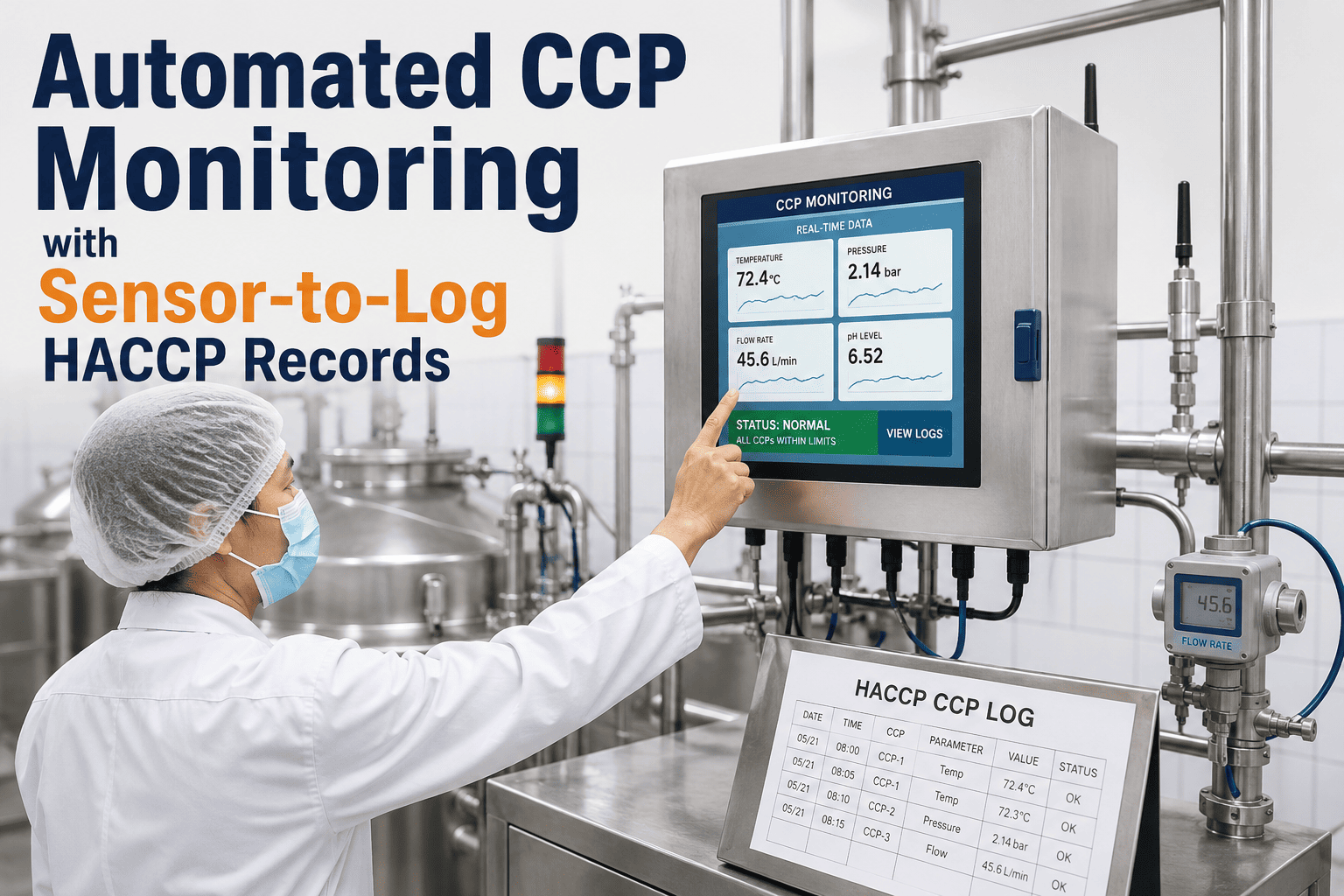
A CIP cycle that completes on schedule is not the same thing as a CIP cycle that actually cleaned. Without real-time sensor data, quality teams are effectively trusting that a wash worked because the timer ran out, not because any instrument confirmed soil was removed or chemistry stayed in range. Inline conductivity, turbidity, and flow sensors turn that blind trust into continuous, objective verification, catching failures the moment they happen instead of during the next scheduled swab test, and that shift is exactly what a Book a Demo of iFactory's CIP monitoring platform demonstrates in real production data.
CIP MONITORING · REAL-TIME SENSORS · CLEANING VERIFICATION
See CIP Cleaning Performance in Real Time, Not After the Fact
iFactory's inline conductivity, turbidity, and flow sensors verify every CIP cycle as it runs, flagging deviations before product goes back on the line.
The Blind Spot in Timer-Based CIP Verification
Most CIP systems still rely on a programmable logic controller simply running each wash phase for a preset duration, with no independent instrument confirming that chemistry concentration, rinse quality, or flow actually met the parameters the cycle was designed around. That approach works fine until a dosing pump drifts out of calibration, a spray ball partially clogs, or a heat exchanger begins fouling, and none of those failures trip an alarm because the timer still runs to completion regardless of what is actually happening inside the equipment.
Conductivity
Live
Confirms caustic and acid concentration and detects incomplete rinse carryover in real time
Turbidity
Live
Detects suspended soil particles in return flow, signaling when a surface is still dirty
Flow Rate
Live
Confirms turbulent flow velocity is maintained across the full pipeline circuit
Temperature
Live
Verifies each wash phase stays within the chemistry's validated effective range
Sensor Technologies
What Each CIP Monitoring Sensor Actually Tells You
Each sensor type answers a different question about cycle performance, and a complete monitoring program layers all three so a failure in one area cannot hide behind a pass in another. Plants that want a sensor mapping specific to their existing CIP skid can request one directly through Book a Demo.
Conductivity Sensor
Chemical Concentration Confirmation
Inline conductivity probes measure dissolved ion content in real time, giving a direct proxy for caustic and acid concentration without needing a manual grab sample and lab titration, and they also confirm final rinse water has returned to baseline conductivity before the line is released.
Turbidity Sensor
Soil Detection in Return Flow
Turbidity sensors detect suspended particulate in the CIP return line, providing an early indicator that a surface is still shedding soil well before a downstream ATP swab test would catch the same failure, often in time to extend the cycle automatically.
Flow Sensor
Turbulent Flow Confirmation
Flow meters confirm that pipeline velocity stays above the turbulent flow threshold throughout the cycle, catching partial blockages, pump degradation, or valve failures that would otherwise silently reduce cleaning effectiveness without tripping any other alarm.
Temperature Sensor
Chemistry Effectiveness Range
Temperature sensors placed at multiple points along the circuit confirm heat is maintained consistently, not just at the supply tank, since heat loss across long pipeline runs can quietly drop wash temperature below the chemistry's effective range by the time fluid reaches the far end of a circuit.
CIP INSTRUMENTATION · AUTOMATED MONITORING
Stop Finding Out About CIP Failures After the Fact
iFactory installs and integrates conductivity, turbidity, and flow sensors on your existing CIP skids, giving quality teams live visibility into every cycle as it runs.
Performance Comparison
Timer-Based vs. Sensor-Verified CIP Monitoring
The gap between assuming a cycle worked and proving it worked comes down to whether an independent instrument, not just a timer, confirmed the result. The comparison below reflects operational differences plants typically report after adding inline monitoring to previously timer-only CIP circuits.
Timer-Based vs. Sensor-Verified CIP Monitoring
Frequently Asked Questions
CIP Monitoring Sensors — Frequently Asked Questions
Can CIP monitoring sensors be retrofitted onto an existing skid?
Yes, inline conductivity, turbidity, and flow sensors can typically be installed on existing CIP piping and return lines without replacing the underlying skid, since most sensor technologies use standard sanitary fittings that integrate into current pipe runs with minimal downtime during installation.
How accurate are turbidity sensors at detecting soil in CIP return flow?
Modern inline turbidity sensors detect suspended particulate at concentrations well below what would be visible to the naked eye, making them effective at flagging incomplete soil removal during the cycle rather than waiting for a post-cycle swab test to catch the same failure hours later.
Do sensor readings replace the need for ATP swab testing?
Sensors and swab testing serve complementary roles. Inline sensors provide continuous, real-time process verification during the cycle, while ATP swabbing provides a direct, surface-level confirmation of biological cleanliness. Most validated programs use both rather than relying on either method alone.
How does sensor data integrate with existing batch record systems?
iFactory's platform streams sensor data directly into structured cycle records that link to batch number, equipment ID, and timestamp, and this data can be pushed to existing MES or quality management systems in real time, eliminating manual transcription from a separate data logger.
What happens when a sensor detects a parameter out of range mid-cycle?
The system can be configured to automatically extend the affected phase, trigger an operator alert, or hold the line from returning to production until the parameter comes back within range, depending on how the deviation response is configured for that specific equipment and soil type.
CIP MONITORING · REAL-TIME VERIFICATION · 2026
Get Real-Time Visibility Into Every CIP Cycle in Your Plant
iFactory integrates conductivity, turbidity, and flow sensors directly into your existing CIP infrastructure for continuous, audit-ready cleaning verification.