An SQF auditor's first request is rarely a policy document — it is "show me a user record." If three technicians share one login, or the person who created a work order is the same person who approved it, the audit finding writes itself before the auditor even looks at a single maintenance record. Role and permission design is not an IT afterthought in a food plant; it is the control that determines whether your maintenance records hold up as trustworthy evidence or collapse under the first serious question. Book a demo to see how iFactory structures roles and e-signatures to survive SQF, BRC, and FDA scrutiny.
CMMS Security → Roles & Permissions Guide for Food Plants
A Shared Login Is Not a Convenience for Your Floor. It's an Audit Finding Waiting to Be Written Down.
Every action in a food plant CMMS maps to a permission, and every permission maps to a role. Get that mapping wrong — shared accounts, no separation between who creates and who approves, contractor access that never gets revoked when the engagement ends — and the maintenance records your team is proud of quietly become evidence working against you instead of for you.
40-60%
Of food and pharma manufacturers show significant gaps in electronic records compliance
10-50x
Cost of non-compliance versus the cost of implementing a properly designed compliant CMMS
1st Hour
How quickly auditors typically find shared accounts and undeactivated former-employee credentials
The Governing Principle Explained
Least Privilege: Every Single User Gets Exactly What Their Job Requires, Nothing More
The single design principle underneath every audit-ready permission structure is simple to state and consistently hard to enforce in daily practice: a user should have access to exactly the functions their job requires, and no more than that. New users start conservative, at the most restricted level appropriate to their role, and access expands only through a documented request, never by default assumption.
Minimizes Attack Surface
Fewer people with elevated access means fewer accounts that could compromise records, whether through simple error or genuine bad intent, and fewer accounts an auditor needs to individually justify during a thorough review of the whole system.
Simplifies the Audit Itself
When permissions map cleanly to job function, an auditor can verify the logic in minutes. When they don't, every account becomes a separate conversation about why that specific person has that specific access level.
Contains the Blast Radius
A contractor account with admin-level access can inadvertently delete asset history or overwrite PM schedules. The same permission that "gets the job done faster" is the one that can undo years of documentation in a single careless mistake.
The Full Role Structure
Five Distinct Roles, Five Distinct Permission Profiles for the Whole Plant
A food plant CMMS role structure should mirror the plant's actual accountability hierarchy — not a generic three-tier template borrowed from a different industry that does not share the same food-safety documentation burden. These five roles cover the access patterns that consistently hold up under SQF, BRC, and FDA scrutiny during a real audit.
| Role |
Can Do |
Cannot Do |
| Technician |
Execute assigned work orders, log completion details with photos and technical notes, e-sign their own completed work when finished |
Approve their own work order, delete records, modify PM schedules or asset templates, alter any historical data on file |
| Supervisor |
Assign work orders, review and approve completed technician work, escalate exceptions to QA or plant management as needed |
Approve their own submitted work, permanently delete audit trail entries, modify user roles or permission templates directly |
| QA / Food Safety |
Review CCP-linked work orders in detail, verify sanitation sign-offs, flag non-compliant records for correction and re-submission |
Edit the underlying maintenance record itself directly — QA verifies and flags, it does not rewrite the original technician history |
| Auditor / Read-Only |
View any record across the entire plant, generate compliance reports, export audit-trail evidence on demand for review |
Create, edit, approve, or delete anything at all in the system — access remains strictly observational and non-interactive by design at every level |
| Administrator |
Configure roles, manage user accounts, set permission templates, deactivate access when staff or contractors depart the site |
Retroactively alter a signed, closed work order under any circumstance — even administrator access fully respects the record's immutability once signed |
The Non-Negotiable Rule
Separation of Duties: The Person Who Creates the Work Order Cannot Also Be the Person Who Approves It
If the same user can both perform a task and sign off on their own work, there is no independent control against spurious, incomplete, or self-authorized maintenance activity. In a regulated food plant, this is not just a compliance gap — it removes the very check that separation of duties exists to provide, leaving the record vulnerable to exactly the kind of question an auditor is trained to ask first.
Creation vs. Approval
A technician completes and e-signs their own work order after finishing the task. A different person — supervisor or QA, depending on the asset's criticality level — reviews and approves it before the record officially closes and becomes part of the permanent audit trail.
Execution vs. Verification
On CCP-linked equipment specifically, the technician who performs the repair is never the same person who verifies the post-maintenance sanitation check before the asset is cleared and returned to active production service.
Configuration vs. Operation
The administrator who configures PM schedules and asset templates for the entire plant should not be the same person routinely executing those same PMs day to day — configuration authority and execution authority stay structurally separate at every level of the hierarchy.
See a Full Role Structure Built for Your Plant's Actual Hierarchy
iFactory maps roles and permissions to your real organizational structure — not a generic template — with separation of duties enforced by the system itself, not by policy alone that relies on people remembering to follow it correctly.
Electronic Signatures Explained
What Actually Makes an E-Signature Legally Count Under FDA and SQF Scrutiny
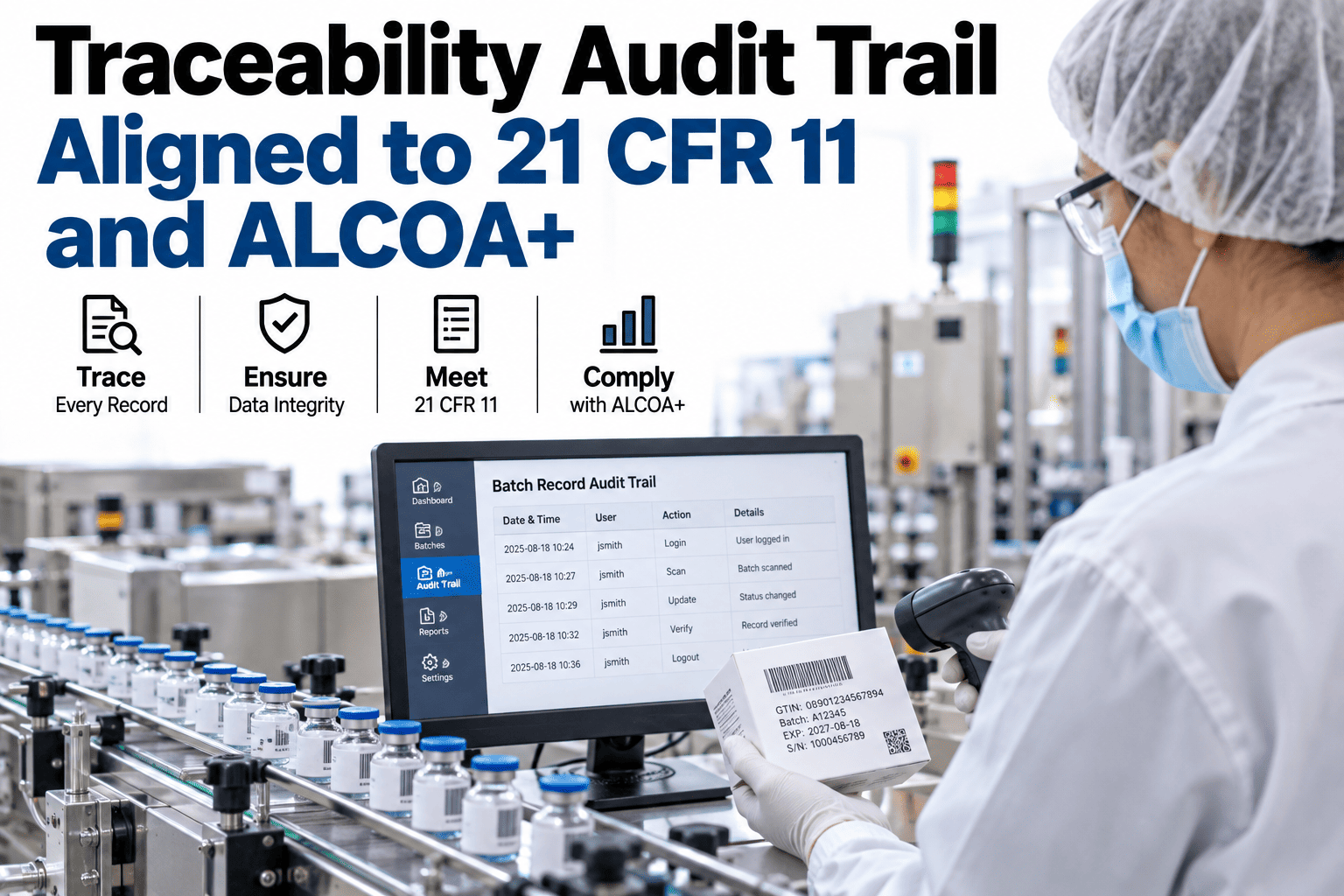
A typed name in a text field is not an electronic signature under 21 CFR Part 11, and auditors know the difference immediately upon inspection. A compliant e-signature has specific, non-negotiable characteristics that a food plant CMMS has to enforce structurally in the system itself, not just offer as an optional feature buried in a settings menu somewhere.
Unique User Authentication
Every signature ties to exactly one individually authenticated user account — never a shared login, a generic department account, or a signature applied casually on someone else's behalf under time pressure at the end of a busy shift.
Password Re-Verification at Signing
The system requires full credential re-entry at the specific point of signing, not just once at login earlier in the session — confirming the specific person applying this specific signature, at this exact moment in time, on this exact record.
Manifestation on the Record
The printed name, date, time, and meaning of the signature appear directly on the record and in any exported copy — legible evidence an inspector can read directly on the page, not a hidden database flag they have to take on faith alone.
The Full Access Lifecycle
Onboarding, Contractors, and the Deactivation Rule Every Auditor Checks First
A permission structure is only as good as the discipline behind adding and removing access over time. Departed employees, transferred contractors, and completed vendor engagements that still hold active credentials are among the very first things an auditor looks for on arrival — and among the easiest gaps to close with the right documented process in place.
1
Onboard
New users start at the most conservative access level appropriate for their role — typically technician-level access — regardless of how senior their eventual position on the plant's org chart will be.
2
Verify Contractor Credentials
Contractor accounts link directly to current training and certification status — food hygiene, site induction, LOTO authorization — before any restricted work order can ever be assigned to them at all.
3
Expand on Documented Request
Additional permissions are granted through a specific, logged request tied to a genuine, verified role change — never as an informal favor or a quick fix pushed through under deadline pressure on a busy day.
4
Deactivate Immediately
Access is revoked the very moment a contractor leaves site or an employee changes roles — not at the next scheduled review, which is where most audit findings actually originate in the first place.
Why All Three Standards Actually Agree
FDA, SQF, and BRC All Converge on the Same Underlying Access Expectations
Despite their differences in scope and certification process, FDA's 21 CFR Part 11, SQF, and BRC converge on the same core documentation requirements when it comes to who can create, approve, and view maintenance records inside a plant's CMMS. A role structure that satisfies one of these frameworks correctly tends to satisfy all three simultaneously, because the underlying expectation each one is built on is fundamentally identical.
FDA — 21 CFR Part 11
Requires individual user authentication, complete audit trails with timestamp and identity for every action, data integrity controls preventing unauthorized modification of a closed record, and documented system validation for any electronic record used to satisfy FDA record-keeping requirements at a regulated facility.
SQF
Expects documented evidence that maintenance activity on food-safety-critical equipment was performed, verified, and signed off by an identifiable, authorized individual — with the audit trail itself treated as a core piece of the compliance evidence presented during the certification review.
BRC
Requires clear accountability for maintenance and calibration records tied to food-safety-critical assets across the plant, with the same expectation that records are attributable, tamper-evident, and retrievable on request at any point during a scheduled or unannounced audit visit.
This convergence is genuinely useful in practice for any plant navigating multiple certifications at once: a plant does not need three separate, competing permission structures to satisfy three separate standards. One well-designed role and e-signature structure, built around individual attribution and separation of duties from the ground up, clears the documentation bar for all three simultaneously without duplicated effort.
Role Changes in Real Practice
What Actually Happens to Access When Someone Gets Promoted, Transfers, or Covers a Shift
Role structures on paper are simple. Real plants are not — technicians get promoted to supervisor mid-quarter, staff cover for absent colleagues in unfamiliar roles during peak season, and contractors sometimes stay on longer than their original engagement was ever scoped to run. Each of these ordinary situations needs a defined answer built into the system, not an improvised one decided on the spot.
Promotion to Supervisor
Access expands only after the role change is formally logged in the system, not informally as soon as the promotion is verbally announced on the floor during a team meeting. The system should reflect the actual confirmed org chart, not run ahead of it based on an unconfirmed assumption someone made in passing.
Temporary Shift Coverage
A technician covering a supervisor's shift for a single day should receive temporary, clearly time-boxed elevated access — not a permanent role change that outlives the actual short-term need and quietly becomes the new unreviewed default.
Extended Contractor Engagement
A contractor whose engagement runs longer than originally scoped needs their access reviewed and formally reconfirmed against the new extended timeline, not left running indefinitely on the original approval without any fresh, deliberate check by the team.
The common thread across all three scenarios is that access changes should always follow a documented trigger — a formal role change, a logged coverage assignment, a confirmed contract extension — rather than happening informally because someone needed to get a task done quickly and nobody on the floor wanted to slow them down with additional process during a busy production day.
Common Rollout Mistakes
Where Food Plant Permission Structures Commonly Fail an Audit
01
Sharing one login across an entire shift or a whole team of technicians on the floor.
A shared account destroys individual attribution entirely — nobody can prove who actually closed a critical inspection or applied a specific corrective action, which is the first thing an SQF or BRC auditor checks and the fastest possible finding in the entire audit process, often within the first hour on site before anything else is even reviewed.
02
Letting the same person create and approve their own work order entirely from start to finish.
Without separation of duties, there is no independent check on spurious or self-authorized maintenance activity — a control gap that reads as both a compliance issue and a genuine internal fraud risk to any serious auditor reviewing the records afterward, regardless of how much good faith existed on the floor at the time the work was done.
03
Leaving departed contractor and employee accounts sitting active on the system indefinitely.
Every credential that should no longer exist but still does is an active attack surface and a documented compliance gap sitting in plain view. Auditors find these in the first hour of a site visit, and the fix — immediate deactivation at offboarding, not at the next scheduled review — costs almost nothing to implement properly once the process is defined.
04
Treating a typed name as a valid electronic signature on record.
A signature without unique authentication, password re-verification, and full manifestation on the record does not meet 21 CFR Part 11 requirements, regardless of how official the field looks on screen to the person filling it in during their shift.
Common Questions Answered Fully
CMMS Roles and Permissions for Food Plants — Full Frequently Asked Questions
What is the minimum role structure a food plant needs to satisfy SQF, BRC, and FDA expectations simultaneously?
At minimum, a defensible structure separates execution (technician), approval (supervisor), food-safety verification (QA), oversight (auditor, read-only), and system configuration (administrator) into five distinct roles with no overlap in the functions that matter most for compliance — namely, nobody approves their own work, and nobody with configuration authority is also the primary person executing routine tasks day to day on the floor. These five core roles satisfy the shared documentation requirements across FDA, SQF, and BRC simultaneously, since all three converge on the same underlying expectation of individual attribution and separation of duties rather than three separate, competing standards each demanding their own unique structure.
Book a demo to see this role structure mapped against your specific plant hierarchy.
Does a small plant with only a few maintenance staff really need this level of role separation?
Yes, though the specific people filling each role can overlap across shifts more freely than at a large plant — what cannot overlap under any circumstance is the same person approving their own work on the same record, regardless of team size or how small the operation is. A three-person maintenance team can still enforce separation of duties by having a shift supervisor or plant manager serve as the approval layer for technician-completed work, even if that same person also handles other unrelated responsibilities throughout the day alongside their approval duties. The role logic matters more than the headcount required to support it structurally.
iFactory scales role structures to fit teams of any size without weakening the underlying controls.
How is a valid electronic signature different from a technician simply typing their name into a field?
A compliant electronic signature under 21 CFR Part 11 requires unique user authentication tied to one specific individual, password or credential re-verification at the exact moment of signing rather than only once at login, and full manifestation of the signer's name, date, time, and the meaning of the signature directly on the record and any exported copy the plant later produces for review. A typed name field with no authentication step behind it does not meet any of these three requirements and will not survive scrutiny during an FDA inspection or a serious SQF or BRC audit, no matter how the field happens to be labeled on screen or how routine the practice has quietly become at a given plant over time.
What happens to maintenance records if a contractor's account is deactivated after they complete work but before an audit?
Deactivating a user account removes their ability to log in and take further action going forward, but it does not and should not alter or remove any record they already created and signed while their account was active — the record remains permanently attributed to that individual, timestamped, and retrievable exactly as it was at the moment of signing, regardless of the account's current status at the time an auditor happens to review it. This is why immediate deactivation at offboarding is safe and actively recommended: it closes the access gap without creating any retroactive gap in the historical record itself, which is exactly the kind of evidence an auditor wants to see documented clearly.
Book a demo to see how iFactory preserves signed records independent of current account status.
How often should a food plant review and re-verify its CMMS permission structure?
A quarterly review of active accounts against current staffing and contractor status catches most drift before it becomes an audit finding, but the deactivation step itself should never wait for a scheduled review — access should be revoked the same day a person leaves the role, not at the next quarterly checkpoint months later when memory of the change may have already faded. Many plants pair the quarterly access review with their existing internal audit calendar, so permission verification becomes a natural extension of work the QA team is already doing rather than an additional standalone task competing for attention and time against other daily priorities on an already busy schedule.
Build a Role Structure That Survives the Very First Question an Auditor Asks
iFactory enforces separation of duties, individual attribution, and compliant e-signatures structurally within the platform itself — not as policy your team has to remember to follow correctly under deadline pressure on a busy shift.