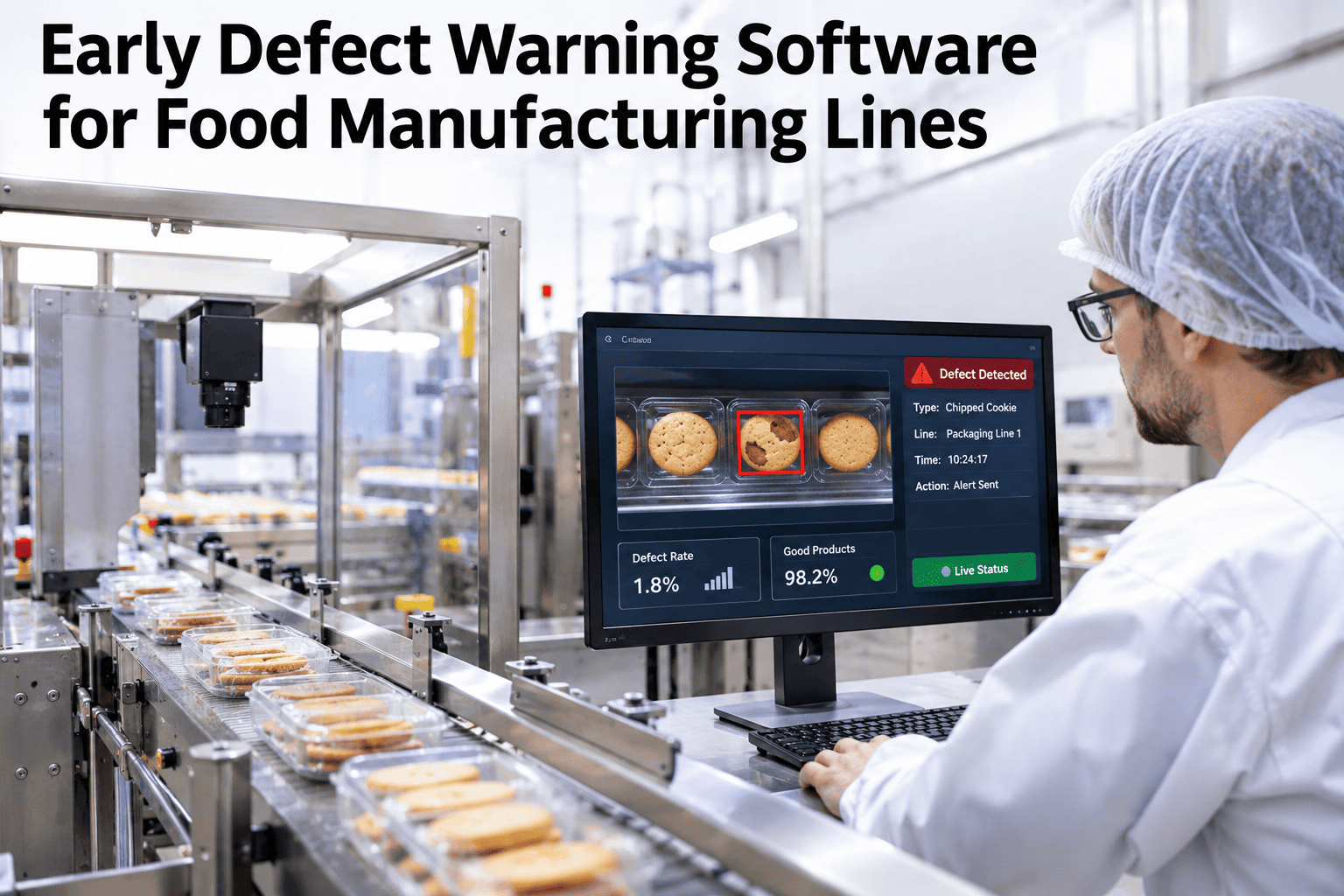
By the time a defect shows up on an inspection table, the batch that produced it is usually finished — the window to intervene has already closed. iFactory, an on-premise AI platform with automated analytics reporting built in, classifies process signatures minute by minute to surface a high-risk window while the batch can still be saved. Food manufacturing quality teams who want this on their own lines can request a demo with our team.
Early Defect Warning Software · Food Manufacturing, 2026
The Batch Can Still Be Saved — If the Warning Comes Before It's Finished
iFactory AI classifies the process signature minute by minute, flagging a high-risk window while there's still time to adjust the batch instead of scrapping it.
Minute 1–8
Normal
Minute 9–14
Normal
Minute 15–18
High-risk window flagged
Minute 19+
Adjustment applied, batch saved
Why detection is usually too late
The Gap Between a Defect Forming and a Defect Being Found
Most food plants find defects through end-of-batch testing or finished-product inspection — both of which happen after the process that created the defect is already complete. The process conditions that produced the problem have moved on, and all that's left is a decision about what to do with product that's already been made.
What a process signature is
Reading the Minutes That Precede a Defect
Signature classification
Process conditions over a rolling window are classified against patterns known to precede specific defect types.
Risk scoring
A high-risk window is flagged when the current signature resembles the conditions that historically led to a defect.
Time-to-defect estimate
Where possible, the system estimates how much time remains before the risk becomes an actual defect.
What makes a batch savable
The Difference Between Early Warning and a Post-Mortem
| Detection point | What's possible |
|---|
| Pre-formation (process signature) | Adjust the process and prevent the defect from ever forming |
| In-process, early | Intervene to limit the defect's extent within the remaining batch |
| In-process, late | Segregate the affected portion before it mixes with good product |
| Post-batch testing | Only options are rework, downgrade, or scrap of the completed batch |
See How Many of Your Recent Defects Had an Earlier Signature
Share your recent batch and quality data, and iFactory AI will show what process conditions preceded your confirmed defects — and how early they could have been flagged.
What an operator sees
From a Risk Score to an Actual Decision
1
Risk window opens
The process signature enters a pattern historically associated with a specific defect type.
2
Operator is alerted
A clear flag identifies which defect type is at risk and the contributing conditions.
3
Adjustment is made
A known corrective action is applied — a setpoint change, a speed adjustment, a material check.
4
Outcome confirms the save
The finished batch quality result confirms whether the intervention worked.
Building the signature library
Learning What Precedes Each Defect Type
A signature library is built from historical batches where a defect's outcome is known, paired with the process data from the minutes leading up to it. The more confirmed defect cases a plant has logged with complete process history, the more defect types the system can learn to flag — which is why plants with good historical quality records tend to get a stronger early-warning system from day one.
Expert review
What a Quality Manager Checks First
Early defect warning earns its place on the line when the flagged risk window gives enough time for a real intervention, not just enough time to feel informed about a defect that's already unavoidable.
Verdict
Strong when the signature library covers the defect types that actually drive most of the plant's scrap and rework.
Watch for
A risk flag that arrives too late in the batch for any real corrective action to matter.
Do next
Pull your top three defect types by scrap volume and check how much process history is logged leading up to confirmed past cases of each.
Frequently asked questions
What Food Plants Ask About Early Defect Warning
How early can this actually flag a developing defect?
Lead time depends on the specific defect type and how distinct its process signature is — some defects have a signature visible many minutes ahead, others only shortly before they form, so results vary by product and line.
Discuss lead time for your most common defects.
What if we don't have much historical defect data to train on?
A smaller signature library starts with fewer defect types covered, and expands as more confirmed cases with complete process history accumulate — most plants begin with their highest-volume defect type and build from there.
Ask support about getting started with limited history.
Does this automatically adjust the process or just alert an operator?
Can this work for batch processes as well as continuous lines?
Yes — the process signature approach applies to both, though what counts as a "savable" batch differs: a continuous line can often segregate an affected window, while a batch process may still allow a mid-batch correction.
Ask support how this applies to your process type.
How is this different from standard real-time SPC alarms?
Standard SPC flags when a single parameter crosses a control limit; this classifies the broader process signature against patterns known to precede a specific defect, which can surface risk before any individual parameter actually breaches its limit.
Talk through how this complements your existing SPC.
Catch the signature, not just the defect
Flag High-Risk Minutes While the Batch Can Still Be Saved
Book a demo to see how iFactory AI classifies process signatures to warn before a defect forms.