In the hyper-competitive landscape of modern food manufacturing, continuous improvement (CI) is no longer a mere operational tactic; it is a strategic imperative for survival and growth. The relentless pressure to reduce costs while simultaneously enhancing product quality, ensuring food safety, and increasing sustainability demands a sophisticated, data-driven approach that goes beyond traditional methodologies. This comprehensive guide delves into the intricate synergy between Lean manufacturing principles, Six Sigma statistical rigor, and the transformative power of Artificial Intelligence (AI) to create a next-generation continuous improvement framework tailored specifically for food plants. From the foundational concept of value stream mapping to the dynamic execution of Kaizen events, we will explore how these disciplines can be woven together to systematically identify and eliminate waste, reduce process variation, and drive unprecedented levels of operational excellence. For operations directors and plant managers seeking to future-proof their facilities, understanding this integrated approach is critical. Book a Demo to see how iFactory’s AI platform can accelerate your CI journey.
The New Mandate for Food Manufacturing Excellence
Combine Lean, Six Sigma, and AI to achieve zero waste, perfect quality, and maximum throughput.
Lean Principles
Focus on waste elimination through value stream mapping, 5S, and continuous flow. Reduce lead times and optimize resource utilization across all production lines.
Six Sigma DMAIC
Apply the Define, Measure, Analyze, Improve, Control cycle to reduce process variation. Achieve less than 3.4 defects per million opportunities in critical quality attributes.
AI-Driven Kaizen
Leverage machine learning to detect hidden patterns, predict equipment failures, and recommend real-time process adjustments. Accelerate Kaizen event outcomes by 40%.
Integrated CI Culture
Build a sustainable culture of improvement where every operator is empowered to identify and solve problems. Use digital tools to track and reward contributions.
Value Stream Mapping in Food Manufacturing
Value stream mapping (VSM) is the cornerstone of any Lean transformation. In a food plant, the value stream encompasses everything from raw material receiving to finished product shipment. The unique challenges of food manufacturing — such as perishability, batch processing, sanitation downtime, and regulatory holds — require a tailored VSM approach. A well-constructed current-state map visually captures all process steps, information flows, and inventory buffers. Using this map, teams can identify non-value-added activities (waste) such as excessive waiting between cooking and packaging, over-processing due to inconsistent ingredient quality, or unnecessary movement of materials. The future-state map then designs a streamlined flow that minimizes waste while maintaining flexibility for product changeovers and cleaning cycles. For example, a dairy processor reduced changeover time by 55% by reorganizing equipment layout based on VSM insights. This systematic approach is essential for targeting improvement efforts that yield the highest ROI.
Identifying and Eliminating the 7+1 Wastes in Food Plants
The classic Lean framework identifies seven wastes (muda): transportation, inventory, motion, waiting, overprocessing, overproduction, and defects. In food manufacturing, an eighth waste — unused employee creativity — is also critical. Each waste manifests uniquely in a food context. For instance, overproduction leads to spoilage and costly disposal; waiting for sanitation approval can idle entire lines; and defects in sealing or labeling result in rework or recalls. A systematic waste walk, guided by a digital checklist, helps operators and supervisors spot these issues daily. Advanced analytics can then quantify the financial impact of each waste type, prioritizing elimination efforts. One poultry plant discovered that motion waste from poorly placed ingredient bins cost over $120,000 annually in lost labor productivity. By applying 5S and ergonomic redesign, they reduced motion by 70% and freed up capacity for value-added tasks. Continuous monitoring ensures that waste does not reappear after process changes.
Kaizen Event Facilitation: A Step-by-Step Blueprint
Define Scope & Team
Select a focused problem area (e.g., packaging line efficiency). Assemble a cross-functional team including operators, maintenance, quality, and engineering.
Collect Baseline Data
Gather real-time data from sensors, MES, and manual logs. AI tools can automatically compile and visualize this data to identify bottlenecks and variation.
Analyze & Brainstorm
Use root cause analysis (5 Whys, fishbone diagram) to identify true causes. AI pattern recognition can reveal correlations invisible to human analysis.
Implement Improvements
Apply Lean tools (SMED, 5S, Kanban) and validate changes with rapid experiments. Digital work instructions ensure consistency.
Sustain & Standardize
Monitor key metrics via dashboards. AI anomaly detection alerts teams to deviations, enabling proactive corrections. Standardize successful changes across lines.
AI-Driven Improvement Tracking: From Data to Action
Traditional continuous improvement relies on manual data collection and sporadic analysis, which is slow and prone to bias. AI transforms this by providing real-time, objective insights. Machine learning models can ingest data from thousands of sensors — temperature, pressure, vibration, flow rates, and more — to detect subtle shifts that precede quality issues or equipment failures. For example, a snack food manufacturer used AI to correlate oven temperature profiles with moisture content, reducing scrap by 18%. Furthermore, natural language processing (NLP) can analyze operator shift logs and maintenance records to identify recurring issues that warrant a Kaizen event. The AI system can even recommend the most effective countermeasure based on historical success rates. This creates a closed-loop improvement cycle where data drives decisions, actions are tracked, and outcomes are measured automatically. Operations directors gain a bird's-eye view of all improvement initiatives, their status, and their financial impact, enabling better resource allocation.
Transform Your Food Plant with AI-Powered Continuous Improvement
Integrate Lean, Six Sigma, and AI to achieve breakthrough efficiency and quality. Our platform provides real-time tracking, predictive analytics, and Kaizen facilitation tools.
Six Sigma DMAIC in Food Processing: A Practical Application
Six Sigma's DMAIC framework provides a rigorous, data-driven methodology for solving complex quality problems. In food manufacturing, this is especially valuable for reducing variability in critical-to-quality (CTQ) attributes such as fill weight, cook time, and final product temperature. The Define phase involves chartering a project with clear goals, like reducing fill weight variation by 50%. During Measure, the team collects baseline data using calibrated instruments and establishes process capability indices (Cp, Cpk). The Analyze phase uses statistical tools like hypothesis testing and regression analysis to identify root causes — for instance, a worn-out filler nozzle may cause drift. Improve involves implementing a solution, such as replacing the nozzle and adding a feedback control loop. Finally, Control ensures the gains are sustained through statistical process control (SPC) charts and periodic audits. AI enhances DMAIC by automatically identifying which variables have the greatest impact on quality, reducing analysis time from weeks to hours. A beverage plant used this approach to reduce product giveaway by 12%, saving $1.2 million annually.
Essential Lean Tools for Food Manufacturing
| Tool | Application in Food | Typical Impact |
|---|---|---|
| 5S | Organize workstations, reduce contamination risks, improve sanitation efficiency. | 30% reduction in cleaning time |
| SMED | Reduce changeover time between product runs (e.g., different flavors or packaging). | 50-70% reduction in downtime |
| Kanban | Control inventory of raw materials and packaging, prevent overproduction and spoilage. | 25% reduction in inventory costs |
| Poka-Yoke | Error-proofing for label verification, metal detection, and allergen control. | 90% reduction in defects |
| TPM | Total Productive Maintenance to maximize equipment effectiveness and reduce unplanned downtime. | 15% increase in OEE |
| Value Stream Mapping | Map entire production flow to identify waste and design future state. | 20-40% lead time reduction |
Building a Culture of Continuous Improvement
Tools and methodologies are ineffective without a supportive culture. A true CI culture empowers every employee, from line operators to senior management, to actively participate in improvement. This requires transparent communication, recognition systems, and a psychologically safe environment where failures are treated as learning opportunities. In food plants, where regulatory compliance and safety are paramount, it is essential to integrate CI into standard operating procedures. Digital platforms can gamify improvement by tracking individual contributions, visualizing team progress, and celebrating successes. For example, an operator who suggests a change that reduces water usage by 10% should be publicly recognized and rewarded. Leadership must visibly champion CI by participating in Kaizen events and allocating resources for improvement projects. Over time, this culture becomes self-sustaining, with employees proactively identifying opportunities and implementing solutions without waiting for management direction. This cultural shift is the ultimate competitive advantage.
Continuous Improvement and Regulatory Compliance
Food manufacturers operate under strict regulatory frameworks (FDA, USDA, FSMA, HACCP). Far from being a hindrance, continuous improvement can enhance compliance by systematically addressing potential risks. For instance, a Kaizen event focused on allergen cross-contact can lead to improved cleaning procedures and verification methods that exceed regulatory requirements. Lean tools like 5S and visual management make it easier to maintain sanitary conditions and quickly identify deviations. Six Sigma projects can reduce the variability in cooking temperatures, ensuring that food safety criteria are consistently met. AI monitoring can provide real-time alerts when critical control points (CCPs) drift out of specification, enabling immediate corrective action. Documentation generated by CI activities also supports regulatory audits by demonstrating a proactive approach to risk management. By embedding compliance into the CI framework, companies not only avoid costly recalls but also build trust with customers and regulators.
Technology Platforms for CI in Food Manufacturing
Modern continuous improvement is powered by digital platforms that integrate data collection, analysis, and collaboration. iFactory’s Industry 4.0 solution offers a unified dashboard that displays real-time OEE, waste metrics, and improvement project status. Machine learning algorithms automatically detect anomalies and suggest root causes. The platform also includes a Kaizen event management module that guides teams through each phase, captures outcomes, and calculates financial impact. Integration with existing MES, ERP, and CMMS systems ensures seamless data flow. Mobile apps allow operators to report issues and track improvements from the factory floor. These technologies eliminate the administrative burden of manual tracking and enable a truly data-driven CI culture. For operations directors, the ability to see the entire improvement portfolio in one place — with clear ROI metrics — is invaluable for justifying investments and aligning CI with business strategy.
Key Metrics for Kaizen Success
OEE
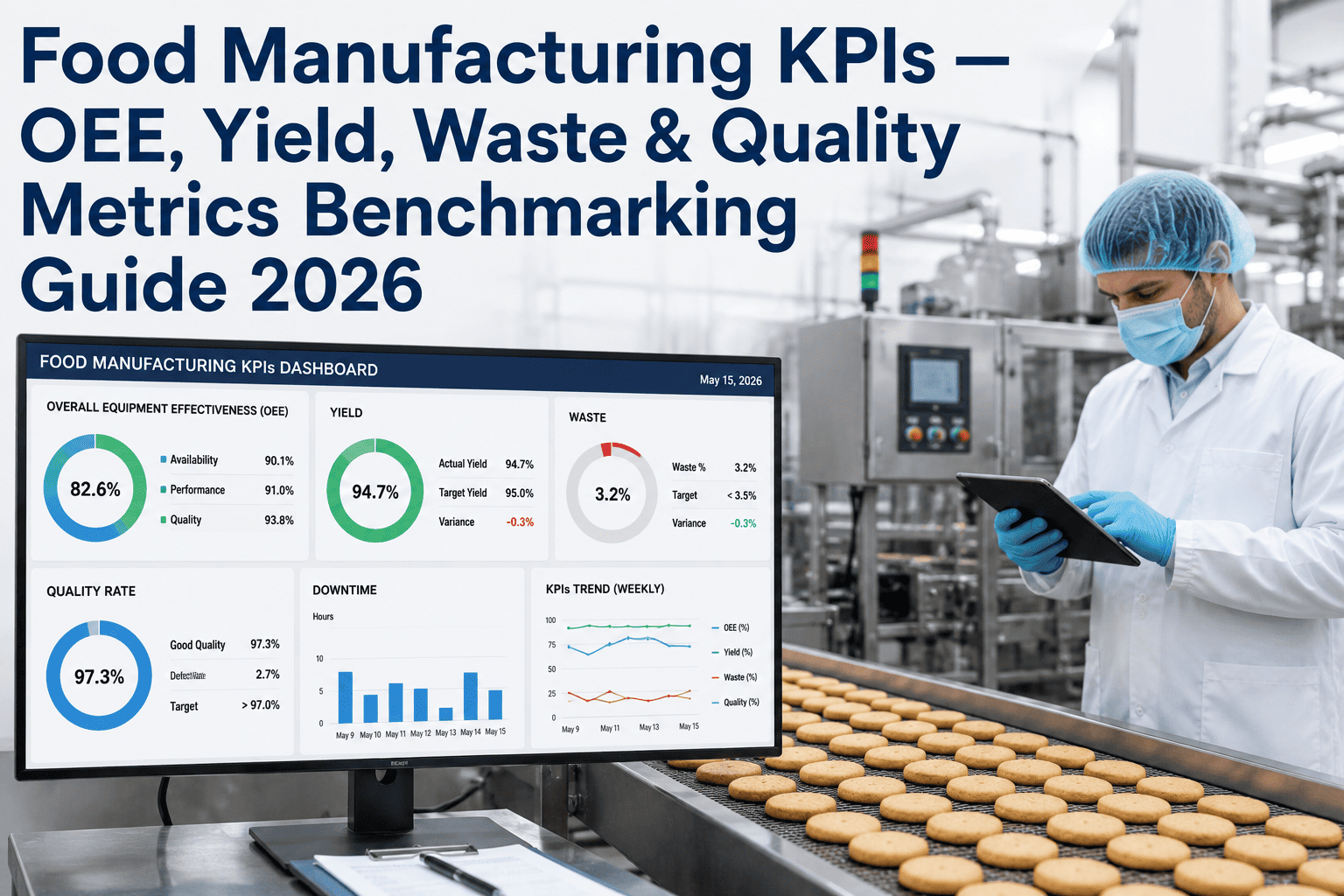
Overall Equipment Effectiveness measures availability, performance, and quality. Target >85%.
First Pass Yield
Percentage of product that meets quality specs without rework. Target >98%.
Changeover Time
Time to switch from one product to another. Target <10 minutes for high-mix lines.
Downtime (Planned vs Unplanned)
Track causes and reduce unplanned downtime to <5% of total production time.
Cost of Poor Quality
Includes scrap, rework, and warranty costs. Target <1% of sales.
Employee Engagement
Number of improvement suggestions per employee per month. Target >2.
Frequently Asked Questions
How do I start a continuous improvement program in my food plant?
Begin by securing executive sponsorship and forming a cross-functional steering team. Conduct a baseline assessment using value stream mapping to identify the biggest opportunities for waste reduction. Start with a pilot area, such as a single packaging line, and run a focused Kaizen event. Use digital tools from iFactory to track baseline metrics and improvement results. Train a small group of facilitators in Lean and Six Sigma basics. Celebrate early wins to build momentum. Gradually expand the program to other areas, always linking improvements to financial outcomes. A phased approach ensures sustainable adoption without overwhelming the organization.
What is the role of AI in continuous improvement for food manufacturing?
AI enhances traditional CI by providing real-time, objective insights that humans cannot detect. Machine learning models analyze sensor data to predict equipment failures, identify process drift, and recommend optimal settings. Natural language processing scans maintenance logs and operator reports to surface recurring issues. AI can automatically prioritize improvement opportunities based on financial impact. It also tracks the effectiveness of implemented changes, closing the feedback loop faster. For example, an AI system might detect that a slight increase in oven temperature during afternoon shifts is causing a higher scrap rate, prompting a targeted Kaizen event. This accelerates the improvement cycle and reduces reliance on manual analysis. Book a Demo to see AI in action.
How do Lean and Six Sigma work together in a food plant?
Lean focuses on eliminating waste and improving flow, while Six Sigma reduces variation and defects. Together, they form a powerful combination. Lean tools like VSM identify where waste exists, and Six Sigma DMAIC provides the rigorous statistical framework to solve the underlying problems. For instance, a Lean team might identify that excessive changeover time is a major waste. A Six Sigma project would then analyze the factors contributing to changeover variability (e.g., tool wear, operator technique) and implement a robust solution. The result is a process that is both lean (fast, efficient) and capable (consistent, high-quality). Many food manufacturers adopt a “Lean Six Sigma” approach, training belts in both methodologies. Digital platforms like iFactory support this integration by providing tools for both waste tracking and statistical analysis.
What are the biggest challenges in implementing continuous improvement in food manufacturing?
Common challenges include resistance to change from employees, lack of dedicated resources, and difficulty sustaining gains. In food plants, additional complexities include regulatory constraints, short shelf lives, and seasonal demand fluctuations. Overcoming these requires strong leadership commitment, clear communication of the “why,” and visible results. Investing in training and digital tools can reduce the burden on employees. For example, using AI to automatically track improvement metrics frees up time for facilitation. It is also critical to align CI projects with business priorities, such as reducing waste or improving food safety. Start small, celebrate successes, and gradually build a culture where improvement is part of everyone’s job. Explore support resources for guidance.
How can I measure the ROI of continuous improvement initiatives?
ROI can be measured by tracking direct cost savings (reduced scrap, lower labor costs, less overtime), increased throughput, improved quality (fewer complaints, less rework), and reduced inventory. Each Kaizen event should have a clear financial target. Use a digital platform to capture baseline and post-improvement metrics. For example, if a Kaizen event reduces changeover time by 30 minutes per shift, calculate the labor savings and additional production capacity. Track the cost of implementation (training, equipment modifications) and compare to savings over a defined period (e.g., 12 months). iFactory’s platform automatically calculates ROI for each project and aggregates it for the entire plant. This data is essential for justifying further investment in CI and demonstrating value to stakeholders. Book a Demo to see how we track ROI.
Ready to Elevate Your Continuous Improvement Program?
Unlock the full potential of Lean, Six Sigma, and AI with iFactory’s industry-leading platform. Drive measurable results and build a culture of excellence.