Robotics in food manufacturing has crossed the tipping point. What began as industrial arms on automotive lines is now a defining competitive advantage inside food and beverage plants — collaborative robots working shoulder-to-shoulder with human operators on packaging lines, autonomous cleaning robots executing sanitation runs between shifts, and AI-powered vision systems catching contamination risks before product reaches consumers. In 2026, food manufacturers who have not yet deployed robotics and intelligent automation are operating at a measurable disadvantage in throughput, food safety compliance, and labor cost control. This guide covers every major robotics application reshaping food production today — and explains how AI Copilot platforms like iFactory turn robotic deployments into fully integrated, data-driven operations.
See iFactory's AI Copilot for Robotic Food Plant Operations
iFactory connects cobots, autonomous cleaning fleets, and packaging robots into a single AI-driven platform — with real-time work order routing, predictive maintenance, and HACCP compliance built in.
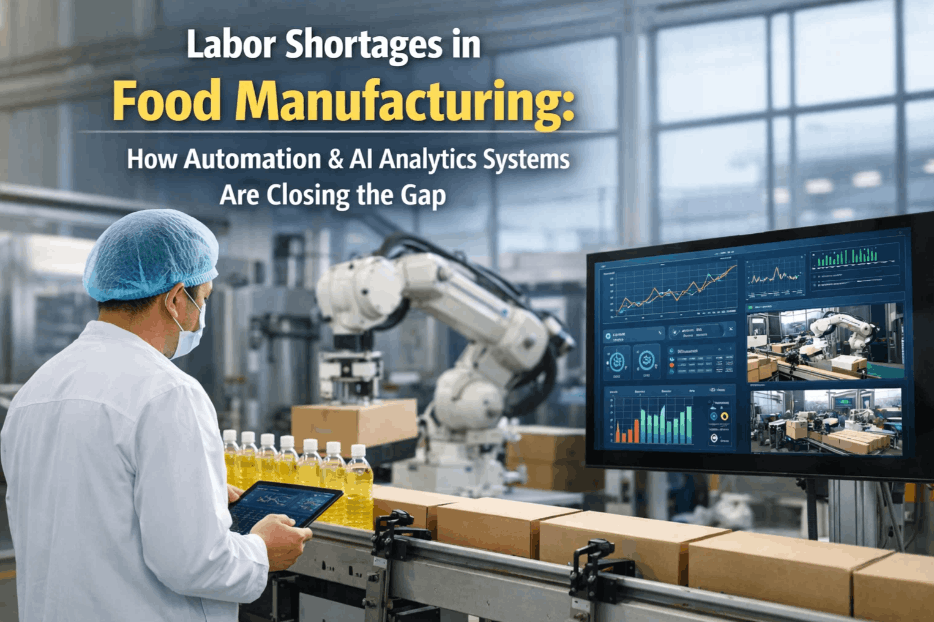
Why Robotics Adoption in Food Manufacturing Is Accelerating in 2026
Three forces are driving rapid robotics adoption: labor shortages in food processing, tightening FSMA and BRCGS compliance requirements, and cobot hardware costs falling 40–60% over five years. Mid-size food manufacturers who once couldn't justify the capital expenditure now have a clear ROI case.
The competitive differentiator is no longer whether a plant has deployed robots — it's how intelligently those robots connect to production scheduling, maintenance, and food safety workflows. If you're evaluating robotics integration, book a demo with iFactory to see how AI Copilot ties robotic systems into your compliance infrastructure.
Food and beverage plants deploying collaborative robots alongside AI-driven operations platforms report 40–55% reductions in line changeover time and 62% fewer manual sanitation compliance gaps compared to plants using human-only processes.
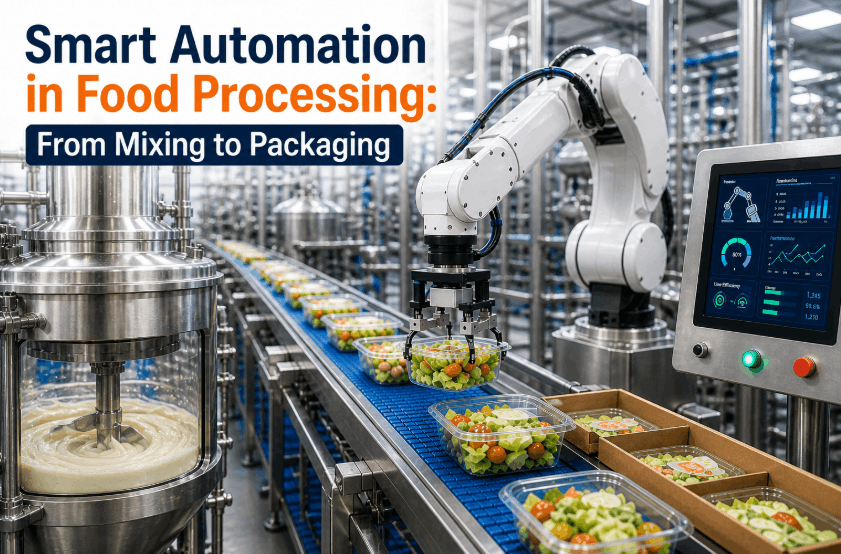
Collaborative Robots (Cobots) on the Food Production Line
Cobots are the fastest-growing robotics segment in food manufacturing because they deliver consistent output on lines that can't be fully automated due to product variability or mixed SKU complexity. Unlike traditional industrial robots, cobots work alongside human operators with no guarding or facility redesign required.
Primary Cobot Applications in Food Processing
The most successful food manufacturing cobot deployments in 2026 are concentrated in four application categories where consistency, speed, and hygiene are simultaneously critical:
Pick-and-Place Packaging
Cobots achieve 60–120 picks per minute with sub-millimeter accuracy — eliminating fatigue-driven errors. IP67-rated surfaces allow in-place sanitation during CIP cycles.
Portioning and Weighing
Vision-guided cobots deliver portion accuracy within ±0.5g — reducing product giveaway and recovering up to $200,000 annually on high-value protein and dairy lines.
Quality Inspection and Rejection
AI vision cobots inspect 100% of product at 600–1,200 units per minute — catching defects, seal failures, and foreign material that manual sampling misses entirely.
Robotic Palletizing
Eliminates the highest-injury-risk task on the floor while maintaining consistent pallet patterns. AI-driven stacking handles mixed-case pallets and maximizes trailer utilization.
Cobot Food Safety Compliance Considerations
Food-grade cobot deployments require EHEDG certification, IP-rated surfaces for zone classification, food-grade lubricants, and maintenance schedules integrated with HACCP documentation. Plants using iFactory's AI Copilot can book a demo to see how robotic asset records link automatically to food safety compliance — eliminating audit gaps.
Autonomous Cleaning Robots: Transforming Food Plant Sanitation
Autonomous floor cleaning robots and CIP automation are becoming standard in food facilities — not just for cost savings, but because machine-executed sanitation delivers consistency and documentation that human crews structurally cannot match. In allergen-processing and RTE environments, autonomous sanitation robots are now a baseline expectation among GFSI-certified plants.
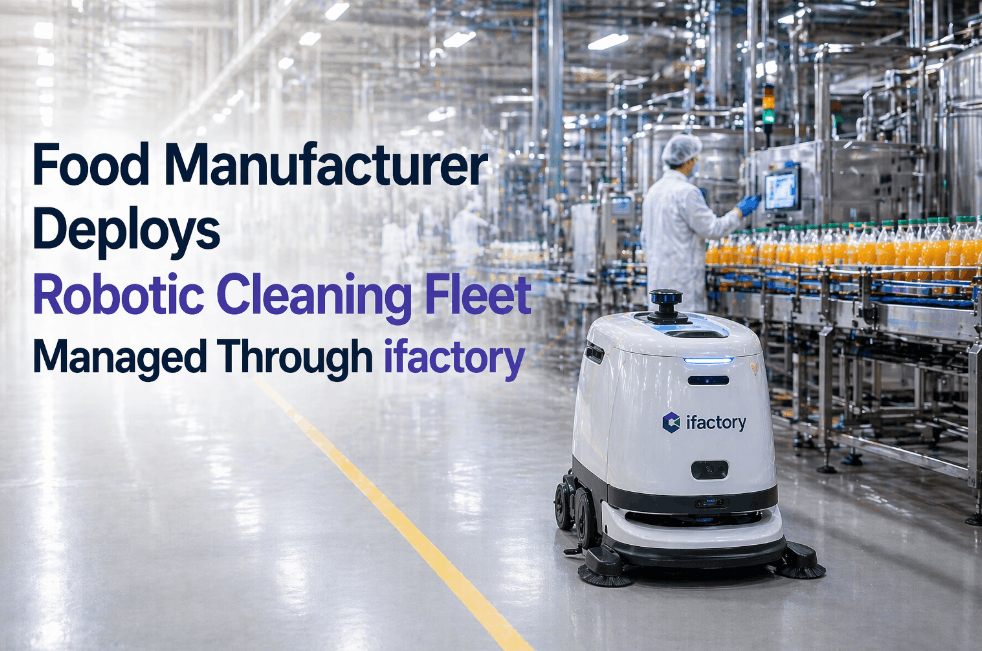
Autonomous Floor Cleaning Fleets in Food Facilities
Cleaning AMRs navigate production zones using LIDAR and computer vision — following the exact same route every run, applying chemicals at consistent dilution, and generating a timestamped digital record of every square meter covered. This documentation is increasingly required by BRCGS and SQF auditors as proof of systematic sanitation execution.
When integrated with production scheduling, AI Copilot platforms automatically dispatch the correct cleaning fleet after allergen changeovers and withhold release authorization until ATP and visual criteria are confirmed. Schedule a demo to see how iFactory orchestrates autonomous sanitation alongside HACCP compliance.
CIP Robot Systems and Environmental Monitoring Integration
Robotic CIP systems use articulated arms or cable-driven spray to reach every interior surface of tanks, conveyors, and enclosed equipment. Programmable parameters — time, temperature, chemical concentration, flow rate — are sensor-verified at every phase, generating a complete machine-executed CIP record with no manual data entry.
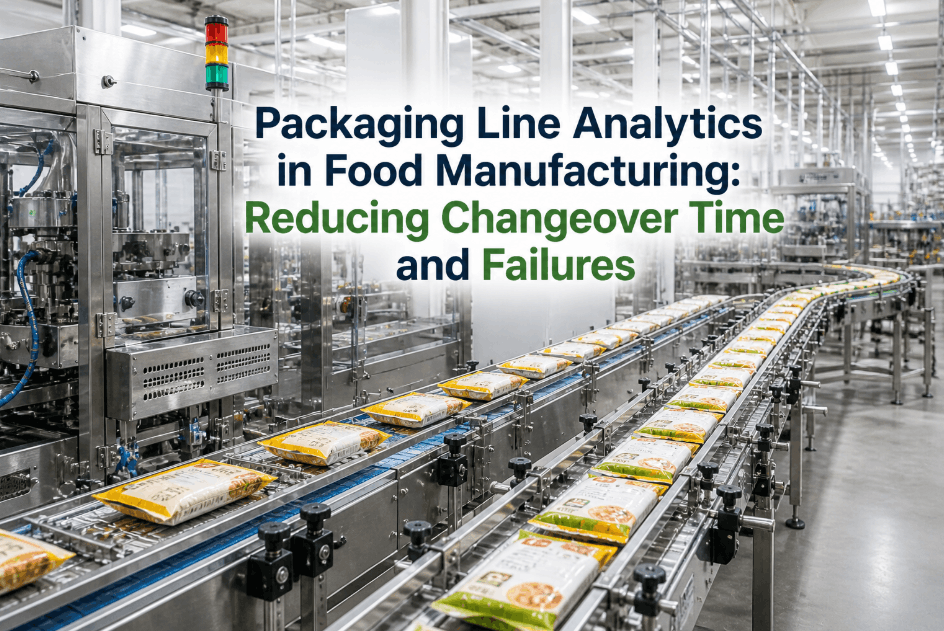
AI-Powered Robotic Packaging Systems
Modern food packaging robots integrate machine vision, AI defect detection, and dynamic line balancing to handle SKU complexity that once made automation impractical. In 2026, robotic packaging is successfully deployed across fresh produce, bakery, dairy, protein, and beverage — categories that were considered unautomatable just five years ago.
Vision-Guided Primary Packaging
AI vision systems on primary packaging robots classify product by size, shape, and surface quality in real time — routing items to the correct packaging format without manual line sorting. Seal integrity inspection at 100% of packs identifies failures before product leaves the line.
- 100% seal integrity inspection at line speed
- Real-time weight verification and rejection
- Allergen changeover verification via vision
Robotic Case Packing and Cartoning
Secondary packaging robots handle mixed-format case packing with AI-driven pattern optimization — adjusting pack configuration automatically when product dimensions vary within tolerance. Integration with ERP batch records enables automatic case labeling with lot number and traceability data.
- Mixed SKU case packing without manual changeover
- Auto-label generation from ERP batch data
- FSMA 204 CTE data captured at case level
Robotic Inspection Systems: AI-Driven Quality and Foreign Material Detection
AI-powered inspection systems combining X-ray, hyperspectral imaging, and machine vision detect hazards — bone fragments, glass, rubber, plastic — that conventional metal detection misses. In FSMA-regulated environments, the machine-generated inspection record provides far stronger audit evidence than manual spot-check logs.
The key integration challenge is connecting rejection events to HACCP corrective action workflows — not just ejecting product. iFactory's AI Copilot links inspection robot data directly to deviation records and lot holds automatically. Book a demo to explore the integration architecture with our food safety engineers.
| Robotic System Type | Primary Application | Food Safety Impact | HACCP Integration | ROI Timeline |
|---|---|---|---|---|
| Collaborative Robots (Cobots) | Pick-and-place, portioning, palletizing | Eliminates human contamination touchpoints | PM records linkable to HACCP plans | 18–30 months |
| Autonomous Cleaning AMRs | Floor sanitation, zone cleaning | Consistent sanitation execution and documentation | Auto-trigger from production schedule | 12–24 months |
| Robotic CIP Systems | Tank and equipment cleaning | Machine-verified CIP cycle completion | CIP records auto-linked to production run | 24–36 months |
| AI Vision Inspection | Defect detection, foreign material | 100% inspection vs. statistical sampling | Rejection events trigger corrective actions | 12–18 months |
| Robotic Packaging Systems | Primary and secondary packaging | Seal integrity and label accuracy | Batch data auto-populates FSMA 204 records | 18–36 months |
Integrating Robotics with AI Copilot: The iFactory Approach
Deploying robots without connecting them to a central operations platform creates data silos — cobot alerts unrouted to maintenance, cleaning robots with no link to production release, inspection rejections that never trigger HACCP records. The hardware works, but compliance and traceability value is lost.
iFactory's AI Copilot serves as the intelligence layer connecting every robotic system to food safety compliance, maintenance, and scheduling workflows. Robotic assets are registered with food-grade PM schedules, fault events auto-route to work orders, and sanitation completions feed directly into HACCP documentation — all without manual data entry.
Connect Your Robotic Systems to iFactory's AI Copilot
iFactory integrates cobot maintenance records, autonomous cleaning verification, and inspection event data into a single food safety compliance platform — eliminating documentation gaps and audit risk.
Predictive Maintenance for Food Manufacturing Robots
Food manufacturing robots operate in wet, chemically aggressive environments where standard PM schedules designed for dry industrial settings systematically underestimate maintenance needs — leading to premature seal failures, bearing degradation, and unplanned downtime during production.
AI predictive models trained on food-grade robotic data detect vibration anomalies, motor current shifts, and thermal patterns weeks before failure — enabling planned interventions during scheduled downtime. iFactory applies these models to every robotic asset, integrating with cobot manufacturer APIs and autonomous robot fleet management systems.
Implementation Roadmap: Deploying Robotics in Your Food Plant
Robotics Readiness Assessment and Use Case Prioritization
Line-by-line analysis of robotic deployment opportunities ranked by ROI, food safety impact, and implementation complexity. Asset registry build for existing robotic equipment. iFactory AI Copilot integration architecture scoped with IT and food safety teams.
Pilot Deployment and AI Copilot Integration
First robotic system deployed with full iFactory AI Copilot integration — work order routing, HACCP linkage, and predictive maintenance model initialization. Operator and food safety team training completed. Baseline metrics established for ROI tracking.
Autonomous Cleaning Fleet and Inspection System Deployment
Autonomous sanitation robots deployed and integrated with production scheduling for automatic dispatch. Vision inspection systems connected to HACCP corrective action workflows. EMP swab results feeding directly into iFactory dashboards alongside robot sanitation records.
Full Fleet Intelligence and Continuous Optimization
All robotic systems operating under AI Copilot orchestration with live dashboards tracking uptime, sanitation completion rates, inspection rejection trends, and predictive maintenance alerts. FSMA 204 traceability data flowing automatically from packaging robots into digital records. Continuous model refinement using operational data from the full robotic fleet.
Frequently Asked Questions: Robotics in Food Manufacturing
Conclusion: The Intelligent Robotic Food Plant of 2026
Robotics in food manufacturing is no longer a future capability — it's a present competitive reality. Cobots on packaging and processing lines, autonomous cleaning fleets executing sanitation runs, and AI-powered inspection systems delivering 100% product verification are all deployed and delivering ROI inside food plants today. The facilities pulling ahead aren't simply those with the most robots — they're the ones where every robotic system is integrated into an intelligent operations platform that connects robotic data to food safety compliance, maintenance management, and continuous improvement workflows. iFactory's AI Copilot is built precisely for this integrated architecture. Book a personalized demo to see how iFactory connects your robotic deployments to HACCP workflows, FSMA traceability, and predictive maintenance in a single purpose-built food manufacturing platform.
Cobots. Cleaning Fleets. Inspection Robots. One Platform.
iFactory's AI Copilot integrates every robotic system into your food safety, maintenance, and compliance workflows — live in 10–14 weeks.