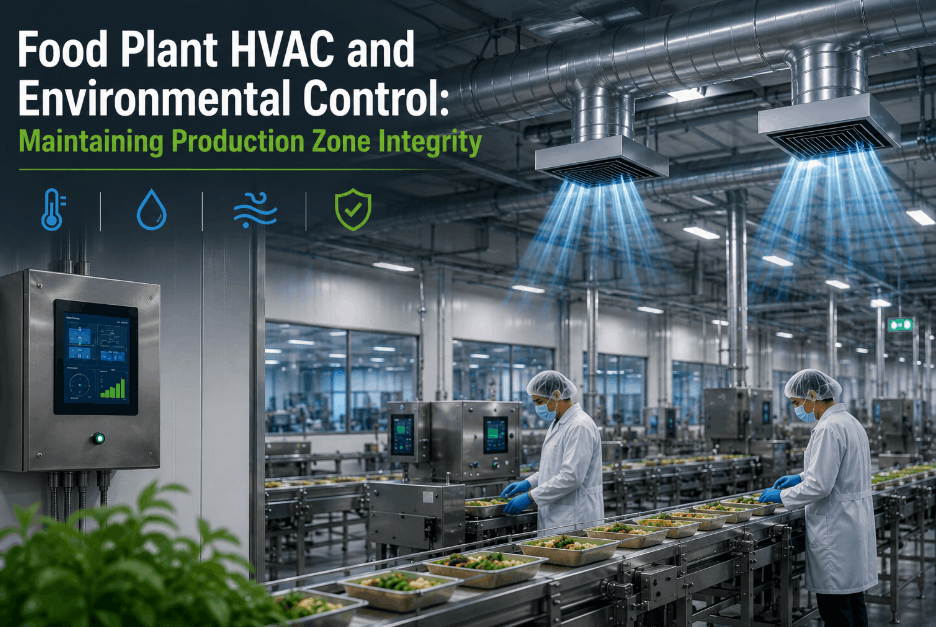
In the ultra-sterile world of food manufacturing, air quality is as critical as any raw ingredient. HVAC and Clean Room systems are the primary defense against airborne pathogens, yeast, mold, and particulate cross-contamination. A single failure in positive pressure or a compromised HEPA seal in a high-risk ready-to-eat (RTE) zone can lead to catastrophic batch recalls and immediate regulatory shutdowns. iFactory's AI-Driven Preventive Analytics platform transforms passive air handling infrastructure into an intelligent, self-monitoring network—tracking differential pressure, particulate trajectories, and AHU motor vibration in real time. Our platform ensures that environmental hazards are predicted and mitigated weeks before they compromise food safety or indoor air quality. Book a Demo to see how leading food plants maintain ISO-class air quality with zero unplanned downtime.
ENVIRONMENTAL ANALYTICS · CLEAN ROOM COMPLIANCE
Achieve Absolute Air Quality Control with AI-Driven HVAC Monitoring.
Discover how iFactory's environmental platform links every AHU and Clean Room sensor to a centralized AI dashboard, ensuring 100% positive pressure stability and regulatory compliance across your high-risk processing zones.
The "Invisible" Bio-Hazard: Why Traditional HVAC Maintenance Fails High-Risk Food Plants
Traditional HVAC maintenance in food plants relies on monthly filter checks, manual thermometer readings, and periodic air balancing by external contractors. This "snapshot" approach creates massive blind spots. Environmental conditions are dynamic—impacted by external humidity, sanitation steam, and frequent door openings during SKU changeovers. If the differential pressure between a "Low-Care" and "High-Care" zone drops even slightly below the critical threshold (typically +0.02" WC), airborne contaminants are sucked into the sterile zone instantly. AI-driven environmental analytics eliminates these structural vulnerabilities by creating a continuous "Digital Audit Trail" of air quality, updated in sub-seconds by high-precision IoT sensors.
How AI-Driven HVAC Analytics Maintains Environmental Sterility
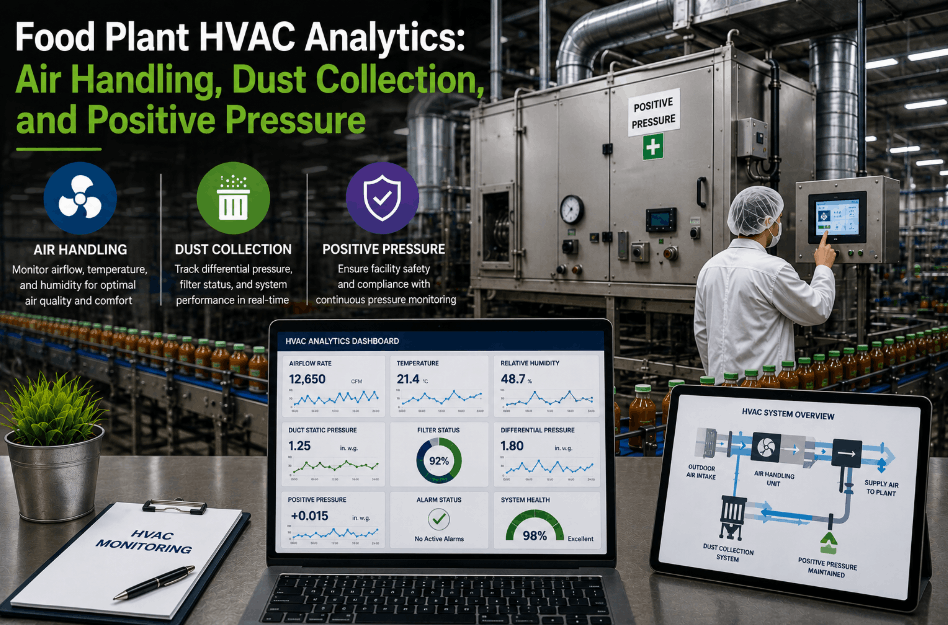
The iFactory platform uses a multi-layered sensor mesh to monitor the "Vitals" of your Clean Room. As air enters the facility, its journey through pre-filters, HEPA banks, and cooling coils is tracked by Delta-P sensors and thermal probes. AI models continuously analyze the vibration signatures of AHU blowers to predict mechanical failures, while simultaneously calculating the "Dew Point" risk on ceilings to prevent the dreaded "Listeria Drip" during washdown. Book a Demo to see our real-time air quality visualization engine.
Differential Pressure Monitoring
Precision IoT transducers track pressure gradients between zones. If pressure drops below ISO-class or SQF requirements, the AI triggers an immediate "Positive Pressure" alert, allowing the HVAC system to ramp up fan speeds automatically.
HEPA Breakthrough Prediction
AI analyzes the loading curve of HEPA filters based on Delta-P data. By predicting the exact moment of filter "breakthrough" or "blinding," iFactory allows you to schedule replacements during zero-production windows, avoiding emergency stops.
Condensation Risk Modeling
High-humidity environments are prone to ceiling condensation. Our AI correlates RH (Relative Humidity) with ceiling surface temperature to predict condensation events *before* they occur, triggering dehumidification cycles instantly.
Blower Vibration Diagnostics
Detecting bearing wear and belt slippage in rooftop AHU blowers. By identifying mechanical degradation weeks in advance, iFactory ensures that sterile air never stops flowing to your most critical production lines.
Quantifying Air Quality: Manual Inspections vs. AI-Driven Environmental Analytics
The transition to automated HVAC monitoring is a critical step in FSMA 204 readiness and overall operational resilience. Moving from reactive crisis management to proactive environmental control reduces contamination risk by 90% and optimizes utility consumption. Understanding the data-driven comparative metrics is essential for modern quality managers. Book a Demo to see our HVAC ROI dashboards.
| Environmental Variable | Manual/Calendar PM | iFactory AI-Driven Analytics | Risk Reduction |
|---|---|---|---|
| Pressure Zone Stability | Weekly Spot Checks | Continuous (Real-Time) | 100% Infiltration Defense |
| HEPA Filter Health | Fixed 6-Month Replace | Predictive Load Analytics | 40% Lower Filter Waste |
| Condensation Alerting | Visual Check (Post-Sanitation) | Predictive Dew-Point AI | Eliminates Mold Drip Risk |
| Audit Record Veracity | Handwritten Logs (Unreliable) | Digital Ledger (Tamper-Proof) | Guaranteed Audit Pass |
| AHU Mechanical Health | None (Run-to-Failure) | AI Vibration Monitoring | Zero Unplanned Downtime |
| Energy Efficiency | Static 100% Fan Speed | AI-VFD Optimization | 25% Utility Savings |
| Compliance Documentation | Manual Data Entry | Auto-Generated ISO/BRC Logs | Zero Human Error |
Bio-Barrier Precision: Protecting the High-Risk Zone with AI
In a traditional food plant, the "Bio-Barrier" is often invisible until a lab test comes back positive for Listeria or Salmonella. AI-driven analytics makes this barrier visible and actionable. By mapping the interaction between airflow velocity and door-opening frequency, iFactory identifies the exact moments your clean room is vulnerable. Instead of relying on hope, you rely on high-frequency data that confirms your HVAC system is performing its protective role 24/7/365. Book a Demo to see our bio-barrier simulation dashboards.
Environmental Compliance: Meeting ISO 14644-1 and BRC Air Quality Standards
Global food safety standards (SQF Edition 9, BRCGS Food Safety) increasingly demand verifiable proof that air in high-care zones is filtered and controlled. iFactory's platform is engineered to automate these complex record-keeping requirements. By integrating ISO 14644-1 particulate monitoring with our AI engine, we ensure your facility is "Audit-Ready" without a single minute of manual data entry. Book a Demo to see our automated compliance engine.
ISO 14644-1 Particulate Monitoring
iFactory integrates with high-resolution particulate counters to track air cleanliness classes in real-time. Every excursion is logged with a Root Cause Analysis (RCA) prompt, ensuring total compliance with clean room standards.
Automated BRC/SQF Air Logs
Our platform generates daily, weekly, and monthly air quality reports that meet the strict requirements of BRC and SQF audits. This eliminates the risk of missing logs or inaccurate manual readings during high-stress audits.
Differential Pressure Alarming
AI-driven alarm thresholds account for external weather events to reduce "Nuisance Alarms." When a true breach occurs, the platform triggers a cascaded notification to Maintenance, Quality, and Operations teams.
Environmental Digital Twins
Create a 3D digital map of your facility's airflow and temperature profiles. This "Digital Twin" allows quality managers to visualize thermal stagnation or stagnation "Dead Zones" where microbial growth is most likely.
Energy Optimization: Reducing the HVAC Utility Load with AI-Driven DCV
HVAC systems are often the single largest energy consumer in a food plant, usually running at 100% capacity regardless of actual air requirements. iFactory implements "Demand-Controlled Ventilation" (DCV) using AI to optimize fan speeds based on real-time particulate load and room occupancy. This approach reduces energy consumption by 20-30% while maintaining absolute safety thresholds. The platform correlates VFD (Variable Frequency Drive) performance with clean room integrity to unlock maximum ROI without compromising sterility.
AI-Driven Environmental Forecasting: Predicting Contamination Risk
The ultimate value of environmental analytics is the ability to forecast risk before air quality degrades. By analyzing patterns across humidity, blower vibration, and pressure stability, iFactory identifies "Environmental Risk Signatures"—such as a blower's recurring vibration spikes that indicate an imminent airflow failure. Book a Demo to see our predictive environmental dashboards.
AHU Mechanical Failure Prediction
AI models analyze high-frequency vibration data from AHU blower bearings. By identifying "Failure Harmonics," the system provides a 3-week lead time for maintenance before a total air loss occurs.
Filter "Blinding" Trajectory
By correlating Delta-P with current draw, AI predicts exactly when a HEPA filter will lose its capture efficiency, preventing the particulate breakthrough that leads to batch contamination.
Dew-Point Crossing Alerts
The platform forecasts condensation risk based on upcoming sanitation cycles and external weather. This allows HVAC systems to pre-adjust dehumidification setpoints, stopping condensation before it forms.
Zone-Pressure Drift Analysis
AI identifies subtle, long-term drifts in zone pressure caused by deteriorating door seals or clogged air-return vents, allowing for scheduled "Tune-Up" maintenance before alarms are triggered.
The Financial Impact: ROI of AI-Driven HVAC & Clean Room Analytics
The business case for advanced environmental analytics is built on three pillars: Recall Risk Mitigation, Energy ROI, and Maintenance Efficiency. While an avoided contamination event is priceless, the daily savings from 25% lower energy bills and extended filter life provide a rapid payback. For plants operating high-risk RTE lines, the data-driven insurance provided by iFactory is the ultimate competitive advantage.
Implementation Roadmap: Achieving Environmental Excellence
Transitioning to an AI-driven Clean Room is a phased progression that ensures you secure your highest-risk processing zones first while building the data infrastructure for total facility climate control.
Critical Zone Pressure & Air Integrity Mapping
Deployment of IoT pressure transducers and particulate counters in high-risk RTE zones. Establishing real-time compliance alerting and digital audit log foundations for immediate audit readiness.
- Digital zone pressure mapping
- Baseline particulate count established
- Automated SMS/Email compliance alerting
AHU Mechanical & Filtration Health Integration
Adding vibration and current analytics to AHU blower motors. AI starts learning mechanical baselines to predict bearing failures and belt issues before air velocity is impacted.
- Vibration failure modeling for blowers
- Predictive Delta-P filter analytics
- Maintenance dashboard activation
Demand-Controlled Ventilation & Energy Optimization
Integrating VFD control with AI-driven particulate and occupancy sensors. Fans automatically modulate speeds to maximize energy savings without ever breaching ISO-class sterility.
- Dynamic AI-VFD setpoint optimization
- Energy ROI dashboard deployment
- Carbon footprint reduction reporting
Full Facility Environmental Digital Twin
The final phase enables total facility environmental visibility. Correlating air quality with cleaning cycles and product quality outcomes to predict bio-contamination risk at the batch level.
- Dew-point crossing predictive alerts
- Bio-risk probability heatmaps
- Autonomous climate control orchestration
STERILE AIR · PREDICTIVE HYGIENE · ENERGY EFFICIENCY
Is Your Air Protecting Your Product or Putting It at Risk?
Don't wait for a positive lab result or an audit failure. Join the world's safest food plants using iFactory to eliminate environmental risk and achieve absolute air quality control.
Frequently Asked Questions: HVAC & Clean Room Analytics
What is AI-driven HVAC analytics for food plants?
It is the use of IoT sensors and machine learning to monitor airflow, pressure, and filtration in real time—predicting mechanical failures, optimizing energy, and ensuring absolute contamination control in sterile zones.
How does positive pressure prevent contamination?
Positive pressure ensures that air always flows *out* of clean zones into dirtier ones. This prevents airborne yeast, mold, or pathogens from being sucked into processing and packaging areas when doors are opened.
Can AI predict when a HEPA filter will fail?
Yes. By monitoring the "Delta-P" (pressure drop) trajectory and correlating it with airflow velocity, our AI predicts when the filter is nearing "blinding" or if a seal breach has occurred, allowing for scheduled maintenance.
What are the ISO air quality standards for food plants?
Food plants typically aim for ISO Class 7 or 8 in high-risk zones. iFactory monitors the particulate counts and environmental variables required to maintain and document these standards automatically for audits.
How do you prevent condensation on plant ceilings?
Our AI monitors the "Dew Point" in real-time. If the humidity level approaches the ceiling's surface temperature, the system triggers an alert or adjusts the HVAC dehumidification cycle before drops form.
Does the system require us to replace our existing AHUs?
No. iFactory is hardware-agnostic. We can pull data from your existing Building Management System (BMS) or deploy "Overlay" IoT sensors on legacy air handling units to enable predictive analytics.
How much energy can we save with AI-driven HVAC?
Most manufacturers achieve a 20-30% reduction in HVAC utility costs by using AI to modulate fan speeds and cooling loads based on real-time room requirements rather than running at static 100% capacity.
How does this help with BRC and SQF audits?
It replaces manual log sheets with a tamper-proof digital audit trail. The system automatically generates the historical air quality and filter maintenance reports required by auditors, ensuring a guaranteed pass on environmental sections.
BIO-BARRIER DEFENSE · PREDICTIVE AIR QUALITY
Secure Your High-Care Environment Today.
Stop reactive environmental management. Deploy iFactory's AI-driven HVAC analytics to achieve 100% air quality compliance and massive energy savings in your food facility.