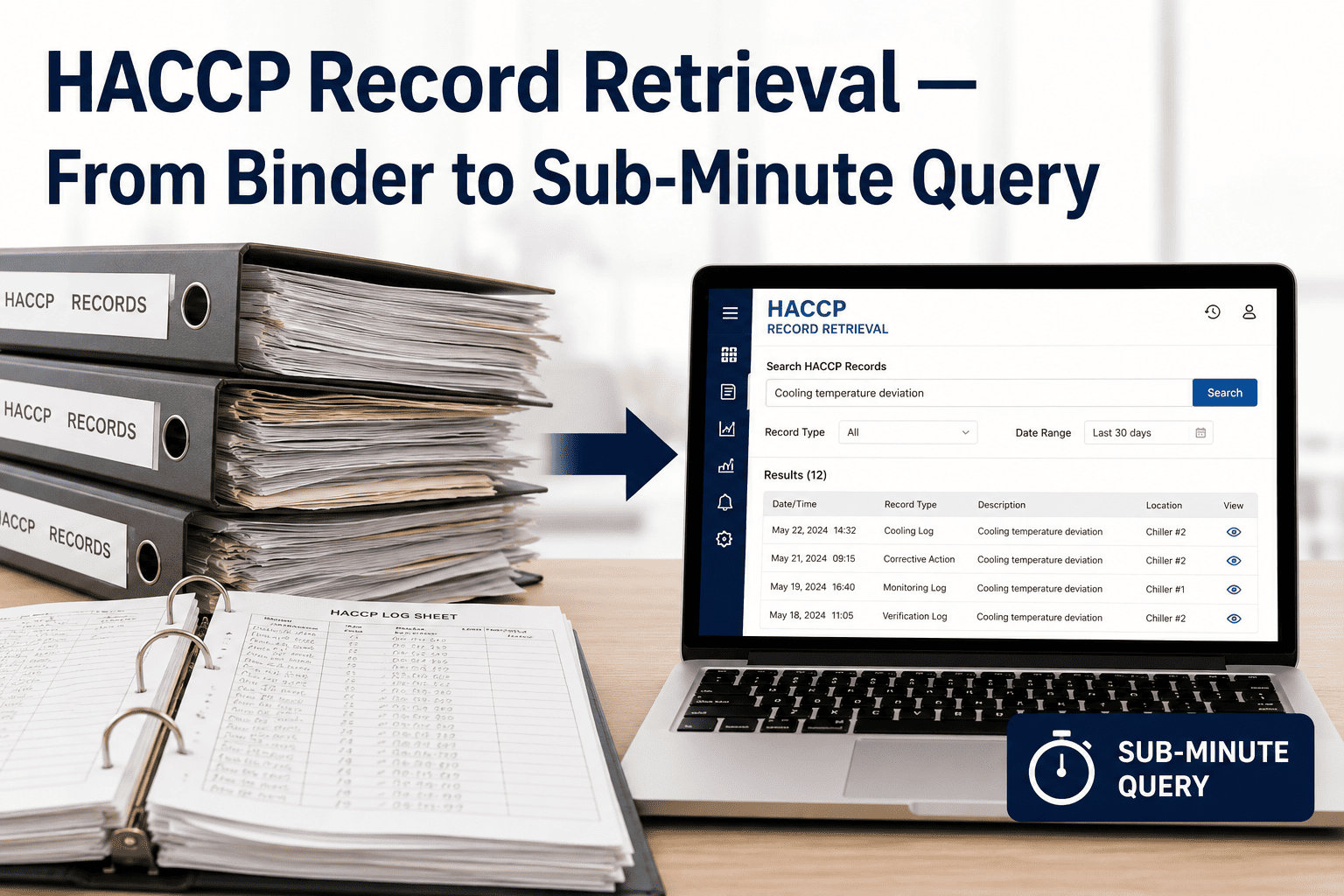
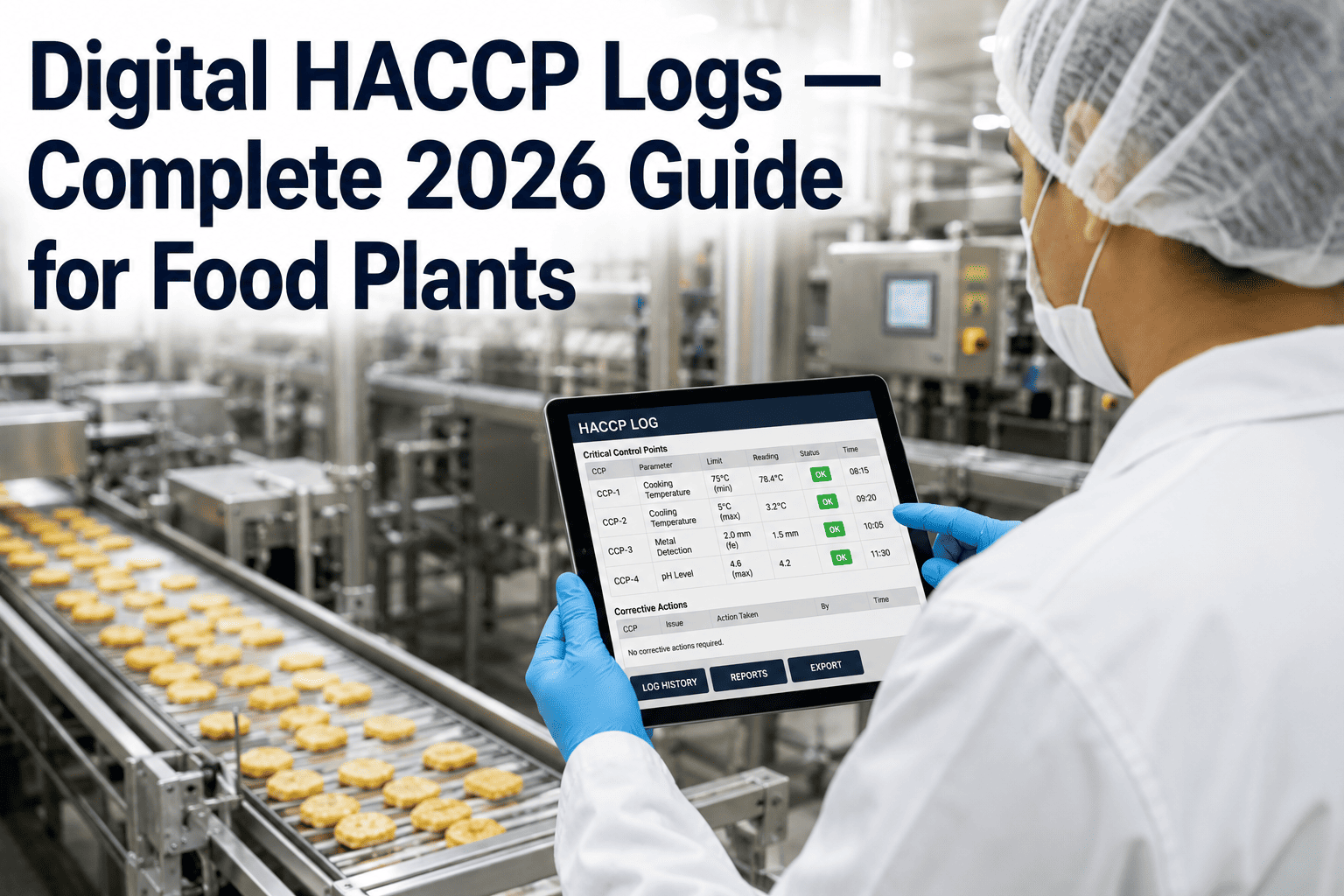
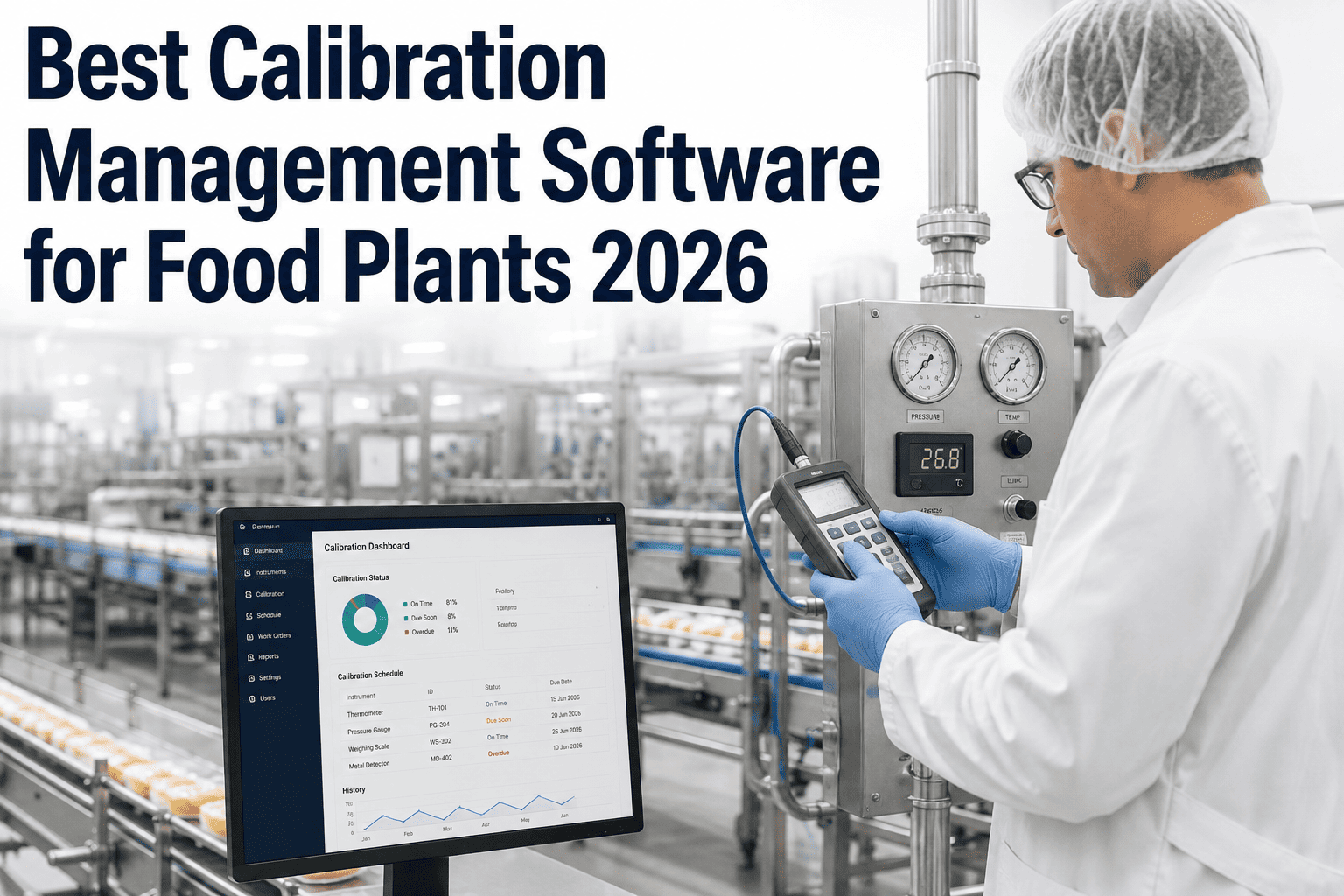
When an auditor asks for the CCP monitoring log from a specific production run six months ago, most food plants send someone to a filing room to search through binders organized by date, not by product or lot. That search routinely takes 30-90 minutes per record request, and a full audit can involve a dozen or more separate pulls across different CCPs, corrective actions and verification logs. iFactory replaces the binder search with a sub-minute query that returns the exact record, complete with every linked corrective action and verification entry, searchable by lot, date, CCP or product. Book a demo to search your own HACCP records back in seconds.
HACCP Record Retrieval
From Binder Search to Sub-Minute Query
iFactory digitizes CCP monitoring, corrective actions and verification records into one searchable system, so an auditor's request that used to mean a trip to the filing room now returns an answer before they've finished asking the follow-up question.
What an Auditor Actually Asks For, and How Long It Takes to Find
Every HACCP audit follows a similar pattern of specific record pulls, each one a separate search through paper logs organized by date rather than by the product, lot or CCP the auditor actually cares about. Ask support how your specific CCP structure gets mapped into a searchable index.
Search
Lot 40522 — Cook CCP — Deviation Records
CCP Log
Cook temperature monitoring, Lot 40522, all readings and timestamps
Corrective Action
Deviation response for Lot 40522, linked to specific out-of-range reading
Verification
Supervisor sign-off and calibration check tied to the same shift and line
Query returned in 0.8 seconds
What Gets Digitized and How Records Stay Linked
Digitizing HACCP records is not just scanning paper into PDFs, it means every entry is captured as structured, searchable data connected to the lot, CCP and shift it belongs to. Book a demo to see your CCP plan mapped into a live retrieval system.
CCP Monitoring
Every Reading Captured With Full Context
Temperature, time, pH, metal detection and every other CCP monitoring point is logged automatically or entered digitally at the point of check, tagged with lot number, line, shift and operator so a single search returns the complete picture rather than an isolated data point.
Corrective Actions
Every deviation response is linked directly to the specific reading that triggered it, closing the gap between a flagged event and its resolution.
Verification Records
Supervisor sign-offs, calibration checks and validation records are searchable alongside the monitoring data they verify.
Multi-Filter Search
Records are retrievable by lot, date range, CCP, product, line or any combination, matching however the auditor actually phrases the request.
Audit Export
Complete Record Packages Exported in One Step
A full audit package covering every linked record for a given date range or product line exports as one organized document, replacing the manual compilation work that previously consumed days ahead of every audit cycle.
Binder Search vs. Digital Sub-Minute Retrieval
| Factor | Paper Binder Search | iFactory Digital Retrieval |
|---|
| Time Per Record Request | 30-90 minutes locating and cross-referencing paper logs. | Under one minute for a full, linked record package. |
| Search Method | Chronological binders, searchable only by date range manually. | Searchable by lot, date, CCP, product or any combination. |
| Linked Records | Corrective actions and verification stored separately, manually cross-referenced. | Automatically linked to the originating monitoring entry. |
| Audit Prep Time | Days spent compiling a full record package ahead of an audit. | Complete package exported in one step, ready for review. |
| Record Integrity Risk | Illegible handwriting, missing pages or misfiled logs common. | Structured data entry with mandatory fields and timestamped entries. |
See Your Own CCP Records Returned in Under a Minute
iFactory maps your existing HACCP plan and CCP structure into a searchable system before any paper records are retired.
Moving From Binders to Digital Retrieval, Stage by Stage
1
HACCP Plan Mapping
Existing CCPs, monitoring frequencies and corrective action procedures are catalogued to define the digital record structure.
2
Data Capture Setup
Monitoring points are connected to automated sensors where possible, with digital entry forms configured for manual checks.
3
Parallel Run Validation
Digital records run alongside existing paper logs for a defined period to validate completeness and accuracy before paper is retired.
4
Search and Export Go-Live
Full search and audit export functionality goes live, with historical paper records scanned and indexed where required.
Results From Plants Running Digital HACCP Retrieval
Ready-to-Eat Food Manufacturer
Audit Record Requests Answered in Under a Minute Each
A ready-to-eat plant preparing for a third-party certification audit previously spent 3-4 hours per audit cycle pulling CCP records from binders across two production lines. After digitizing monitoring, corrective action and verification records, the same audit cycle's record requests were each answered in under a minute, and the auditor specifically noted the completeness of linked corrective action documentation.
98%
Reduction in record retrieval time
0
Missing or misfiled records at audit
6 wks
Time to full digital go-live
What Food Safety Leaders Say
Our auditor asked for a specific deviation record from four months back, and we had it on screen before he finished explaining what he needed. That never happened with binders.
Food Safety Manager
Ready-to-Eat Food Manufacturer, Illinois
Linking corrective actions directly to the monitoring entry that triggered them closed a gap our auditors had flagged for two years running.
Quality Assurance Director
Meat Processing Plant, Nebraska
Frequently Asked Questions
Do we need to re-enter years of historical paper records to use this system?
No, most plants go live with digital capture for new records while historical paper logs are scanned and indexed only as far back as your retention policy or upcoming audit scope requires. This keeps the transition manageable rather than requiring a full retroactive data entry project before the system delivers any value.
How does the system handle CCP readings that come from manual checks rather than sensors?
Manual checks are entered through digital forms configured to match your existing monitoring frequency and required fields, so an operator recording a manual temperature check enters it the same way they would on paper, just into a structured, searchable format instead. Mandatory fields prevent the incomplete entries that are common with handwritten logs.
Can this system generate the specific record formats our certification body requires?
Audit exports are configured during setup to match the record format and content your specific certification body or regulatory auditor expects, since requirements vary between schemes and jurisdictions.
Talk to support about the certification standards your plant operates under.
What happens if a sensor or connectivity issue interrupts automated CCP monitoring?
Fallback procedures for manual entry during a connectivity or sensor interruption are defined during setup, ensuring monitoring continuity is maintained and clearly documented in the record rather than leaving a gap in the CCP log. This is one of the scenarios validated during the parallel run stage before paper logs are retired.
How long does it take to go from paper binders to a fully searchable system?
Most plants complete HACCP plan mapping, data capture setup and parallel run validation within four to six weeks, after which full search and audit export functionality goes live. Additional lines or product families onboard faster once the initial CCP structure and digital forms are established.
Book a demo to see a rollout timeline scoped for your plant.
Stop Sending Someone to the Filing Room for Every Audit Request
iFactory digitizes CCP monitoring, corrective actions and verification records into one searchable system, turning a binder search into a sub-minute query.
Records searchable by lot, date, CCP or product
Corrective actions linked automatically to source readings
Full audit packages exported in one step
Sub-minute retrieval instead of a filing room search