A finished product test only tells you what already happened. By the time a lab confirms a defect in a completed batch, the ingredients are spent, the packaging is filled, and the only remaining decision is how much of the run gets destroyed. In-process quality checks exist to catch the deviation while the batch is still correctable — while a temperature can still be adjusted, a fill weight can still be recalibrated, and a pH drift can still be traced to its cause before an entire shift's output is affected. Getting the sampling frequency, the critical parameter list, and the hold-and-release discipline right is what separates a plant that occasionally scraps a pallet from one that occasionally scraps a truckload, and that difference compounds every single shift the gap goes unaddressed. iFactory's Support Contact team works with quality teams to build exactly that discipline into the line.
Catch the Deviation While the Batch Is Still Correctable
iFactory monitors your critical process parameters continuously against defined limits, holds product automatically when a checkpoint is missed, and gives supervisors the exact data they need to release or reject a batch before it reaches the next station — closing the gap between when a deviation starts and when someone actually notices it.
The Checkpoints That Cannot Wait for the End-of-Shift Report
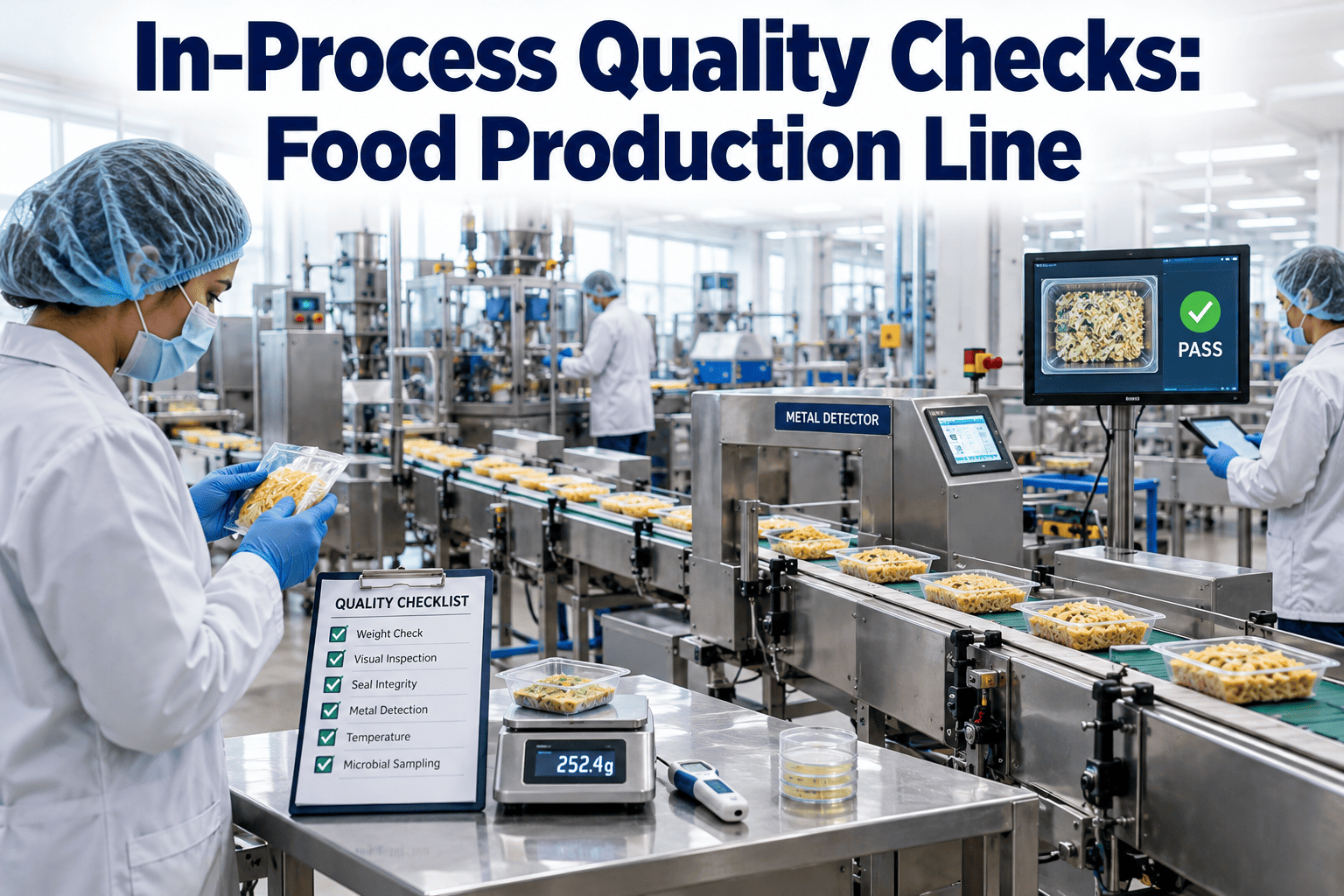
Every food production line has a handful of parameters where a deviation means real safety or quality risk, and a much longer list of parameters that matter but do not carry the same urgency. Confusing the two is how monitoring programs become either dangerously thin at the points that matter most or so bloated with low-value checks that operators start treating all of them as equally routine, which paradoxically makes the genuinely critical ones easier to overlook rather than harder. iFactory's in-process module is configured around the specific critical control points defined in your HACCP plan, so the highest-consequence checkpoints get continuous sensor coverage while lower-risk parameters follow a documented periodic schedule that still gets checked, logged, and escalated consistently without consuming the same level of continuous attention.
Thermal Process Verification
Cook, pasteurization, and retort temperatures are logged continuously against the validated time-temperature curve for that product, with an automatic hold triggered the moment a reading drops below the critical limit for longer than the validated duration allows.
pH and Water Activity
Acidified and low-moisture products depend on pH and water activity staying within a narrow validated band to control microbial growth. Continuous probes flag drift before it crosses the critical limit, giving operators time to adjust rather than discovering the deviation after the batch is packaged.
Metal Detection and X-Ray Rejection
Foreign material detection equipment is verified against test pieces at a defined frequency, and every reject event is logged with product, time, and detected fragment size so a pattern of recurring rejects at one station can be traced to a specific piece of upstream equipment.
Fill Weight and Net Content
Checkweigher data is captured on every unit rather than a periodic sample, which both protects against under-fill compliance issues and catches a slow mechanical drift in the filler head well before it becomes a customer-facing complaint.
Allergen Changeover Verification
Swab test results and visual line clearance checks following an allergen changeover are logged with photo evidence and timestamp, creating a defensible record that the line was verified clean before the next product started running.
Seal and Package Integrity
Seal strength, vacuum level, and modified atmosphere composition are sampled at a defined frequency per product line, with results tied back to the specific packaging shift and machine head so a seal failure trend can be isolated quickly.
Which Checkpoint on Your Line Has the Widest Sampling Gap?
iFactory shows you exactly how long your critical control points go unmonitored between checks — and what that gap has already cost in rework and holds.
How Often Is Often Enough? It Depends on What Happens Between Checks
Sampling frequency should be set by asking a specific question for each checkpoint: if this parameter drifted out of limit right after the last check, how much product would be affected before the next one catches it? The answer determines whether a checkpoint needs continuous sensor coverage, a check every fifteen minutes, or a check once per shift. Getting this calculation wrong in either direction has a real cost — too infrequent and a slow drift affects far more product than necessary before anyone notices, too frequent and operators spend so much time on low-value checks that the genuinely critical ones start to feel routine rather than urgent. The table below reflects the frequency ranges most food safety consultants recommend for common checkpoint categories, though the exact interval for your line should still be validated against your specific process speed and product risk profile.
| Checkpoint Type | Recommended Frequency | Method | Escalation on Deviation |
|---|---|---|---|
| Kill-step temperature (CCP) | Continuous | In-line probe with automatic logging | Automatic batch hold, supervisor alert |
| Fill weight / net content | Every unit | In-line checkweigher | Line stop if trend exceeds tolerance |
| pH / water activity | Every 15-30 min | Handheld or in-line probe | Documented recheck, hold if repeated |
| Seal integrity | Hourly or per changeover | Destructive sample test | Quarantine affected time window |
| Sensory / visual defects | Every 30-60 min | Trained visual inspection | Increase frequency, root cause review |
What Happens the Moment a Reading Crosses the Line
A critical limit deviation is only as good as the response it triggers. A monitoring system that logs a temperature drop but does not stop the affected product from advancing down the line has documented a problem without solving it. Too many quality programs treat detection as the finish line, when detection is really just the starting signal for a chain of actions that has to happen quickly and consistently regardless of which supervisor is on shift when the deviation occurs. iFactory's hold-and-release workflow is built to close that gap automatically, moving from detection to a documented disposition decision without depending on any single person remembering every step in the sequence.
Detect
The sensor or inspection reading crosses the defined critical limit, and the system timestamps the exact moment and the specific product window affected.
Hold
Affected product is automatically flagged on hold in the system, and where the line configuration allows, a physical diverter or stop is triggered so the flagged units cannot reach the next process step.
Investigate
Supervisors and quality staff review sensor history, equipment status, and any related events in the minutes before the deviation to identify a probable cause before deciding on disposition.
Disposition
The held product is released, reworked, or destroyed based on documented evidence, and the full record — sensor data, investigation notes, and final decision — is retained for audit and trend analysis.
Your Batch Record Is Only as Trustworthy as Its Weakest Entry
A batch record with ninety-eight complete, accurate entries and two blank or estimated ones is not ninety-eight percent trustworthy in an auditor's eyes — it is a record with a credibility problem, because the two gaps raise the question of what else might have been filled in after the fact rather than recorded in the moment. In-process monitoring data feeds directly into the batch record for exactly this reason: an automatically captured, timestamped reading cannot be backfilled or estimated the way a paper entry can, which gives the entire record a level of integrity that is difficult to achieve through manual transcription alone.
This matters most during a regulatory inspection or a customer audit, where the reviewer is not just checking whether your process ran within limits — they are evaluating whether they can trust the record as an honest, contemporaneous account of what actually happened on the line, shift after shift, product after product. A monitoring system that captures data automatically at the moment of measurement removes the opportunity, however well-intentioned, for a busy operator to round a number or estimate a time under production pressure, and it removes the question entirely rather than requiring the auditor to take the plant's word for it.
The Hourly Log Sheet Was Never Built for a Line Running This Fast
An hourly temperature log made sense when production lines ran at a fraction of today's speeds and a single deviation affected a small, easily identifiable batch of product. On a modern high-speed line, an hour of undetected drift can affect thousands of units, and reconstructing exactly which units were in the affected window from a paper log is often impossible with any precision.
Manual Hourly Logging
A technician records a single reading once per hour, capturing a snapshot that may not reflect what happened between checks. A deviation that both starts and resolves between two scheduled checks is never recorded at all, and reconstructing the affected product window after the fact relies on estimated line speed rather than exact timestamps.
iFactory Continuous Monitoring
Sensor data is captured continuously and logged automatically, so a brief excursion between what would have been two manual checks is caught, timestamped, and tied precisely to the affected product window using actual line speed data rather than an estimate.
Three Ways In-Process Monitoring Programs Quietly Fail
Most in-process monitoring failures are not caused by a missing procedure. The procedure usually exists on paper. The failure is in how consistently it survives contact with a busy, understaffed shift.
The Check Happens, but the Record Doesn't
A technician genuinely performs the temperature check on schedule but fills in the paper log at the end of the shift from memory, rounding values and estimating times. The check happened; the record did not accurately capture it, which means an auditor or investigator reviewing the log later is working from data that does not reflect reality.
Deviations Get Corrected Without Being Documented
An experienced operator notices a parameter drifting, adjusts a setting, and moves on without logging that a deviation occurred at all, because from their perspective nothing went wrong — they caught it. Without a documented corrective action, this pattern of near-misses is invisible to anyone trying to identify a recurring equipment issue before it becomes a real failure.
Sampling Frequency Was Set Once and Never Revisited
A checkpoint frequency established years ago for a slower line speed or an older product formulation stays in place long after both have changed, leaving a monitoring gap that nobody deliberately created but that nobody has re-evaluated either. Reviewing sampling frequency whenever line speed, product mix, or equipment changes is as important as setting it correctly the first time.
A Deviation Is a Data Point. A Pattern Is the Actual Problem.
Handling one temperature excursion or one fill weight hold in isolation solves that specific event, but it does nothing to prevent the next one if the underlying cause is systemic. The real value of continuous in-process data is not any single reading — it is the ability to look back across weeks of readings and see that a particular filler head drifts out of tolerance every time ambient temperature in the plant rises above a certain threshold, or that a particular supplier's ingredient lots correlate with a slightly wider pH variance than other suppliers of the same material. This kind of pattern is invisible in a shift-end summary that reports only pass or fail for each checkpoint, because pass and fail hide exactly how close to the limit each reading actually was. A parameter that passed every check for three weeks but trended steadily closer to its limit the entire time is a very different situation than one that stayed comfortably centered throughout, even though both would show an identical string of passing results on a simple compliance log.
Equipment Drift Patterns
Plotting a parameter against time since last maintenance or last calibration often reveals a predictable drift curve, which turns reactive maintenance into a scheduled intervention before the equipment ever produces an out-of-spec unit or forces an unplanned line stop.
Shift and Operator Correlation
When deviation frequency correlates with a specific shift or a specific new hire's training period, the fix is targeted training and standard work reinforcement rather than an equipment investment that would not address the actual underlying cause of the pattern.
Supplier and Ingredient Variance
In-process parameter variance that tracks with a specific ingredient lot or supplier points quality conversations back to the incoming material specification rather than the production line itself, redirecting corrective action to where it actually belongs instead of an equipment adjustment that would not fix anything.
Turning a Critical Control Point List Into a Working Monitoring Plan
A HACCP plan identifies critical control points and their critical limits, but it rarely spells out the operational detail of exactly who checks what, how often, with which instrument, and what happens the moment a reading is out of range. That operational layer is where most monitoring programs either succeed or quietly erode over time. Building it well means assigning clear ownership for each checkpoint, specifying the exact instrument and calibration requirement, and defining an escalation path that does not depend on the availability of any single person.
iFactory's configuration process works through this operational layer directly with your quality team during onboarding, translating each critical control point in your HACCP plan into a specific monitoring rule — sensor or manual check, frequency, critical limit, and escalation contact — so the verification schedule that exists in the system matches the one your food safety plan actually requires, rather than an approximation of it built from general industry practice.
We used to find out about a filler head drifting out of tolerance when the checkweigher sample at the end of the hour came back light, by which point we had an hour of product to sort through. With continuous fill weight data on every unit, we catch the same drift within a few minutes and adjust before it ever crosses our reject threshold. Our rework volume from fill weight issues dropped by more than half in the first two months.
Frequently Asked Questions
Does continuous monitoring replace the need for trained quality technicians on the floor?
No. Sensors are excellent at catching a numeric parameter crossing a defined limit, but sensory attributes like flavor, texture, and certain visual defects still require trained human judgment. iFactory is designed to handle the continuous, high-volume monitoring that humans cannot sustain across an entire shift, freeing your quality technicians to spend their attention on the checks that genuinely require expertise rather than repetitive readings. Contact Support Contact to discuss how sensor and human checkpoints are typically divided on a line like yours.
How is the critical limit for each parameter determined?
Critical limits come from your validated process — typically a thermal process validation study, a formulation specification, or a regulatory requirement specific to the product category. iFactory does not set these limits independently; it is configured to enforce the limits your food safety team has already validated and documented in your HACCP plan, and any change to a limit goes through the same change control your quality system already requires, with a full record of who approved the change and when, so an auditor reviewing your monitoring configuration can trace every limit back to its supporting validation document.
What happens if a sensor itself fails or gives an implausible reading?
The system is configured with plausibility ranges for each sensor type, so a reading far outside any realistic range for that parameter is flagged as a probable sensor fault rather than treated as a genuine process deviation. This distinction matters because a false hold based on a faulty sensor wastes production time and erodes operator trust in the system, just as a missed genuine deviation because a fault went unnoticed creates real safety risk, and the calibration schedule for each sensor is tracked automatically so overdue calibrations are flagged well before they become a source of unreliable data on the line.
Can the hold-and-release workflow integrate with our existing batch record system?
Yes, the disposition record generated for each hold event — including sensor history, investigation notes, and final decision — is designed to attach directly to the batch record for that production run, so your electronic or paper batch record reflects the complete quality history without requiring duplicate data entry from your quality team. Book a Demo to see this integration with a sample batch record from your product line.
How quickly can sampling frequency be adjusted if our line speed or product mix changes?
Frequency and limit configurations can typically be updated within the same day a validated change is approved, since the underlying rules engine is designed to be reconfigured rather than rebuilt for each product or line change. The Support Contact team assists with re-validating the monitoring configuration whenever a significant process change occurs, so the sampling plan never lags behind the actual production reality for more than the time it takes your change control process to approve it, and historical data collected under the previous configuration remains available for trend comparison once the new configuration takes effect.
See Your Critical Control Points Monitored in Real Time
Walk through your current in-process checkpoints with our team and see exactly where continuous monitoring would have caught your last hold before it became a full batch investigation.