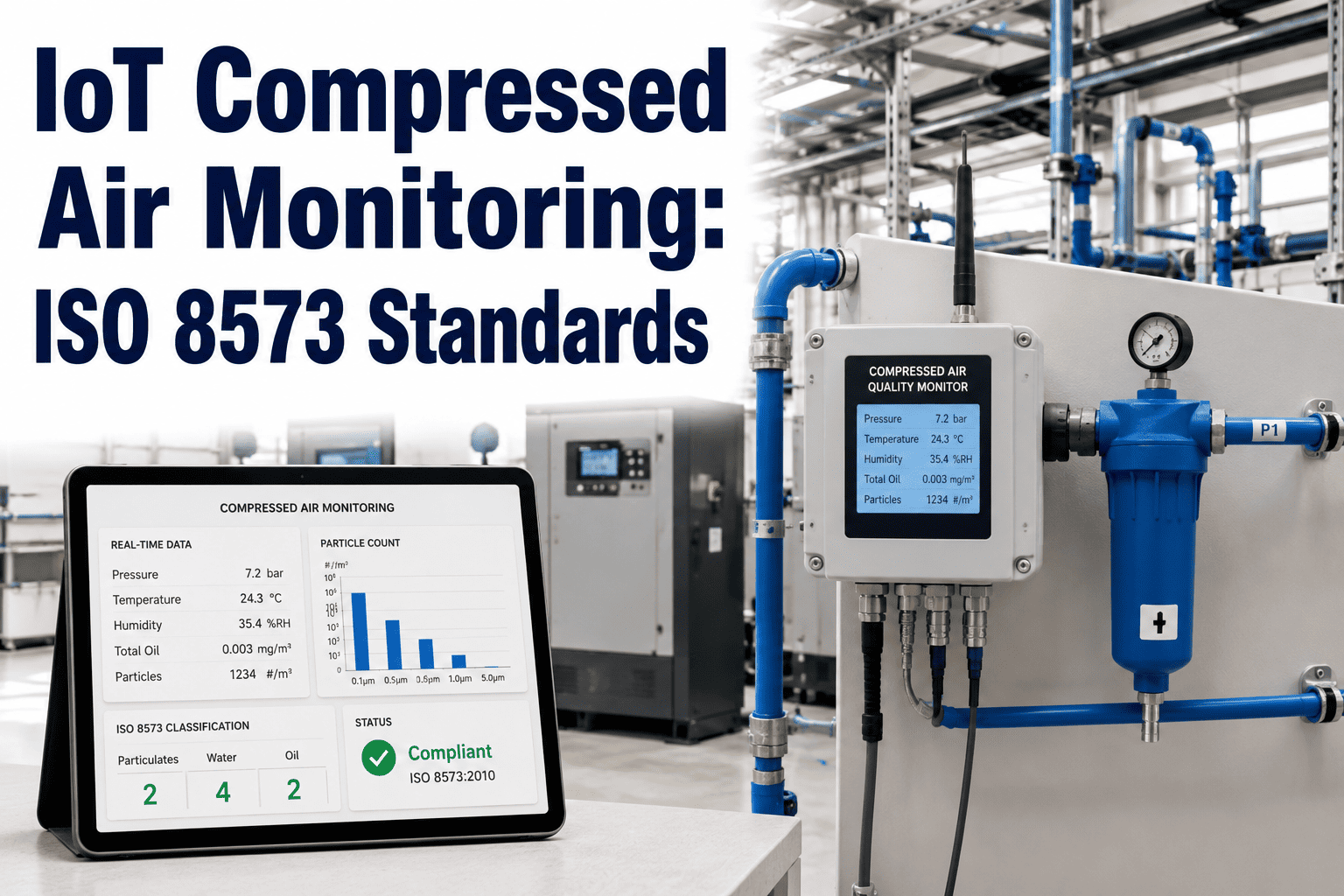
Compressed air touches food more often than most people realize — blowing off packaging before filling, propelling product through pneumatic conveying lines, agitating ingredients, even direct product contact in some blow-molding and drying applications. Every one of those contact points is a potential contamination pathway if the air itself isn't clean, and unlike a visibly dirty surface or an obviously spoiled ingredient, contaminated compressed air is invisible until it shows up as a quality failure, a foreign material complaint, or a food safety audit finding. ISO 8573 compressed air quality standards define exactly how clean food-grade air needs to be — particle count, moisture content, and oil content, each classified into specific purity classes — but meeting that standard once during commissioning and actually maintaining it continuously are two very different challenges. IoT compressed air monitoring closes that gap by tracking air quality continuously at the point of use, not just at periodic test intervals. You can book a demo to see this monitoring running against a live food-grade compressed air system.
Why Compressed Air Quality Is a Food Safety Issue, Not Just a Utility Issue
Most plants treat compressed air as a utility — something that needs to be available at sufficient pressure and volume, with quality treated as a secondary concern handled once during system design. In a food plant, that framing misses something important: any compressed air that contacts food, food-contact surfaces, or open product during processing is functionally an ingredient, in the sense that it can directly introduce contamination if it isn't clean.
This distinction matters more than it might initially seem, because most food safety programs are built around thoroughly documented control points for raw materials, processing steps, and packaging — yet compressed air quality has historically received far less rigorous, continuous attention despite carrying genuine contamination risk. A HACCP plan that carefully controls every ingredient specification while treating compressed air as a background utility has a real gap in its risk coverage, one that becomes especially apparent when a foreign material or microbial contamination investigation eventually traces back to an air system nobody had been monitoring closely.
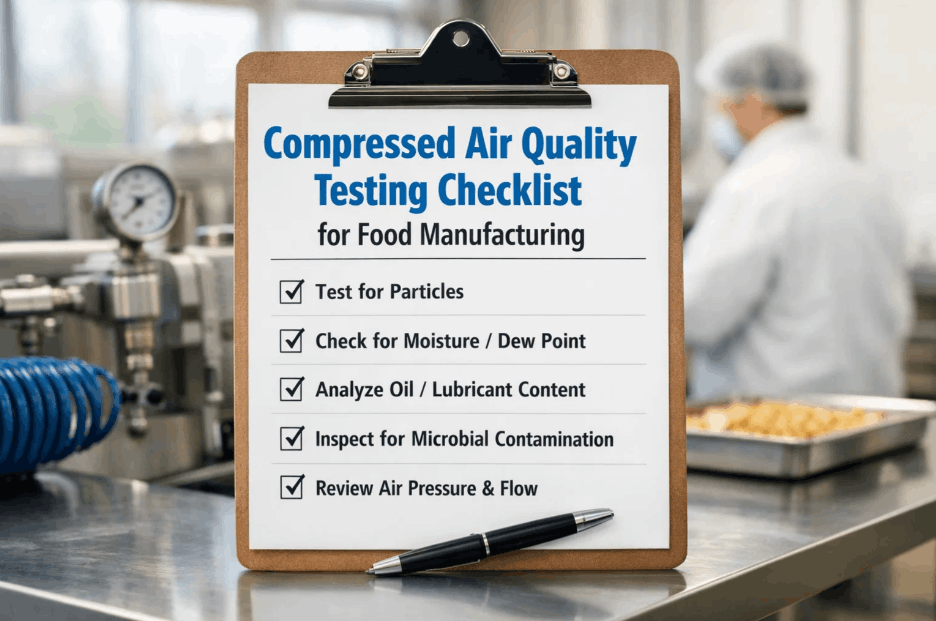
Particulate contamination in compressed air can introduce foreign material directly into product. Moisture creates a growth environment for microorganisms both in the air lines themselves and wherever that moisture ends up in the process. Oil carryover from compressor lubrication, if not properly filtered, can introduce both a chemical contamination risk and a potential allergen concern depending on the lubricant used. None of these risks are hypothetical — they're documented root causes in real food safety investigations, which is exactly why ISO 8573 exists as a formal classification standard rather than a general best-practice guideline.
Understanding ISO 8573 Purity Classes
ISO 8573 classifies compressed air purity across three contamination categories — solid particles, water, and oil — each rated on a numerical class scale where lower numbers indicate cleaner air. Food-grade applications typically require specific class combinations depending on whether the air has direct, indirect, or no product contact. The standard's structure as three independent scales, rather than a single combined purity score, matters practically because a compressed air system can easily meet the requirement on one contaminant type while quietly failing on another — a system might have excellent particle filtration but inadequate drying, meaning it passes on particle count while failing on moisture content, a distinction a single blended score would obscure entirely. Book a demo to see how your current air quality data maps against these classifications.
| Contamination Type | What It Measures | Typical Food-Grade Direct Contact Class |
|---|---|---|
| Solid Particles | Particle count and size distribution per cubic meter of air | Class 1–2 |
| Water (Moisture) | Pressure dew point, indicating moisture content and condensation risk | Class 1–4, depending on application |
| Oil (Total Oil Content) | Aerosol, liquid, and vapor oil concentration in mg per cubic meter | Class 1, often requiring oil-free compressor technology |
Particle, Moisture, and Oil — How Each Contaminant Actually Gets Into the Air
Understanding how each contaminant type enters a compressed air system is what makes targeted monitoring and remediation possible, rather than treating air quality as one undifferentiated problem to solve with a single generic filter. Each contamination pathway responds to different equipment and maintenance interventions, which means a facility experiencing an oil carryover issue gains nothing from simply upgrading particle filtration, and a moisture problem won't be solved by addressing oil content — the diagnosis has to match the specific pathway actually causing the problem.
These three contamination sources don't operate independently of each other in practice — a poorly maintained system often shows degradation across all three simultaneously, since the same root causes, like inadequate filter change intervals or a compressor running past its expected service life, tend to affect particle, moisture, and oil control together. This is one reason monitoring all three parameters at the same use point provides more diagnostic value than tracking any single contaminant in isolation, since a change in one often signals a broader system condition worth investigating.
Risk Varies by Contact Type — Direct, Indirect, and No Product Contact
Not every compressed air application in a food plant carries the same contamination risk, which is why ISO 8573 compliance requirements should be evaluated separately for each specific use point rather than applying a single blanket standard across the entire plant. Book a demo to see how monitoring can be scoped to your highest-risk contact points first.
A common and costly mistake is applying a uniform purity standard across the entire compressed air distribution system regardless of actual contact risk at each use point, which either wastes money over-treating low-risk applications or, more dangerously, under-treats a high-risk use point because it was grouped in with lower-risk applications during initial system design. Mapping every compressed air use point in the facility against its actual contact risk category is a foundational exercise that should precede any monitoring or filtration investment decision, since it determines exactly where the strictest attention and resources actually need to go.
Why Periodic Testing Alone Doesn't Guarantee Continuous Compliance
Most food plants validate compressed air quality through periodic testing — quarterly or annual sampling that confirms compliance at the moment of the test. This approach establishes a baseline, but it says very little about air quality on any of the days between tests, when actual conditions can drift meaningfully from what the last test result showed. A test conducted in January under one set of ambient humidity and compressor load conditions tells you very little about air quality in July, when higher ambient humidity puts considerably more demand on dryer performance.
Filter elements degrade gradually and don't announce their declining performance visually. A dryer operating slightly outside its rated dew point doesn't trigger an alarm on most systems unless specifically instrumented to do so. A compressor developing early-stage wear can begin passing more oil carryover long before that wear becomes a maintenance-visible problem. Each of these gradual degradations can push actual air quality below the ISO 8573 class the last periodic test confirmed, without anyone knowing until the next scheduled test — or worse, until a quality incident forces the question.
This isn't a criticism of periodic testing as a practice — it remains a necessary and valuable part of a documented compliance program. The issue is treating a periodic test result as if it represents ongoing system performance rather than a single snapshot in time. The gap between what a quarterly test confirms and what's actually happening in the system on any given production day is exactly the blind spot that leaves food safety risk unmanaged between test cycles.
What Continuous Air Quality Monitoring Actually Adds
Continuous monitoring of particle count, dew point, and oil content at critical use points closes the gap that periodic testing leaves open. Rather than confirming compliance at a single moment and assuming it holds until the next test, continuous data shows exactly when and why air quality began drifting — filter loading, dryer performance decline, compressor wear — often with enough lead time to intervene before the drift crosses a compliance threshold. This shift in timing matters enormously for a food safety program, since catching a developing air quality issue while it's still a maintenance item is a fundamentally different outcome than discovering it only after it has already contributed to a product quality or safety event. Book a demo to see how this fits into your existing food safety and quality documentation.
Deploying Compressed Air Monitoring — A Practical Starting Point
Facilities don't need to instrument every compressed air line in the plant simultaneously to get meaningful value from monitoring. A phased approach starting with the highest-risk use points delivers the most immediate food safety benefit while building the operational experience needed for broader rollout.
The first step is completing the contact-risk mapping exercise described earlier — identifying every point where compressed air touches product, food-contact surfaces, or open production areas, and classifying each by direct, indirect, or no-contact risk. Direct product contact points should receive monitoring priority, since they carry both the highest contamination consequence and, often, the tightest ISO 8573 class requirement to maintain. From there, sensors are installed at these priority points, baseline performance is established, and alert thresholds are configured against the specific ISO 8573 class each use point needs to maintain — creating a monitoring program that reflects actual plant risk rather than a generic, one-size-fits-all sensor deployment.