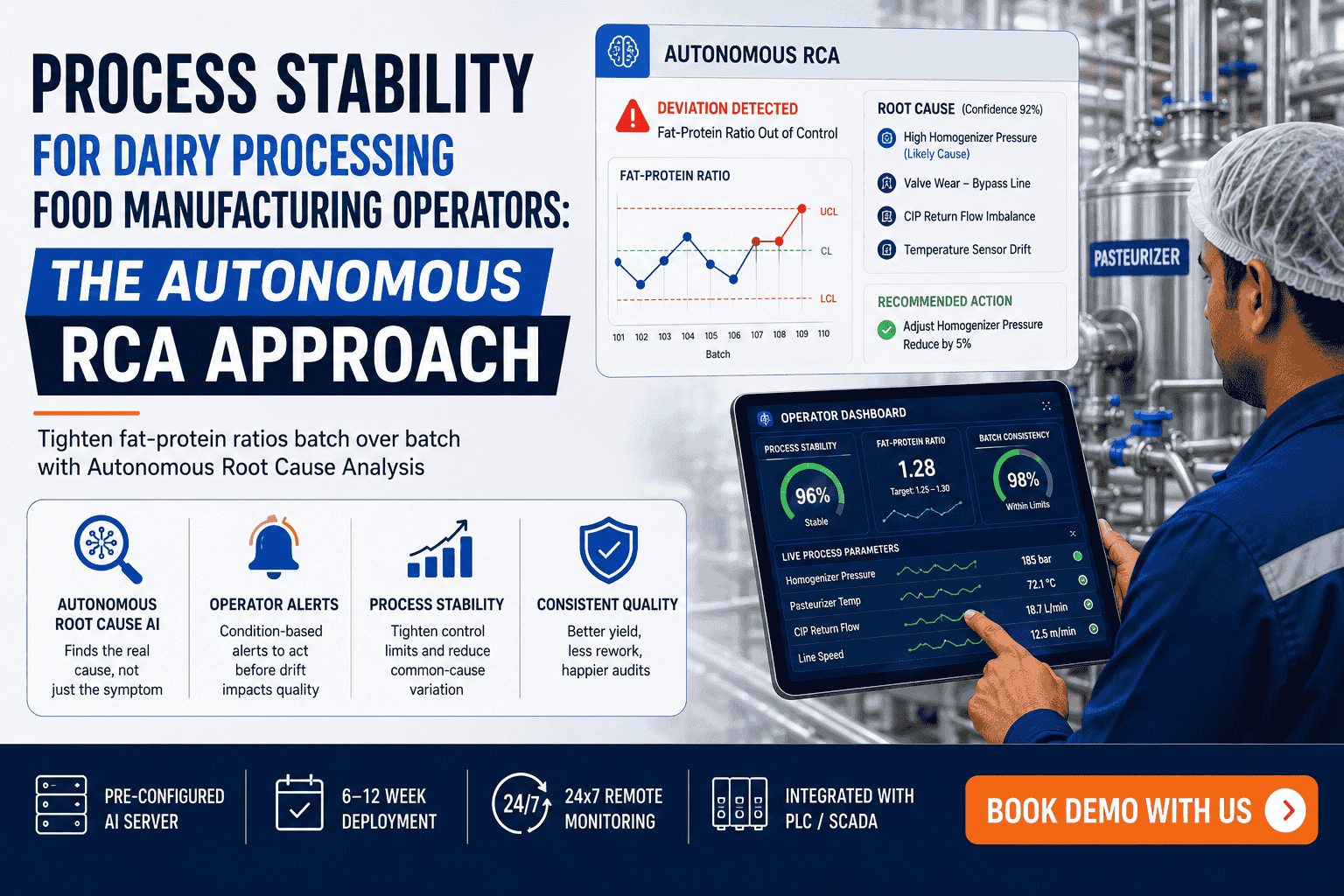
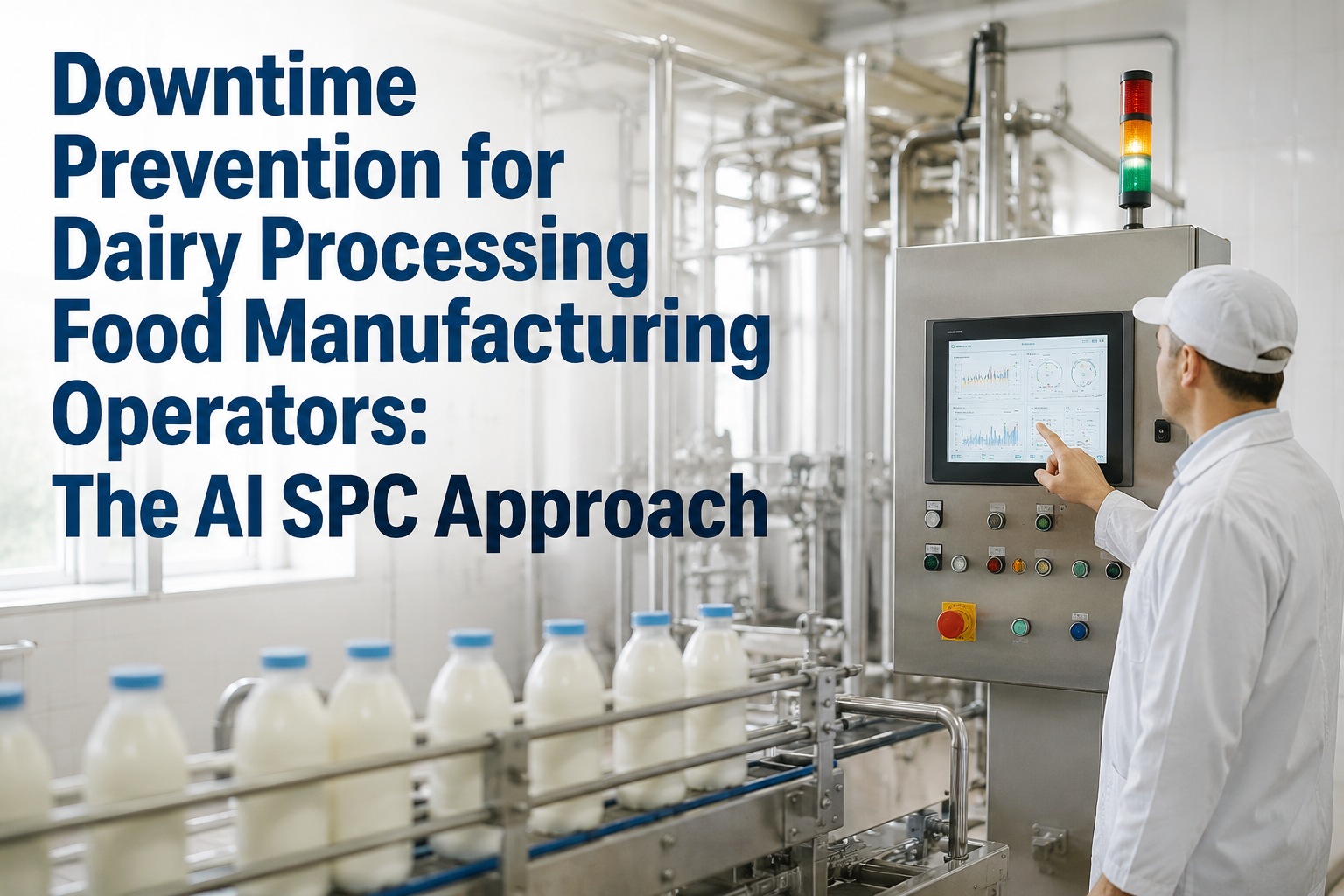
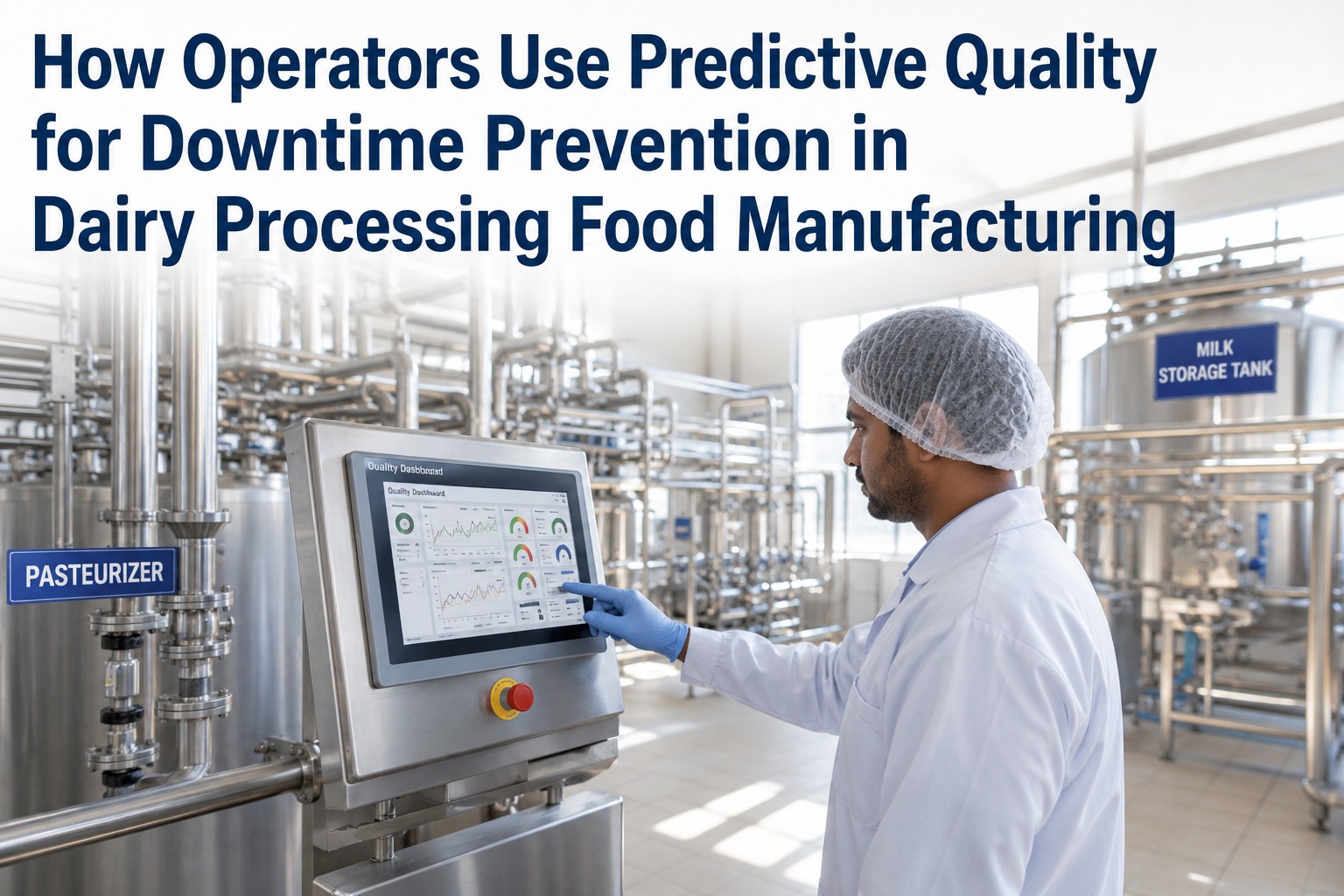
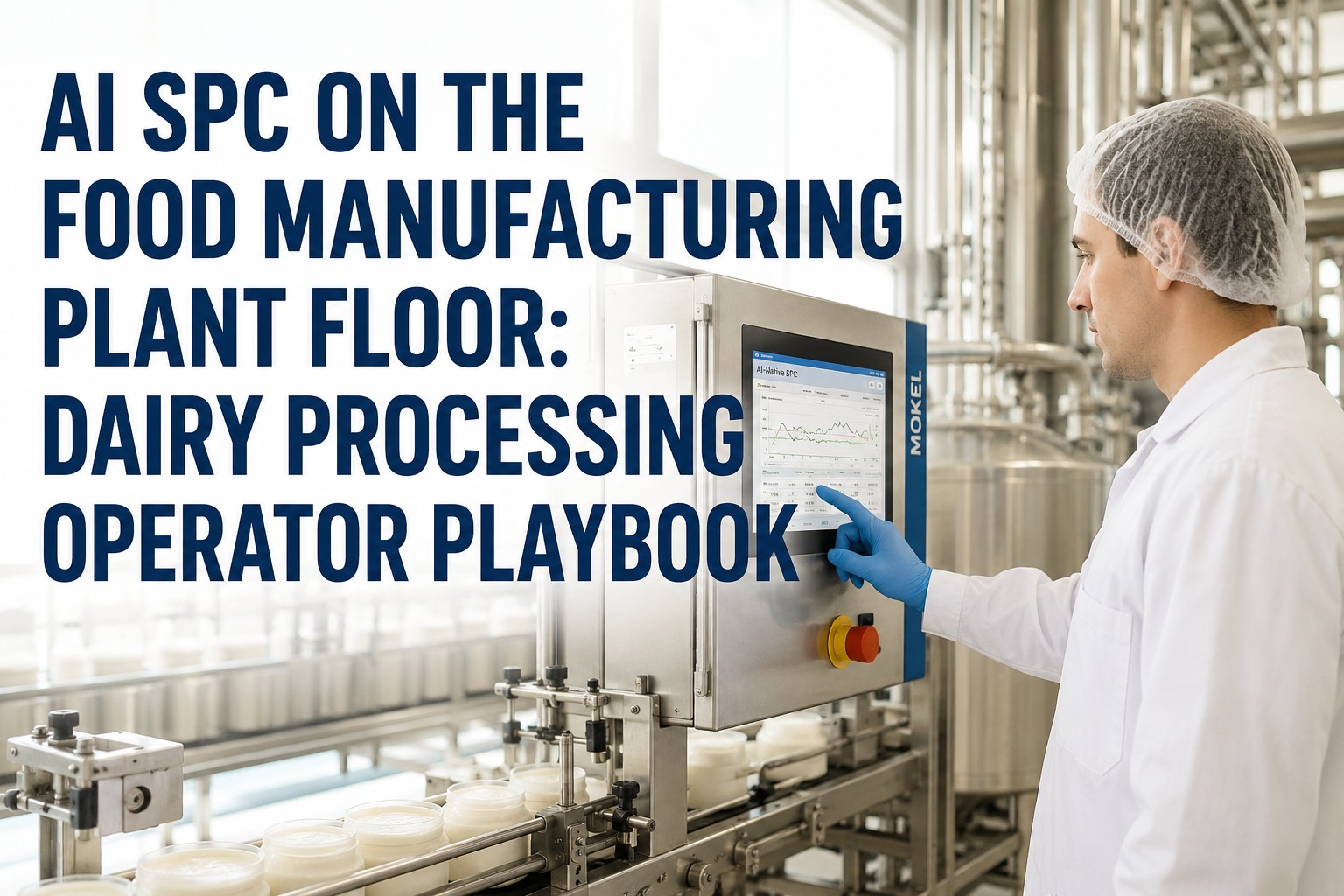
Dairy line operators run pasteurizers, separators, fillers, and cheese vats where small drift creates big problems fast. A pasteurizer holding 72°C for 15 seconds doesn’t announce its drift — it slips toward 71.7°C, then 71.4°C, and somewhere in there PMO lethality is no longer demonstrably met. Static control limits set last quarter don’t adapt to incoming milk that varies by season, farm, and load. AI-native SPC gives operators adaptive limits that learn current process conditions, plain-language alerts that say which probe to check, and the 6–12 week deployment that means your shift sees the value this quarter, not next year. Book a demo with us to see how AI-native SPC sits on your existing PLC and SCADA stack with no rip-and-replace.
For Dairy Line Operators
Real-Time AI SPC That Speaks Your Language
Adaptive control limits that learn your process. Plain-language alerts that name the probe, line, and recommended action. Sits on your existing PLC and SCADA — no new screens to learn. 24×7 monitoring across pasteurizer, separator, filler, and cheese vat.
6–12 wkdeployment to live monitoring
24×7monitoring across all shifts
0PLC or SCADA replacement required
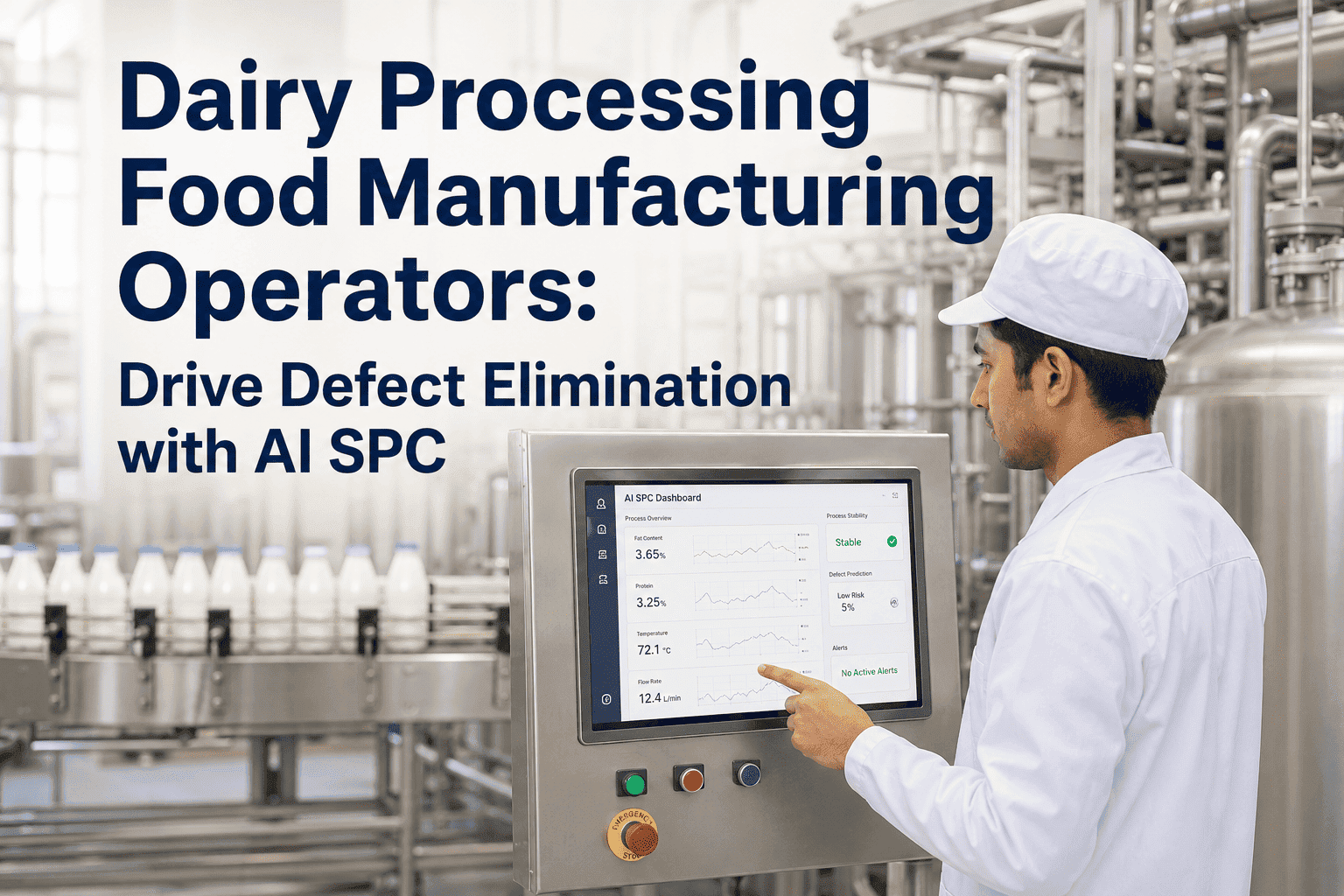
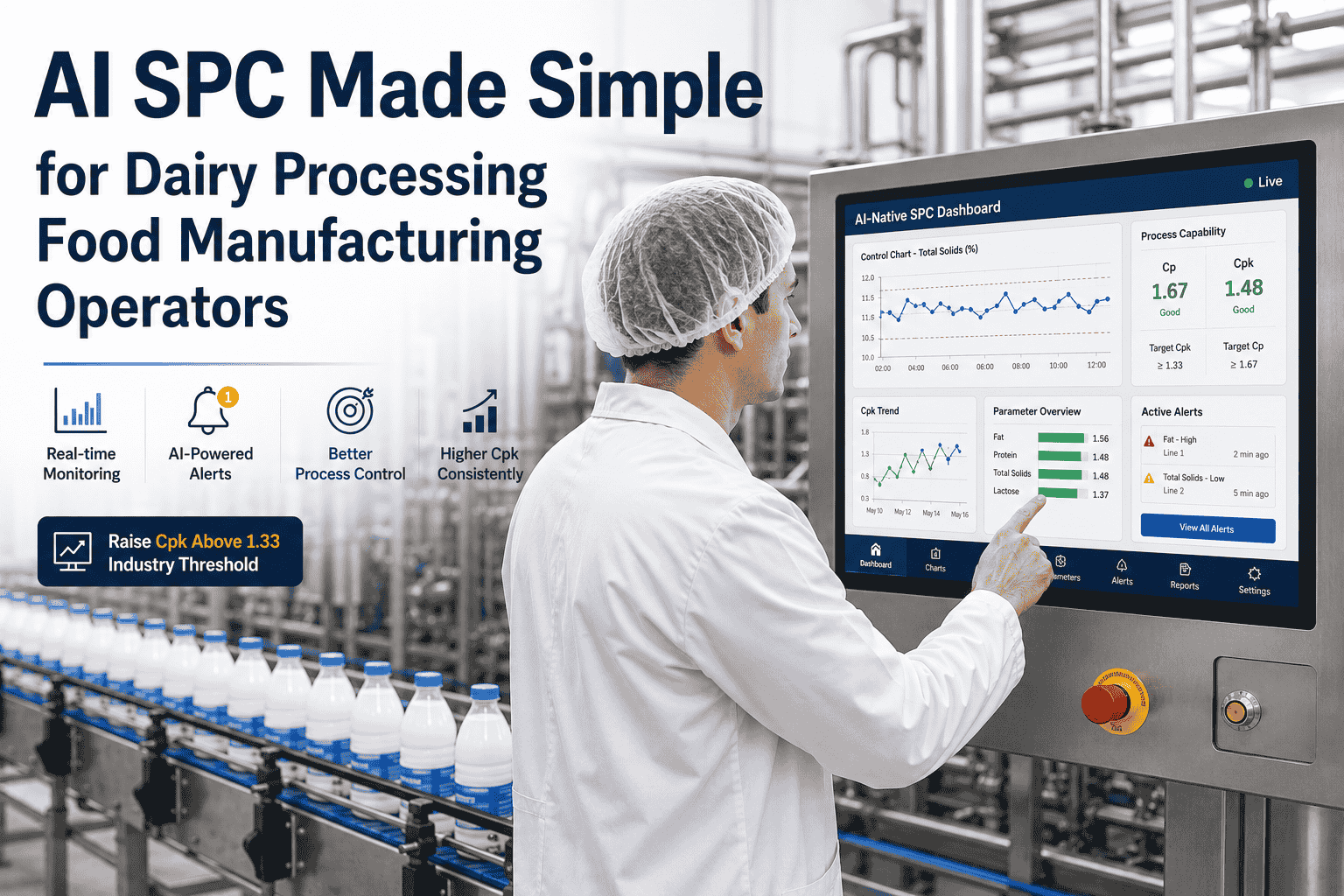
Operator Console · Pasteurizer Line 2
Adaptive limits active
Heads-up · TT-105
Temp drifting 0.4°C below adaptive UCL over last 6 readings. Pattern matches probe calibration drift. Recommended: check TT-105 against reference probe.
Pasteurizer Temp
71.6°C
UCL 72.4 · LCL 71.5
Hold Tube Flow
4,180 L/h
UCL 4,250 · LCL 4,100
Differential P
+1.8 psi
UCL +2.5 · LCL +1.0
Process Capability
Cpk 1.42
Stable · trending up
What Dairy Operators See Today — And Why It’s Costing Yield
Dairy operators run the most consequential continuous process in food manufacturing, with the thinnest margin for error. PMO lethality requires demonstrable hold time and temperature on every drop of milk passing through HTST. Cheese yield swings 3–7% based on coagulation parameters most operators can’t see in real time. And the SPC tools most plants run today were designed before edge AI was practical — static limits set quarterly, paper or HMI charts that don’t adapt, and alarms that fire when it’s already too late.
Pain 01
Static limits don’t match current milk
Incoming milk varies by season (fat 3.4–4.2%), farm, and load. SPC limits set quarterly assume average conditions and miss drift when this morning’s milk runs different from the baseline.
Pain 02
Alarms fire after quality fails
Traditional control charts flag the out-of-spec value — not the drift toward it. Operators see the alarm at the moment the batch is already compromised, not when intervention would have prevented the loss.
Pain 03
Cryptic alerts, no recommended action
SCADA alarms say “TT-105 HI HI” or “FT-203 LO.” Operators have to interpret, troubleshoot, and decide — often during shift change or while running three other lines.
Pain 04
Nelson rules detected by hand
Pattern detection (7 points one side of center, 6 points trending, etc.) requires operator vigilance across multiple charts simultaneously. Most patterns get noticed only in retrospective review, not real time.
Pain 05
CIP cycle quality is a black box
Clean-in-place cycles between batches affect downstream quality — but operators rarely see CIP performance data in their SPC view, so post-CIP variability gets blamed on incoming milk instead.
Pain 06
Shift change loses context
Incoming shift inherits a process state without history of what the previous operator saw, adjusted, or escalated. The next-shift troubleshooting starts from scratch.
Adaptive Limits vs Static Limits — What Actually Changes
The core innovation in AI-native SPC is adaptive control limits that learn current process conditions instead of using fixed bounds set quarterly. The difference matters because dairy processes aren’t stationary — incoming milk fat, protein, and somatic cell count vary daily, seasonal temperature affects PHE performance, and CIP cycle quality shifts equipment baseline. Static limits force operators to either run alarm-fatigue-inducing tight limits or tolerance-eating loose limits. Adaptive limits move with the process so operators get actionable signals only.
What Operators See
Static SPC (Traditional)
AI-Native SPC (Adaptive)
Control limits
Set quarterly, fixed bounds
Adapt to current milk & conditions
Alert timing
After value exceeds limit
When drift pattern emerges
Alert content
Tag ID + HI/LO code
Plain-language + recommended action
Nelson rule detection
Manual operator vigilance
Automated across all rules
Shift handoff
Verbal + handwritten log
Full history with annotations
CIP cycle visibility
Separate system, post-event
Integrated with process SPC
Capability (Cpk) tracking
Calculated monthly, manual
Live and trending continuously
PLC/SCADA replacement
N/A
None — layers above existing stack
Want to see adaptive limits running on your actual pasteurizer data? Book a demo with us — we’ll connect to a sample of your historian data and show the difference in 30 minutes.
The Four Dairy CCPs iFactory Monitors 24×7
Dairy processing has well-defined critical control points where small drift creates big quality and compliance consequences. iFactory’s AI-native SPC monitors all four continuously, with dairy-specific models trained on HTST pasteurization, separation, filling, and cheese-make patterns. Operators get the right signals on the right screens at the right time — not a flood of generic alarms from a system that doesn’t understand dairy.
CCP 01
HTST Pasteurization
Temperature, hold time, flow rate, and differential pressure monitored against PMO requirements. Adaptive limits account for incoming milk variability and PHE performance drift.
Hold Tube Temp
Flow Rate
Diff Pressure
Lethality
CCP 02
Cream Separation
Fat content target stability through separator performance monitoring. Adaptive models track bowl speed, feed rate, and incoming fat variability to predict separation efficiency.
Bowl Speed
Feed Rate
Output Fat %
Skim Loss
CCP 03
Filling & Sealing
Fill weight, fill volume, and seal integrity tracked against label declarations and customer specifications. Operators see drift before giveaway crosses cost thresholds.
Fill Weight
Fill Volume
Seal Integrity
Giveaway %
CCP 04
Cheese Make & Yield
Coagulation timing, curd firmness, whey moisture, and yield (Van Slyke) tracked through the make cycle. Operators see protein recovery and yield impact while there’s still time to correct.
Coag Time
Curd Firmness
Whey Moisture
Van Slyke Yield
Plain-Language Operator Alerts — Not Cryptic Codes
The biggest practical change for operators isn’t the AI model — it’s the alert content. AI-native SPC translates pattern detection into plain language that names the equipment, describes the pattern, and recommends the action. No more interpreting “TT-105 HI HI” at 3 AM. The alert tells you what’s happening and what to do about it.
Traditional SCADA Alarm
TT-105 HI
FT-203 LO
PT-118 DEV +
→
AI-Native SPC Alert
Pasteurizer hold tube drifting 0.4°C below adaptive UCL for 6 consecutive readings. Pattern matches probe calibration drift signature. Recommended: check TT-105 against reference probe.
Traditional SCADA Alarm
FILLER-3 OOS
WEIGHT OFFSET
→
AI-Native SPC Alert
Filler 3 trending toward 1.2g overfill across last 12 minutes. Giveaway projected at 1.8% by end-of-shift. Recommended: adjust target setpoint by −0.8g, check piston seal F3-P2.
Traditional SCADA Alarm
CHEESE-V2
COAG FAIL
→
AI-Native SPC Alert
Vat 2 coagulation timing 14% slower than adaptive baseline. Incoming protein 3.1% (low side). Recommended: increase rennet by 8% on this make, hold curd cut by 90 seconds.
See Operator Alerts on Your Real Data
A live demo connects to a sample of your historian data and shows what your operators would see on Day 1 of AI-native SPC. Pasteurizer, separator, filler, or cheese vat — whichever line you want to walk through.
6–12 Week Deployment — What Each Phase Delivers
Deployment runs 6–12 weeks from kickoff to live operator monitoring, depending on plant complexity (single line vs multi-line, single product vs multi-product). The phasing protects production — iFactory deploys alongside existing SPC initially, then operators transition as adaptive limits prove out on their lines.
Week 1–2
Connection & Baseline
Pre-configured AI server installed in plant network
PLC/SCADA tag mapping — no code changes to existing systems
Historian data ingested for baseline model training
Operator-facing displays mocked up for review
Week 3–6
Shadow Mode & Tuning
AI runs in parallel with existing SPC (shadow mode)
Adaptive limits tune to your specific milk, equipment, and products
Alert content reviewed and refined with operators
Pattern detection accuracy validated against historical incidents
Week 7–12
Live Operator Monitoring
Operators transition to AI-native SPC as primary view
Shift handoff workflows include AI annotations & history
24×7 monitoring active across all configured CCPs
Continuous learning — models tune as conditions evolve
How It Fits Your Existing PLC/SCADA Stack
AI-native SPC layers above your existing automation stack — it doesn’t replace Allen-Bradley, Siemens, Rockwell, Schneider, or whatever PLC/SCADA you’re running today. The pre-configured AI server connects via standard OPC-UA, Modbus, or MQTT depending on your stack. No code changes to your PLC programs. No new operator screens to learn from scratch — the AI SPC view supplements your existing HMI rather than replacing it.
iFactory AI-Native SPC Layer
Adaptive limits · pattern detection · plain-language alerts
SCADA / HMI
FactoryTalk, WinCC, iFIX
PLCs
Allen-Bradley, Siemens, Schneider
Historian
PI System, AVEVA, Canary
MES / QMS
SAP, Rockwell PharmaSuite
Already running a particular SCADA or historian stack? Book a demo with us — we’ll confirm integration coverage and walk through the specific tag mapping approach for your environment.
Expert Perspective
"The shift from static SPC to AI-native adaptive SPC is the biggest change in shop-floor quality tools since SCADA itself. Dairy is one of the highest-value applications because the process is continuous, the variability sources are well-understood, and the regulatory framework (PMO, FSMA 21 CFR 117 Subpart C) requires demonstrable control. Operators running pasteurizers and cheese vats with adaptive limits see drift 30–60 minutes before a static-limit system would alarm — which is the difference between adjusting a setpoint and discarding a batch. The plain-language alert content matters more than most plants realize. Operators don’t need more alarms; they need clearer instructions when an alarm fires. A SCADA alarm that says ‘TT-105 HI HI’ requires interpretation. An AI alert that says ‘pasteurizer hold tube drifting, check probe TT-105 against reference’ requires action. The 6–12 week deployment timeline matters because operators see results in the same quarter the project starts — not eighteen months out when leadership has moved on to other priorities. That cadence keeps shop floor engagement high through the transition."
— Dairy Process Quality Practice, 2026 industry perspective
30–60 min
earlier drift detection vs static limits
3–7%
cheese yield swing from coagulation parameters
6–12 wk
deployment to live operator monitoring
Frequently Asked Questions
Do operators need new training or new screens?
Minimal new training, no replacement screens. AI-native SPC adds a supplementary view that operators access from existing HMI or a dedicated tablet on the line. The plain-language alert content is designed to be self-explanatory — if an alert says “pasteurizer drifting, check TT-105,” the operator knows what to do without classroom training. Typical operator onboarding is 30–60 minutes per shift, with iFactory’s deployment team walking each shift through their specific line views during weeks 7–12 of deployment. Operators continue using their existing SCADA HMI for control actions — the AI SPC layer is for monitoring, pattern detection, and recommendations, not direct equipment control.
Does this replace our SCADA or PLC system?
No. AI-native SPC layers above your existing PLC and SCADA stack via standard protocols (OPC-UA, Modbus, MQTT). No code changes to PLC programs. No SCADA reconfiguration. Your operators keep their existing HMI for control actions; the AI SPC view supplements with adaptive limits, pattern detection, and plain-language alerts. iFactory supports the major PLC ecosystems (Allen-Bradley, Siemens, Schneider, Mitsubishi, Omron) and SCADA platforms (FactoryTalk, WinCC, iFIX, Wonderware, Ignition). Historian integration covers PI System, AVEVA, Canary, and others. The pre-configured AI server is installed within your plant network and processes data on-premise, which is important for dairy plants with strict data sovereignty requirements.
What is “adaptive” about adaptive limits, exactly?
Static SPC limits are set at one point in time (typically quarterly) based on a window of historical data. They don’t change as your process changes. Adaptive limits are recalculated continuously by AI models that learn the current relationship between input variables and process behavior. When incoming milk fat is 3.4% vs 4.1%, the adaptive limits on downstream parameters adjust automatically. When CIP cycle quality shifts equipment baseline, adaptive limits track the new normal instead of alarming on every reading. When seasonal temperature affects PHE performance, the limits accommodate. The result: alarms fire when there’s actually drift, not because conditions changed in ways the static limits didn’t anticipate. Operators get fewer total alarms and higher-quality alarms.
How does this handle PMO compliance for HTST pasteurization?
AI-native SPC complements PMO compliance — it doesn’t replace the regulatory recording or the legal-traceability framework your plant already has. The pasteurizer’s legal recorder (Chart-Lite, eMaint, or equivalent) continues to operate as the PMO-recognized record of temperature, time, and flow. AI SPC adds a parallel monitoring layer that detects drift patterns earlier than the legal recorder would alarm on out-of-spec values. This means operators see the drift toward a non-compliance condition with enough time to correct — before the legal recorder logs an out-of-spec event that triggers diversion or batch hold. The AI SPC layer also documents pattern detection events for FSMA 21 CFR 117 Subpart C preventive controls records, complementing the PMO trail with a documented preventive-control history.
What happens if the AI gets it wrong — false alarms or missed drift?
Two safety mechanisms. First, AI-native SPC runs in shadow mode during weeks 3–6 of deployment, where the AI runs in parallel with existing SPC but operators continue to act on the legacy system. False alarms and missed signals get identified and tuned out before operators transition. Second, the AI doesn’t replace your existing SCADA alarms or PMO legal recorder — those continue to operate. AI SPC is an additive monitoring layer, not a replacement of safety-critical systems. If the AI misses something, your existing systems still catch it; the AI just won’t have alerted earlier. Over time, accuracy improves because the model is continuously learning from operator feedback — when an operator marks an alert as “not actionable,” that signal feeds back into model tuning.
How is this different from the existing SPC software our plant runs?
Most existing SPC software in dairy plants was designed for static-limit charting. It reads tag values from SCADA or historian, plots them against fixed UCL/LCL bounds, and alarms when values exceed limits. AI-native SPC is fundamentally different in three ways. First, limits adapt to current process conditions instead of staying fixed quarterly. Second, pattern detection runs continuously across all configured Nelson rules instead of requiring operator vigilance. Third, alert content is plain-language with recommended actions instead of cryptic tag codes. The deployment also differs: traditional SPC software requires extensive plant-specific configuration and chart-building, while iFactory’s AI-native SPC comes pre-configured for dairy CCPs (HTST pasteurization, separation, filling, cheese make) so configuration is tuning rather than building from scratch.