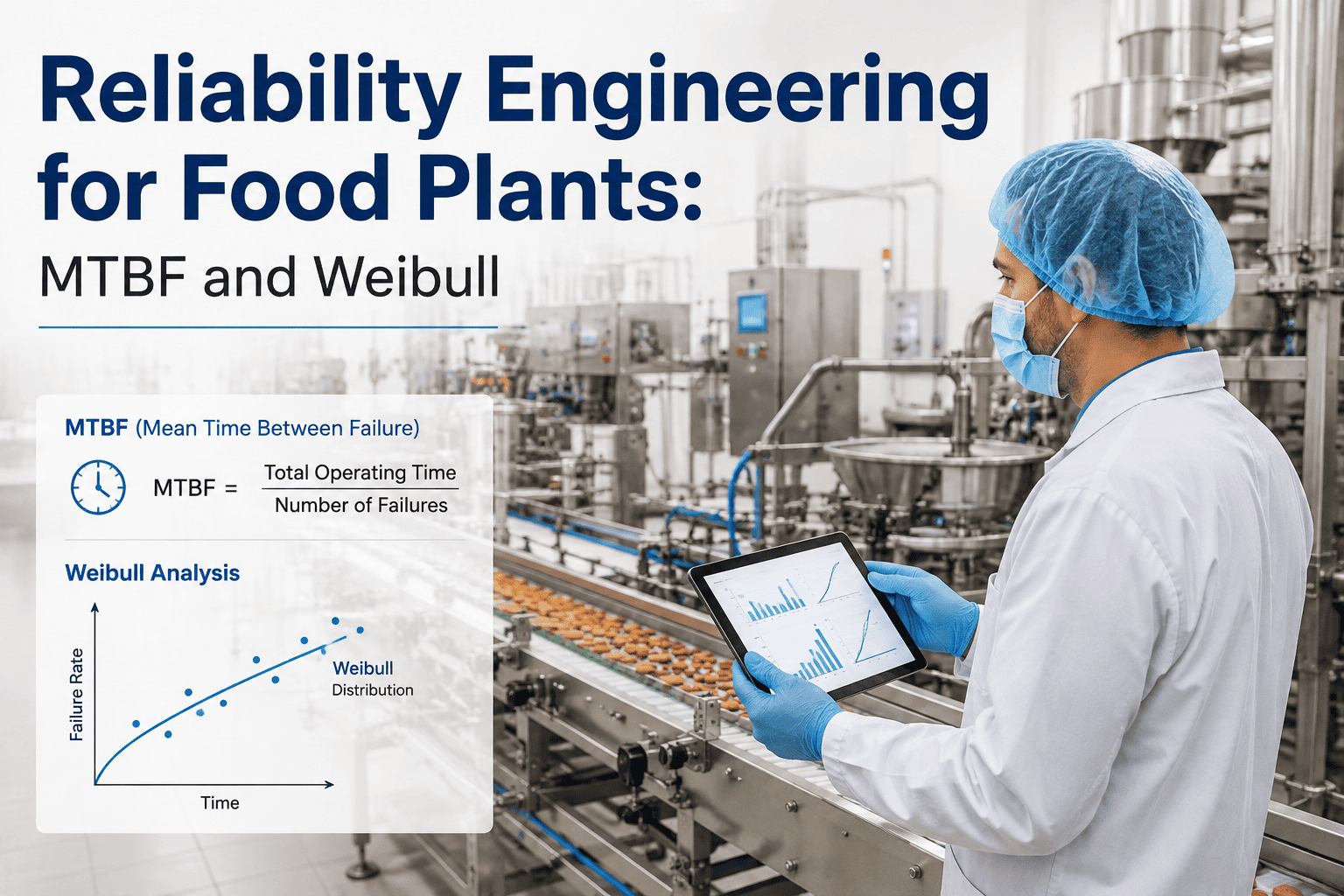
Most food plant maintenance teams can tell you how often a pump failed last year, but far fewer can tell you whether that pump is more likely to fail from random chance or from wear that's accelerating as it ages — and that distinction is exactly what separates firefighting maintenance from genuine reliability engineering. MTBF tells you the average time between failures, but a Weibull analysis tells you the shape of the failure pattern itself, revealing whether an asset is in its stable operating life or has entered a wear-out phase where failure probability climbs with every additional hour of run time. For food plants with high-value rotating equipment and packaging lines running continuously, that distinction directly shapes whether a maintenance strategy is time-based, condition-based, or run-to-failure. Book a session with iFactory's reliability team to run this analysis against your own critical asset data.
Food & Beverage · Reliability Engineering
Reliability Engineering for Food Plants: MTBF and Weibull Analysis
Move from firefighting to genuine reliability strategy using MTBF and Weibull analysis on the assets that matter most to your line.
The Two Core Metrics
MTBF and Weibull — What Each One Actually Tells You
MTBF and Weibull analysis answer related but distinct questions, and understanding what each one reveals is what turns raw failure data into an actual maintenance strategy rather than just a number on a report.
MTBF
Mean Time Between Failures
A single average number showing how much operating time typically passes between failures on a given asset — useful for tracking overall trend, but it doesn't reveal whether failures are random or accelerating.
Weibull Analysis
Failure Pattern Shape
A statistical model of how failure probability changes over an asset's life, revealing whether it's in a stable random-failure phase or a wear-out phase where risk climbs with age.
See Your Own Assets Analyzed
Run a Weibull Analysis Against Your Critical Equipment History
iFactory reviews your failure history and shows what MTBF and Weibull analysis reveal about your specific critical assets.
Common F&B Assets
Where Reliability Analysis Pays Off Fastest in Food Plants
| Asset Type |
Typical Failure Pattern |
Strategy Implication |
| Rotating pumps and motors |
Often shows wear-out behavior as bearings age |
Time-based or condition-based replacement before wear-out phase |
| Conveyor and packaging drives |
Mix of random and wear-related failures |
Condition monitoring to catch developing wear-related failures |
| Electronic control components |
Often random failure, not age-related |
Run-to-failure may be appropriate with adequate spares on hand |
| Seals and gaskets in sanitary lines |
Typically wear-out driven by CIP cycle exposure |
Scheduled replacement based on cycle count, not just calendar time |
From Firefighting to Strategy
What Changes Once a Plant Adopts Reliability Analysis
Maintenance Strategy by Asset, Not Blanket Rules
Each asset's actual failure pattern drives whether it gets time-based, condition-based, or run-to-failure treatment, instead of applying the same generic PM interval to everything.
Defensible Spare Parts Stocking
Understanding an asset's failure probability curve supports a data-backed case for which spares actually need to be on the shelf versus ordered on demand.
Capital Replacement Timing
Weibull analysis showing an asset entering its wear-out phase gives engineering a data point for planning replacement before failure forces the decision.
Field Perspective
The plants stuck in permanent firefighting mode are almost always treating every asset the same way — same PM interval, same run-to-failure tolerance, regardless of whether that specific asset actually fails randomly or predictably as it ages. Once a plant starts running Weibull analysis on its critical rotating equipment, the maintenance strategy conversation changes completely, because now there's an actual data-backed reason to replace a bearing at a specific run-hour mark instead of guessing based on when it happened to fail last time. Reliability engineering isn't about more maintenance — it's about the right maintenance at the right time for each specific asset's actual failure behavior.
Alaric Nkemdirim-Petrov
Reliability Engineering Consultant · 16 years applying MTBF and Weibull analysis in food and beverage manufacturing · Former Senior Reliability Engineer, food processing operations
Common Questions
MTBF and Weibull Reliability Analysis — Frequently Asked
How much failure history data do we need before Weibull analysis becomes reliable?
More failure events produce a more confident analysis, but even a modest history of failures on a critical asset can start revealing whether it trends toward random or wear-out behavior, with confidence improving as more data accumulates over time.
Book a demo to assess what your current failure history can already support.
Do we need a dedicated reliability engineer on staff to run this kind of analysis?
Not necessarily — modern reliability tools can generate MTBF and Weibull analysis directly from work order history without requiring in-house statistical expertise, though a reliability engineer or consultant can help translate the results into specific maintenance decisions.
Book a demo to see how analysis is generated from your existing maintenance data.
Which assets should we prioritize for reliability analysis first?
High-cost, high-downtime-impact assets with a reasonable failure history — critical pumps, packaging line drives, key rotating equipment — typically offer the fastest and clearest return on a first reliability analysis effort.
Book a demo to identify priority assets from your own criticality data.
How does Weibull analysis actually change our day-to-day maintenance decisions?
An asset shown to be entering a wear-out phase supports shifting from reactive repair to scheduled proactive replacement, while an asset showing random failure patterns may be better served by condition monitoring or adequate spares rather than fixed-interval replacement.
Book a demo to translate analysis results into a specific strategy change for your assets.
Can reliability analysis integrate with our existing CMMS work order history?
Yes — MTBF and Weibull analysis can be generated directly from existing work order and failure history already captured in your maintenance system, without requiring a separate data collection effort.
Book a demo to see analysis generated from your current CMMS data.
Move From Firefighting to Data-Backed Strategy
Bring MTBF and Weibull Analysis to Your Food Plant's Critical Assets
iFactory turns your existing work order history into reliability analysis that shows which assets need time-based replacement, condition monitoring, or run-to-failure treatment.