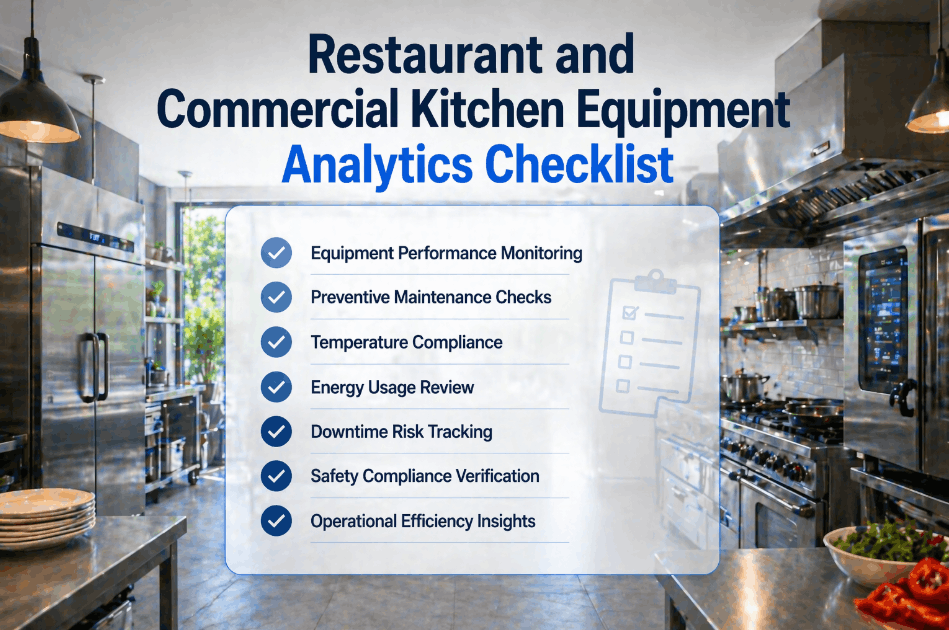
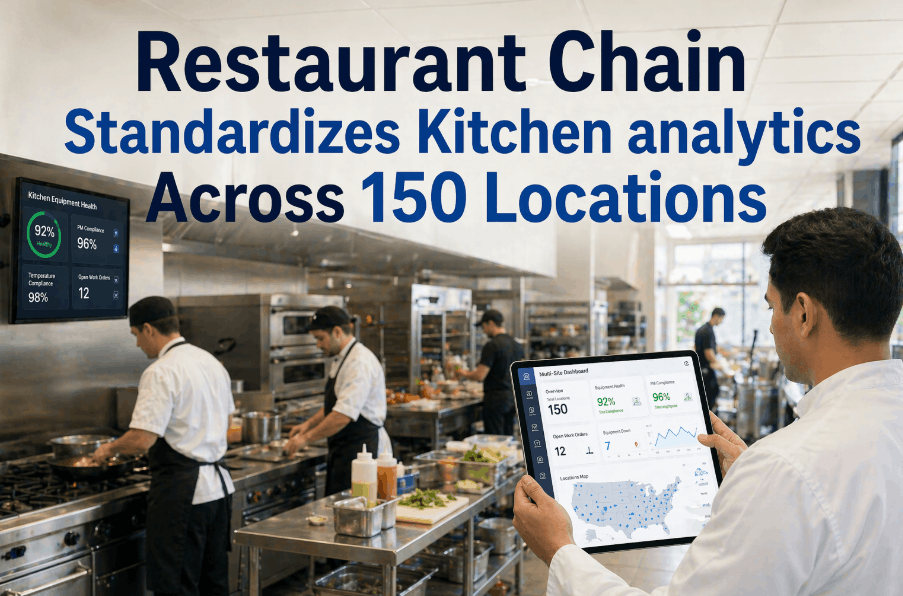
Restaurant and commercial kitchen equipment analytics is redefining how food service operators manage asset reliability, health department compliance, and operational uptime. From refrigeration failures that trigger food safety violations to cooking equipment breakdowns that shut down service during peak hours, the consequences of unmanaged kitchen assets are immediate and costly. AI-driven analytics platforms now give restaurant operators and commercial kitchen managers the real-time visibility to prevent failures before they happen—turning reactive maintenance into a structured, compliance-ready operation. Book a Demo to see how iFactory's Work Order Management system transforms commercial kitchen equipment reliability from the ground up.
AI-Driven Restaurant Equipment Analytics for Commercial Kitchens
iFactory's Work Order Management platform gives restaurant and food service teams a unified view of PM compliance, equipment health, refrigeration monitoring, exhaust hood status, and health department audit readiness—tracked and actioned in real time.
Why Restaurant Equipment Analytics Is Critical for Commercial Kitchen Operations
The average commercial kitchen operates with dozens of high-value assets running continuously under extreme thermal and mechanical stress. Walk-in coolers, reach-in refrigerators, commercial ovens, fryers, dishwashers, and exhaust hood systems all require structured preventive maintenance schedules to maintain food safety compliance and operational throughput. Without restaurant equipment analytics, most operators discover equipment problems only after failure—when the repair cost is highest and the operational disruption is most severe.
Food service analytics platforms solve this by digitizing every work order, PM task, and inspection record across the entire equipment fleet. When refrigeration temperature deviates, when a dishwasher's sanitizer concentration drops below compliance thresholds, or when an exhaust hood's last cleaning date approaches its regulatory limit, an AI-driven system generates the work order automatically—before a health department inspector finds the gap first. Operators who implement restaurant analytics software consistently report measurable reductions in equipment downtime, food safety incidents, and emergency repair spend.
The Six Critical Equipment Categories in Commercial Kitchen Analytics
Effective kitchen equipment lifecycle management requires category-specific analytics strategies. Each equipment class in a commercial kitchen carries distinct failure modes, compliance requirements, and maintenance intervals. The following six categories represent the highest-priority asset classes for restaurant analytics management.
Restaurant Refrigeration Analytics
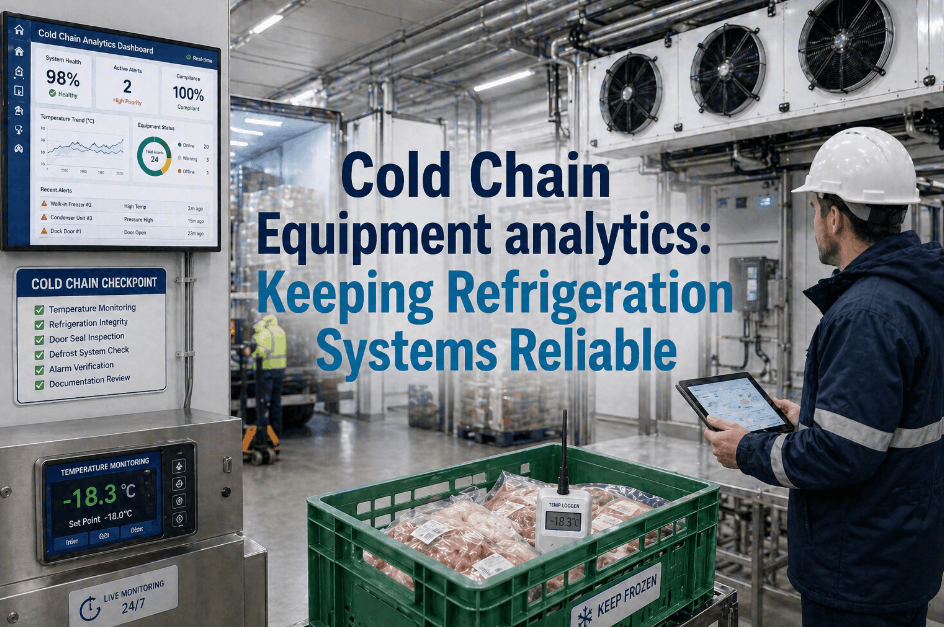
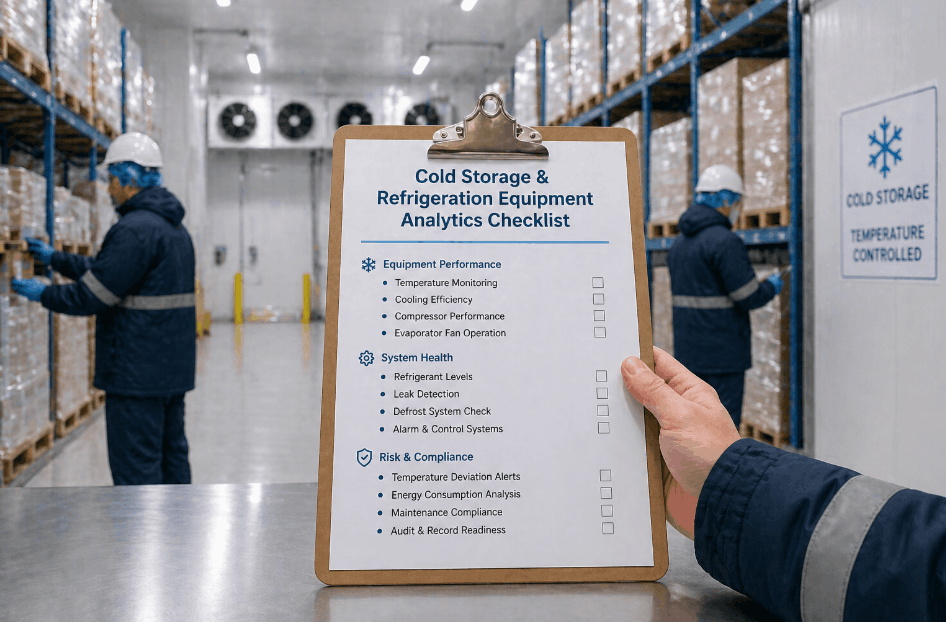
Refrigeration equipment is the highest-stakes asset class in any commercial kitchen. Walk-in coolers, walk-in freezers, undercounter refrigerators, and display cases must maintain precise temperature ranges continuously to prevent food safety violations and product loss. Restaurant refrigeration analytics tracks compressor runtime cycles, door seal integrity, defrost performance, and temperature log compliance in real time—triggering work orders automatically when any parameter deviates from the safe operating envelope. AI anomaly detection identifies compressor degradation weeks before complete failure occurs.
Commercial Cooking Equipment PM
Commercial cooking equipment—including ranges, ovens, fryers, griddles, steamers, and combi ovens—operates under extreme thermal cycles that accelerate mechanical wear. Commercial cooking equipment analytics tracks burner calibration, thermostat accuracy, gas valve performance, and cleaning compliance against manufacturer-specified PM intervals. Structured kitchen equipment PM schedules for cooking assets reduce ignition failures, uneven heating events, and energy waste from miscalibrated temperature controls. When cooking equipment PM compliance is tracked at the work order level, operators gain full audit trails for every maintenance event.
Restaurant Dishwasher Analytics
Commercial dishwashers are compliance-critical assets that must meet specific sanitization temperature and chemical concentration thresholds on every cycle to satisfy health department requirements. Restaurant dishwasher analytics monitors wash temperature, rinse temperature, sanitizer dosing concentration, and cycle count against maintenance milestones. When sanitizer feed systems underperform or wash arm pressure drops, the analytics platform generates a corrective work order before the next health department inspection captures the failure. Dishwasher PM compliance records also provide the documentation trail needed during formal audit reviews.
Exhaust Hood Analytics Kitchen
Exhaust hood systems represent one of the most heavily regulated equipment categories in commercial kitchens, with cleaning frequency requirements mandated by NFPA 96, local fire codes, and health department standards. Exhaust hood analytics tracks the date of last professional cleaning, grease accumulation rate by cooking volume, make-up air balance, and fan motor performance against compliance schedules. Operators using kitchen equipment analytics for exhaust hood management eliminate the risk of fire code violations and unplanned hood cleaning shutdowns during service periods.
Warewashing & Ice Machine Monitoring
Ice machines and warewashing equipment carry disproportionate health risk relative to their size. Ice machine analytics tracks water filter change intervals, bin sanitization compliance, scale buildup accumulation, and production rate degradation—each of which represents a direct pathway to health department citations. Automated work order generation for filter changes and scheduled sanitization keeps these assets continuously compliant without relying on staff memory or paper-based logs. Filter change compliance rates above 95% are consistently achievable when tracked at the work order level.
Kitchen Equipment Lifecycle Management
Beyond individual asset monitoring, restaurant asset management requires portfolio-level visibility into equipment age, total maintenance cost, failure frequency, and projected replacement timelines. Kitchen equipment lifecycle analytics aggregates work order history, parts spend, and downtime events per asset to calculate total cost of ownership and flag equipment approaching end-of-reliable-life. This data transforms capital equipment decisions from gut-feel estimates into evidence-based investment planning—allowing operators to replace aging assets proactively rather than in emergency response to catastrophic failure during service.
How iFactory's Work Order Management Drives Commercial Kitchen Equipment Reliability
iFactory's Work Order Management platform is purpose-built for the operational rhythm of food service environments—where equipment failures happen without warning, compliance documentation must be instantly accessible during inspections, and maintenance staff need mobile-first tools that work in a busy kitchen environment. The platform moves restaurant analytics management from reactive paper-based processes to a structured, digitized workflow that captures every maintenance event in real time.
From Paper Logs to AI-Driven Kitchen Compliance
Digital Equipment Registry & Asset Profiling
Every piece of commercial kitchen equipment is registered in the platform with full asset profiles—make, model, serial number, installation date, warranty status, manufacturer PM intervals, and regulatory compliance requirements. QR codes affixed to each asset allow kitchen staff to pull up equipment history, open work orders, and log observations directly from a mobile device without returning to a back-office terminal. This digital registry becomes the foundation for all subsequent PM scheduling, work order generation, and compliance tracking.
Automated PM Scheduling & Work Order Generation
PM schedules for every asset class—refrigeration units, cooking equipment, dishwashers, ice machines, exhaust hoods—are configured once at the platform level and then generate work orders automatically at the correct intervals. When a compressor's 90-day PM is due, or when a dishwasher's monthly sanitizer system check reaches its trigger date, the work order appears in the assigned technician's queue without any manual scheduling input. This automated kitchen equipment PM system eliminates the scheduling gaps that lead to compliance failures and premature equipment degradation.
AI Anomaly Detection & Predictive Alerts
AI models trained on commercial kitchen equipment failure patterns monitor sensor data, work order history, and PM compliance trends to detect early-stage degradation before failure occurs. When a walk-in cooler's compressor runtime pattern indicates bearing wear, or when a fryer's thermostat drift exceeds the calibration tolerance established during its last PM, the system generates a predictive alert and routes a corrective work order to the appropriate technician. Book a demo to see iFactory's kitchen equipment AI alerting system running against live equipment data.
Health Department Compliance Reporting
When a health department inspector arrives—announced or unannounced—every PM completion record, temperature log, sanitizer concentration check, exhaust hood cleaning certificate, and corrective work order is instantly exportable from a single dashboard. Restaurant compliance analytics generates structured audit packages in under 20 seconds, organized by equipment category and compliance requirement. The ability to demonstrate a complete, timestamped maintenance history for every asset in the kitchen during an active inspection is one of the highest-value outcomes that food service operators report after deploying iFactory's platform.
Commercial Kitchen Equipment KPI Benchmarks: Performance Targets by Asset Class
The table below provides PM compliance, uptime, and inspection readiness benchmarks for the core commercial kitchen equipment categories tracked by iFactory's restaurant analytics software. Performance gaps against these targets represent the clearest signal for prioritizing maintenance investment in any food service operation.
| Equipment Category | PM Compliance Target | Typical Unmanaged Rate | Avg Downtime Without Analytics | Primary Compliance Risk |
|---|---|---|---|---|
| Refrigeration Units | ≥95% | 58–67% | 4–8 hrs/event | Temperature log gaps; food safety violation |
| Commercial Cooking Equipment | ≥92% | 61–72% | 2–5 hrs/event | Calibration drift; uneven cooking temperatures |
| Dishwashers | ≥97% | 64–74% | 1–3 hrs/event | Sanitizer failure; NSF/health dept. citation |
| Exhaust Hood Systems | 100% | 55–70% | Service closure | NFPA 96 fire code violation; permit risk |
| Ice Machines | ≥95% | 52–63% | 3–6 hrs/event | Biofilm accumulation; immediate health risk |
| Overall Audit Readiness | ≥94% | 60–75% | Reactive only | Incomplete records; failed inspection |
Top Failure Modes in Restaurant Equipment Analytics Management
Understanding where commercial kitchen equipment management breaks down is as important as knowing best practices. The following failure patterns are the most consistent contributors to health department violations, emergency repair costs, and operational disruptions across food service operations that lack a structured analytics platform.
What Goes Wrong Without Kitchen Equipment Analytics
Paper-Based PM Logs with No Accountability
Most independent and small-chain restaurant operations still track kitchen equipment PM on paper logs or whiteboards. These systems have no enforcement mechanism, no completion verification, and no audit trail. When a health department inspector asks for the last three months of cooler temperature logs and the dishwasher sanitizer check records, a missing or incomplete paper log is the single most common documentation failure cited in health department inspection reports. Digitizing these records into a work order management platform eliminates this gap permanently.
Reactive Refrigeration Maintenance
Walk-in cooler and freezer failures are almost always preceded by detectable early warning signals—increased compressor runtime, reduced delta-T across the evaporator coil, rising ambient temperature variance—that go unnoticed without sensor-based monitoring. Operators who lack restaurant refrigeration analytics discover these failures only after temperature excursions have already compromised product, triggering both food waste costs and potential health code violations for improper storage temperatures.
Exhaust Hood Cleaning Interval Overruns
NFPA 96 mandates exhaust hood cleaning at intervals ranging from monthly (for high-volume solid-fuel cooking) to annually (for low-volume operations), but the actual interval required for a specific kitchen depends on cooking type and volume—and it changes when menus or throughput change. Kitchens without exhaust hood analytics routinely overrun their required cleaning intervals because the schedule is tracked informally rather than against a dynamic, volume-adjusted compliance trigger. A single overrun on an exhaust hood cleaning schedule is a direct NFPA 96 violation with potential permit consequences.
No Equipment Lifecycle Cost Visibility
Without kitchen equipment lifecycle tracking, restaurant operators have no visibility into which assets are consuming disproportionate repair budgets, approaching end-of-reliable-life, or generating recurring failure patterns that indicate systemic problems rather than isolated incidents. This absence of data leads to repeated repair investments in equipment that should have been replaced—often totaling two to three times the replacement cost over a 24-month period. Restaurant asset management analytics makes these lifecycle decisions data-driven rather than reactive and budget-constrained.
Restaurant Compliance Analytics: Health Department Inspection Readiness at Scale
Health department inspections are the most consequential compliance events a commercial kitchen faces. A single critical violation—an out-of-temperature cooler, a dishwasher failing to reach sanitization temperature, or an exhaust hood with an overdue cleaning—can result in mandatory closure, public posting of inspection results, and lasting reputational damage. Restaurant compliance analytics turns inspection readiness from a periodic scramble into a continuous operational state.
iFactory's platform maintains a live compliance score for every piece of commercial kitchen equipment—updated in real time as work orders close, temperature logs are recorded, and PM tasks are completed. When any asset's compliance score falls below its defined threshold, a corrective work order is generated automatically and routed to the responsible technician with a priority classification. By the time an inspector walks through the door, every compliance record is timestamped, complete, and exportable in the exact format required for review. Operators using commercial kitchen inspection analytics consistently report cleaner inspection outcomes and reduced citation frequency.
Frequently Asked Questions: Restaurant Equipment Analytics
What is restaurant equipment analytics?
Restaurant equipment analytics refers to the practice of tracking, monitoring, and managing commercial kitchen assets—including refrigeration units, cooking equipment, dishwashers, exhaust hoods, and ice machines—using a digital platform that records PM compliance, work order history, failure events, and compliance documentation. The objective is to move kitchen equipment management from reactive paper-based processes to a proactive, AI-driven system that prevents failures and ensures continuous health department compliance.
How does AI-driven analytics improve commercial kitchen equipment reliability?
AI-driven kitchen analytics detects early-stage equipment degradation patterns—such as compressor runtime anomalies, temperature variance trends, and sanitizer dosing inconsistencies—before they produce failures. By generating predictive work orders based on performance data rather than calendar intervals alone, AI models reduce unplanned downtime, extend equipment useful life, and eliminate the reactive emergency repair cycles that consume a disproportionate share of food service maintenance budgets.
What equipment categories does iFactory track in commercial kitchens?
iFactory tracks all major commercial kitchen equipment categories including refrigeration (walk-in coolers, reach-ins, display cases), cooking equipment (ovens, ranges, fryers, griddles, combi ovens), warewashing (dishwashers, glasswashers), ice machines, exhaust hood systems, make-up air units, and ancillary equipment such as prep refrigerators and holding units. Each category has configurable PM templates, compliance thresholds, and work order routing rules.
How does iFactory help with health department inspection preparation?
iFactory maintains a real-time compliance score for every asset in the kitchen—updated automatically as PM tasks are completed, temperature logs are recorded, and corrective work orders are closed. During a health department inspection, operators can export a complete, timestamped audit package covering all equipment categories in under 20 seconds. The platform also generates advance alerts when any compliance record approaches an expiration or overdue threshold, allowing corrective action before the inspection occurs.
How quickly can iFactory be deployed in a commercial kitchen environment?
Single-location restaurant deployments typically achieve full platform activation—including asset registry, PM template configuration, work order routing, and compliance dashboard setup—within 5 to 10 business days. Multi-location food service chains can achieve network-wide deployment within 15 to 30 days depending on the number of locations and complexity of existing maintenance records. Mobile QR code asset tagging can be completed in a single shift at most restaurant kitchens.
What is kitchen equipment lifecycle management and why does it matter?
Kitchen equipment lifecycle management is the practice of tracking total cost of ownership—including acquisition cost, repair history, downtime frequency, and energy consumption—for every asset in the commercial kitchen fleet over its operational life. Lifecycle analytics enables operators to identify equipment approaching end-of-reliable-life, calculate the break-even point between continued repair investment and planned replacement, and build evidence-based capital expenditure plans that reduce emergency procurement costs and budget overruns.
Stop Managing Your Commercial Kitchen Equipment Without Real-Time Analytics
iFactory's Work Order Management platform gives restaurant and food service operations a unified, AI-driven view of refrigeration health, cooking equipment PM compliance, dishwasher sanitization, exhaust hood status, and health department audit readiness—tracked and actioned in real time across every kitchen in your operation.