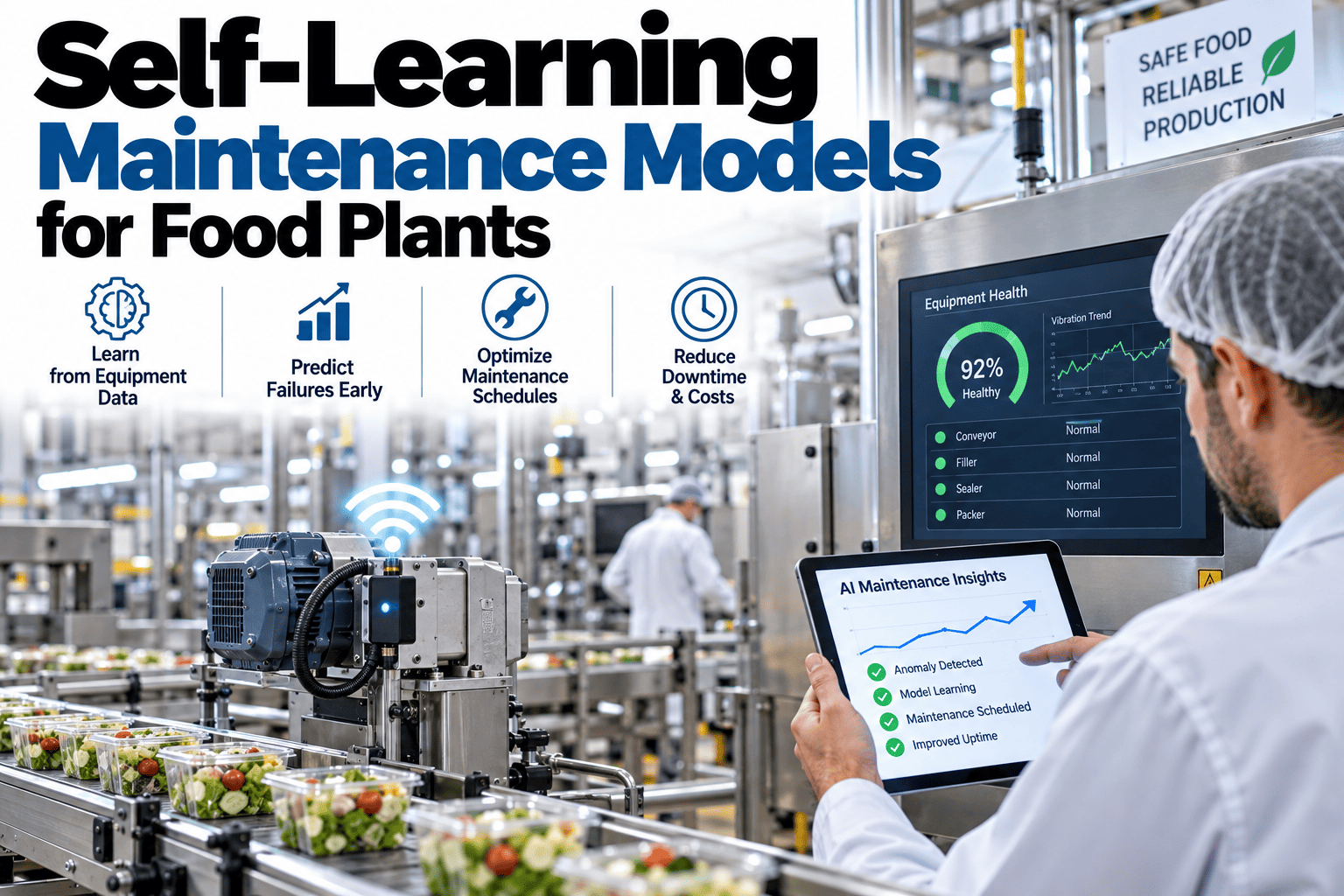
A predictive maintenance model trained once and left alone behaves a lot like a new hire who never gets any feedback after their first week on the job. It performs reasonably well on exactly the conditions it learned from, and then slowly, invisibly, falls further behind as your product mix shifts, your equipment ages, and failure patterns emerge that simply didn't exist in the data it was originally shown. Most plants discover this the hard way, months after deployment, when someone notices predictions have quietly stopped matching what's actually happening on the floor. A self-learning model closes that gap by retraining continuously against new data rather than sitting frozen at whatever it knew on day one, and if your predictive model hasn't been retrained since it was first deployed, book a demo to see what it's likely missing by now.
FOOD & BEVERAGE · SELF-LEARNING AI MODELS
A Model That Never Stops Learning From Your Own Floor
iFactory's maintenance models retrain automatically on new failure and condition data, so accuracy keeps pace with your changing equipment and product mix without a single manual intervention.
PREDICT
→
COMPARE
→
RETRAIN
→
DEPLOY
↺ back to Predict
WHY STATIC MODELS QUIETLY DECAY
The Four Ways Your Plant Changes Underneath a Frozen Model
A model trained once captures a snapshot of your plant at a single moment. Every one of these four changes, individually ordinary and expected, gradually pulls that snapshot further away from current reality until the model's predictions stop being reliable without anyone deliberately breaking anything.
Data Drift
Sensor readings shift over time as instruments age, get recalibrated, or get replaced, quietly moving the input distribution away from what the model originally learned.
Concept Drift
The actual relationship between a signal and a failure changes, a bearing that used to fail at a certain vibration level now fails earlier because of a lubrication change or a new supplier's component.
Seasonal Drift
Ambient temperature and humidity swings across the year shift baseline readings in ways a model trained only on a few months of data was never shown.
New SKU Drift
A new product, recipe, or packaging format introduces operating patterns the model has never seen, producing unreliable predictions until it learns the new normal.
WHAT ACTUALLY TRIGGERS A RETRAIN
Retraining On a Signal, Not Just On a Schedule
A purely calendar-driven retraining cadence has the same weakness as a calendar-driven PM schedule, it retrains whether or not retraining is actually needed and misses a sudden shift that happens between scheduled cycles. A self-learning system watches for the specific signals that indicate retraining will actually help.
Confidence Score Decline
A sustained downward trend in the model's own confidence scores over consecutive weeks is the earliest and most reliable signal that retraining is due.
Confirmed New Failure Mode
Once a reliability engineer confirms a failure the model didn't anticipate, that event is folded directly into the next training cycle.
Operator or Technician Feedback
A technician marking a prediction as wrong or a repair as unrelated to the flagged cause feeds directly back into the model's next update.
Scheduled Baseline Refresh
Even without a specific trigger, a periodic refresh keeps the model current against slow seasonal and gradual drift that no single event would flag on its own.
Find out how far your current model has drifted
iFactory can benchmark your existing predictive model's confidence trend against its original training baseline.
STATIC VS SELF-LEARNING OVER TIME
What Six Months Actually Looks Like Under Each Approach
STATIC MODEL — TRAINED ONCE
SELF-LEARNING MODEL — CONTINUOUS RETRAIN
Both models start from the same accuracy on day one. The difference is entirely in what happens next: one keeps learning from every new failure and every new operating condition, the other simply gets more wrong with each passing month as the plant it was trained on keeps changing underneath it.
STATIC VS SELF-LEARNING
What Changes When the Model Never Stops Updating
| Factor |
Static Model |
Self-Learning Model |
| Accuracy over time |
Declines gradually as conditions change |
Holds steady or improves as new data arrives |
| New SKU or format |
Requires manual retraining project |
Learns the new pattern within days |
| New failure mode |
Invisible until someone manually updates it |
Incorporated automatically once confirmed |
| Maintenance overhead |
Periodic manual retraining projects |
Continuous, automated, minimal manual effort |
| Long-term reliability of predictions |
Erodes silently without warning |
Tracked and maintained against a live baseline |
HOW THIS IS BUILT
Keeping the Loop Running Without Manual Intervention
What Gets Built
A baseline model trained on your current failure and condition history
Continuous confidence-score monitoring against that baseline
Automated retraining triggered by drift, feedback, or new failure confirmation
A technician feedback loop built directly into the work order workflow
Version tracking so every prediction is traceable to a specific model iteration
Rollout Timeline
Weeks 1-3: Baseline model training on existing failure and condition data
Weeks 4-6: Live deployment with confidence tracking and feedback loop activation
Ongoing: Automated retraining cycles running continuously in production
FREQUENTLY ASKED QUESTIONS
What Teams Ask Before Adopting Self-Learning Models
Could a self-learning model actually get worse if it learns from bad data?
This is a real risk with any continuously retraining system, which is why new model versions are validated against a held-out set of known outcomes before they ever replace the version currently running in production. If a retrained version performs worse than the one it would replace, it doesn't go live, the system simply continues running the prior version while flagging the discrepancy for review rather than automatically deploying an unvetted update. This validation gate is what allows continuous learning without the risk of a single bad batch of data quietly degrading live predictions.
Book a demo to see how model validation works before any update goes live.
Does this mean the model's behavior keeps changing under our technicians' feet?
The underlying model updates continuously, but the practical experience for a technician stays consistent, since retraining refines accuracy rather than changing how predictions are presented or how the workflow operates day to day. Version tracking also means every prediction is traceable back to the specific model iteration that produced it, so if a technician or reliability engineer ever needs to understand why a particular call was made, that context is fully available rather than lost in an opaque, constantly shifting black box.
Contact our support team to see how version tracking and explainability work in practice.
How much technician involvement does the feedback loop actually require?
The feedback mechanism is designed to be lightweight enough that it doesn't add meaningful burden to a technician's normal workflow, typically a quick confirm or dispute action on a prediction directly inside the work order they're already completing, rather than a separate reporting task. This small amount of ongoing input is what allows the model to correct itself quickly when a prediction turns out to be wrong, and most technicians find it faster than the alternative of an inaccurate model repeatedly flagging the same false pattern without ever being corrected.
Book a demo to see the exact feedback interaction technicians would use.
What happens during the baseline period before enough data has accumulated?
The initial baseline model is trained on whatever failure and condition history your plant already has, which for most established operations is enough to produce a genuinely useful starting model rather than requiring a lengthy blind period. Confidence scores are typically more conservative during the first several weeks of live operation while the system builds live confirmation of its early predictions, and this is explicitly communicated rather than hidden, so your team knows to weight early predictions accordingly until confidence stabilizes.
Contact our support team to discuss what baseline data you already have available.
How is this different from just scheduling a manual model retrain every quarter?
A quarterly manual retrain is better than never retraining at all, but it shares the same core weakness as a fixed PM calendar: it retrains on a schedule regardless of whether retraining is actually needed, and it misses a sudden shift that happens between quarterly cycles entirely. A self-learning approach retrains in response to actual signals, a confidence decline, a confirmed new failure mode, direct technician feedback, which means it responds to real drift within days rather than waiting for the next scheduled quarter to roll around, while still running a periodic baseline refresh to catch the kind of slow seasonal drift no single event would trigger on its own.
Book a demo to compare this against your current retraining cadence.
A MODEL THAT KEEPS PACE WITH YOUR PLANT
Stop Letting Your Predictive Model Fall Behind Reality
iFactory's self-learning models retrain continuously against your own new failure and condition data, so accuracy never quietly erodes the way a frozen model's does.