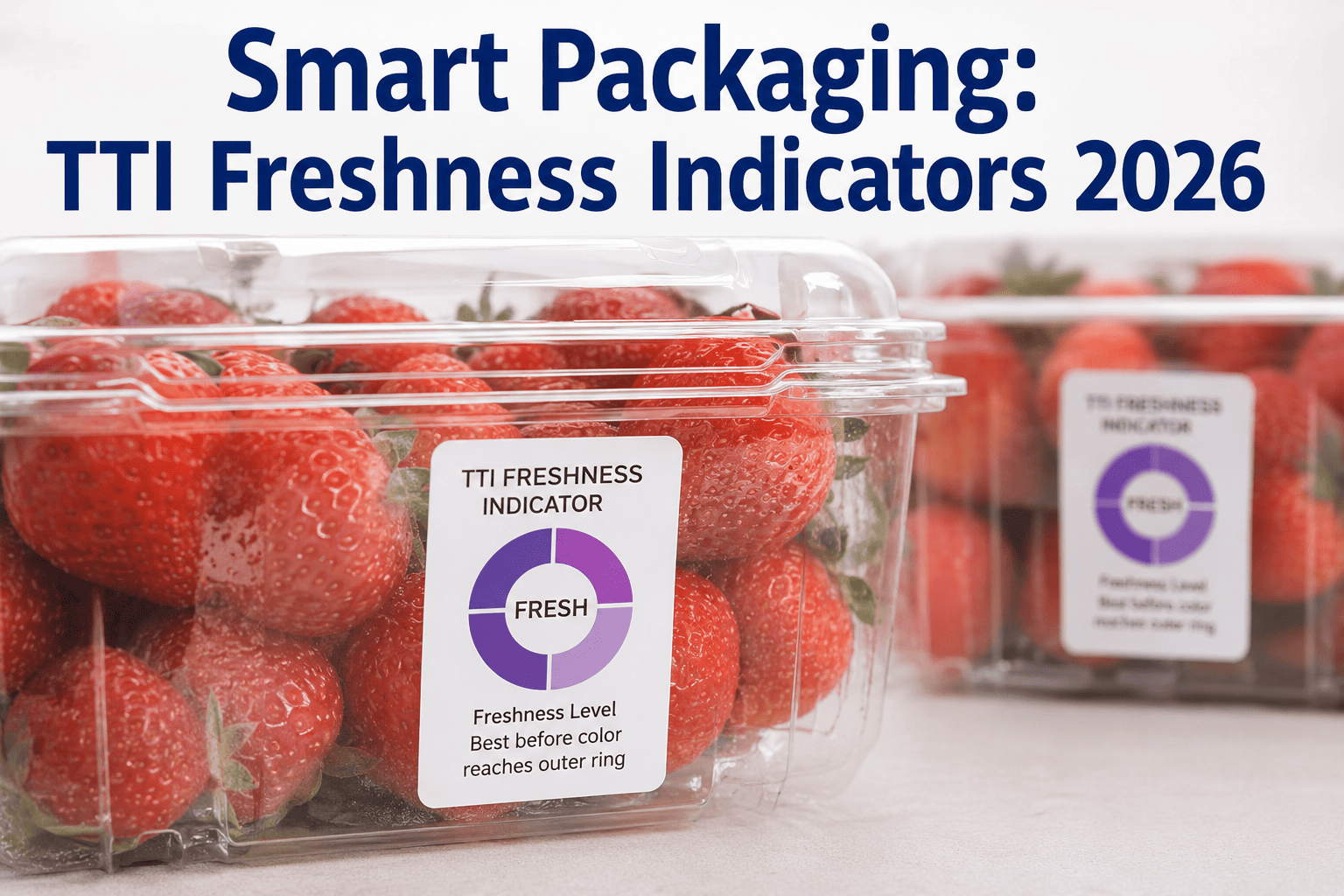
A cold chain can be flawless for 99% of a product's journey and still fail on the last mile — a delayed delivery truck, a warm loading dock, a few hours in a consumer's car. Time-temperature indicators solve a problem no upstream monitoring system can: they travel with the product all the way to the point of consumption, giving shoppers and staff a visible, tamper-evident answer to "is this still good?" The global market for these labels is projected to nearly triple over the next decade as retailers and regulators push for more transparency at the shelf. Here's how the technology works, which label type fits which product, and where iFactory Support can help you pair TTIs with your existing cold chain monitoring.
Smart Packaging: Time-Temperature Freshness Indicators
A practical look at TTI label types, how they work, and where they add consumer trust and traceability that upstream sensors alone can't reach.
How a TTI Actually Works
A time-temperature indicator records the accumulated effect of both time and temperature exposure on a product, typically shown through a visible color change. The length of time between activation and full color change corresponds to the tracked shelf life of the specific food it's attached to, so a label calibrated for fresh seafood will change at a different rate than one calibrated for dairy. Once triggered, most indicators are irreversible, which is what makes them trustworthy — a color that has already changed cannot be reset by simply re-cooling the product.
Three Label Technologies Compared
| Type | How It Responds | Best Fit |
|---|---|---|
| Full-history | Continuous color change reflecting total accumulated exposure | Fresh produce, meat, dairy needing a running record |
| Enzymatic | Color shift triggered by an enzymatic reaction rate tied to temperature | Products with a well-defined, predictable spoilage curve |
| Critical-threshold | Changes only once a specific temperature limit is breached | Vaccines, biologics, and products with a hard safety cutoff |
Where TTIs Fit Alongside Sensor-Based Monitoring
TTIs and connected IoT sensors solve different halves of the same problem. IoT sensors give operations teams a real-time, actionable data feed inside trucks, warehouses, and display cases. TTIs give the product itself a portable, consumer-visible record that survives after it leaves that monitored environment — on a retail shelf, in a delivery bag, or in someone's kitchen. The strongest cold chain programs use both: connected sensors for operational response, and TTIs for the last stretch where connectivity and control run out.
Pair smart packaging with real-time cold chain visibility
iFactory connects your in-transit and in-store temperature sensors into one dashboard, so TTI-triggered concerns can be traced back to exactly where and when the deviation happened.
The Brand Trust Case for Smart Packaging
Consumer confidence
A visible freshness indicator gives shoppers a direct, at-a-glance answer instead of relying on a printed date alone.
Reduced returns & waste
Retailers can pull only genuinely compromised units rather than discarding an entire batch on suspicion alone.
Regulatory alignment
Growing traceability requirements in food safety regulation favor suppliers who can show product-level exposure history.
Frequently Asked Questions
Can a TTI label be reset once it changes color?
No, and that's intentional. The majority of commercial TTI labels are designed to be irreversible once triggered, which is what gives them credibility as a monitoring tool rather than a marketing gimmick. If a label could be reset by simply cooling the product back down, it would no longer provide a trustworthy record of what actually happened during transport or storage.
Do TTI labels replace the need for cold chain sensors in trucks and warehouses?
No, they serve a complementary role rather than a replacement. Connected sensors give your operations team real-time data they can act on immediately, such as rerouting a shipment or adjusting a thermostat, while TTIs travel with the individual product and remain useful after it leaves any monitored environment. Most mature cold chain programs deploy both together rather than choosing one over the other.
Which products benefit most from time-temperature indicators?
Highly perishable categories with a well-understood spoilage curve see the clearest benefit, particularly meat, dairy, seafood, and fresh produce, along with temperature-sensitive pharmaceuticals like vaccines and biologics. Products with a hard safety cutoff, rather than a gradual quality decline, are typically better matched to critical-threshold indicators than full-history labels. iFactory Support can help assess which of your product lines would benefit most.
Are TTI labels required by regulation, or purely optional?
Requirements vary significantly by region and product category, and there is no single universally binding standard governing TTI use in food packaging. That said, regulatory momentum toward stricter traceability enforcement in several major markets is pushing more suppliers toward adopting TTIs proactively, especially for export-focused seafood, dairy, and pharmaceutical cold chains where destination markets increasingly expect this level of visibility.
How do I decide between a colorimetric label and a full IoT sensor solution?
The decision usually comes down to where in the supply chain you need visibility and who needs to act on it. Colorimetric TTIs are low-cost, require no power or connectivity, and are ideal for the consumer-facing final stretch, while IoT sensors provide continuous, actionable data for the portions of the journey your team actively manages. Book a demo to map out where each fits in your specific supply chain.
Give your product a visible record, backed by real-time data
iFactory helps food and beverage brands combine smart packaging with connected cold chain monitoring for full farm-to-shelf traceability.