Every food processing line depends on a temperature sensor somewhere, but the three sensor technologies used across the industry, thermocouples, RTDs, and thermistors, behave so differently in accuracy, response time, and durability that picking the wrong one for a given application can quietly undermine an entire HACCP program. A thermocouple built for a smokehouse will underperform badly in a precision pasteurization loop, and an RTD sized for a retort vessel is often overkill and overpriced for a simple walk-in cooler check. Understanding which sensor fits which food processing step, and why, is the difference between a monitoring system that actually protects product safety and one that just produces numbers on a screen. See how AI-driven sensor selection and monitoring keeps every point on your line reading accurately when you book a demo.
FOOD PROCESSING · TEMPERATURE SENSORS · THERMOCOUPLE VS RTD VS THERMISTOR
Three Sensor Technologies, One Decision That Determines Whether Your Data Can Be Trusted
iFactory's AI platform ingests and cross-validates readings from thermocouples, RTDs, and thermistors across your entire facility, flagging sensor drift and mismatched sensor choices before they compromise food safety data.
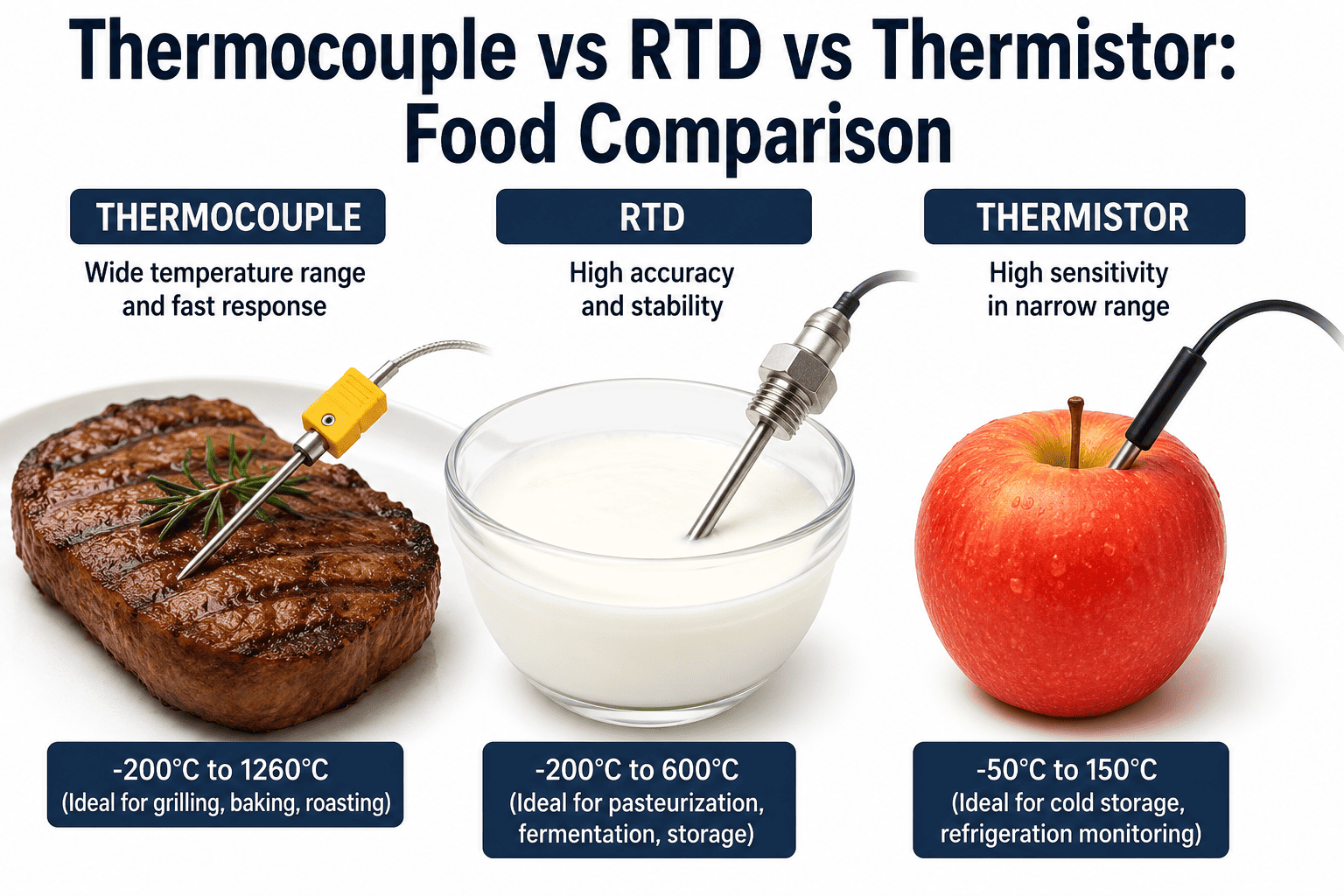
THERMOCOUPLE
Fastest response, widest range, lower cost per point
VS
RTD
Highest accuracy, best long-term stability
VS
THERMISTOR
High sensitivity in a narrow, tightly controlled range
WHY SENSOR CHOICE MATTERS MORE THAN MOST OPERATORS REALIZE
A Compliant Process Log Is Only as Good as the Sensor Behind It
Food processors often inherit sensor choices made years earlier by equipment vendors rather than by a deliberate evaluation of accuracy needs, temperature range, and environmental conditions. A thermistor installed on a high-temperature retort will fail outright, while an RTD installed on a fast-cycling blast freezer may lag behind the true temperature swing enough to mask a brief but critical excursion. Getting the sensor technology right at each measurement point is a foundational, often overlooked layer of food safety compliance that sits underneath every HACCP plan, every scheduled process filing, and every automated monitoring dashboard built on top of it.
±0.1°C
Typical accuracy achievable with a properly specified RTD in a calibrated laboratory or critical control point application.
Milliseconds
Response time advantage thermocouples hold over RTDs and thermistors in fast thermal transients like flash pasteurization.
2,300°F
Upper temperature limit some thermocouple types reach, far beyond what RTDs or thermistors can sustain reliably.
Years
Long-term drift stability window RTDs typically hold, reducing recalibration frequency compared to other sensor types.
SENSOR TECHNOLOGY BREAKDOWN
How Each Sensor Type Actually Measures Temperature
All three sensor types convert a physical property change into an electrical signal, but the underlying physics determine each sensor's strengths, weaknesses, and ideal application within a food processing environment.
Thermocouple
PrincipleVoltage generated across two dissimilar metal junctions
Range-330°F to 2,300°F depending on type
Accuracy±1°C to ±2°C typical
Response TimeFastest of the three, often under one second
Best ForOvens, smokehouses, retorts, high-heat processing steps
RTD (Resistance Temperature Detector)
PrincipleElectrical resistance change in a pure metal element, typically platinum
Range-328°F to 1,472°F depending on construction
Accuracy±0.1°C to ±0.5°C typical
Response TimeModerate, several seconds depending on sheath design
Best ForPasteurization loops, CIP validation, critical control points
Thermistor
PrincipleResistance change in a ceramic semiconductor material
RangeTypically -40°F to 300°F, narrower than the other two
AccuracyVery high within its rated narrow range
Response TimeFast within its narrow operating band
Best ForRefrigeration, cold storage, ambient monitoring points
Not Sure Which Sensor Belongs at Each Point on Your Line?
iFactory's team maps sensor technology to each measurement point based on temperature range, response time need, and accuracy requirement, then keeps every reading validated through continuous AI monitoring.
MATCHING SENSOR TO APPLICATION
Which Sensor Belongs at Which Point in a Food Processing Facility
The right sensor choice depends less on which technology is "best" in the abstract and more on matching the sensor's strengths to the specific demands of each processing step. The scenarios below reflect the most common sensor placement decisions across food manufacturing facilities.
01
Retort and Thermal Processing Vessels
Thermocouples dominate retort applications because scheduled process validation requires fast response to detect the exact moment the vessel reaches target temperature, and the wide range handles the high heat of sterilization cycles without degrading.
02
HTST and Pasteurization Loops
RTDs are the standard for pasteurization critical control points because regulatory frameworks demand tight accuracy at the recording device, and an RTD's stability over long continuous runs reduces the recalibration burden on a system that operates nearly nonstop.
03
Cold Storage and Refrigeration Monitoring
Thermistors excel in walk-in coolers, freezers, and refrigerated transport because their narrow operating range aligns exactly with cold storage temperatures, delivering high sensitivity and fast response at a lower cost than an RTD would require for the same application.
04
Smokehouses and High-Heat Cooking
Thermocouples handle the extreme and rapidly changing temperatures inside smokehouses and combi ovens where thermistors would fail outright and RTDs would respond too slowly to capture short thermal spikes accurately.
05
CIP System Validation Points
RTDs are typically specified for clean-in-place validation because CIP cycles require documented proof that cleaning fluid reached and held a target temperature, and RTD accuracy holds up well to the frequent thermal cycling CIP systems impose.
06
Ambient and Environmental Monitoring
Thermistors are frequently deployed for general ambient temperature monitoring across a facility because their lower cost per point makes wide-scale deployment economical without sacrificing the accuracy needed for general compliance tracking.
SIDE-BY-SIDE COMPARISON
Thermocouple, RTD, and Thermistor Compared Across Key Criteria
The table below summarizes the practical differences that matter most when specifying sensors for a food processing environment, from raw accuracy to total cost of ownership across a facility-wide deployment.
| Criteria |
Thermocouple |
RTD |
Thermistor |
| Accuracy |
Moderate |
Highest |
High within narrow range |
| Response Time |
Fastest |
Moderate |
Fast within range |
| Temperature Range |
Widest |
Wide |
Narrow |
| Long-Term Stability |
Moderate drift over time |
Excellent |
Moderate, needs periodic checks |
| Cost per Sensor Point |
Lowest |
Highest |
Moderate |
| Typical Food Application |
Ovens, retorts, smokehouses |
Pasteurization, CIP validation |
Cold storage, ambient points |
FREQUENTLY ASKED QUESTIONS
What Food Manufacturers Ask Before Standardizing Sensor Choice
Can a facility mix thermocouples, RTDs, and thermistors across the same monitoring platform?
Yes, most food processing facilities operate all three sensor types across different process steps, and a well-designed monitoring platform should normalize and validate readings from each sensor type on a single unified dashboard rather than forcing a single sensor standard across every application. iFactory's platform ingests signals from all three sensor types and applies the correct calibration curve and accuracy expectations for each.
Book a demo to see mixed-sensor monitoring applied to a facility with a similar process mix.
How often does each sensor type need to be recalibrated in a food processing environment?
RTDs typically hold calibration the longest due to their inherent stability, often requiring annual verification in stable applications, while thermocouples and thermistors generally need more frequent checks, particularly in high-cycle or high-heat environments where junction degradation or ceramic element aging occurs faster. Calibration frequency should ultimately be driven by the criticality of the control point rather than a blanket schedule.
Contact our support team for a calibration schedule recommendation based on your sensor mix.
Why would a facility choose a more expensive RTD when a thermocouple covers a wider range for less cost?
Range and cost are only two of the relevant factors, and for critical control points like pasteurization or CIP validation, the accuracy and long-term stability advantages of an RTD directly reduce the risk of a false compliance record or a missed excursion, which carries far greater cost than the sensor price difference. The wider range of a thermocouple is simply unnecessary in applications where the operating temperature stays within a tighter, well-defined band.
Book a demo to review sensor cost against compliance risk for your specific control points.
Can AI monitoring detect when a sensor has drifted or is producing unreliable readings?
Yes, continuous AI analysis compares each sensor's readings against expected process behavior, historical baselines, and, where available, redundant nearby sensors, flagging patterns consistent with drift, degradation, or outright sensor failure well before a manual calibration check would catch the issue. This proactive detection prevents a slowly failing sensor from silently generating inaccurate compliance data for weeks or months.
Book a demo to see drift detection running on live sensor data.
Do sanitary or food-grade versions of these sensors differ significantly from industrial versions?
Sanitary versions of thermocouples, RTDs, and thermistors use food-contact-approved materials, smooth crevice-free housings, and wash-down-rated seals designed to withstand repeated CIP and sanitation cycles without harboring bacteria or degrading, which meaningfully increases both the durability and the compliance suitability of the sensor compared to a standard industrial version.
Contact our support team to confirm sanitary sensor specifications for your process environment.
Your Temperature Data Is Only as Reliable as the Sensor Behind Each Reading
iFactory validates and monitors thermocouple, RTD, and thermistor readings across your entire facility in real time, catching drift and mismatched sensor choices before they become a compliance gap. Book a demo and see it applied to your process line.