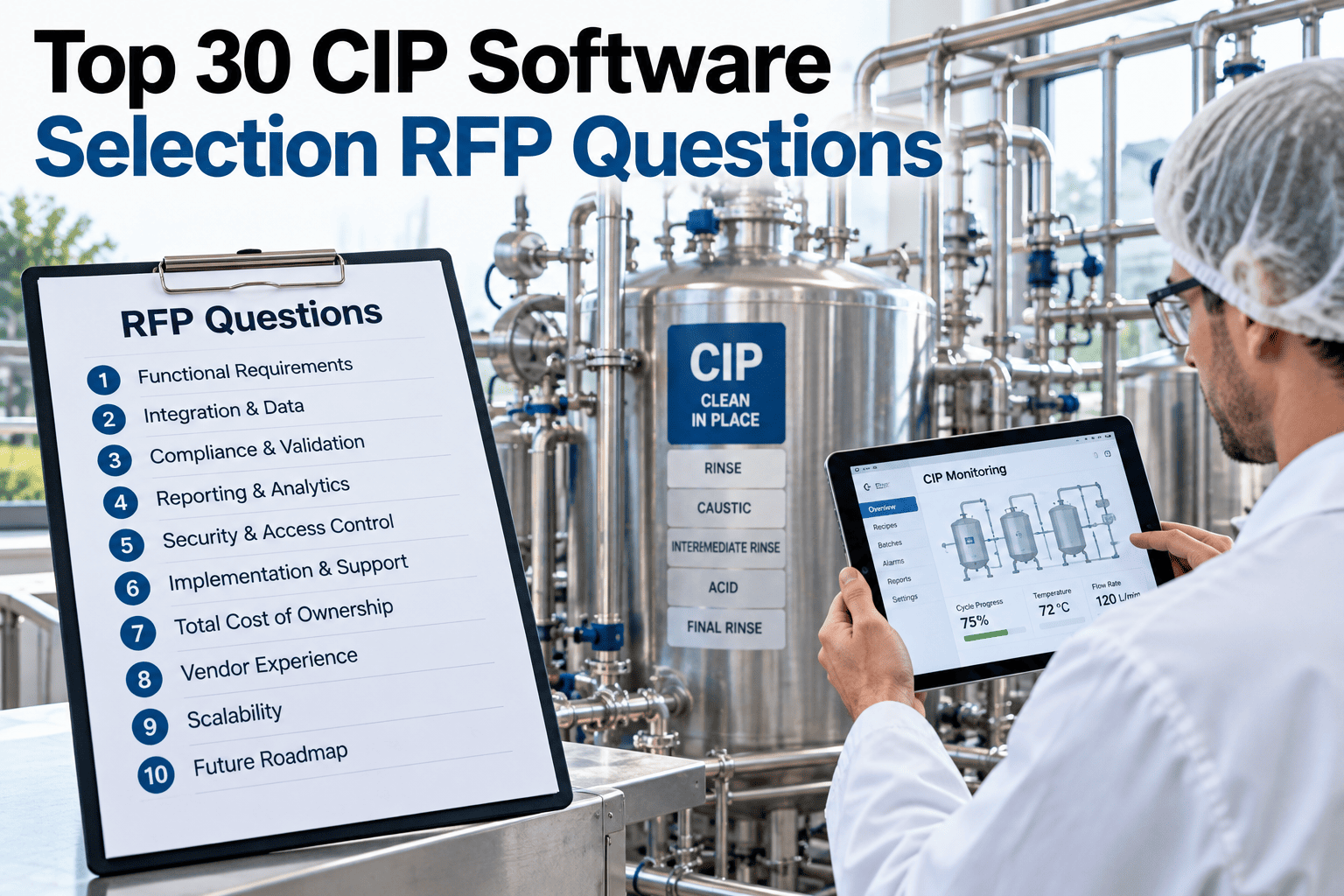
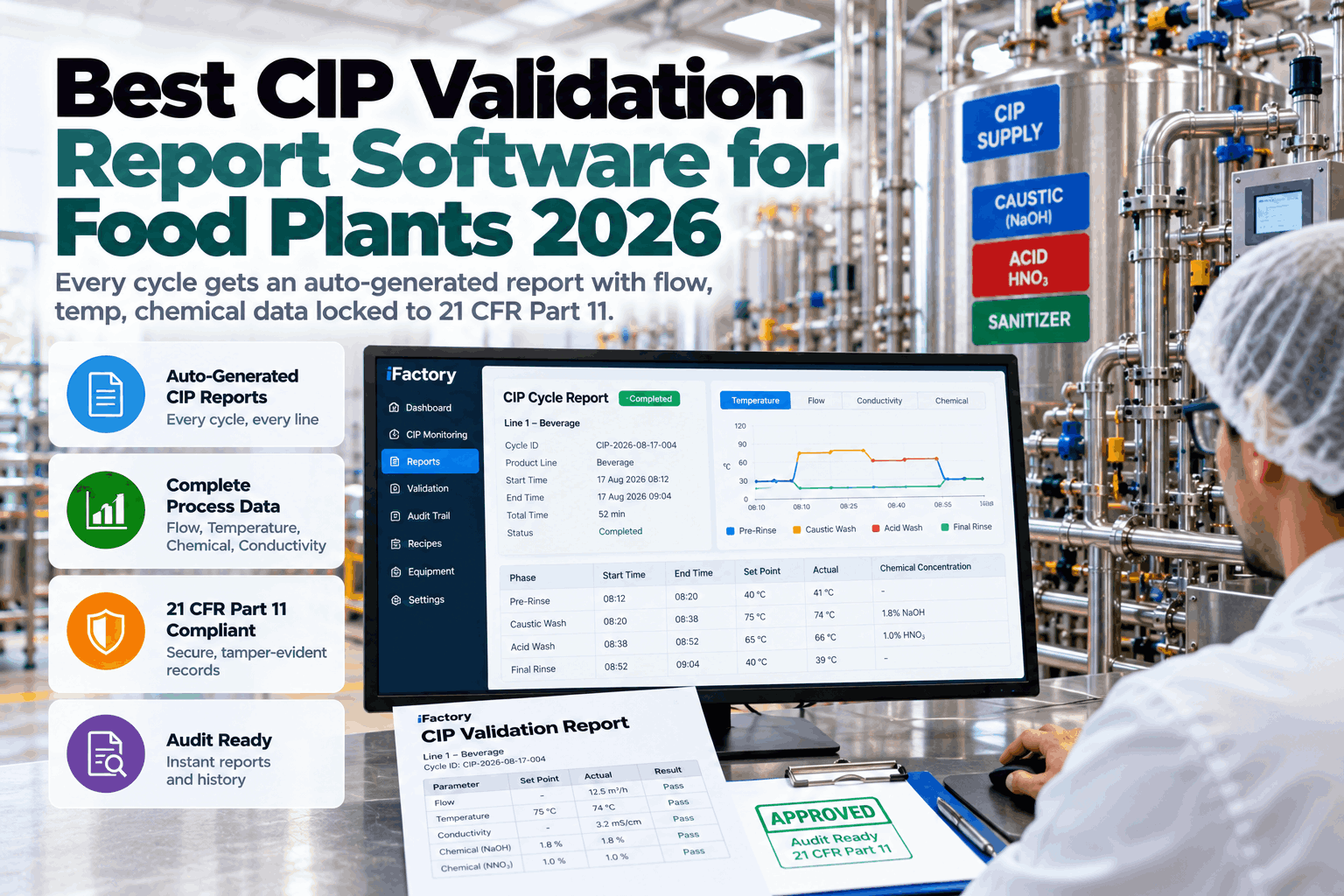
Most CIP software RFPs get built by copying the last vendor's own feature list back at them — a guaranteed way to end up with a system that demos beautifully and then can't tell you why Line 3 ran nine minutes long on Tuesday. A defensible RFP works backward from what a food safety and operations team actually needs to defend during an audit and act on during a shift: real sensor coverage, condition-based cleaning logic instead of fixed timers, deviation alerting that reaches the right person fast, records in a format an auditor can actually use, and a genuine connection into existing sanitation SOPs rather than a parallel system nobody trusts. This checklist covers thirty questions across five categories, built from what actually separates CIP monitoring platforms that get used from the ones that get abandoned within a year. See how iFactory answers every one of these thirty questions before you finalize your shortlist.
Food & Beverage · CIP Monitoring · Software Selection
Top 30 CIP Software Selection RFP Questions
Evaluate any CIP monitoring platform against thirty specific questions across sensor coverage, condition-based logic, deviation alerting, records format, and SOP integration before you sign a contract.
30Specific evaluation questions across five categories
5Categories every serious CIP RFP should cover
60–70%Of CIP software evaluations skip condition-based logic entirely
1Connected system instead of a parallel dashboard nobody trusts
Section 1 — Sensor Coverage
Section 2 — Condition-Based Logic
Section 3 — Deviation Alerting
Section 4 — Records Format
Section 5 — SOP Integration
Section 01
Sensor Coverage
A CIP monitoring platform is only as good as the sensor data feeding it. A system that reports cycle pass or fail based on the skid controller's own internal logic, without independently verifying flow, temperature, and concentration, is reporting the program's assumptions rather than the physical reality of the wash.
Physical Measurement Coverage
Does the platform independently capture flow rate, temperature, and conductivity or concentration data rather than relying solely on the skid controller's self-reported pass or fail status?Ask for: Sample sensor data export from a reference site
Can the system integrate with the specific sensor brands and protocols already installed on our CIP skids, or does it require replacing existing instrumentation?Ask for: Supported sensor and protocol compatibility list
What is the data capture frequency during an active cycle, and is it sufficient to catch a short-duration deviation rather than only averaged or sampled readings?Ask for: Minimum and typical sampling rate specification
Does the platform monitor spray coverage or flow velocity indirectly, to catch a partially blocked spray ball or degraded turbulent flow before it causes a cleaning failure?Ask for: Case example of a coverage-related deviation caught
How does the system handle sensor drift or calibration lapses — does it flag a sensor reading outside its expected calibration window, or trust every reading equally?Ask for: Sensor health monitoring documentation
Can the platform scale to cover every CIP skid and line across multiple plants under one account, or does each site require a separate license and separate data silo?Ask for: Multi-site architecture and pricing model
Section 02
Condition-Based Logic
Fixed-timer cycles set to worst-case soil conditions are the single largest source of avoidable water, chemical, and production time waste in most CIP programs. A platform without genuine condition-based logic can report data beautifully while doing nothing to actually shorten a cycle that is already clean.
Cycle Intelligence & Optimization
Can the platform recommend or trigger a cycle stage to end based on real-time sensor confirmation of clean, rather than only reporting after a fixed timer completes?Ask for: Live demonstration of condition-based stage ending
Does the system distinguish between different soil types or product changeovers when recommending cycle parameters, or apply one static logic to every cycle?Ask for: Soil-type or product-specific logic documentation
What validation evidence does the vendor provide showing condition-based logic maintains equivalent microbial kill results compared to the existing fixed-timer approach?Ask for: Third-party or customer validation study
Can any cycle logic change be piloted on a single line first, with a clear rollback path, before committing to plant-wide deployment?Ask for: Documented pilot-to-scale rollout process
Does the platform quantify the specific water, chemical, and time savings achieved by condition-based logic changes, in a format that supports a business case to leadership?Ask for: Sample savings report from a comparable deployment
Does implementing condition-based logic require reprogramming the existing skid controller, or does it operate as a supervisory layer that leaves current control logic intact?Ask for: Technical architecture diagram
See condition-based CIP logic running on a live reference site before you shortlist a single vendor.
Section 03
Deviation Alerting
A deviation caught by a sensor but never surfaced to the right person in time is functionally the same as no monitoring at all. Alerting design is where most CIP software evaluations underinvest, focusing entirely on the dashboard and treating notification as an afterthought.
Detection, Routing & Escalation
Does the platform alert in real time during an active cycle, or only after the cycle completes and the deviation is already part of the historical record?Ask for: Alert latency specification from sensor reading to notification
Can deviation severity be tiered by parameter and characteristic criticality, so a temperature deviation on a critical kill step alerts differently than a minor time variance?Ask for: Severity tiering and configuration documentation
Does the system automatically escalate an unacknowledged critical alert to the next role in the chain, or does it wait indefinitely for a response?Ask for: Escalation logic and configurable timing windows
Can alerts be delivered through the channels our team actually monitors — mobile push, SMS, line-side visual signal — rather than only an email inbox checked twice a shift?Ask for: Supported notification channel list
Does a deviation alert automatically place a production hold on the affected batch or lot, or does it require a separate manual step to prevent the product from advancing?Ask for: MES or production-hold integration documentation
How does the platform handle alert fatigue — is there a mechanism to tune sensitivity on chronically noisy parameters without disabling genuine safety-critical alerts?Ask for: Alert tuning and false-alarm rate reduction approach
Section 04
Records Format
An audit trail that technically exists but takes three days to reconstruct into a format an FDA or third-party auditor can review is a compliance liability, not an asset. Records format matters as much as data capture itself.
Audit Trail & Reporting
Can the platform generate an audit-ready cycle record on demand, showing every parameter, timestamp, and pass or fail determination for a specific cycle or date range?Ask for: Sample exported audit report
Does the system retain raw sensor-level data, or only summarized pass or fail outcomes, in case an auditor or customer needs to see the underlying reading?Ask for: Data retention policy and raw data accessibility
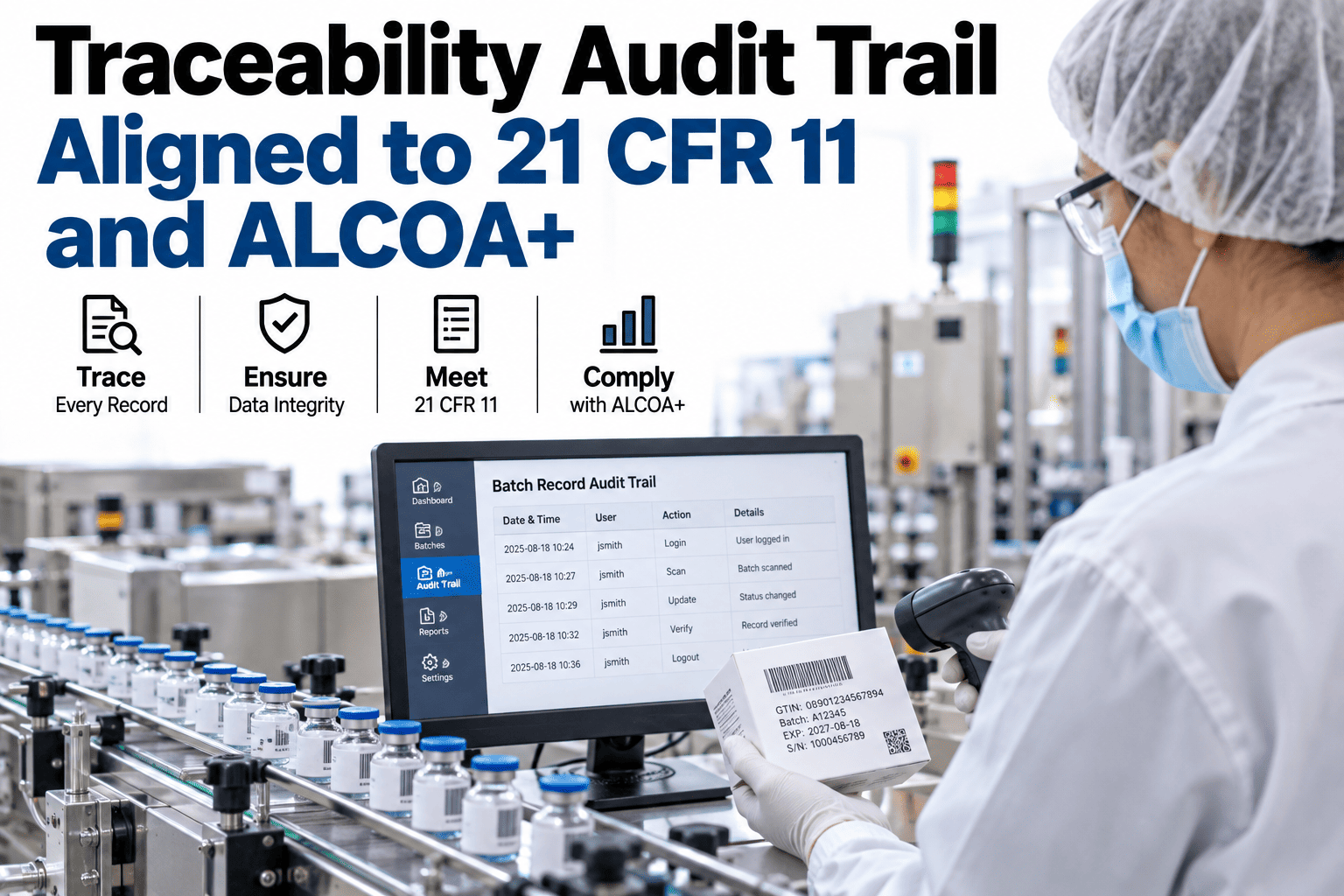
Are records stored in a format that satisfies our specific certification scheme's requirements — SQF, BRCGS, FSSC 22000 — including electronic signature or 21 CFR Part 11 needs if applicable?Ask for: Compliance certification and validation documentation
Can records be exported in a format compatible with our existing document control and quality management system, without manual reformatting?Ask for: Export format options and API documentation
How long is historical data retained, and is retention length configurable to match our specific regulatory or customer contractual requirements?Ask for: Data retention configuration options
Does the platform maintain a tamper-evident change log for any manual data correction or override, so an auditor can see exactly what was changed and by whom?Ask for: Change log and user permission documentation
Pull a sample audit-ready cycle record and compare it against what your current system can produce today.
Section 05
Sanitation SOP Integration
A CIP monitoring platform that lives entirely separate from documented sanitation SOPs creates two sources of truth — the SOP describing what should happen, and the software recording what did happen — with no guarantee the two ever line up during an audit.
Procedure Linkage & Change Control
Can each monitored cycle be directly linked to its specific documented SOP, so a reviewer can trace the executed cycle back to the approved procedure it was supposed to follow?Ask for: SOP-to-cycle linkage demonstration
When an SOP is updated or revalidated, does the platform's monitoring parameters update in sync, or is there a manual reconciliation step that can drift out of alignment?Ask for: SOP version control and sync process
Does the system support role-based sign-off matching our SOP's required approval chain for cycle exceptions or manual overrides?Ask for: Role-based workflow and sign-off configuration
Can operators access the relevant SOP directly from the monitoring interface at the point of an alert, rather than needing to separately locate a paper or PDF copy?Ask for: In-context SOP access demonstration
Does the vendor provide implementation support to map our existing SOPs into the platform's monitoring configuration, or is that mapping left entirely to our internal team?Ask for: Implementation scope and support model
How does the platform handle a documented deviation from SOP that still resulted in a validated clean outcome — is this captured as an exception with justification, or simply hidden?Ask for: Exception handling and justification workflow
Evaluation Timeline
A Realistic RFP-to-Contract Timeline
Rushing vendor selection to hit an arbitrary internal deadline is how plants end up locked into a multi-year contract with a platform that fails half of this checklist. A structured timeline keeps the process moving without skipping the diligence that actually matters.
From Draft RFP to Signed Contract
Weeks 1–2: Finalize the thirty-question RFP internally with input from quality, operations, and IT, and identify three to five candidate vendorsOwner: Quality Manager and Plant IT
Weeks 3–4: Distribute the RFP and collect written responses against all thirty questions, flagging vague or evasive answers for direct follow-upOwner: Quality Manager
Weeks 5–6: Conduct live technical demos with the top two or three vendors, requesting a real demonstration rather than a slide deck for every capability claimedOwner: Quality Manager and Process Engineering
Weeks 7–8: Complete reference checks with existing customers running a comparable line configuration, specifically asking about deviation alerting reliability and audit supportOwner: Quality Manager
Weeks 9–10: Negotiate a pilot scope on one or two lines before committing to a full-site, multi-year contract, with clear success criteria defined in advanceOwner: Plant Manager and Procurement
Vendor Red Flags
Answers That Should Make You Pause
Certain vendor responses to these thirty questions are a reliable signal the platform is not built for the rigor a food safety program actually requires.
"We just trust the skid's own pass/fail"A platform with no independent sensor verification is a reporting layer on top of existing assumptions, not genuine monitoring.
"Alerts go to a shared inbox"No severity tiering or escalation path means a critical deviation and a minor variance look identical to whoever eventually checks that inbox.
"Exports are a manual process our team handles"A records format that requires vendor intervention to produce an audit-ready report will not be there when you need it during a surprise audit.
"SOPs live in a separate binder"No SOP linkage means the software and the procedure it's supposed to monitor can silently drift apart with nobody noticing until an auditor does.
Cost of Getting It Wrong
What a Poor CIP Software Fit Actually Costs
Beyond the wasted license fee, choosing a CIP monitoring platform that fails several of these thirty questions creates costs that compound well after the contract is signed.
Downstream Consequences of a Weak Fit
Quality and operations teams build manual workarounds — spreadsheets, side notebooks — to compensate for gaps, eventually running two systems instead of oneResult: Duplicated effort, inconsistent records
An auditor requests a specific historical record the platform cannot produce cleanly, turning a routine audit into a multi-day scrambleResult: Audit finding, remediation cost
A genuine out-of-spec cycle goes unnoticed because alerting routed to a channel nobody actively monitors, resulting in a downstream customer complaintResult: Customer escalation, potential recall exposure
Operator adoption fails because the platform wasn't built around actual sanitation SOPs, and the plant reverts to paper tracking within monthsResult: Sunk software cost with no ongoing value
FAQs
Frequently Asked Questions
How many of these thirty questions should a vendor be able to answer confidently in a first demo?
A vendor genuinely built for automotive-grade or food-safety-grade CIP monitoring should be able to answer the large majority of these questions directly in a first technical demo, often with a live example rather than a slide describing the capability in the abstract. Vague answers, references to a roadmap feature "coming soon," or redirecting the question toward an unrelated strength are all reasonable grounds to keep evaluating other vendors.
Book a demo to see how iFactory answers each category directly.
Should we prioritize sensor coverage or deviation alerting if we can't get everything in a first phase?
Sensor coverage generally comes first, since alerting is only as reliable as the underlying data it's built on — a platform with excellent notification design but shallow sensor visibility will alert confidently on incomplete information. That said, both categories matter enough that a platform weak in either area is worth scrutinizing closely before committing to a multi-year contract.
Is condition-based cycle logic realistic for a plant still running fixed-timer CIP today?
Yes — most plants transition through a phased pilot on one or two lines first, validating that condition-based logic produces equivalent microbial kill results before expanding further, rather than converting the entire site at once.
Talk to solutions engineering about a realistic pilot scope for your specific lines.
What's a reasonable timeline for a full CIP software RFP process using this checklist?
Most food and beverage plants complete vendor scoring, reference checks, and a live technical demo against this thirty-question framework within six to eight weeks, followed by a pilot period before a full contract commitment — considerably faster than starting from a generic feature list and discovering gaps only after implementation begins.
Do we need separate RFPs for CIP monitoring and broader plant sanitation compliance software?
Not necessarily — a platform with strong SOP integration and audit-ready records format, as covered in sections four and five of this checklist, can often serve both needs from one connected system, which is generally preferable to maintaining separate tools that require manual reconciliation.
Book a program assessment to see whether a unified approach fits your specific compliance scope.
Score Your Shortlist Against All Thirty Questions
iFactory answers every question in this checklist directly, with independent sensor verification, condition-based cycle logic, tiered deviation alerting, audit-ready records, and native SOP integration in one connected platform.