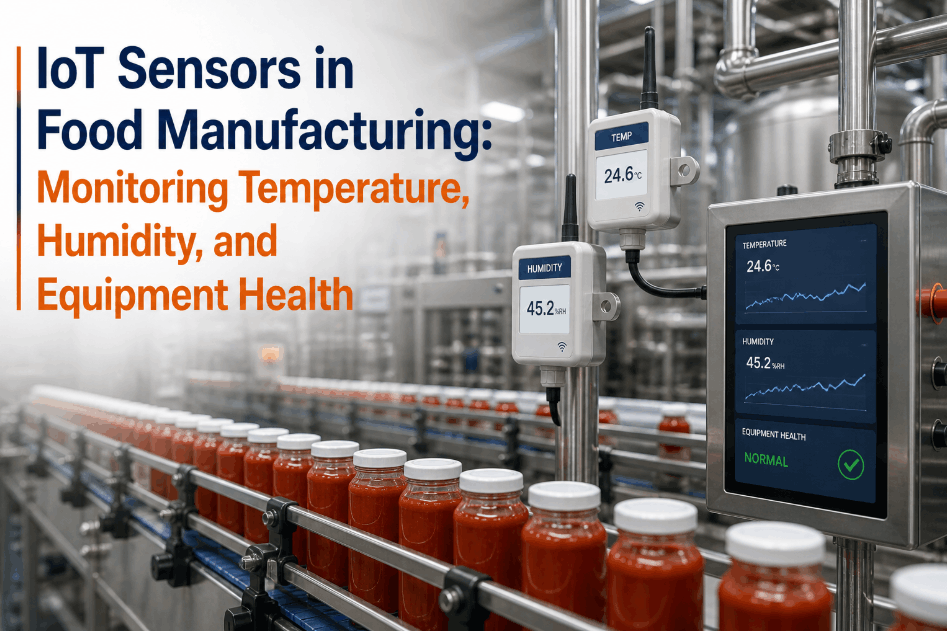
A food factory is one of the least forgiving environments a wireless sensor network will ever meet — stainless steel walls that bounce 2.4 GHz signals into chaos, walk-in freezers at minus 40°C, daily washdown cycles hitting sensors with 80-bar water at 80°C, and HACCP critical control points that cannot tolerate a missed reading. Generic industrial wireless designs fail here because they were built for automotive body shops, not for pasteurisers or freezer bays. This guide walks the four protocols you will actually evaluate — WiFi, LoRaWAN, Zigbee, and cellular IoT — the environmental gates each passes or fails inside a food plant, and the zone-by-zone hybrid architecture most winning 2026 deployments converge on. Teams ready to design against their own layout can start with a 30-minute demo that maps protocols to their production zones.
Wireless Sensor Network Design for Food Factories — The Protocol Playbook
WiFi, LoRaWAN, Zigbee, and cellular IoT — where each one wins and where each one dies inside a food plant. Zone-by-zone protocol mapping, IP69K and cold-storage constraints, and the hybrid architecture HACCP-grade monitoring actually needs.
No single protocol wins across a food plant. WiFi handles high-bandwidth vision and video where APs can survive. LoRaWAN carries temperature, humidity, and CCP data across walls and freezers. Zigbee runs local mesh where density is high. Cellular IoT backs up HACCP-critical points. The winning design is a multi-protocol gateway with zone-mapped radio choices.
The Food Plant Environment Problem
Before protocol comparison, understand what the room does to a wireless signal. Four environmental factors decide which radios survive and which drift into unreliability inside three months. Miss one and the network works in the pilot and fails in production.
Stainless Steel Chaos
Sanitary stainless walls, tanks, and conveyors reflect 2.4 GHz into a multipath nightmare. Zigbee and consumer WiFi degrade fast — sub-GHz LoRaWAN penetrates because longer wavelengths bend around metal.
Washdown Reality
Daily CIP at 80 bar and 80°C requires IP69K enclosures on every wet-zone node. Insist on the DIN 40050-9 test document from the vendor, not just an IP69K claim.
Cold Storage Reality
Deep-freeze at -30°C to -40°C drains batteries and cracks enclosures rated only to 0°C. Battery LoRaWAN still works but needs lithium chemistries validated for the temperature.
HACCP Determinism
Critical Control Points cannot tolerate missed readings. A protocol that drops packets under load is fine for dry-storage humidity, not for a pasteuriser hold-time monitor.
The Four Wireless Protocols — Deep Comparison
Every food-factory wireless design in 2026 comes down to some combination of these four. Understanding what each is optimised for — not its marketing claims — is the difference between a network that survives the third washdown and one that does not.
What it does: High data rates for vision, video, and dashboard traffic. Familiar IT stack, immediate integration.
Where it wins: Vision AI cameras, tablet operator terminals, engineering offices, dry-storage areas with AP coverage.
Where it dies: Metal-heavy processing floors, cold storage without wired APs, battery-powered sensors.
What it does: Sub-GHz long-range, ultra-low-power sensor data over kilometers with 5 to 10 year battery life.
Where it wins: Temperature, humidity, door-open, and CCP monitoring across large plants — one gateway can cover the entire building.
Where it dies: High-bandwidth applications like video or high-frequency vibration streams that exceed its low data-rate ceiling.
What it does: Self-healing mesh network for dense clusters of sensors in a bounded area with low latency.
Where it wins: Local mesh around a specific line or cell — packaging stations, batching kitchens, dense sensor arrays.
Where it dies: Long-range coverage across a whole plant, and 2.4 GHz interference on the processing floor.
What it does: Uses the mobile carrier network — no on-site gateway, no WiFi dependency. LTE-M reports faster than NB-IoT.
Where it wins: HACCP CCP monitoring, outdoor cold storage, satellite buildings, multi-site consistency with no local IT.
Where it dies: Metal-shielded interior rooms with no signal, and cost profiles where per-device fees stack up at scale.
Feature-by-Feature Protocol Comparison
The engineering rubric that actually matters when you sit down to score. Ten dimensions across four protocols, ranked on how they behave inside a food plant — not on datasheet claims.
| Dimension | WiFi | LoRaWAN | Zigbee | Cellular IoT |
|---|---|---|---|---|
| Range per gateway | 30 – 100 m | 2 – 10 km | 10 – 100 m | National |
| Battery life (typical node) | Days – weeks | 5 – 10 years | 1 – 3 years | 3 – 5 years |
| Data rate | Up to 1 Gbps+ | 0.3 – 50 kbps | 250 kbps | Up to 1 Mbps (LTE-M) |
| Metal / wall penetration | Poor | Excellent | Poor | Good outdoors |
| Cold-storage survival | Needs wired AP | Battery node OK | Mesh degrades | Signal often blocked |
| Latency | Very low | Seconds | Low | Low (LTE-M) |
| Infrastructure cost | APs + backhaul | 1 gateway per plant | Coordinator + mesh | None on-site |
| Recurring cost | Low | Low | Low | Per-device SIM |
| HACCP determinism | Fair | Good | Fair | Very high |
| Best sensor volume per plant | Dozens | Hundreds+ | Dozens per cluster | Tens |
Zone-by-Zone Protocol Mapping
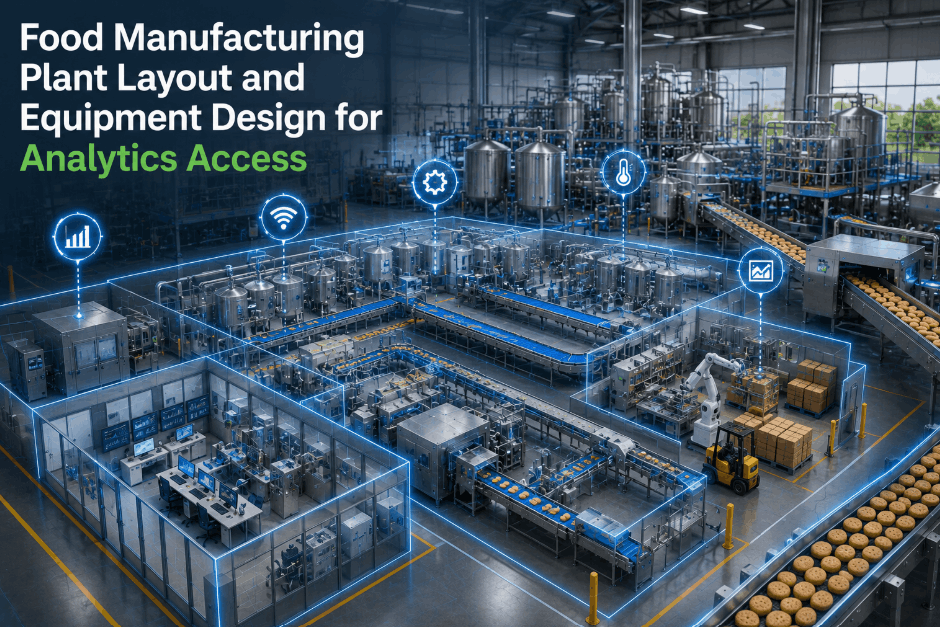
A food plant is not one environment — it is five. Each zone imposes different constraints, and the winning wireless architecture assigns the right protocol to each zone rather than picking one radio for the whole facility.
Processing Floor (Wet, Metal, IP69K)
Pasteurisers, mixers, evisceration lines, fillers. Sub-GHz penetration handles stainless multipath. IP69K nodes survive washdown. One gateway usually covers the hot side.
Cold Storage and Freezer Bays
Deep-freeze at -40°C. LoRaWAN with cold-rated lithium chemistry monitors temperature and door-open. Cellular LTE-M as redundant path for HACCP CCPs.
Packaging and Palletising Cells
Dense clusters of presence, weight, and label sensors around a bounded cell. Zigbee mesh gives low-latency coordination without saturating plant-wide LoRaWAN.
Vision AI and Operator Terminals
Vision cameras, tablet HMIs, inspection stations. High bandwidth demands. Industrial IP67 APs at wet-zone boundaries, wired backhaul to the edge appliance.
HACCP Critical Control Points
Pasteuriser hold time, cook temperature, chill-tunnel exit. LTE-M primary, LoRaWAN backup. Deterministic reporting, carrier redundancy, no dependency on plant IT.
The Hybrid Gateway — What Winning Architectures Look Like
The dirty secret of food-factory wireless is that nobody picks one protocol. The winning architecture is a single multi-protocol gateway that ingests all four radio families into one edge appliance, then normalises the data for the platform above.
The Food-Plant Wireless Design Checklist
Before you commit to any wireless architecture, run it through this eight-point audit. Every check that fails is a project risk you will meet again in month four when the network is live.
One radio does not fit a food factory. The zone map does.
The winning wireless architecture in 2026 is multi-protocol by design — LoRaWAN across processing, Zigbee where density demands mesh, WiFi for vision, cellular backup on HACCP CCPs. iFactory runs all four on a single multi-protocol gateway with washdown-aware, HACCP-grade software above it. A 30-minute demo maps the pattern to your plant.
Frequently Asked Questions
Why not just use WiFi across the whole plant?
Because a food factory is a hostile RF environment. Stainless steel tanks, walls, and conveyors reflect 2.4 and 5 GHz signals into multipath interference that consumer WiFi struggles with. Cold storage without a wired AP inside is effectively invisible to WiFi. And battery-powered sensors cannot sustain the power draw for years — WiFi radios are power-hungry by design. WiFi remains right for vision cameras and terminals, wrong for the sensor layer. To scope which zones qualify for WiFi in your plant, contact iFactory Support.
Is LoRaWAN really deterministic enough for HACCP monitoring?
For most CCP applications, yes — LoRaWAN carries a 5 to 30 second reporting cadence reliably with strong wall penetration, which is more than sufficient for pasteuriser hold-time, chill-tunnel exit, or cold-storage temperature. For CCPs where a single missed report triggers a food-safety violation, the safer architecture is LoRaWAN as primary and cellular LTE-M as an independent backup path. That redundancy is the pattern most audit-ready facilities adopt, and it removes single-radio failure from the risk register.
Can we run this on our existing plant network?
Yes, and this is the fastest path to ROI. The sensor network sits below your existing Ethernet backbone — the multi-protocol gateway plugs into your OT switch and sensor traffic never touches enterprise WiFi. No IT project to negotiate before the first sensor goes live, and no interference with vision cameras or SCADA already running on plant WiFi. To see the topology on your own layout, book a demo.
What about battery replacement cost across hundreds of sensors?
This is exactly why LoRaWAN dominates the sensor layer in 2026 food-plant designs. Ten-year battery life on a well-tuned LoRaWAN node means a sensor deployed today survives a full audit cycle without being touched. Zigbee is closer to 1 to 3 years and needs planned rotation. WiFi sensors typically need line power or weekly battery swaps — impractical at scale. Rule of thumb: one battery per LoRaWAN node per decade, negligible next to sensor-swap labour on shorter-lived radios.
How fast can we go live on the first zone?
Standard deployment is 8 to 12 weeks for the first zone plus multi-protocol gateway, with subsequent zones adding 1 to 2 weeks each. The lowest-risk sequence is to start with processing-floor temperature and CCP monitoring on LoRaWAN — the easiest ROI proof and the least IT dependency — then extend to cold storage, packaging, and vision zones in the following quarter. A 30-minute demo walks the phased plan against your plant layout. Schedule one here.
Design your zone map before you buy your first sensor.
The most expensive wireless mistakes in food factories are decided at architecture time — one radio for the whole plant, non-IP69K enclosures in wet zones, no CIP-aware software above the gateway. A 30-minute demo runs the zone map against your floor plan and returns a protocol-per-zone architecture, gateway placement, and battery projection in the same session. Sessions available this week.