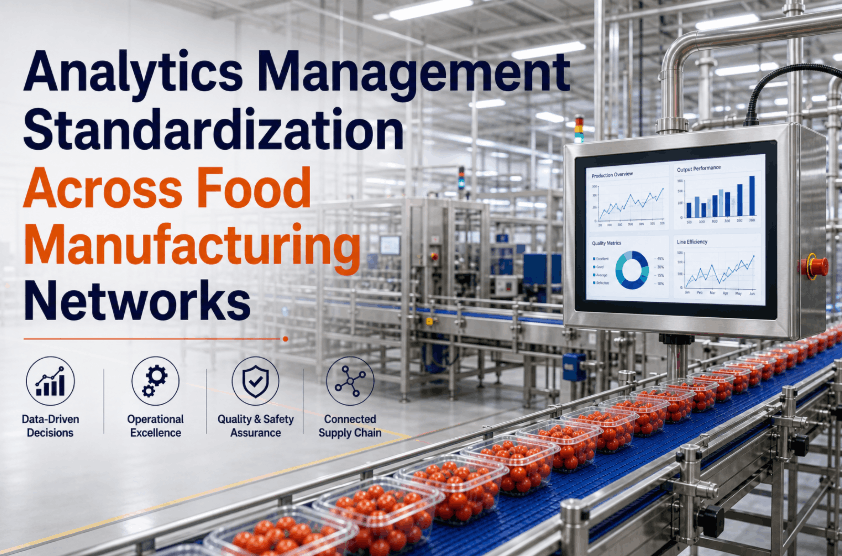
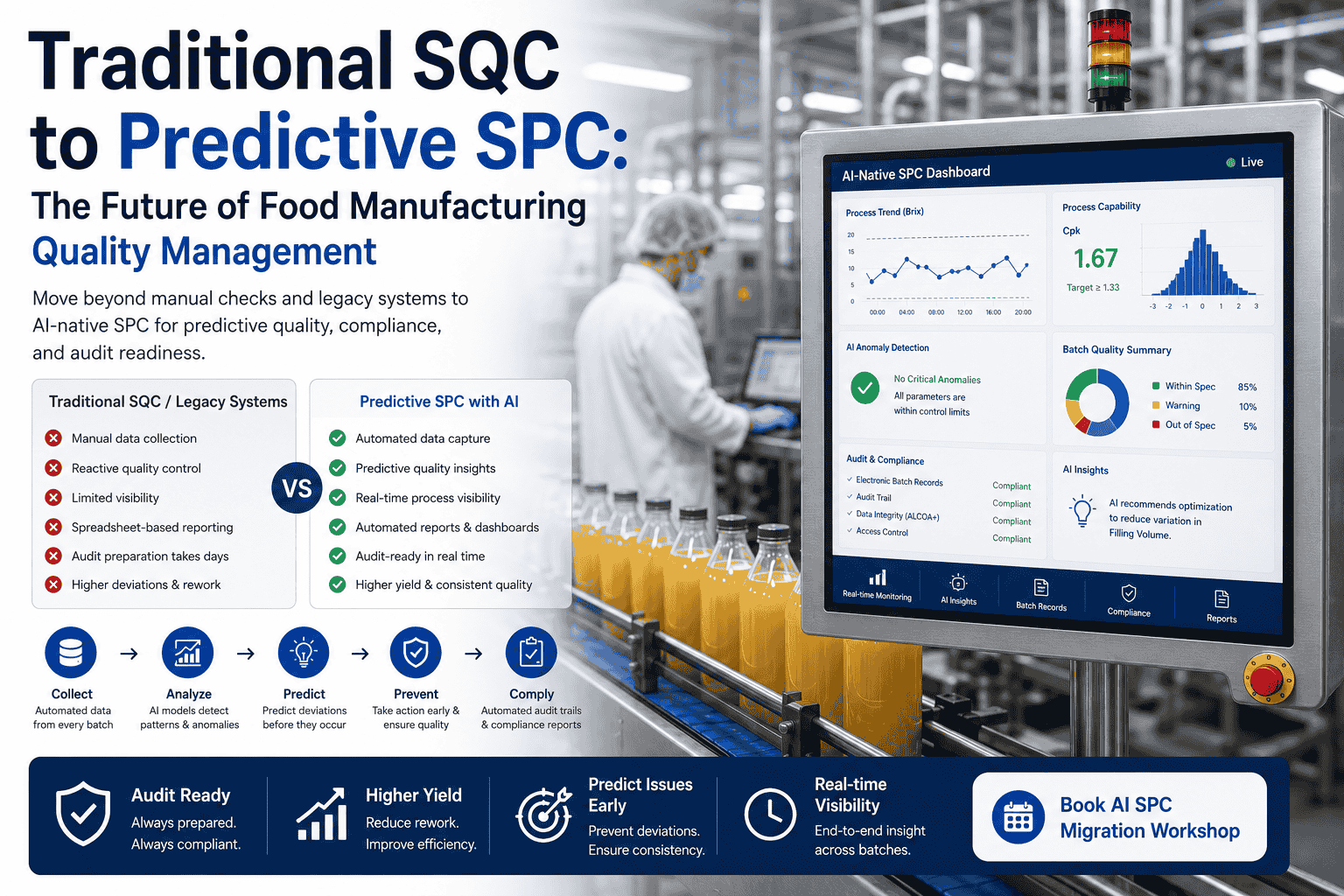
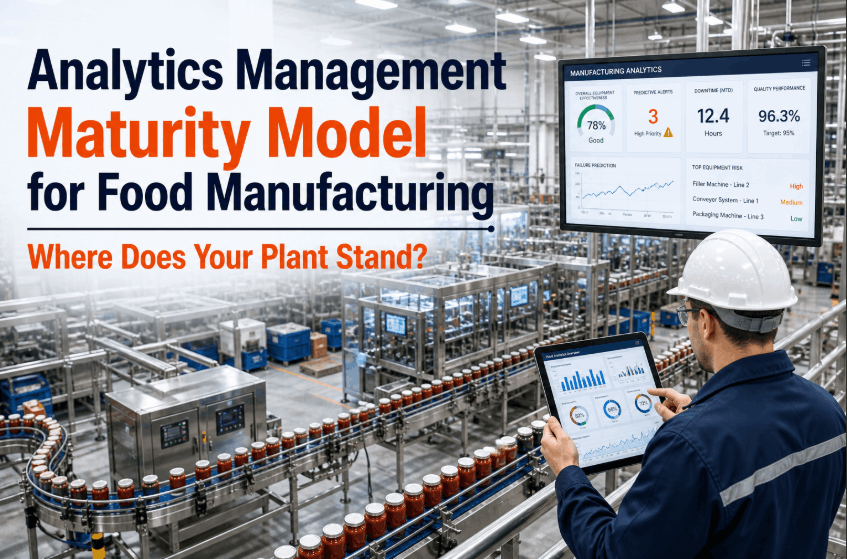
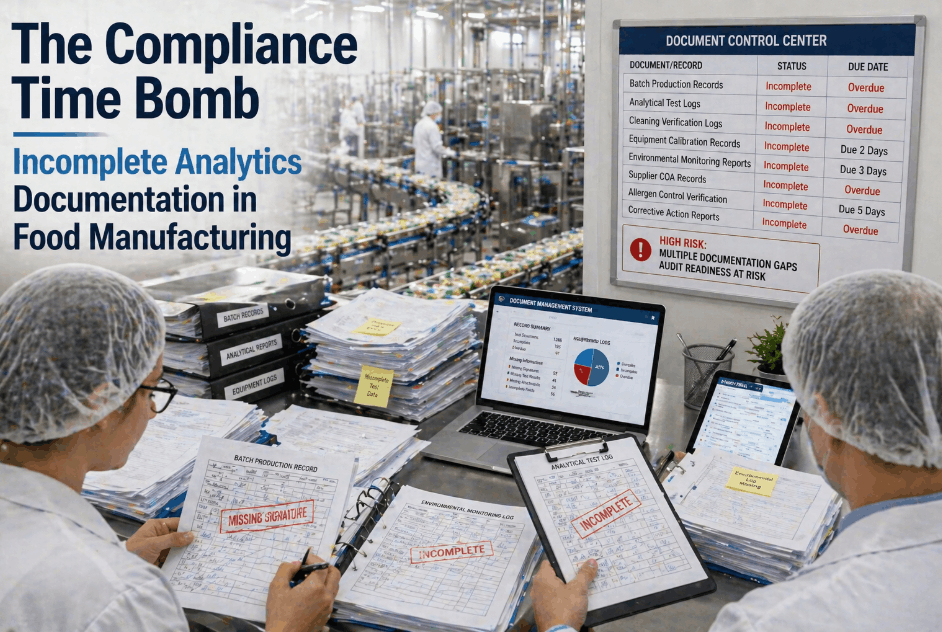
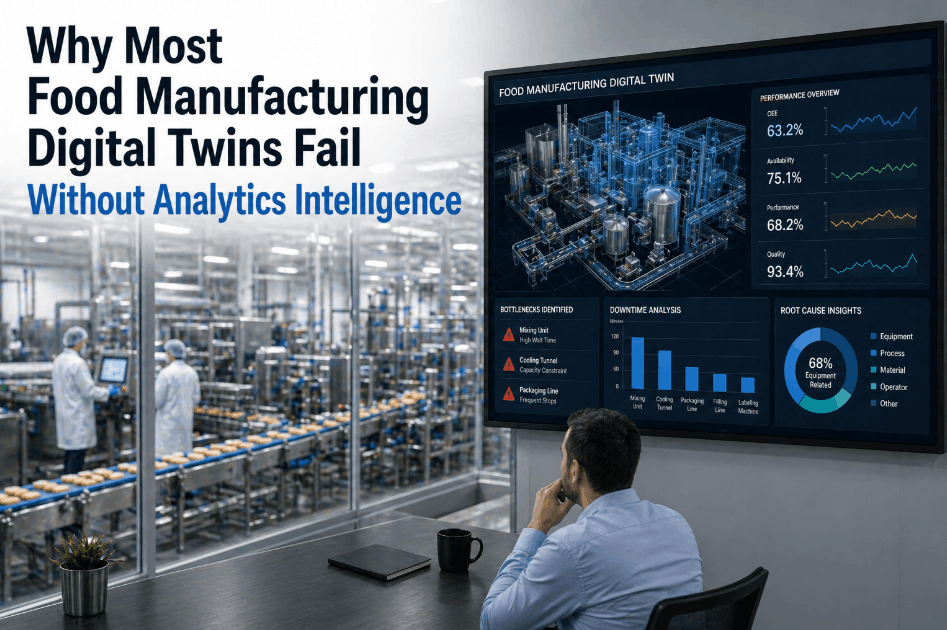
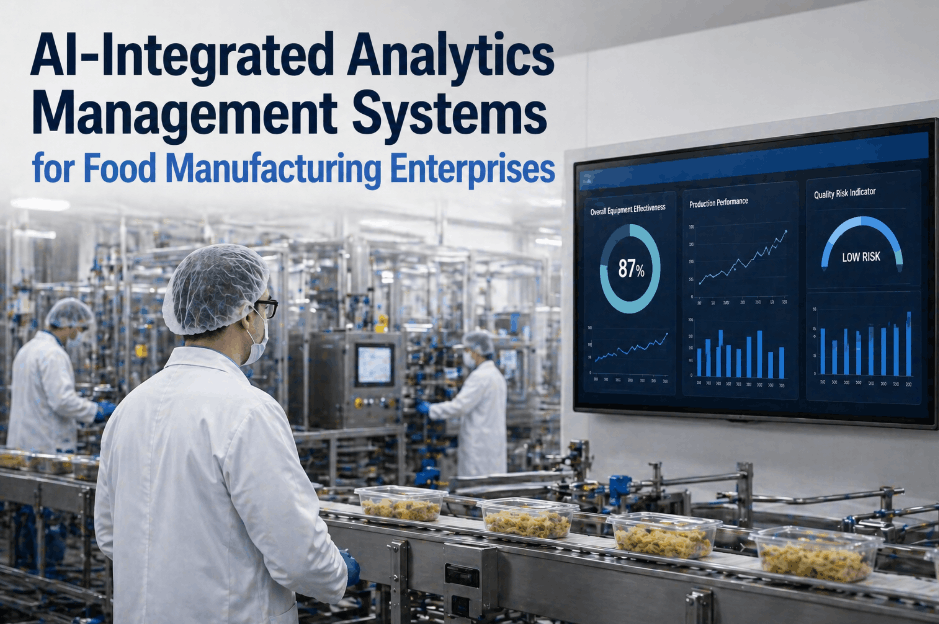
Analytics management standardization is no longer a back-office initiative for food manufacturers — it is a frontline competitive requirement. As food production networks expand across multiple facilities, regions, and regulatory environments, the absence of a unified enterprise analytics management framework creates compounding operational risk. Inconsistent data definitions, fragmented manufacturing execution system configurations, and siloed quality records across plants don't just slow reporting cycles — they actively undermine the decisions that determine yield, compliance, and margin. In 2026, food manufacturers operating multi-plant networks without standardized analytics governance are paying a measurable performance penalty that grows with every new facility added to the network. Book a demo to see how iFactory delivers network-wide analytics standardization from day one.
ENTERPRISE ANALYTICS · MULTI-PLANT STANDARDIZATION · SMART FACTORY
Standardize Analytics Across Every Plant in Your Food Manufacturing Network
iFactory delivers unified analytics governance, digital SOP management, and real-time operational intelligence across multi-plant food manufacturing networks — turning fragmented data into consistent, decision-ready performance visibility at every facility.
Why Analytics Standardization Fails Across Multi-Plant Food Manufacturing Networks
Most food manufacturers recognize the problem only after it has already cost them. A facility in one region is tracking OEE with a different formula than a sister plant two states away, quality hold definitions vary between production managers, and digital SOP implementations that worked in one facility were never replicated across the network. The result is a reporting environment where corporate dashboards aggregate metrics that are, at the definition level, measuring different things — masking facility-specific performance gaps that compound quarterly.
The root causes of analytics fragmentation in food manufacturing networks are predictable and addressable. Understanding them is the prerequisite for any meaningful multi-plant management software strategy. Book a demo to assess your network's current fragmentation gaps with iFactory's diagnostic tools.
Decentralized Technology Procurement
Individual facilities acquire industrial analytics platforms independently, driven by local budget cycles. Over time, the network accumulates incompatible systems with no shared data schema, producing metrics that cannot be meaningfully compared across plants.
SOP Drift Without Digital Enforcement
Standard operating procedures on paper degrade as plant teams adapt them to local conditions. Without document control software enforcing version integrity, the network's operational standards exist in name only — each facility running a different variant.
Absent Data Governance Infrastructure
Facilities rarely have a governance layer defining common data taxonomies and metric calculation standards across the enterprise. Data governance is treated as a post-implementation concern rather than a foundational architecture requirement.
Change Management Without Adoption Architecture
Standardization initiatives from corporate headquarters fail at the facility level when they require behavior change without delivering operational benefit at the point of work. Reversion to fragmented practices is inevitable when plant teams don't trust the new system.
Performance Benchmarks
The Measurable Cost of Unstandardized Analytics in Food Manufacturing Networks — 2026 Data
The performance gap between food manufacturing networks with standardized operational analytics platforms and those operating with fragmented analytics infrastructure is quantifiable across every critical operational dimension. These benchmarks represent measured outcomes from network-level analytics standardization deployments in mid-to-large food manufacturing enterprises.
Analytics Standardization Impact — Network Performance Comparison 2026
Governance Framework
Building an Enterprise Analytics Governance Framework for Food Manufacturing Networks
Effective operational governance software for food manufacturing networks requires more than a technology layer — it demands a governance architecture that defines standards, enforces consistency, and adapts to operational reality across every facility simultaneously. Food manufacturers ready to build this foundation can book a demo with iFactory to map their network's current governance gaps.
01
Unified Data Taxonomy and Metric Standardization
Every KPI — OEE, yield, downtime, changeover time — must be calculated identically at every plant to produce comparable performance data. Networks that skip this step generate dashboards showing comparable numbers that are, in reality, measuring incomparable operational realities.
02
Digital SOP Infrastructure With Version Control and Compliance Tracking
A digital SOP infrastructure provides version-controlled procedures with audit trails and automated distribution to relevant facility teams upon update. When a critical process change is required, it reaches every facility within hours and adoption is tracked automatically rather than assumed.
03
Cross-Plant Benchmarking and Performance Normalization
Standardized analytics enables meaningful cross-plant benchmarking that identifies the specific practices driving performance differences between top-quartile and bottom-quartile facilities. When one plant achieves a yield improvement, the digital SOP infrastructure propagates that practice change at enterprise speed.
04
Integrated Compliance Management Across Regulatory Environments
A standardized analytics governance framework integrates compliance documentation with operational data capture, eliminating manual effort of assembling audit packages from disconnected systems. Networks that
book a demo with iFactory typically find compliance documentation time drops by over 85% within the first audit cycle.
05
Industrial IoT Monitoring Standards and Integration Protocols
API-based integration protocols and standardized data tagging conventions transform isolated monitoring investments into a coherent network-level sensing infrastructure. Data quality — not data source uniformity — is the governing requirement at this layer.
Implementation Roadmap
90-Day Analytics Standardization Roadmap for Multi-Plant Food Manufacturing Networks
Network-wide analytics standardization does not require simultaneous disruption of every facility's operations. A phased deployment approach delivers measurable standardization milestones while minimizing operational disruption — building credibility through early-stage wins that accelerate facility-level adoption in later phases. Book a demo with iFactory to receive a network-specific deployment roadmap based on your current infrastructure.
1
Days 1–20: Network Analytics Audit and Governance Blueprint
Conduct a comprehensive inventory of every analytics system, data source, and reporting process across all network facilities. Document metric definitions, identify KPI inconsistencies across plants, and produce a governance blueprint with a prioritized integration roadmap based on operational impact.
Outcome: Quantified analytics fragmentation baseline with prioritized standardization roadmap
2
Days 21–50: Unified Data Layer Deployment Across Priority Facilities
Deploy the centralized analytics integration layer at two to three priority facilities, establishing standardized metric calculations, automated data flows from existing ERP and MES systems, and the first generation of cross-plant performance dashboards. Validate data quality and establish baseline performance benchmarks that anchor ROI documentation.
Outcome: Real-time standardized performance visibility across priority facilities without manual compilation
3
Days 51–75: Digital SOP Rollout and Compliance Infrastructure Activation
Migrate the highest-impact operating procedures to the digital SOP platform with version control and compliance tracking. Activate automated compliance documentation and establish the best-practice propagation workflow that distributes performance improvements as updated SOPs across the network.
Outcome: Automated compliance documentation and network-wide SOP enforcement with measurable adherence tracking
4
Days 76–90: Full Network Integration and Predictive Analytics Activation
Complete standardized analytics deployment across remaining facilities and activate predictive models for quality deviation early warning, equipment failure prediction, and yield optimization — built on the validated data foundation established in prior phases.
Outcome: Fully standardized network analytics with documented ROI and active predictive intelligence across all facilities
Industry Reality
What Genuine Analytics Standardization Delivers That Fragmented Networks Cannot
The compounding operational advantage of a standardized enterprise analytics infrastructure is most visible not in individual facility metrics but in network-level capabilities that fragmented organizations simply cannot access. These are the strategic capabilities that separate food manufacturing networks with genuine standardization from those still operating in fragmented data environments. Book a demo to see which of these capabilities your network is currently missing.
Network-Wide Quality Event Correlation
When a quality deviation occurs at one facility, a standardized network immediately determines whether similar conditions exist at other plants. Fragmented networks discover multi-plant quality issues days after they have already expanded.
Supplier Performance Intelligence Across Facilities
Standardized supplier data definitions allow food manufacturers to correlate input quality with production outcomes across multiple receiving facilities. These cross-facility patterns are invisible when quality metrics are not standardized at the network level.
Rapid Capacity Reallocation Decision Support
When demand shifts require production reallocation, standardized analytics provides genuinely comparable capacity and efficiency data for every plant. This eliminates protracted debates about whose numbers to trust before decisions can be made.
Accelerated New Facility Integration
Networks with mature analytics governance frameworks integrate new facilities in weeks rather than quarters. Every new facility joins a standardized analytics environment from day one rather than operating in fragmented isolation until a future project catches them up.
Enterprise-Level Regulatory Readiness
Multi-jurisdiction food manufacturers with standardized compliance management can respond to regulatory inquiries and prepare multi-facility audit packages at enterprise scale. Fragmented documentation systems cannot deliver this within the response windows regulators now require.
Continuous Improvement at Network Velocity
When every facility measures the same things the same way, best-performing practices can be identified and propagated through digital SOP infrastructure across the entire network. The network improves as a system rather than as a collection of independent plants.
Network Performance Case
A six-facility protein and dairy manufacturer had invested in plant-level analytics across four years, yet corporate leadership still required a five-day manual consolidation process to produce a cross-network OEE comparison. After deploying iFactory's standardized analytics governance framework, the organization produced its first real-time network performance dashboard within 47 days — revealing a 19-point OEE gap between its highest and lowest performing facilities that had been invisible in prior reporting. Within two production quarters, the bottom-quartile facility closed 14 of those 19 points by adopting practices propagated through the digital SOP infrastructure.
Book a demo to see how iFactory makes your network's best knowledge available to every facility.
Frequently Asked Questions — Analytics Standardization for Food Manufacturing Networks
What is analytics management standardization in food manufacturing?
It is the process of aligning data definitions, metric calculations, SOP documentation, and reporting architectures across all facilities in a food manufacturing network so that performance data is comparable, compliance documentation is consistent, and best practices can be systematically propagated across plants.
How long does analytics standardization take across a multi-plant food network?
With a structured deployment approach, initial standardization across priority facilities can be achieved in 45–60 days. Full network integration including digital SOP rollout, compliance automation, and predictive analytics activation typically completes within a 90-day deployment cycle without requiring replacement of existing ERP or MES systems.
Can analytics standardization work across facilities with different ERP and MES systems?
Yes. Modern manufacturing intelligence platforms create a unified analytics layer above existing systems via API integrations — normalizing data from different source systems into a common taxonomy without requiring system replacement. The standardization occurs at the analytics layer, not at the ERP or MES level.
What is the ROI of analytics management standardization for food manufacturers?
Network-level analytics standardization typically delivers measurable ROI through reduced manual reporting labor (80–90% reduction), improved OEE through cross-plant benchmarking, reduced compliance burden, and faster quality event response. Most deployments achieve full ROI within two production quarters.
How does digital SOP software improve compliance across food manufacturing networks?
Digital SOP platforms replace static documents with version-controlled procedures that are automatically distributed to relevant teams upon update, with compliance tracking that captures actual execution data rather than assumed adherence — eliminating the SOP drift that occurs in every paper-based environment over time.
What data governance infrastructure does a food manufacturing network need before deploying AI analytics?
Before deploying predictive analytics across a network, food manufacturers need a unified data taxonomy, data quality validation rules at each source, cross-system integration protocols, and a governance process for maintaining standards as systems evolve. AI models built on unstandardized data produce unreliable outputs that floor teams will not trust.
NETWORK-WIDE STANDARDIZATION · 90-DAY DEPLOYMENT · MEASURABLE ROI
Stop Managing Fragmented Analytics Across Your Food Manufacturing Network
iFactory's enterprise analytics standardization platform delivers unified data governance, digital SOP management, and network-wide operational intelligence — transforming disconnected facilities into a genuinely integrated, high-performance food manufacturing network.