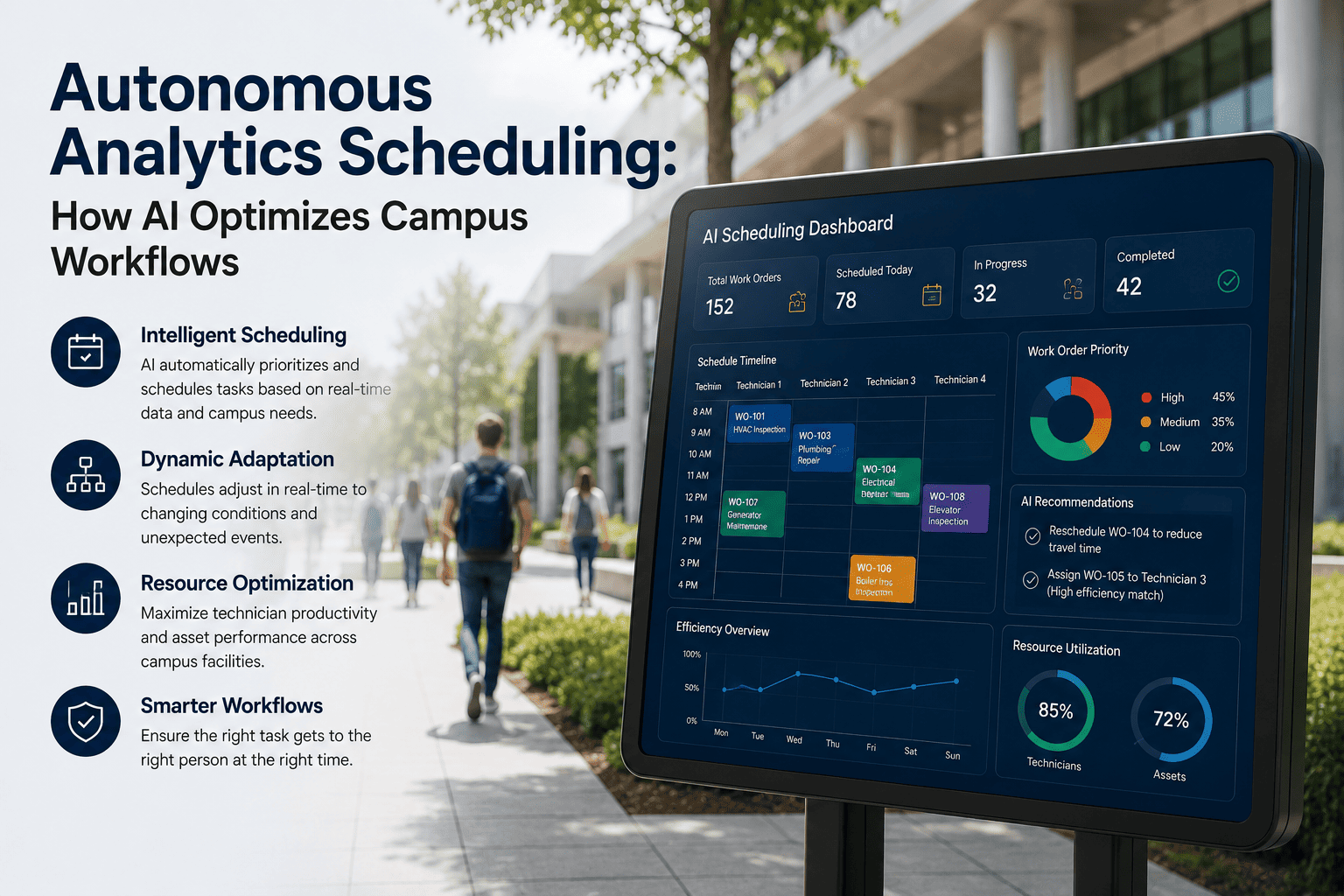
Campus facility teams spend 40-50% of their time on scheduling and task assignment — deciding which technician fixes which equipment on which day, prioritizing work orders based on risk and availability, coordinating across maintenance, energy, and compliance teams. This is cognitive work that could be automated. AI-driven scheduling systems analyze equipment risk data, technician skills, facility priorities, and calendar constraints — then autonomously generate optimized maintenance schedules that maximize throughput, minimize emergency work, and ensure high-risk assets get attention first. Campus teams approve automated schedules in seconds instead of spending days manually coordinating. This guide covers how AI scheduling works, what data drives it, and why leading universities are automating workflow optimization to free up management time. To see autonomous scheduling in action, schedule a workflow demo with our team.
Campus Workflows · AI Scheduling · Automation
Autonomous Analytics Scheduling: How AI Optimizes Campus Workflows
Automated work order prioritization · Technician skill-based assignment · Risk-driven scheduling · Real-time schedule optimization · Zero manual coordination.
45%
Management time freed from scheduling
60-75%
Emergency work reduction (scheduling prevents)
22-30%
Labor productivity improvement
5 min
Time to generate optimal schedule
Why Campus Scheduling Is Broken and How AI Fixes It
Facilities directors spend their days answering the same question: "Who should do what, when?" A chiller needs bearing replacement. A roof needs inspection. An electrical panel needs load test. A technician calls in sick. A critical system fails unexpectedly. Priorities shift minute-by-minute. Manual scheduling cannot adapt. AI scheduling continuously re-optimizes — integrating new asset risk data, real-time staff availability, and priority changes into a living schedule that always reflects current reality.
Manual vs AI-Automated Scheduling Flow
1. Backlog Review (1 hr)
Manager reviews 200+ work orders in system. Marks "priority" on 20-30 based on memory and complaints.
2. Technician Puzzle (2-3 hrs)
Checks technician skills, availability, location. Tries to match job to person. Email exchanges clarify scope.
3. Calendar Negotiation (1-2 hrs)
Coordinates across teams. "Can you move that to Wednesday?" Building occupancy constraints. Supplier lead times. Resolves scheduling conflicts manually.
4. Schedule Posted (by EOD)
Partial schedule created. Missing 10-15 work orders still unassigned. Emergency work discovered next day invalidates schedule.
Total: 4-6 hours daily for partial, outdated schedule
1. Risk Analysis (automatic)
AI analyzes asset condition data. Scores all 200+ work orders by failure risk and business impact. Updates continuously.
2. Skill-Based Assignment (automatic)
Matches job requirements to technician certifications, experience, availability. Considers travel time, current workload.
3. Constraint Optimization (automatic)
Integrates occupancy, weather, supplier constraints, equipment dependencies. Generates conflict-free schedule automatically.
4. Schedule Generated & Updated (5 min)
Complete, optimized schedule ready. All 200+ work orders assigned. New emergencies trigger re-optimization in real-time.
Total: 5 minutes for complete, continuously optimized schedule
Four Workflow Problems AI Scheduling Solves
01
Prioritization Blindness — High-Risk Assets Go Unnoticed
Without risk scoring, facility managers prioritize based on urgency (complaints) and visibility, not actual failure probability. A chiller bearing approaching failure (high risk) might be backlogged for months while a low-risk equipment gets priority because someone complained. AI scheduling integrates real-time asset risk data — ensuring high-risk work orders float to the top automatically, regardless of complaint volume.
Risk-based prioritizationPrevent failures, not complaints
02
Skill Mismatch — Wrong Technician Assigned to Wrong Job
Manual scheduling often assigns work based on availability alone. A certified elevator technician gets assigned HVAC troubleshooting. A junior technician gets complex electrical diagnostic. Jobs take 2-3x longer due to skill mismatch. AI scheduling maintains technician skill profiles and automatically matches jobs to certified, experienced staff — reducing job time, improving quality, and accelerating schedule completion.
Certification matchingSkill-optimized assignment
03
Schedule Obsolescence — Plan Invalidated by Emergencies by 9 AM
A facilities director spends 5 hours creating Wednesday's schedule. At 8:15 AM Wednesday, a critical chiller fails. Schedule is now useless. The director manually reassigns everyone. High-risk prevention work gets postponed. Manual schedules are static snapshots that become obsolete in hours. AI scheduling continuously re-optimizes — when emergencies occur, the system automatically adjusts remaining work orders and alerts affected technicians in seconds.
Real-time re-optimizationEmergency integration
04
Unscheduled Work Backlog — 30% of Work Orders Never Get Assigned
With manual scheduling, complex or low-priority work orders often never get scheduled. A preventive maintenance task that takes 6 hours sits in backlog for months because it's not urgent. Over time, this work becomes emergency work. AI scheduling handles 100% of work orders in one system — assigning every job (including low-priority prevention work) into an optimized sequence that balances risk, urgency, and available capacity. Nothing falls through cracks.
100% work order coveragePrevention work never deferred
How AI Scheduling Actually Works: The Optimization Engine
Asset Risk Score
Real-time ML models (bearing wear, thermal aging, electrical stress)
Prioritize high-risk work first
Critical systems get attention before degradation hits failure threshold
Technician Skills & Availability
Skill matrix (certifications, experience level, current workload, location)
Match job to capable, available technician closest to location
Jobs completed 30-40% faster due to skill match. Zero rework.
Campus Constraints
Building occupancy, class schedules, equipment dependencies, supplier lead times
Schedule work during low-occupancy windows, coordinate dependent tasks
Minimize occupant impact. Prevent work delays due to constraint violations.
Travel Time & Logistics
Campus map, technician location, job location, drive time estimates
Cluster jobs by geographic proximity. Optimize route efficiency.
Reduce travel time 20-25%. More jobs per technician per day.
Emergency Events
Real-time failure alerts, urgent work orders, unscheduled events
Re-optimize entire schedule in <5 minutes, alert affected teams
Emergency response integrated without manual schedule rebuild.
Three Scheduling Scenarios Optimized by AI
AI identifies 40-50 preventive maintenance tasks needed this week based on equipment condition, maintenance history, and risk models. Manually prioritizing and scheduling these would take a director 8-10 hours. AI generates optimal schedule in 5 minutes: groups jobs by building, assigns to qualified technicians with spare capacity, schedules around occupancy constraints. Schedule presented to director for 1-minute review and approval. 100% of prevention work gets scheduled instead of deferring to backlog.
Work orders40-50 preventive tasks identified and scheduled
Scheduling time5 minutes (vs 8-10 hours manual)
Completion rate100% of identified work gets scheduled (vs 60-70% manual)
ImpactPrevention work never deferred. Emergency maintenance drops 40-50%.
Schedule Workflow Demo
Monday 8:00 AM: Director's optimized weekly schedule is live. 45 work orders assigned, technicians dispatched. Monday 8:47 AM: Critical chiller fails. Facility loses cooling to 8 buildings. Emergency response required immediately. Manual process: director calls all technicians, reassigns everyone, cancels 15 non-critical jobs, reschedules remaining work across week. Takes 1-2 hours. AI process: System detects emergency alert. Re-optimizes entire schedule in 90 seconds. Prioritizes chiller repair, reassigns available technician, cascades other work to remaining slots, notifies all affected technicians via app. Zero manual intervention. Director approves re-plan in 1 minute.
Emergency response time90 seconds (vs 60-120 minutes manual)
Team notificationAutomatic, within 2 minutes of emergency
Schedule disruptionMinimal. Cascading reschedule prevents job cancellations.
Management overhead1-minute approval vs 1-2 hour full reschedule
Schedule Workflow Demo
Facilities director plans staffing 4 weeks out. Current process: estimates workload, guesses at technician availability, creates static 4-week schedule that becomes outdated by week 2. AI scheduling generates 4-week forward plan based on current asset risk data — identifying all high-risk work that needs completion within 4 weeks, distributing evenly across available team capacity, identifying bottlenecks. If risk increases, schedule adjusts automatically. Director sees weekly capacity utilization forecast and can add staff before overload occurs.
Planning horizon4-week forward schedule with continuous updates
High-risk coverage100% of critical work scheduled within 4-week window
Capacity visibilityTeam utilization forecast prevents overload and burnout
Staffing decisionsData-driven. Add temps/contractors only when forecast shows need.
Book Demo
What Autonomous Scheduling Delivers to Campus Teams
45%
Management time freed from daily scheduling
Directors spend 4-6 hours/day on manual scheduling. AI cuts this to 15-30 minutes/day.
60-75%
Emergency work reduction through prevention scheduling
Prevention work no longer deferred. High-risk assets get attention before failure.
22-30%
Labor productivity improvement
Skill-matched assignment + geographic clustering = more jobs per technician per day.
100%
Work order scheduling coverage
All work orders (including low-priority prevention) get assigned and scheduled.
Frequently Asked Questions
Deploy Autonomous Scheduling for Your Campus
AI-optimized work scheduling integrated with asset risk data. Prevent emergencies through intelligent prevention work prioritization. Free facility management time. Maximize team productivity.
Risk-Based Prioritization
Skill-Matched Assignment
Real-Time Re-Optimization
100% Work Order Coverage
Emergency Integration