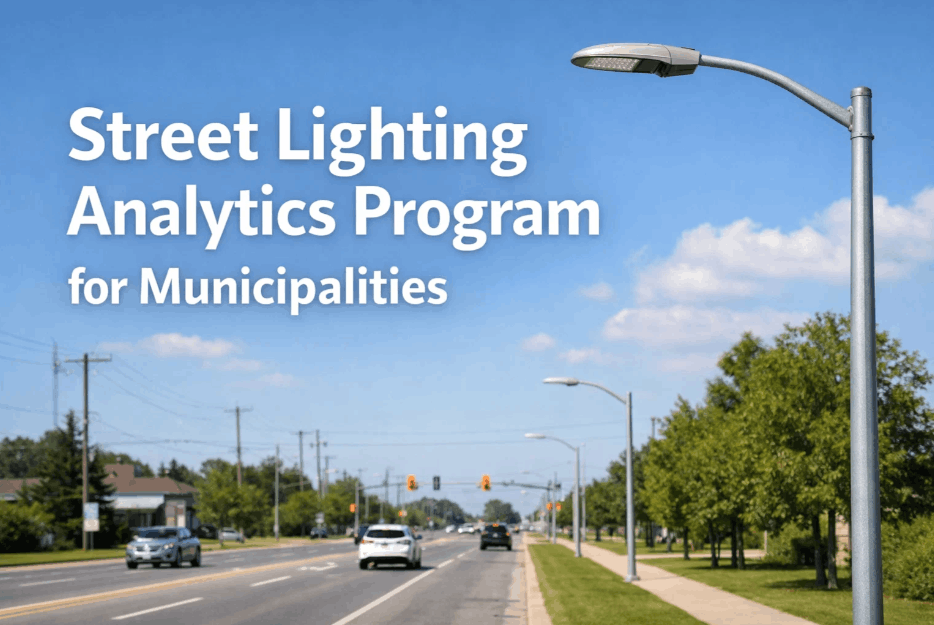
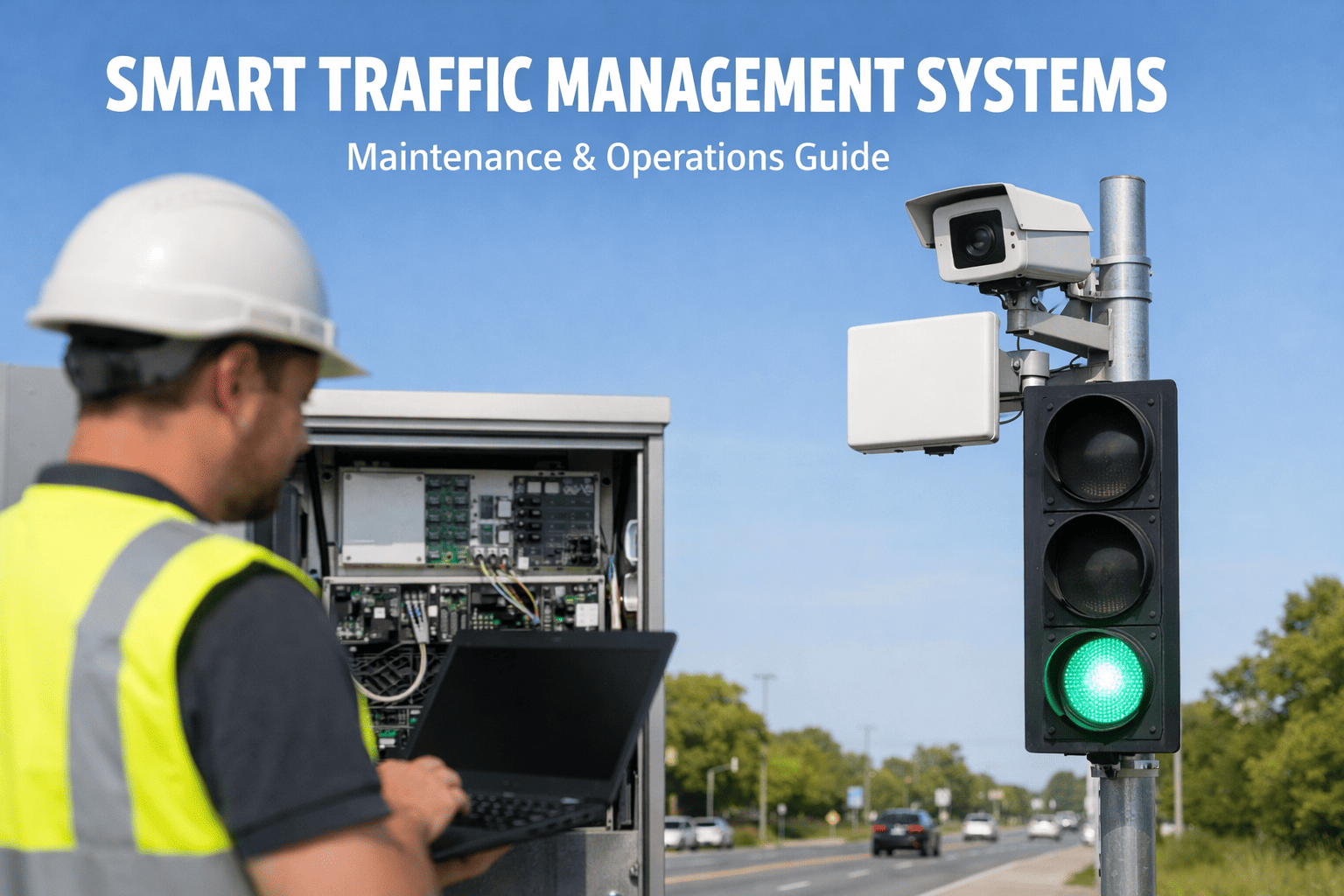
Municipalities spend up to 40% of their electricity budgets keeping streets illuminated, yet most still rely on fixed timers, manual nighttime patrols, and complaint-driven repairs that leave outages undetected for days. IoT-enabled smart street lighting replaces this reactive cycle with connected infrastructure that monitors itself—detecting faults in real-time, adjusting brightness based on conditions, and scheduling maintenance before failures ever happen. The result is safer streets, lower energy bills, and maintenance teams that work smarter instead of harder. Talk to our smart city specialists to learn how connected lighting can transform your municipal operations.
What Is Smart Street Lighting and How Does IoT Make It Work?
A smart street light is a network-connected LED luminaire equipped with embedded controllers, sensors, and communication modules that transmit operational data to a centralized management platform. Unlike conventional street lights that simply turn on and off based on timers or photocells, IoT-enabled lights continuously report their health, energy consumption, and environmental surroundings—giving operators total visibility and control over every fixture in the network.
Anatomy of a Connected Street Light
Hardware
LED Luminaire + Smart Controller
High-efficiency LED fixture paired with an outdoor lamp controller (OLC) installed in a standard NEMA or Zhaga socket. The controller handles dimming commands, data collection, and two-way communication with the central platform.
Sensors
Light, Motion & Power Sensors
Ambient light sensors (LDR) trigger on/off based on actual daylight. PIR motion detectors activate full brightness when pedestrians or vehicles approach. Power meters track wattage, voltage, and current at each pole.
Network
Wireless Communication Layer
Low-power protocols like LoRaWAN, Zigbee, or NB-IoT transmit telemetry from luminaires to gateways. Mesh networking ensures coverage across dense urban corridors and extended rural highways alike.
Platform
Cloud Management System
A centralized dashboard aggregates data from every fixture—displaying real-time status on an interactive map, generating automated fault alerts, running energy analytics, and creating maintenance work orders.
How Much Energy Do Smart Street Lights Save?
Energy savings are the primary driver behind most smart lighting projects, and the numbers are significant. LED conversion alone cuts consumption by half compared to legacy sodium-vapor or metal-halide lamps. When IoT adaptive controls are layered on top—dimming during low-traffic hours, responding to ambient light, activating on motion—the total savings become dramatic.
50-70%
LED Retrofit Savings
Replacing sodium-vapor or metal-halide lamps with LEDs delivers immediate energy reductions even without smart controls
+10-30%
IoT Dimming & Scheduling
Adaptive brightness control based on traffic, time-of-day, and ambient light adds significant savings on top of LED conversion
Up to 80%
Combined Total Reduction
Municipalities running LED + IoT smart controls report total energy reductions up to 80% versus legacy lighting infrastructure
Beyond direct energy savings, IoT monitoring catches "dayburners"—lights stuck on during daytime due to failed photocells—which individually waste $120-$180 per fixture annually. Across a network of thousands of lights, automated dayburner detection alone can recover tens of thousands of dollars each year.
Smart Street Light Fault Detection: How IoT Eliminates Manual Inspections
Traditional fault detection requires crews to drive routes at night, visually scanning for dark poles—a slow, expensive, and unreliable process. IoT transforms this completely by enabling every fixture to self-report its operational status continuously.
Without IoT
Nighttime patrol drives to spot outages visually
Citizen complaints as primary fault notification
Days or weeks before outages are discovered
No distinction between lamp, driver, or power failure
Emergency truck rolls at overtime rates
With IoT Monitoring
Real-time alerts within minutes of any failure
Automatic fault classification: lamp, driver, circuit, or power
GPS-tagged locations for precise crew dispatching
Severity-ranked notifications to reduce alert fatigue
Planned repairs during normal working hours
The operational impact is immediate. Municipalities deploying IoT fault detection report up to 80% fewer truck rolls because crews are dispatched only when needed—with the right parts, to the exact location, for the specific fault type. Response times drop from days to hours, and public safety improves as outages are resolved before citizens even notice them.
LED Street Light Maintenance Schedule: From Reactive to Predictive
IoT sensors do more than detect failures—they track the gradual degradation that precedes them. By monitoring power draw patterns, LED driver temperature, and lumen output over time, predictive algorithms identify fixtures headed toward failure weeks or months in advance.
How Predictive Maintenance Works for Street Lights
Continuous Monitoring
IoT controllers sample power consumption, driver temperature, and operating hours at regular intervals—building a performance profile for every fixture in the network.
Baseline Comparison
AI compares each fixture's current readings against its historical baseline and fleet-wide averages. A driver drawing 12% more current than normal signals degradation beginning.
Failure Prediction
Machine learning models trained on thousands of failure events estimate remaining useful life. The system flags fixtures likely to fail within 30-90 days with confidence scoring.
Automated Work Orders
Predicted failures automatically generate maintenance work orders in the CMMS—grouped by geographic zone and priority, with optimized routing for crew efficiency.
Planned Replacement
Crews replace components during normal shifts with the correct parts already staged. Zero emergency overtime, zero public complaints, zero safety gaps.
LoRaWAN vs Zigbee vs NB-IoT: Choosing the Right Protocol for Smart Lighting
The communication protocol you select determines network cost, range, scalability, and long-term maintenance complexity. There is no single best protocol—the right choice depends on your city's size, density, existing infrastructure, and budget.
Smart Lighting Communication Protocol Comparison
| Protocol | Range | Power | Cost per Node | Best Fit |
| LoRaWAN |
2-15 km |
Ultra-low |
Low (few gateways needed) |
Large-scale municipal networks, rural and suburban corridors |
| Zigbee |
100-300 m (mesh) |
Very low |
Low per node, more gateways |
Dense urban areas with close pole spacing and mesh reliability |
| NB-IoT |
Cellular range |
Low |
Per-node SIM subscription |
Scattered deployments using existing cellular infrastructure |
| LTE Cat-1 |
Cellular range |
Moderate |
Higher per-node cost |
Applications needing firmware OTA updates or higher bandwidth |
| PLC |
Along power cables |
N/A (wired) |
Low (uses existing wiring) |
Retrofit projects where wireless deployment is impractical |
How Smart Cities Use Connected Street Lights to Cut Costs
The financial case for IoT-enabled lighting goes well beyond energy savings. Connected infrastructure delivers measurable returns across five distinct value streams that compound over the life of the system.
01
Energy Cost Reduction
LED + adaptive dimming + motion controls reduce electricity spending by 60-80%. For a city with 10,000 street lights, this translates to hundreds of thousands of dollars in annual savings at typical utility rates.
02
Maintenance Efficiency
Predictive fault detection and optimized crew routing cut maintenance spending by up to 50%. Planned repairs during normal hours eliminate overtime costs, and condition-based replacement extends component life beyond fixed-schedule programs.
03
Extended Asset Lifespan
Smart dimming reduces thermal stress on LED drivers and lenses, extending fixture lifespan from 50,000 to 100,000+ hours. Predictive maintenance catches degradation before it damages adjacent components, preventing cascading failures.
04
Reduced Truck Rolls
Remote diagnostics resolve many issues without dispatching crews. When site visits are needed, GPS-tagged fault data ensures crews arrive at the right pole with the right parts—cutting repeat visits by up to 80%.
05
Smart City Platform Foundation
Connected light poles provide power and network backhaul for additional IoT applications—environmental sensors, traffic monitoring, public Wi-Fi, EV charging management—turning the lighting network into multi-purpose smart city infrastructure.
See How IoT Transforms Street Lighting Operations
iFactory provides the intelligent platform that ties your entire lighting network together—real-time monitoring, predictive analytics, automated work orders, and energy optimization in one centralized system built for smart city infrastructure.
Street Light Asset Management with IoT Sensors
Effective asset management requires knowing the exact condition, location, and performance history of every fixture in your network. IoT sensors deliver this data automatically, replacing manual spreadsheets and infrequent audits with a continuously updated digital asset registry.
IoT-Driven Asset Management Capabilities
GPS-Tagged Asset Registry
Every pole automatically mapped with fixture type, wattage, installation date, circuit assignment, and real-time operational status on an interactive GIS dashboard.
Lifecycle Tracking
Operating hours, power cycles, maintenance history, and component replacements logged automatically per fixture—enabling data-driven capital planning and replacement budgeting.
Performance Benchmarking
Compare energy efficiency and failure rates across zones, fixture types, manufacturers, and installation batches to identify underperformers and guide procurement decisions.
Compliance Documentation
Automated logging of inspections, repairs, and safety checks creates audit-ready compliance records without manual data entry—essential for regulatory reporting and liability protection.
Geographic Heat Mapping
Visualize failure concentrations, energy consumption patterns, and maintenance activity by neighborhood—revealing infrastructure weak points and enabling equitable service delivery across all districts.
Spare Parts Intelligence
Predictive analytics forecast which components will be needed based on failure trends, ensuring warehouse stock matches actual demand and reducing emergency procurement costs.
Managing thousands of street light assets across your municipality? Our platform centralizes every fixture into a single digital registry with live status tracking and automated maintenance workflows.
Connect with our asset management specialists.
Real-World Impact: What Municipalities Report After Deployment
Cities and utilities deploying IoT-connected street lighting consistently report measurable improvements across energy, maintenance, safety, and operational efficiency—often exceeding initial projections within the first year.
60%
Average reduction in energy costs after LED + IoT smart controls deployment across municipal lighting networks
50%
Decrease in maintenance spend through predictive analytics, optimized routing, and elimination of nighttime patrol drives
99.9%
Lighting network uptime achieved through proactive monitoring and rapid fault response capabilities
2-3 yr
Typical payback period for full IoT lighting system deployment, with ongoing savings compounding annually
Build Smarter Lighting Infrastructure for Your City
Every dark pole is a safety liability. Every over-lit empty street at 3 AM is wasted taxpayer money. iFactory gives your team a centralized platform that sees every fixture, predicts every failure, and optimizes every watt—turning street lighting from a cost burden into intelligent, connected infrastructure.
Frequently Asked Questions
What is the average cost of implementing IoT smart street lighting?
The cost depends on whether your network already has LED fixtures. For LED-ready infrastructure, adding IoT controllers typically costs $50-$150 per node, plus gateway and platform costs. Full LED + IoT projects for mid-sized municipalities (10,000-30,000 lights) generally run $40K-$80K for CMMS and sensor implementation, delivering $120K-$250K in first-year savings through reduced energy and maintenance spend. Most cities see full ROI within 2-3 years.
Ask our team for a cost estimate based on your network size.
Can IoT controllers retrofit onto existing LED street lights?
Yes. Most controllers install into standard NEMA 5-pin, NEMA 7-pin, or Zhaga Book 18 sockets already present on modern LED fixtures. Installation takes approximately 10-15 minutes per pole and does not require replacing the luminaire itself, making it a practical and affordable way to add intelligence to an existing LED network without a full fixture swap.
How does a smart street light system handle network outages?
Smart lights are built with fail-safe logic. If communication is lost, each luminaire continues operating on its last configured schedule or defaults to full brightness to maintain public safety. Local controllers buffer telemetry data during outages and synchronize automatically when connectivity is restored. Critical corridors can be equipped with redundant communication paths for added reliability.
What data security measures protect municipal lighting networks?
Enterprise-grade security layers include TLS/SSL encrypted communications between luminaires and the cloud platform, device certificate authentication preventing unauthorized access, role-based access control within the management dashboard, and regular firmware security patches delivered over-the-air. Network segmentation isolates lighting management traffic from other municipal systems to minimize attack surface.
Speak with our security team about compliance requirements.
Can smart street lights integrate with other smart city platforms?
Absolutely. Connected light poles are increasingly recognized as the backbone of smart city infrastructure because they provide distributed power and network access. IoT-enabled poles can host environmental sensors (air quality, noise, weather), traffic monitoring cameras, public Wi-Fi access points, EV charging management, and emergency notification systems—all managed through integrated platforms that share data across municipal departments.