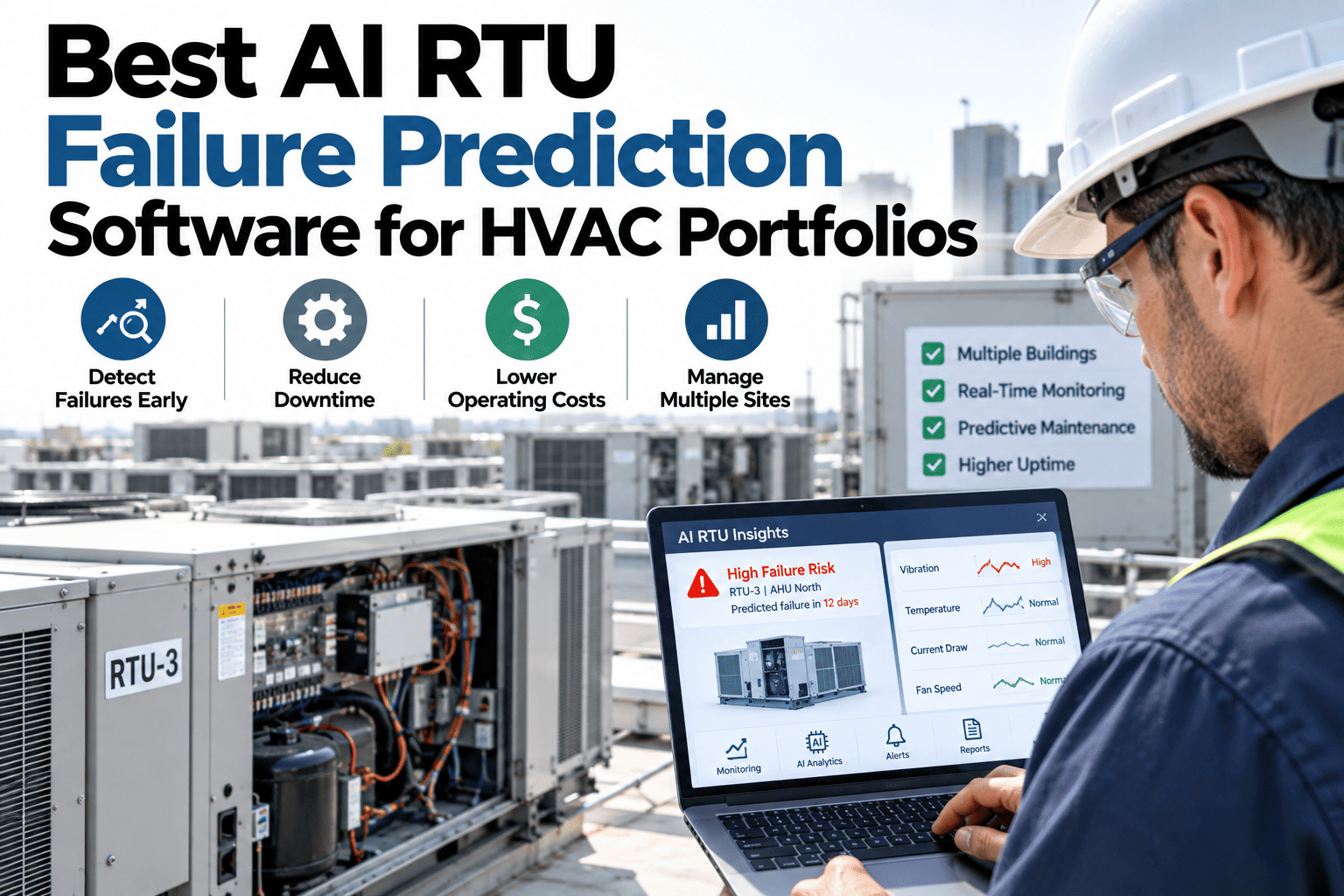
A rooftop unit doesn't fail the way a single expensive asset does. It fails the way a fleet does — quietly, one unit at a time, spread across dozens or hundreds of roofs where nobody's standing next to it when the compressor starts drawing high amps or the economizer damper stops responding to a test command. The three failure modes that actually drive most emergency RTU calls — compressor short-cycling, economizer damper stall, and refrigerant loss — all leave a detectable signature in the data weeks before the unit stops cooling. The software question isn't whether AI can catch these signatures. It's whether a given platform is actually built to watch an entire portfolio of units for all three at once. To see how that works across your own RTU fleet, talk to our team at ifactory support.
What "Best" Actually Means for RTU Failure Prediction Software
Compressor short-cycling, economizer damper stall, and refrigerant loss are the three failure signatures that drive most RTU emergency calls — and the best AI prediction software is the one that reliably catches all three across an entire portfolio, not just one unit at a time.
Why RTU Portfolios Are Different From a Single-Asset PdM Problem
A chiller plant has a handful of large, centrally located assets someone walks past regularly. An RTU portfolio is the opposite — dozens to hundreds of units scattered across rooftops, each one weather-exposed, rarely visited, and easy to forget about until a tenant calls or the energy bill spikes. That structural difference is exactly why RTU failure prediction software needs to be evaluated differently than a single-machine monitoring tool: the real test isn't whether it can read one compressor's amp draw, it's whether it can hold a consistent baseline and flag drift across an entire fleet without burying the facility team in false alarms drawn from units that simply run differently by design.
The three signatures below aren't an exhaustive list of everything that can go wrong with an RTU — they're the three that account for the overwhelming majority of emergency calls, which is exactly why they're the right benchmark for evaluating any platform that claims to predict RTU failure.
Signature One: Compressor Short-Cycling
Short-cycling happens when a compressor starts, satisfies the thermostat differential too quickly, and shuts down again well before it should — repeating that cycle far more often than the unit was designed for. Oversized equipment paired with a narrow thermostat differential is a common cause, and every extra start subjects the compressor to locked-rotor inrush current and oil return stress that accumulates as real mechanical wear, not just an inefficiency statistic. Left unaddressed, this pattern shortens compressor life well ahead of its expected service window, turning what looked like a minor control-tuning issue into a full compressor replacement.
Signature Two: Economizer Damper Stall
An economizer damper that seizes — from winter ice, corrosion, or accumulated debris — often goes undetected for months, because a stuck damper doesn't trip an alarm. It just quietly forces the compressor to run during outdoor conditions that should have supported free cooling, inflating energy costs without any comfort complaint to flag the problem. This is one of the most common RTU failures that produces zero symptoms a building occupant would ever notice, which is exactly why it tends to persist the longest of the three signatures once it develops — nobody has a reason to go looking for it.
Signature Three: Refrigerant Loss
Refrigerant leaks rarely announce themselves as a sudden event — they develop slowly, and a unit running on marginal charge can still maintain adequate cooling during mild weather, which is exactly why the problem often isn't discovered until peak summer demand exposes it. A 10% undercharge can translate into a 20 to 30% capacity loss once ambient temperature climbs into the range where the unit is actually being asked to work hard, and by then it's an emergency call instead of a planned repair.
Talk Through Your RTU Portfolio's Current Monitoring Setup
Bring your unit count and existing BMS setup to the call. We'll walk through how continuous fleet-wide monitoring catches short-cycling, damper stall, and refrigerant loss weeks ahead of an emergency call.
Evaluation Criteria: What "Best" Should Actually Mean
Software vendors in this space tend to lead with a headline accuracy number, but accuracy alone doesn't tell a facilities team whether a platform will actually work across their specific portfolio. Four criteria matter more in practice than any single accuracy claim.
| Criterion | Why It Matters |
|---|---|
| Portfolio scale, not single-unit | A platform that works well on one demo unit may not hold consistent baselines across hundreds of units with different ages and duty cycles |
| Works with existing BMS | Retrofitting sensors or replacing controls on every rooftop unit is often more disruptive than the maintenance problem it solves |
| Seasonal-transition awareness | Spring startup and peak summer carry different failure risks — a platform tuned only for one misses the other |
| Signal-to-noise on alerts | A platform that flags too much gets ignored; the value is in a small number of alerts a technician actually trusts |
Why Seasonal Timing Changes What to Watch For
RTU failure risk isn't evenly distributed across the year, and software that treats every month the same misses the pattern. Compressors that sat idle all winter face startup risk from oil migration and liquid slugging on the very first cooling call, while economizer dampers that seized during winter only reveal themselves once free cooling mode should activate — and doesn't. By peak summer, the risk profile shifts entirely toward condenser fouling and capacitor degradation, which accelerates sharply once roof surface temperatures climb well above 130°F near the fan motor. A platform aware of this seasonal shift can pre-position technician attention ahead of the specific risk that particular month actually carries, rather than applying a flat monitoring approach year-round.
Why Retail and Multi-Site Portfolios Face the Sharpest Version of This Problem
Not every RTU portfolio carries the same risk profile. Units serving retail spaces operate under cycling loads driven by variable occupancy, sit in high ambient heat on an exposed roof, and often receive the least frequent maintenance attention of any commercial HVAC application — a combination that accelerates compressor wear faster than most other building types experience. A single failed RTU in a retail location doesn't just create a comfort problem; it creates a sales-floor problem, with lost trade during exactly the hours the space needs to be at its most inviting.
Multi-site facility portfolios compound this further. A regional manager overseeing dozens of locations can't personally walk every roof, and a spreadsheet-based PM schedule tends to treat every unit as identical regardless of its actual age, duty cycle, or local climate exposure. This is precisely the scenario where fleet-wide software earns its value — not by replacing the judgment of a good technician, but by making sure that judgment gets applied to the right unit at the right time, instead of being spread evenly and inefficiently across a portfolio where risk is anything but evenly distributed.
How Vendors in This Space Tend to Differ
Most platforms marketed for RTU predictive maintenance fall into one of a few general approaches, and understanding which approach a vendor is actually taking matters more than comparing headline accuracy percentages side by side.
| Approach | Strength | Limitation |
|---|---|---|
| PM scheduling with alerts | Simple to deploy, familiar workflow for technicians | Reactive by nature — flags issues near or after they've already developed |
| Single-signal threshold monitoring | Catches obvious, large deviations reliably | Misses gradual drift and produces false alarms from normal seasonal variation |
| Per-unit baseline with multi-signal correlation | Distinguishes real mechanical drift from normal variation across a diverse fleet | Requires more setup investment to establish accurate baselines per unit |
Why the Three Signatures Need to Be Prioritized Together, Not Separately
A facilities team managing a large RTU portfolio doesn't have unlimited technician hours, which means the real question isn't just "can the software detect this," it's "can the software tell me which unit needs attention first across my entire fleet." A single unit showing early-stage refrigerant loss during mild spring weather is a lower priority than a unit showing compressor short-cycling right before peak summer demand — but that prioritization only works if the platform is scoring risk across the whole portfolio at once, not generating isolated alerts per unit that a human then has to manually rank.
This is where fleet-scale software earns the "best" label in a way a single-unit monitoring tool never can. The value isn't just catching a fault signature early — it's turning a portfolio of hundreds of units into a short, ranked list of the handful that actually need a technician this week, sorted by how close each one is to failure and how much that failure would cost if it happened during peak-demand conditions rather than a mild shoulder season.
Four Signs a Platform Isn't Built for RTU Portfolios
Frequently Asked Questions
Monitor Your Entire RTU Portfolio for All Three Failure Signatures
A turnkey AI deployment watches compressor short-cycling, economizer damper stall, and refrigerant loss across your full rooftop unit fleet, working alongside your existing BMS instead of replacing it.