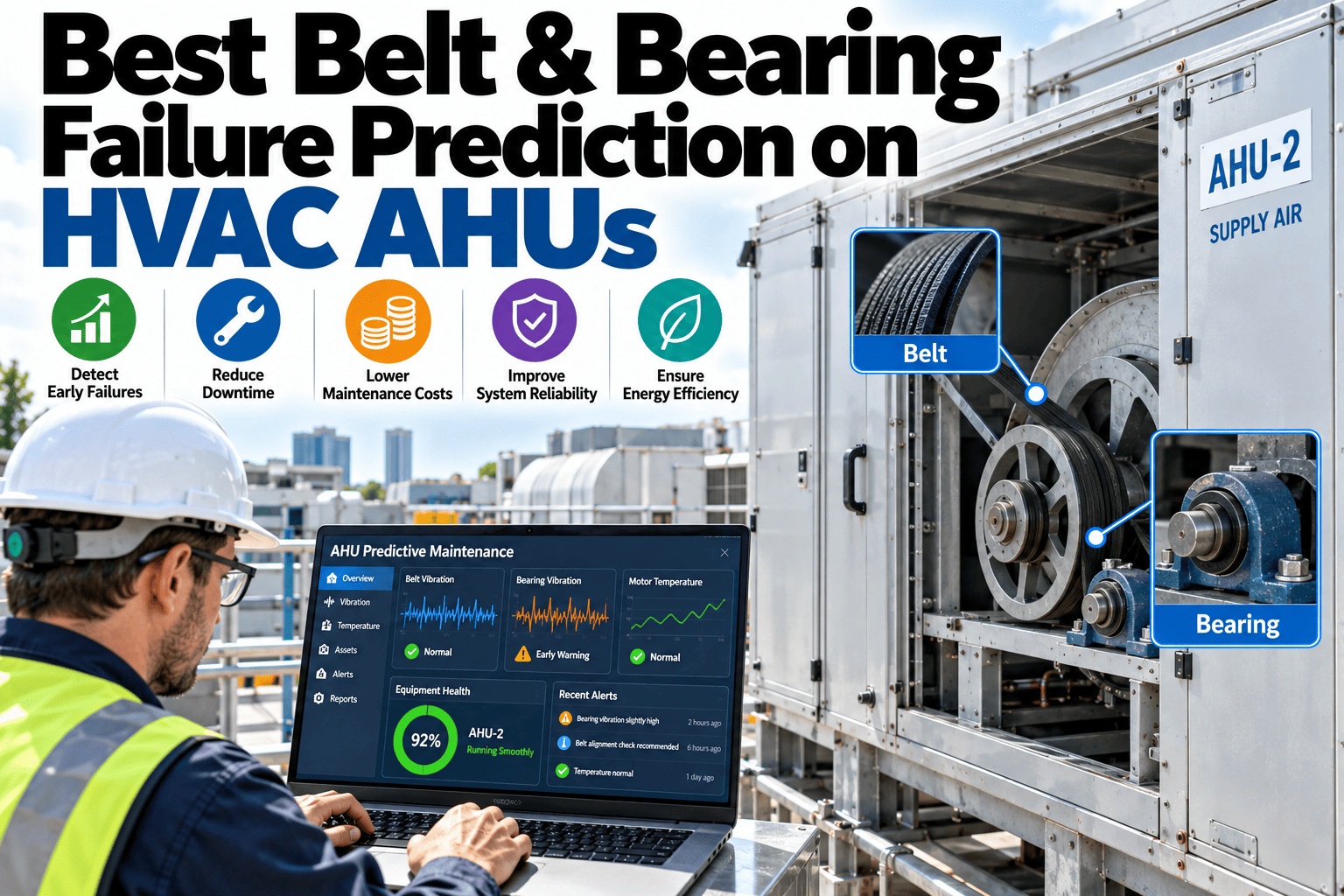
An AHU fan doesn't fail all at once — the belt and the bearings that drive it degrade for weeks or months before anything actually breaks, and every stage of that decline leaves a specific, readable signal behind. Vibration frequency bands reveal exactly which bearing race or belt condition is degrading, motor current signature analysis picks up the same faults non-invasively from the electrical supply, and a slow temperature rise at the sheave or bearing housing confirms what the other two are already showing. Reading these three signals together, rather than waiting for a belt to squeal or a bearing to seize, is what turns an AHU failure from an emergency call into a scheduled repair. Facilities teams wanting to see this applied to their own AHU fleet can walk through a belt and bearing prediction model with iFactory AI's team.
Read the Vibration, Current, and Temperature Signals Before the Belt Snaps
iFactory's AI reads bearing defect frequencies, belt-pass harmonics, and motor current sidebands together, giving AHU fan drives a diagnostic window measured in months, not minutes.
Why Belt and Bearing Faults Have to Be Read Together
On a belt-drive AHU fan, the belt and the bearings share load in a way that makes their failure signatures interact. A worn or mistensioned belt increases the radial load on the fan and motor bearings, which accelerates bearing wear — meaning the two faults are frequently cause and effect, not two independent problems happening to occur on the same unit.
Belt Fault Drives Bearing Wear
Incorrect tension, a worn belt, or mismatched sheave sizes all increase side-load on the bearings supporting the shaft, accelerating a fault that would otherwise develop far more slowly.
Sheave Misalignment Compounds Both
Sheave eccentricity or misalignment shows up in both the belt-pass frequency and the bearing spectrum simultaneously, since the same geometric error is loading both components.
One Missed Fault Masks the Other
A monitoring program that checks only overall vibration amplitude, without frequency-domain analysis, can miss an early belt fault entirely while the bearing damage it's causing quietly accumulates.
The Four Bearing Defect Frequencies
Every rolling-element bearing generates four mathematically predictable frequencies when a specific component develops a defect. Modern condition monitoring reads these directly out of the vibration spectrum, and each one points at a different physical location inside the bearing.
Ball Pass Frequency, Outer Race
The most common bearing failure mode. Because the outer race is stationary, the defect position stays fixed relative to the load zone, and no sidebands accompany the peak.
Ball Pass Frequency, Inner Race
Always runs higher than BPFO. As the inner race defect rotates through the load zone it produces amplitude modulation, which shows up as sidebands spaced at 1x shaft speed around the main peak.
Ball Spin Frequency
Points to a defect on the rolling elements themselves. Usually accompanied by damage on the races too, and the harmonic with the greatest amplitude often indicates how many balls are affected.
Fundamental Train Frequency
A sub-synchronous frequency tied to the bearing cage. Often erratic and harder to isolate with standard FFT averaging, and typically traced back to lubrication-driven cage wear.
The diagnostic skill isn't calculating these four frequencies — that's a fixed formula from bearing geometry and shaft speed. It's recognizing which pattern of peaks, harmonics, and sidebands corresponds to which fault under real conditions, where shaft speed varies and process noise can bury a low-amplitude early signal.
The Belt-Side Signature
Belt faults generate their own characteristic frequency, calculated from shaft speed and the belt-and-sheave geometry, and reading it correctly catches tension and wear problems well before a belt actually fails on the floor.
Harmonics of this frequency appear when the belt is worn, unevenly loaded, or running on mismatched or eccentric sheaves — and the amplitude of those harmonics trends upward as the fault progresses.
| Signal Pattern | Likely Cause | Corrective Action |
|---|---|---|
| Belt-pass harmonics rising | Worn belt or incorrect tension | Re-tension or replace belt per spec |
| Belt-pass peak with sidebands | Mismatched sheave sizes | Verify sheave diameters match design ratio |
| 1x and 2x running speed elevated | Sheave eccentricity or misalignment | Check sheave runout, laser or straight-edge align |
| Fluctuating tension symptoms | Loose mounting, soft foot, degraded base | Inspect hold-down bolts and mounting integrity |
See Your AHU Fleet's Belt and Bearing Signatures
Book a 30-minute session and iFactory AI will walk through what vibration, current, and temperature trending would look like on your specific AHU fan drives.
Motor Current Signature Analysis: The Non-Invasive Cross-Check
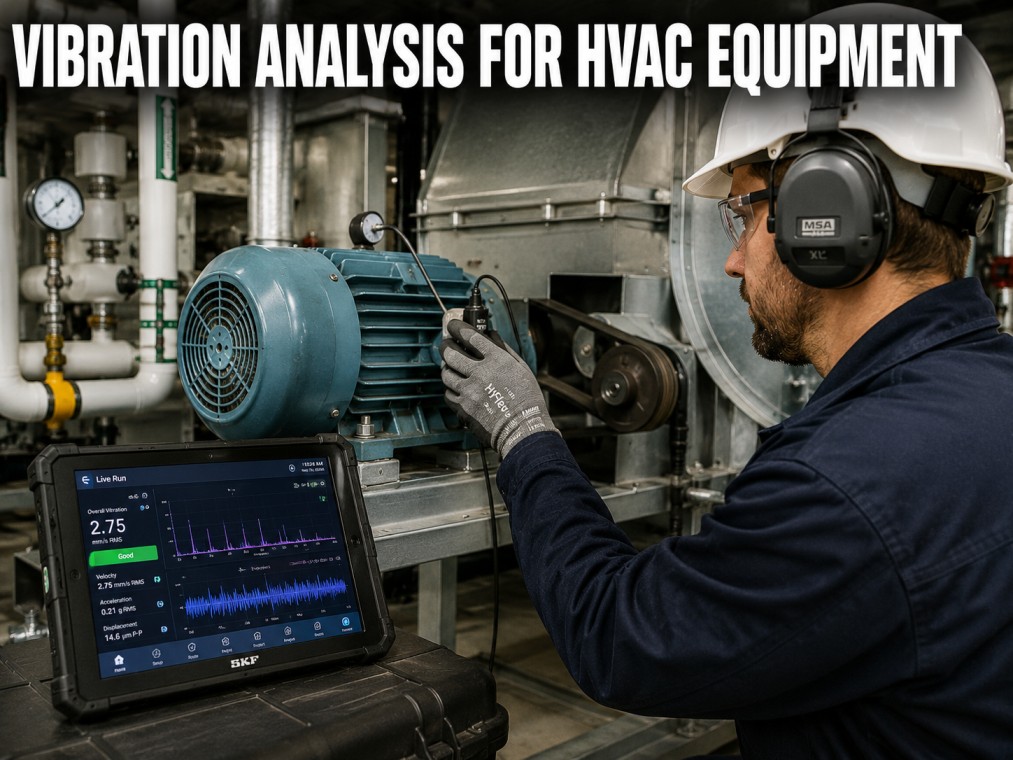
Vibration analysis needs an accelerometer mounted on or near the bearing housing. Motor current signature analysis needs neither — it reads the same mechanical faults out of the electrical current the motor already draws, measured non-invasively from existing motor control circuits.
The Physics
Any mechanical fault disturbs the magnetic flux inside the motor, which modulates the current drawn from the supply — bearing defects, belt-pass events, and misalignment all leave a signature in that modulation.
Bearing Fault Sidebands
Bearing degradation produces vibration-induced current modulation at the same BPFO, BPFI, BSF, and FTF frequencies read from vibration, appearing as sidebands around the supply frequency.
Belt-Pass in the Current Spectrum
Belt-pass peaks in the current spectrum are good early indicators of belt alignment, wear, and sheave problems — the same faults vibration catches, confirmed from a completely independent signal path.
Load-Dependent Reliability
Accurate MCSA results generally require the motor running at meaningful load — a motor idling at low load weakens fault signatures and reduces detection reliability, which matters on variable-speed AHU fans.
Temperature: The Third Confirming Signal
A degrading bearing or a mistensioned belt generates friction, and friction generates heat. Temperature trending at the sheave and bearing housing won't tell you which fault is developing on its own, but it confirms what the vibration and current signals are already suggesting — and it's the cheapest signal to collect.
The Four-Stage Progression From First Signal to Failure
Bearing degradation follows a broadly consistent progression from an undetectable microscopic defect to catastrophic failure, and each stage narrows the window for a scheduled, low-cost intervention versus an emergency one.
Ultrasonic Detection Only
The defect is microscopic — no heat, no noise, nothing visible during a standard inspection. Only ultrasonic or high-frequency envelope methods pick up anything at this stage.
Early Spectrum Signal
Bearing defect frequencies begin appearing at low amplitude, typically in the high-frequency regions first. Overall vibration amplitude can still read as normal.
Classic Pattern Visible
BPFO, BPFI, BSF, and FTF peaks are now clearly visible in standard velocity spectra with multiple harmonics. This is the optimal replacement window — machine still fully operational, degrading visibly.
Broadband Failure
Discrete fault frequencies disappear, replaced by random broadband vibration across the spectrum. Audible noise and heat are now obvious. Secondary damage is imminent — stop the machine.
A Composite Scenario: The Belt Fault That Was Actually a Bearing Problem
A rooftop AHU on a commercial office building had its belt replaced twice in one year, each time after a technician found visible wear and assumed normal belt life had simply run its course on a heavily used unit.
When the third belt showed unusual wear after only a few months, a vibration and current signature check was run before another routine belt swap. The spectrum showed clear BPFO harmonics on the fan-side bearing — the belt wasn't wearing out on its own schedule, it was being chewed up by radial load from a bearing that had been quietly degrading for months, adding side-load the belt was never designed to absorb. Replacing the bearing alongside the belt, instead of the belt alone, ended the repeat-replacement cycle entirely.
How iFactory Reads Belt and Bearing Signals Together
Per-Asset Frequency Baselines
Every AHU's vibration and current spectrum is trended against its own baseline, not a generic industry threshold, so a fault shows up as a deviation from that specific unit's normal signature.
Combined Belt-and-Bearing Correlation
Belt-pass harmonics and bearing defect frequencies are read together, so a belt fault driving bearing wear — or the reverse — gets flagged as one connected issue rather than two separate tickets.
Diagnostic Work Orders, Not Raw Alerts
A flagged fault arrives as a diagnostic work order naming the specific fault type and likely cause, not just an overall vibration alert a technician has to interpret from scratch.
Trending, Not Snapshots
Fault indicator amplitudes are tracked over time for every AHU, showing whether a developing fault is stable, slowly progressing, or accelerating — the difference between a scheduling decision and a guess.
iFactory's Predictive Maintenance module ingests accelerometer and current data across your AHU fleet, overlays it against bearing and belt fault-frequency formulas, and applies AI severity scoring so your team gets a diagnostic finding, not a raw alert to interpret.
Frequently Asked Questions
How early can vibration and current analysis actually catch a bearing fault?
Combined vibration and motor current signature analysis typically detects inner and outer race defects three to six months before catastrophic bearing seizure, since the characteristic defect frequencies begin appearing at low amplitude long before the fault becomes audible or generates noticeable heat. That window is generally wide enough to schedule replacement during a normal maintenance visit rather than reacting to a failed fan drive. iFactory AI's team can review your current AHU sensor coverage to confirm what lead time is realistic for your specific fleet.
Why would a belt keep failing repeatedly if the belt itself isn't the problem?
A degrading bearing on the same shaft adds radial load the belt was never designed to carry, accelerating belt wear in a way that looks like normal belt fatigue if only the belt is inspected. Because belt and bearing faults on the same drive system frequently interact — one causing or accelerating the other — a repeat belt failure pattern is a strong signal to check the bearing's vibration and current signature before simply replacing the belt again.
Do we need vibration sensors on every AHU, or does motor current analysis cover it?
The two methods are complementary rather than interchangeable. Motor current signature analysis can detect many of the same faults non-invasively from existing motor control circuits, which makes it practical to deploy broadly, but vibration analysis generally offers higher resolution for isolating which specific bearing component — outer race, inner race, rolling element, or cage — is affected. Many predictive maintenance programs use current analysis for broad fleet coverage and add vibration sensors on the highest-criticality or highest-failure-cost units. Book a demo to see how iFactory AI combines both across an AHU fleet.
What's the difference between BPFO and BPFI, practically speaking?
Both are ball-pass frequencies, but BPFO indicates a defect on the outer race and BPFI indicates a defect on the inner race, and they behave differently in the spectrum because the outer race is stationary while the inner race rotates with the shaft. BPFO typically shows no sidebands since the defect position stays fixed relative to the load zone, while BPFI shows sidebands spaced at the shaft's rotational speed because the inner race defect rotates through the load zone, creating amplitude modulation. Recognizing which pattern is present tells a technician which part of the bearing to expect damage in before it's even disassembled.
How much load does the AHU fan need to be running for motor current analysis to work reliably?
Accurate results generally require the motor operating at a meaningful fraction of its rated load — low-load conditions weaken the fault signatures current analysis depends on and reduce detection reliability. This matters specifically on variable-speed AHU fans running under a VFD, where load and speed vary continuously, and it's one reason fault-frequency baselines need to account for the actual operating conditions a given unit runs under rather than a single fixed reference point.
Catch the Belt and Bearing Fault Before It's an Emergency Call
iFactory reads vibration, motor current, and temperature signals together across your AHU fleet, turning a developing belt or bearing fault into a scheduled repair instead of a breakdown. Book a walkthrough to see it on your own fan drives.