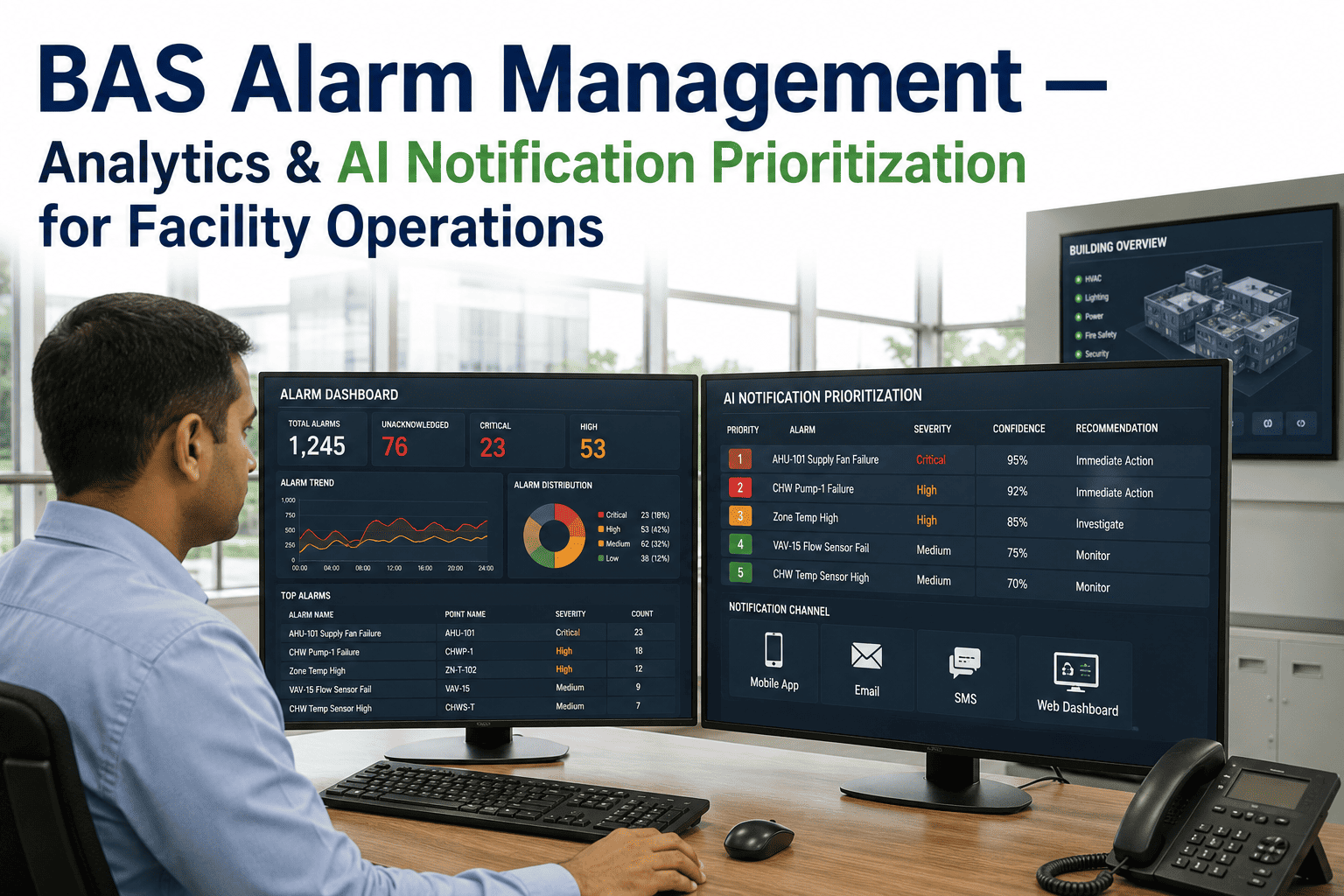
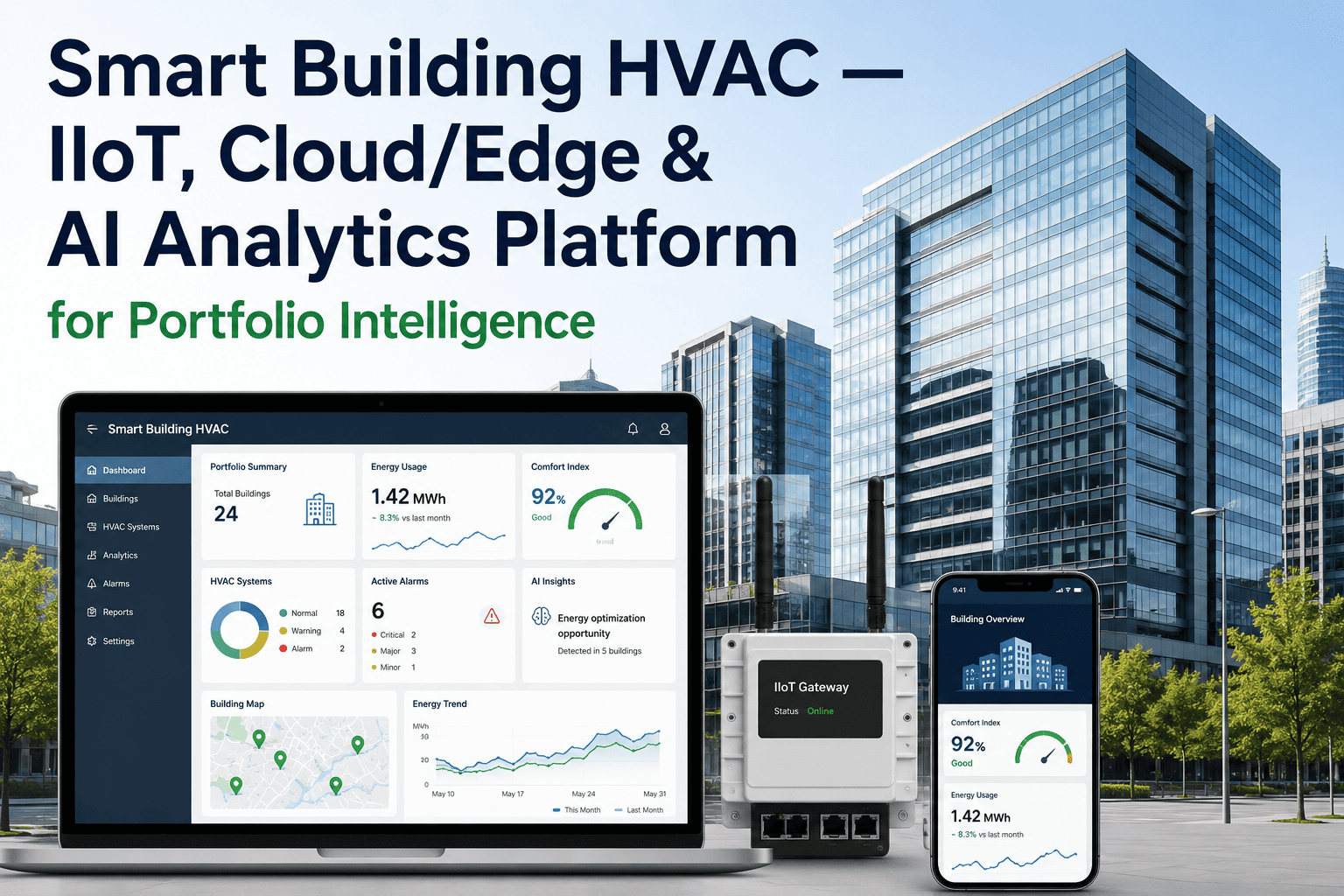
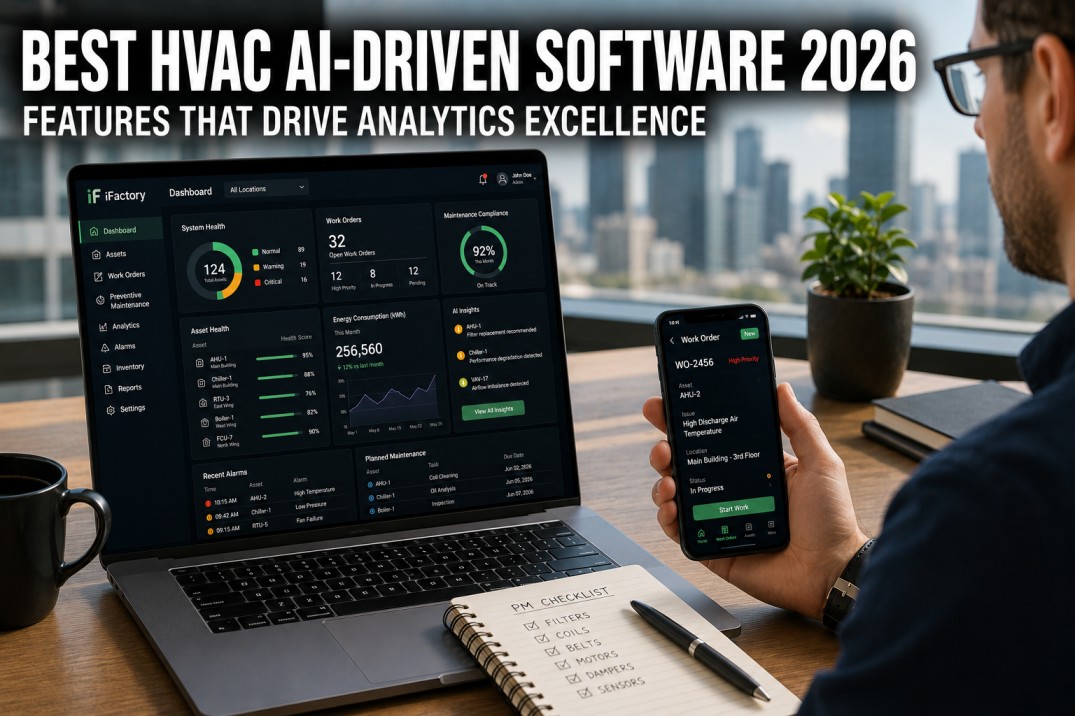
A building management system that generates hundreds of alarms a day isn't actually managing anything, it's just forwarding every sensor deviation to an operator and calling that visibility, which is exactly why so many HVAC teams have learned to tune out alarms rather than chase every one down. The software category built to fix this has matured significantly heading into 2026, moving past simple threshold alerts toward AI-driven prioritization that separates the alarm actually worth a technician's time from the dozen related ones that are really just symptoms of the same root cause. Evaluating these platforms means looking past the alarm count on a spec sheet and into how the system actually reasons about what's urgent, and booking a demo is the clearest way to see that reasoning applied to your own building's alarm history.
P10 · HVAC BMS ALARM MANAGEMENT · AI PRIORITIZATION
Alarm Management Software That Actually Tells You What Matters
iFactory's HVAC BMS alarm management platform uses AI-driven prioritization, root-cause grouping, and fault-detection overlays to cut through alarm noise and surface the handful of alerts that actually need a technician.
THE PROBLEM WITH LEGACY ALARMING
Why Most BMS Alarm Systems Train Operators to Ignore Them
A traditional BMS raises an alarm the instant a sensor reading crosses a fixed threshold, with no awareness of whether that reading is the actual cause of a problem or just one of a dozen downstream symptoms of a single upstream fault, which means operators end up manually piecing together which alarms actually matter during every event.
Alarm Flooding
A single failed damper actuator can trigger a dozen related temperature and pressure alarms across connected zones, all at once, all looking equally urgent.
No Root Cause Context
Each alarm arrives as an isolated event with no indication of which upstream equipment or condition is actually driving the deviation.
Static Thresholds
Fixed setpoints don't account for occupancy patterns, seasonal load, or equipment-specific baselines, generating alarms during entirely normal operating conditions.
Alarm Fatigue
Operators facing a constant stream of low-value alarms learn to acknowledge and dismiss them quickly, a pattern that eventually causes a genuinely critical alarm to get the same reflexive dismissal.
WHAT TO LOOK FOR
Evaluation Criteria for Alarm Management Software in 2026
Choosing between platforms in this category comes down to a short list of capabilities that actually determine whether alarm volume goes down and response quality goes up, rather than marketing language about "smart alarms" that doesn't specify what the system is actually doing differently.
1
Dynamic Prioritization
The system should rank alarms by actual operational impact and urgency, learned from historical response patterns, not a fixed severity label assigned once at setup.
2
Root-Cause Grouping
Related alarms triggered by the same underlying fault should be automatically grouped and presented as one incident, not a dozen separate tickets.
3
Fault-Detection Overlays
The platform should be able to detect developing equipment faults from sensor trends before a threshold alarm would ever fire on its own.
4
Integration Depth
Native compatibility with your existing BMS protocol and hardware matters more than a long feature list that requires a full rip-and-replace to access.
See how many of your current alarms are actually root-cause duplicates
iFactory can run a diagnostic against your recent alarm history to show what a grouped, prioritized view would have looked like.
HOW AI PRIORITIZATION WORKS
From Raw Alarm to Ranked Priority
The value of AI-driven prioritization comes from what happens between an alarm firing and it reaching an operator's screen, a sequence of steps that turns a flood of individual events into a short, ranked list of what actually needs attention.
01
Alarm Capture
Every alarm from every connected zone and piece of equipment is ingested in real time, regardless of source protocol.
02
Correlation
Alarms occurring close together across related equipment are checked for a shared root cause based on system topology and historical patterns.
03
Impact Scoring
Each grouped incident is scored against occupancy impact, equipment criticality, and historical resolution urgency to produce a priority rank.
04
Operator Delivery
A ranked incident list reaches the operator with the root cause identified, instead of a raw feed of individual, unranked alarms.
TRADITIONAL VS AI-DRIVEN
What Actually Changes for the Operator
The comparison that matters isn't a feature list, it's what an operator's actual workday looks like under each approach when a real fault occurs somewhere in the building.
| Factor |
Traditional Threshold Alarming |
AI-Driven Prioritization |
| Alarm Volume |
Every threshold breach generates a separate alarm |
Related alarms grouped into a single ranked incident |
| Root Cause Visibility |
Operator manually correlates symptoms to find the cause |
Root cause identified automatically at the point of alert |
| Fault Detection Timing |
Alarm fires only after a fixed threshold is crossed |
Developing faults flagged from trend data before threshold breach |
| Operator Trust |
Degrades over time as noise leads to reflexive dismissal |
Maintained since alarms reaching the operator are pre-filtered for relevance |
FAULT-DETECTION OVERLAYS
Catching the Fault Before It Ever Becomes an Alarm
The most valuable capability in this category isn't handling alarms better, it's reducing how many alarms need to fire at all by detecting a developing equipment fault from its trend signature well before any threshold is actually crossed.
Drift Detection
A slow sensor or setpoint drift is flagged as a developing trend long before it accumulates enough deviation to trigger a hard alarm threshold.
Cycling Anomalies
Equipment short-cycling or unusual run-time patterns are detected as a behavioral change even when every individual reading stays within normal range.
Cross-Zone Comparison
A zone performing meaningfully differently from comparable zones under the same conditions is flagged, even without a single reading breaching a fixed setpoint.
Seasonal Baseline Adjustment
Expected performance ranges shift automatically with season and occupancy pattern, avoiding false alarms during entirely normal operating swings.
TURNKEY DELIVERY
How iFactory Rolls Out Alarm Prioritization Across Your Portfolio
iFactory connects to your existing BMS regardless of protocol, builds prioritization and root-cause grouping against your actual alarm history, and layers fault-detection overlays on top without requiring new hardware in most buildings.
What Gets Built
Real-time alarm ingestion from your existing BMS infrastructure
Root-cause grouping model calibrated to your building's equipment topology
Priority scoring tuned to your occupancy patterns and equipment criticality
Fault-detection overlays trained on your specific zone and equipment history
Deployment Timeline
Weeks 1-2: BMS integration and historical alarm data ingestion
Weeks 3-4: Grouping and prioritization model calibration
Weeks 5-6: Dashboard go-live and operator training
FREQUENTLY ASKED QUESTIONS
What Facilities Teams Ask Before Choosing an Alarm Platform
Does this replace our existing BMS, or work alongside it?
It works alongside your existing BMS as an intelligence layer on top of it, ingesting the alarm and sensor data your system already generates rather than requiring a replacement of the underlying building management infrastructure. This means the rollout timeline is driven by integration and model calibration rather than a disruptive hardware or controls replacement project.
Book a demo to see the integration against your specific BMS platform.
How does root-cause grouping actually know which alarms are related?
Grouping is based on a combination of your building's equipment topology, so the system understands which zones share air handlers or which sensors sit downstream of a given piece of equipment, and historical correlation patterns learned from how alarms have actually clustered together during past events. This combination is what allows the system to group a damper fault with its downstream temperature alarms accurately rather than guessing from timing alone.
Contact our support team to discuss how topology mapping works for your building.
Will this reduce alarm volume immediately, or does it take time to learn our building?
Some noise reduction happens immediately from grouping alone, since related alarms are consolidated from the first day of operation based on equipment topology alone, but the more precise priority scoring and fault-detection overlays improve meaningfully over the first several weeks as the model learns your building's specific patterns and historical alarm resolution data. Most teams see a substantial reduction in perceived alarm volume within the first month.
Book a demo to set realistic expectations for your rollout timeline.
Can different buildings in our portfolio have different priority rules?
Yes, priority scoring is calibrated per building since occupancy patterns, equipment criticality, and even what counts as an urgent fault vary meaningfully between a hospital wing and an office floor, and applying one universal rule set across a diverse portfolio would undermine the accuracy that makes prioritization useful in the first place. Each building's model reflects its own operating context while still rolling up to a portfolio-wide view for facilities leadership.
Contact our support team to discuss portfolio-wide configuration.
What happens to alarms the system doesn't group or confidently prioritize?
Any alarm that doesn't match an established grouping pattern or falls outside confident priority scoring is still surfaced to the operator, flagged as ungrouped or uncertain rather than being suppressed or hidden, since the goal is reducing noise without ever risking a genuinely novel fault going unnoticed. These ungrouped events also feed back into the model, refining grouping accuracy for similar situations going forward.
Book a demo to see how uncertain alarms are handled in the interface.
FEWER ALARMS, THE RIGHT ONES, EVERY TIME
Give Your Operators a Ranked List Instead of a Flood of Noise
iFactory's HVAC BMS alarm management platform uses AI-driven prioritization, root-cause grouping, and fault-detection overlays to end alarm fatigue and surface what actually needs a technician.